TECCO Active Slope Protection System for Philippine Mining Operations: MGB Compliance and Surigao-Benguet Case Studies 2026
1. TECCO Active Slope Protection System Overview
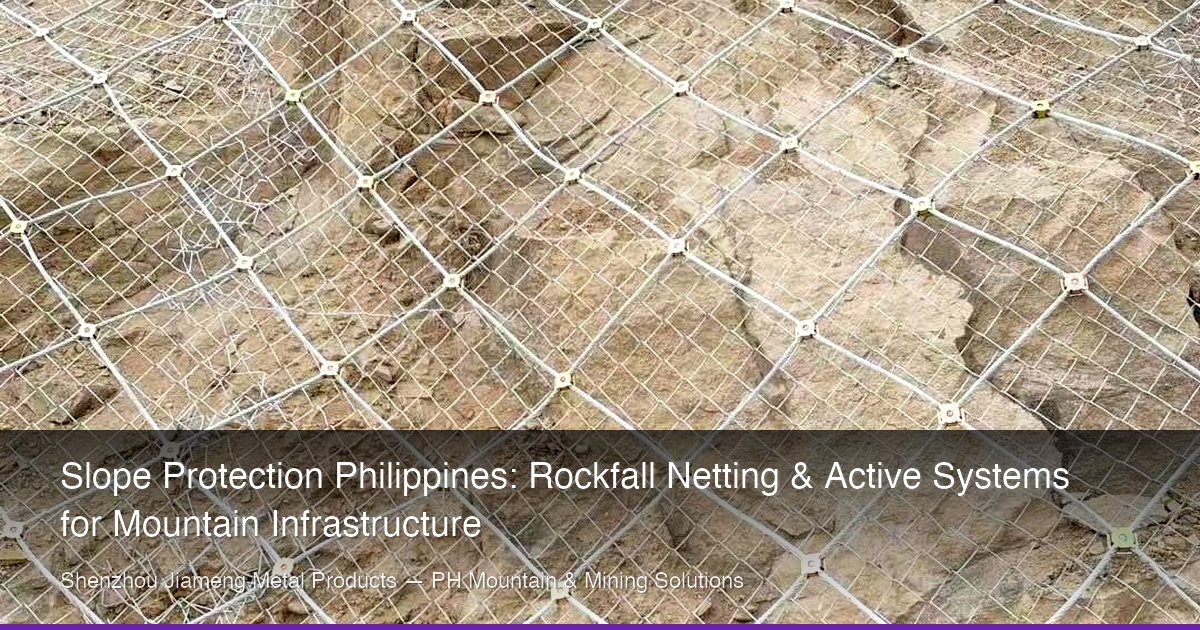
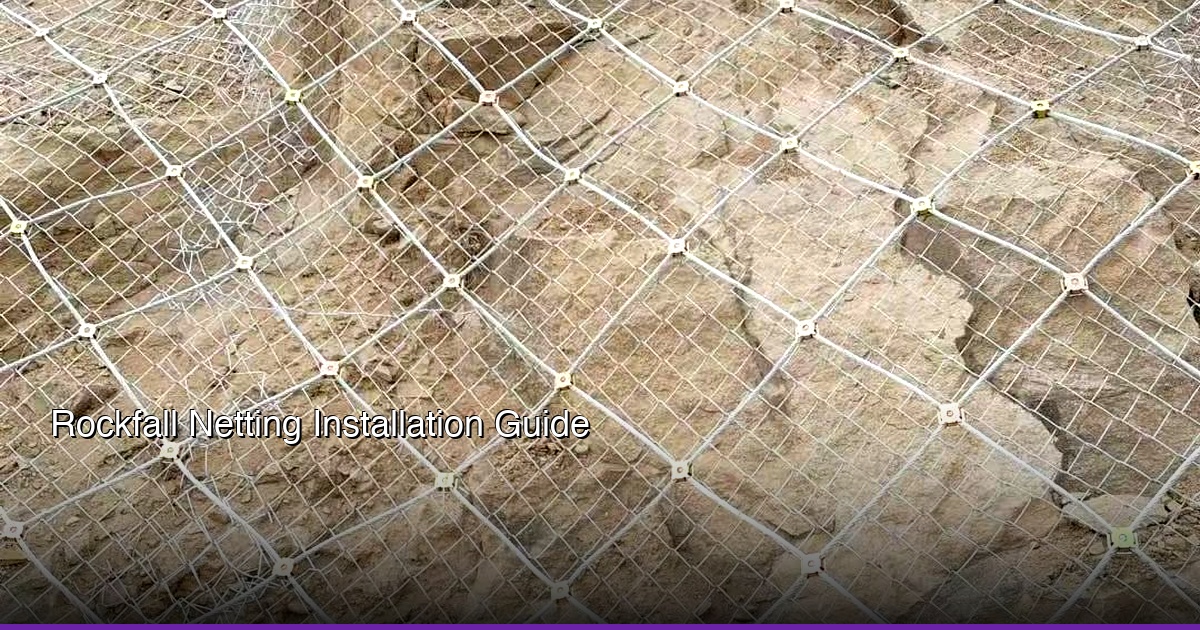
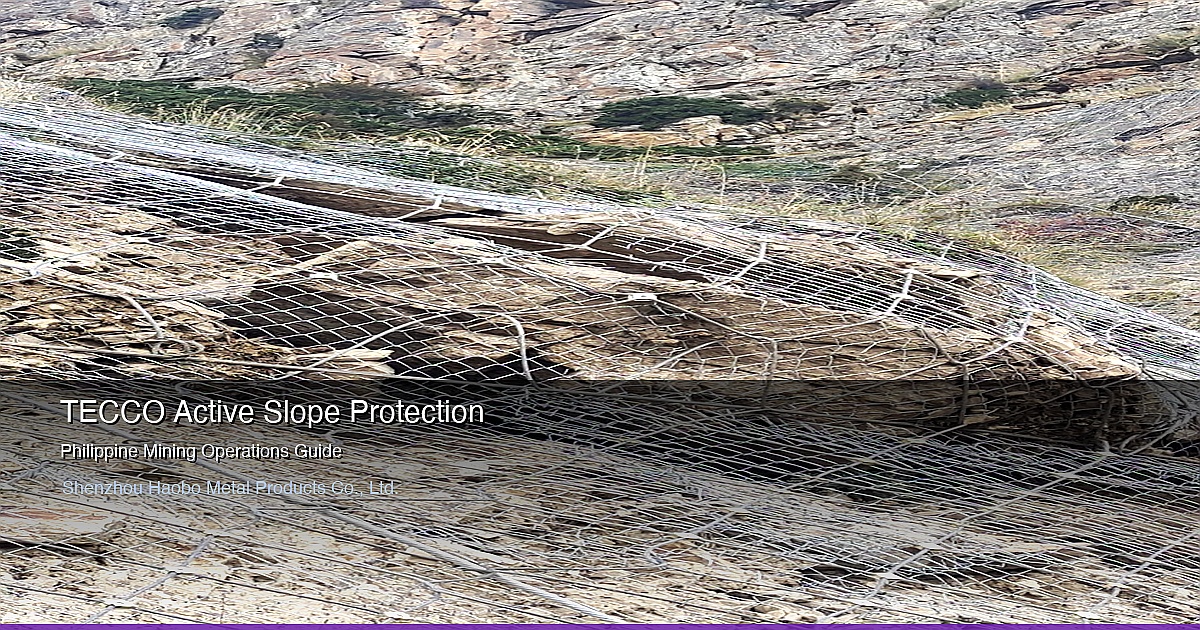
TECCO active slope protection systems represent the most advanced high-tensile steel wire mesh technology for surface stabilization on Philippine mining slopes. Unlike traditional shotcrete or rock bolting, TECCO systems use a continuous high-tensile steel wire mesh (typically 3mm or 4mm diameter with tensile strength exceeding 1,200 MPa) secured to the slope face with systematic anchoring patterns. This creates a flexible, draping reinforcement that conforms to irregular slope geometry while providing substantial surficial stability.
Key Takeaways
- TECCO high-tensile steel wire mesh (1,200 MPa) provides active slope stabilization for mining slopes exceeding 45 degrees — required by MGB per DAO 2000-98
- TECCO G65/3 installed cost: PHP 1,110-1,480/m2 — 20-30% cheaper than shotcrete (PHP 1,500-2,100/m2) with 2-3x faster installation
- Surigao nickel mine case study: 4,200m2 TECCO G65/3 installation performed flawlessly through Typhoon Odette (350mm rainfall in 24 hours) with zero deformation
- Benguet copper-gold mine case study: 62m-high slope stabilized with TECCO G65/4 at 1,400m elevation using self-drilling anchors and rope access installation
- FOB Tianjin pricing: $6.80/m2 for TECCO G65/3, $8.80/m2 for G65/4, all with Galfan coating and complete MGB-compliant test certificates
Table of Contents
- 1. TECCO Active Slope Protection System Overview
- 2. MGB Compliance Requirements for Mining Slope Protection
- 3. TECCO Mesh vs Shotcrete: Performance and Cost Comparison
- 4. Case Study: Surigao Nickel Mining Slope Protection
- 5. Case Study: Benguet Copper-Gold Mine Slope Stabilization
- 6. Installation Methodology for Philippine Mining Conditions
- 7. Maintenance and Monitoring Protocol
- 8. Procurement Guide and FOB Pricing
The TECCO system was developed in Switzerland and has been adapted for tropical mining conditions in the Philippines. The system's key advantage in mining applications is its ability to handle slopes with complex geometry, variable rock quality, and high groundwater conditions — all common challenges in Philippine open-pit mining operations in the Caraga region (Surigao nickel mines) and Cordillera Administrative Region (Benguet gold and copper mines).
The Mines and Geosciences Bureau (MGB), under the Department of Environment and Natural Resources (DENR), regulates all slope stability requirements for Philippine mining operations through DENR Administrative Order (DAO) 2000-98 (Mine Safety and Environmental Standard). MGB requires that all open-pit mining slopes exceeding 45 degrees must have engineered slope protection systems. TECCO mesh has become a preferred solution because it meets MGB requirements while offering faster installation and lower environmental impact than traditional methods.
| Parameter | TECCO G65/3 | TECCO G65/4 | TECCO G80/4 |
|---|---|---|---|
| Wire diameter | 3.0 mm | 4.0 mm | 4.0 mm |
| Mesh opening | 65 x 65 mm | 65 x 65 mm | 80 x 80 mm |
| Tensile strength | 1,200 MPa | 1,200 MPa | 1,200 MPa |
| Mesh strength | 140 kN/m | 195 kN/m | 195 kN/m |
| Coating | Galfan (Zn-5%Al) | Galfan (Zn-5%Al) | Galfan (Zn-5%Al) |
| Roll dimensions | 3.0 x 30m | 3.0 x 30m | 3.0 x 30m |
| Typical application | Soil slopes, weathered rock | Rock slopes, mixed faces | Large rock slopes |
2. MGB Compliance Requirements for Mining Slope Protection
The Mines and Geosciences Bureau enforces slope stability through the Mining Act of 1995 (RA 7942) and DAO 2000-98. For active mining operations, the Environmental Compliance Certificate (ECC) and the Mining Project Feasibility Study both require detailed slope stability analysis and mitigation measures. The MGB conducts annual Safety and Environmental Inspections, and slope protection is one of the most scrutinized aspects.
Key MGB requirements for slope protection on mining operations:
1. Slope Stability Analysis: All slopes exceeding 45 degrees must have a geotechnical stability analysis demonstrating a minimum Factor of Safety (FS) of 1.3 for static conditions and 1.1 for seismic conditions. The analysis must be performed by a licensed Geotechnical Engineer using accepted methods (Bishop, Janbu, or Spencer for circular failures; wedge analysis for rock slopes).
2. Surface Protection: MGB requires that all exposed slopes on mining operations be protected against surface erosion and shallow instabilities. Acceptable methods include: shotcrete/gunite, rock bolting with mesh, geotextile reinforcement, or high-tensile steel wire mesh systems like TECCO. The protection system must be designed by a licensed engineer and approved in the Annual Mine Plan.
3. Drainage Control: Surface water management is critical on mining slopes. MGB requires interceptor ditches at the top of slopes, bench drains on intermediate benches, and toe drains at the base. For slopes with TECCO mesh, drainage is facilitated through the mesh openings, but subsurface drainage must still be provided through horizontal drain holes or gravity drains.
4. Monitoring: Mining operations must install slope monitoring systems for all slopes exceeding 60 degrees or 50 meters in height. Monitoring methods include: survey prisms with total station measurement, inclinometers for subsurface movement detection, and crackmeters for tension crack monitoring. Data must be collected monthly and after every significant rainfall event (exceeding 100mm in 24 hours).
5. Annual Inspection and Reporting: The MGB Annual Mine Safety and Environmental Conference (AMSEC) inspection reviews all slope protection installations. Mining companies must submit annual reports documenting: slope conditions, protection system status, monitoring data, and any incidents of slope instability. Failure to maintain adequate slope protection can result in suspension of mining operations.
3. TECCO Mesh vs Shotcrete: Performance and Cost Comparison
Shotcrete (sprayed concrete) has been the traditional slope protection method in Philippine mining. However, TECCO active protection systems offer significant advantages in most applications. The following comparison is based on actual project data from mining operations in Surigao and Benguet.
| Comparison Factor | Shotcrete (75mm) | TECCO G65/3 System | TECCO G65/4 System |
|---|---|---|---|
| Material cost (PHP/m2) | 850-1,100 | 680-820 | 880-1,050 |
| Installation cost (PHP/m2) | 450-650 | 250-380 | 280-420 |
| Anchors (PHP/m2) | 200-350 | 180-280 | 220-340 |
| Total installed (PHP/m2) | 1,500-2,100 | 1,110-1,480 | 1,380-1,810 |
| Installation speed (m2/day) | 80-150 | 200-350 | 180-300 |
| Flexibility | Rigid — cracks under movement | Flexible — conforms to movement | Flexible — conforms to movement |
| Drainage | Poor — traps water | Excellent — 65mm openings | Excellent — 65mm openings |
| Vegetation establishment | Impossible — blocks all growth | Excellent — allows hydroseeding | Good — allows hydroseeding |
| Service life (tropical) | 15-25 years (spalls) | 40-60 years (Galfan) | 40-60 years (Galfan) |
The data clearly shows that TECCO systems offer 20-30% cost savings over shotcrete while providing superior performance in flexibility, drainage, and environmental compatibility. The faster installation rate (2-3x) also reduces mine downtime during slope protection campaigns.
4. Case Study: Surigao Nickel Mining Slope Protection
The Caraga Region in northeastern Mindanao is the center of Philippine nickel mining, accounting for over 50% of national nickel production. The region's lateritic nickel deposits are typically extracted through open-pit methods on slopes ranging from 35 to 60 degrees. A major nickel mining operation in Surigao del Norte implemented a TECCO G65/3 active protection system on a 4,200-square-meter slope following MGB inspection findings.
Project Parameters:
- Slope height: 45 meters (3 benches of 15m each)
- Slope angle: 50-55 degrees overall (bench faces at 65 degrees)
- Material: Weathered laterite overlying serpentinite bedrock
- Groundwater: Seepage on middle bench during rainy season (June-January)
- Design life: 25 years (mine life remaining)
- MGB requirement: Surface stabilization for all bench faces above 45 degrees
Design Solution: TECCO G65/3 mesh with 3mm high-tensile steel wire (1,200 MPa tensile strength) and Galfan coating. Systematic anchoring pattern: 2.0m x 2.0m grid using 25mm diameter deformed steel bars, 3.0m length, grouted with cement-bentonite grout. Edge restraints using 12mm steel cables secured to perimeter anchors. The mesh was installed from top to bottom using rope access techniques.
Installation Details:
- Site preparation: Removal of loose material and vegetation, scaling of unstable blocks
- Anchor installation: Rotary percussion drilling, 76mm diameter holes, cement-bentonite grout (w/c ratio 0.45)
- Mesh deployment: Rolls unrolled from top of slope, secured with bearing plates (200x200x8mm)
- Tensioning: Mesh tensioned using come-along winches at anchor points to ensure full slope contact
- Overlap: Minimum 200mm overlap between mesh rolls, connected with high-tensile clips at 500mm spacing
Performance after 3 years: No significant deformation or anchor displacement detected. Vegetation has established through the mesh openings (65mm), with native grasses and pioneer species covering approximately 70% of the slope surface. No surface erosion rills observed, even after Typhoon Odette (2021) which brought 350mm of rainfall in 24 hours. The MGB inspection report cited the installation as a model for other mining operations in the region.
5. Case Study: Benguet Copper-Gold Mine Slope Stabilization
The Cordillera Administrative Region hosts the Philippines' oldest mining district, with copper and gold operations in Benguet dating back over a century. Historical underground mining has created surface subsidence zones, and modern open-pit expansions have encountered steep, highly fractured rock slopes. A copper-gold operation in Mankayan, Benguet installed TECCO G65/4 mesh on a critical slope above a haul road.
Project Parameters:
- Slope height: 62 meters (4 benches)
- Slope angle: 55-70 degrees (highly variable due to jointing)
- Rock type: Fractured volcanic tuff with quartz vein intrusions
- Joint sets: 3 dominant joint sets creating wedge failure potential
- Elevation: 1,400m above sea level (frequent fog, high humidity)
- Seismic risk: PGA = 0.46g (Baguio seismic zone)
Design Solution: TECCO G65/4 mesh (4mm wire, 195 kN/m mesh strength) was selected due to the potential for larger rock block failures. Anchors were designed on a 1.5m x 1.5m grid for the upper two benches (lower rock quality) and 2.0m x 2.0m for the lower two benches. Special detail: 32mm diameter self-drilling anchors (SDA) were used in the fractured upper benches where conventional grouted anchors could not achieve adequate bond strength.
Key challenges and solutions:
- Access: Rope access (IRATA-certified climbers) required for all installation work due to steep, inaccessible terrain
- Drilling: Compressed air rotary drills transported by helicopter to upper bench locations
- Weather: Installation scheduled during dry season (March-May) to avoid daily rainfall interference
- Seismic: Bearing plates designed with energy-absorbing load rings to accommodate seismic displacement
Cost breakdown (per square meter):
| Cost Item | Amount (PHP/m2) | Share |
|---|---|---|
| TECCO G65/4 mesh (Galfan coated) | 950 | 35% |
| Self-drilling anchors (32mm x 3m) | 620 | 23% |
| Bearing plates and load rings | 180 | 7% |
| Installation labor (rope access) | 580 | 21% |
| Drilling and grouting | 280 | 10% |
| Mobilization and access | 120 | 4% |
| Total installed cost | 2,730 | 100% |
6. Installation Methodology for Philippine Mining Conditions
The installation of TECCO active protection systems on Philippine mining slopes requires specialized techniques adapted to tropical conditions, remote locations, and the unique challenges of each mining region.
Phase 1: Site Assessment and Scaling (Days 1-5)
Geotechnical engineer conducts detailed mapping of slope conditions, including: rock type distribution, joint and fracture mapping (orientation, spacing, aperture), weathering grades, groundwater seepage locations, and existing instability features. Loose blocks and unstable material are scaled from the slope face using mechanical scaling bars or controlled blasting for larger blocks. This phase is critical — installing mesh over loose material will fail when the material shifts behind the mesh.
Phase 2: Anchor Installation (Days 5-15)
Anchors are drilled and grouted following the design pattern. For Philippine mining conditions, the following anchor types are commonly used:
- Grouted rebar anchors (25-32mm diameter): Standard for competent rock. Drill 76-90mm diameter holes, insert rebar, grout with cement-bentonite mix (w/c = 0.45). Minimum embedment 2.5m into sound rock.
- Self-drilling anchors (SDA): Used in fractured or weathered rock where hole collapse is a risk. The hollow bar serves as both drill rod and anchor, with grout pumped through the hollow core during drilling.
- Soil nails: Used in residual soil or completely weathered rock. Typically 28-32mm diameter, 3-4m length, with centralizers to ensure grout coverage.
Phase 3: Mesh Deployment and Tensioning (Days 10-20)
TECCO mesh rolls (3m x 30m) are deployed from the top of the slope downward. For accessible slopes, mesh is deployed using excavator-mounted boom. For inaccessible slopes, rope access teams deploy mesh manually. The mesh is secured at each anchor with a bearing plate (200x200x8mm steel plate) and nut. Edge restraint cables (12mm steel cable) are installed along the top, sides, and bottom of each mesh panel.
Phase 4: Quality Control and Documentation (Days 18-22)
Pull-out tests are conducted on minimum 5% of installed anchors to verify design bond strength. The test load is typically 1.5 times the design load. Mesh tension is checked visually — the mesh should be in full contact with the slope face with no sagging areas. Installation documentation includes: anchor installation logs (depth, grout volume, installation time), pull-out test results, and as-built drawings showing actual anchor locations.
7. Maintenance and Monitoring Protocol
TECCO active protection systems require minimal maintenance compared to shotcrete, but regular monitoring is essential for long-term performance, particularly in the aggressive tropical environment of Philippine mining operations.
Regular Inspection Schedule:
- Monthly visual inspection: Mine safety officer or geotechnical technician walks the toe of the slope and observes the mesh from a distance. Check for: mesh tears, loose bearing plates, exposed anchors, bulging areas indicating material accumulation behind mesh, and vegetation overgrowth that could obscure damage.
- Quarterly close inspection: Rope access team performs close-up inspection of the mesh on each bench. Check for: corrosion of wire mesh (particularly at overlaps and cut ends), anchor nut tightness, bearing plate deformation, and drainage function (water should flow freely through mesh openings).
- Post-typhoon inspection: After every typhoon event (Signal 3 or above), conduct full inspection within 48 hours. Check for: new rockfall deposits behind mesh, anchor displacement, mesh deformation from debris impact, and drainage pathway blockage.
- Annual geotechnical inspection: Licensed geotechnical engineer conducts comprehensive inspection for MGB annual report. Includes: prism monitoring data review, inclinometer data analysis, and assessment of overall slope stability conditions.
Common maintenance issues and solutions:
- Mesh corrosion at cut ends: Apply zinc-rich paint or cold galvanizing compound to any exposed cut wire ends. This is the most common maintenance issue in tropical mining environments.
- Vegetation overgrowth: Trim vegetation that could overload the mesh or obscure inspections. Maintain vegetation at 30-50% coverage for erosion control without structural concern.
- Loose bearing plates: Re-tighten nuts using torque wrench to design torque value (typically 150-200 Nm for 25mm anchors).
- Debris accumulation: Remove accumulated soil and rock debris from behind the mesh through access panels or by carefully cutting and re-securing mesh sections.
8. Procurement Guide and FOB Pricing
Shenzhou Haobo Metal Products Co., Ltd. manufactures TECCO-type high-tensile steel wire mesh at our factory in Hebei Province, China. We supply to Philippine mining companies directly from FOB Tianjin, with complete technical documentation and MGB-compliant test certificates.
Product specifications and FOB Tianjin pricing:
| Product | Specification | FOB Tianjin (USD/m2) | Landed Manila (USD/m2) |
|---|---|---|---|
| TECCO G65/3 | 3.0mm wire, 65x65mm mesh, Galfan | 6.80 | 8.20 |
| TECCO G65/4 | 4.0mm wire, 65x65mm mesh, Galfan | 8.80 | 10.40 |
| TECCO G80/4 | 4.0mm wire, 80x80mm mesh, Galfan | 8.20 | 9.70 |
| Bearing plates | 200x200x8mm, galvanized | 1.20/pc | 1.45/pc |
| Edge restraint cable | 12mm steel cable, Galfan coated | 2.50/m | 3.00/m |
| Connection clips | High-tensile steel, Galfan | 0.35/pc | 0.42/pc |
Ordering process for Philippine mining projects:
- Technical consultation (Day 1-3): Send slope parameters (height, angle, rock type, joint data, groundwater conditions, design life) to our engineering team. We provide mesh specification recommendation, anchor design, and preliminary quotation.
- Production (Day 4-18): Upon order confirmation, production begins. Standard TECCO mesh (G65/3, G65/4, G80/4) has 10-14 day production lead time. All mesh is manufactured per EN 10223-8 standards with Galfan coating per EN 10244-2 Class A.
- Quality testing (Day 18-19): Each production batch undergoes: wire tensile test (1,200 MPa minimum), mesh strength test (per EN 10223-8 Annex C), Galfan coating weight test (minimum 250 g/m2), and dimensional verification. Test certificates provided with shipment.
- Shipping (Day 19-30): Container loading at Tianjin Port, 7-12 day transit to Manila. For mining projects in Surigao or Benguet, transshipment to Cagayan de Oro or Manila then inland transport to mine site.
- Customs clearance (Day 30-33): With Form E (ASEAN-China FTA Certificate of Origin), import duty is 0% under ACFTA. VAT is 12%. Processing time 2-3 days.
Minimum order quantity: 500 m2 for standard mesh specifications. For project-specific requirements (custom mesh opening, special coating), minimum order is 1,000 m2. Sample pieces (300mm x 300mm) are available free of charge for evaluation — contact us with your project details for sample requests.
Need TECCO Mesh for Your Mining Operation?
Tell us your mining slope parameters — height, angle, rock type, groundwater conditions, and MGB requirements. Our engineering team provides TECCO mesh specifications, anchor design, and FOB Tianjin quotation for your mine site within 48 hours.
www.haobomesh.com | Shenzhou Haobo Metal Products Co., Ltd.