Steel Wire Rope Net Active Protection System for Philippine Quarry Slopes: MGB DAO 2000-98 Compliance and Rizal Basalt Case Study 2026
1. Philippine Quarry Operations: Slope Stability Challenges and Regulatory Framework
The Philippines operates over 1,500 active quarries and aggregate extraction sites, supplying the construction materials that fuel one of Southeast Asia's fastest-growing construction sectors. From the basalt quarries of Rizal province serving Metro Manila, to the limestone quarries of Cebu and Davao, these operations share a common engineering challenge: maintaining slope stability on increasingly high and steep excavation faces as deposits are progressively deepened.
Key Takeaways
- MGB DAO 2000-98 requires active slope protection for all quarry slopes exceeding 45 degrees — wire rope net (ROCCO) systems are the preferred solution for Philippine quarry operators
- ROCCO R-200 (8mm wire rope, 200x200mm mesh, 1,770 MPa tensile) with TECCO G65/3 supplementary mesh provides comprehensive protection for slopes with mixed rock/soil conditions
- Rizal basalt quarry case study: 2,400m2 installation with 612 rock bolts (25mm x 4m, 2.0m grid) — zero rockfall incidents through 3 typhoon seasons (2022-2024)
- Installed cost: PHP 1,800-2,400/m2 including materials, rope access labor, equipment, and engineering — 20-30% cheaper than shotcrete with 2-3x faster installation
- FOB Tianjin pricing: $5.80/m2 for ROCCO R-200, $4.50/m2 for TECCO G65/3, all with 245 g/m2 galvanized coating and complete MGB-compliant test certificates
Table of Contents
- 1. Philippine Quarry Operations: Slope Stability Challenges and Regulatory Framework
- 2. Steel Wire Rope Net System Components and Specifications
- 3. MGB DAO 2000-98 Compliance Requirements for Quarry Slope Protection
- 4. Case Study: Rizal Province Basalt Quarry Slope Protection
- 5. Installation Methodology for Quarry Slope Conditions
- 6. Cost Analysis and BOQ Template for Quarry Slope Protection
- 7. FOB Tianjin Pricing and Procurement Guide
- 8. Maintenance, Monitoring, and Long-Term Performance
The Mines and Geosciences Bureau (MGB), under the Department of Environment and Natural Resources (DENR), regulates all quarry operations in the Philippines through DAO 2000-98 (Denr Administrative Order No. 2000-98) and its subsequent amendments. MGB requires all quarry operators to submit an Annual Mining Environmental Protection and Enhancement Program (MEPEP) that includes a comprehensive slope stability management plan. For quarry slopes exceeding 45 degrees or 30 meters in height, active slope protection systems are mandatory — and steel wire rope net systems have emerged as the preferred solution for Philippine quarry operators due to their cost-effectiveness, rapid installation, and proven performance in tropical conditions.
| Parameter | Active Protection (Wire Rope Net) | Passive Protection (Rockfall Barrier) | No Protection |
|---|---|---|---|
| Mechanism | Prevents rockfall by holding material on slope face | Catches falling rocks at slope toe | Relies on natural stability only |
| MGB compliance | Meets DAO 2000-98 for all slopes >45 degrees | Supplementary, does not replace active | Non-compliant for slopes >45 degrees / >30m |
| Risk to operations | Very low — rocks never leave the face | Moderate — rocks fall before being caught | High — frequent rockfall, operational disruption |
| Installed cost (PHP/m2) | 980 - 1,450 | 1,200 - 2,800 (per linear meter) | 0 (but high long-term risk cost) |
| Maintenance frequency | Annual inspection | After each major rockfall event | N/A |
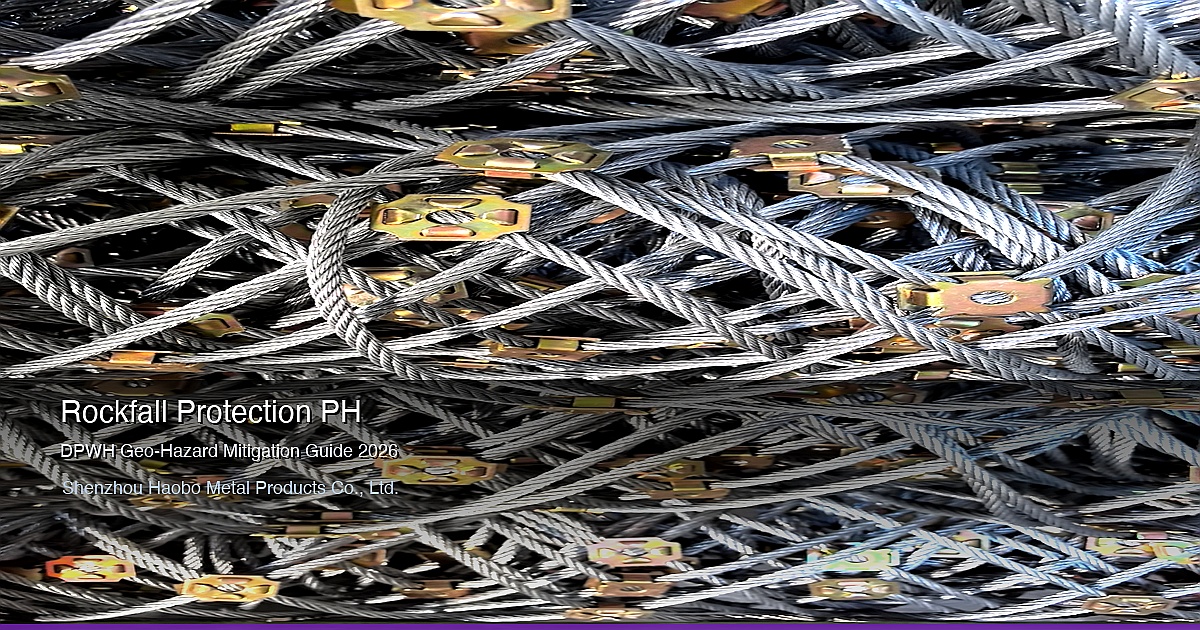
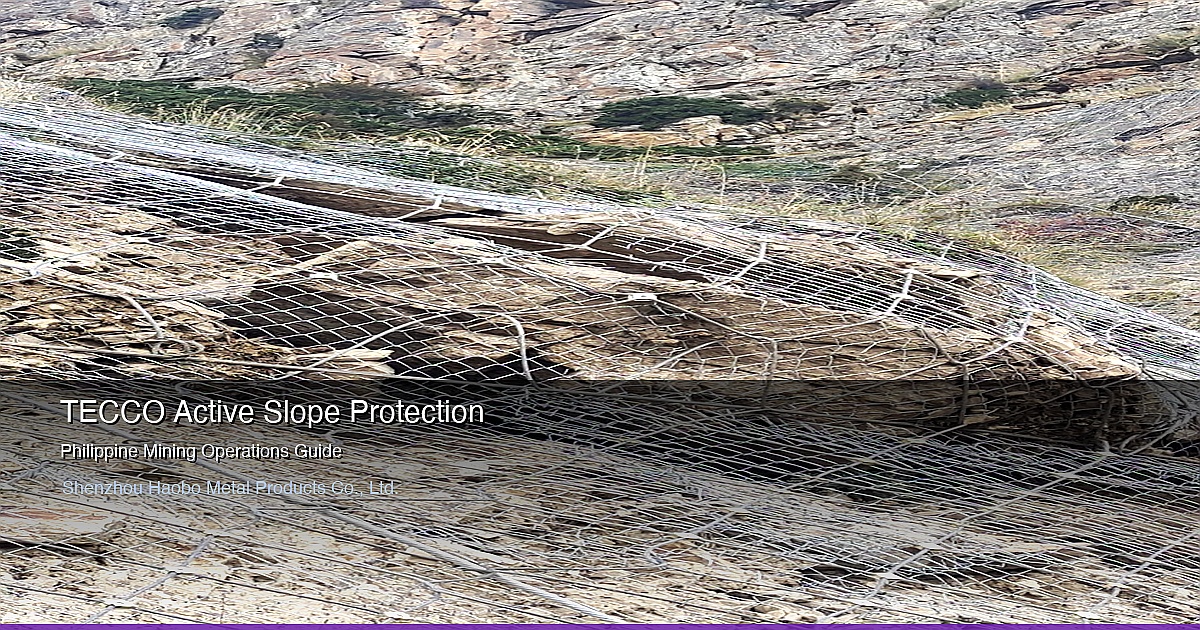
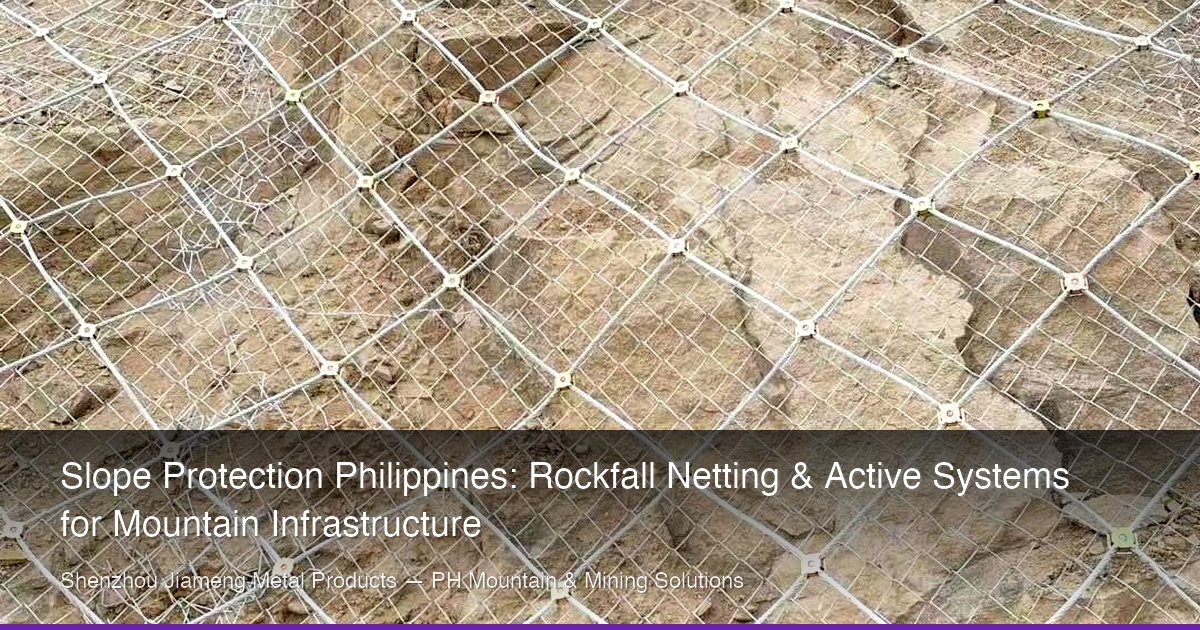
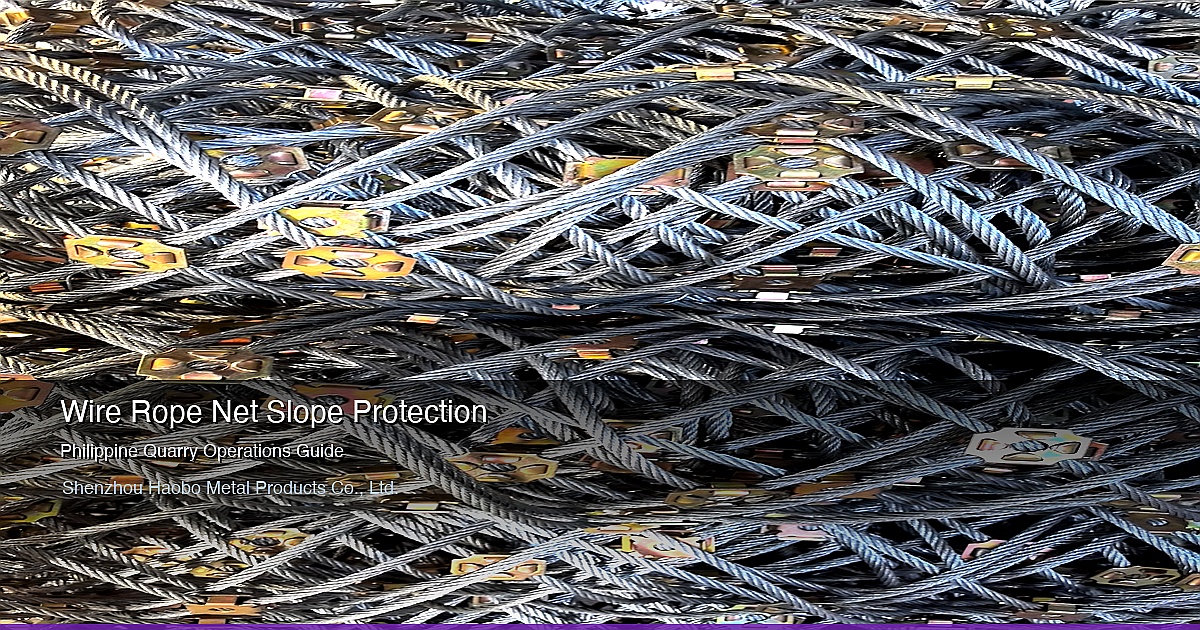
Steel wire rope net active protection systems — sometimes referred to as "spider nets" due to their three-dimensional structure — consist of a high-tensile steel wire rope net secured to the slope face by a pattern of soil nails, rock bolts, or anchor cables. The net applies continuous confinement pressure to the slope surface, preventing loosened material from detaching while allowing vegetation growth through the mesh openings. This approach is fundamentally different from passive rockfall barriers (which catch falling rocks at the toe) and from shotcrete (which seals the surface completely), making it the optimal solution for most Philippine quarry slope conditions.
2. Steel Wire Rope Net System Components and Specifications
A complete active slope protection system for quarry applications consists of five primary components, each engineered to meet the specific loading conditions of the quarry slope. All components must conform to JT/T 528-2022 (the Chinese national standard for slope protection wire mesh systems) and pass MGB-accepted testing protocols.
2.1 Wire Rope Net (Primary Mesh)
The primary mesh is fabricated from high-tensile steel wire rope with a minimum tensile strength of 1,770 MPa per JT/T 528-2022. The wire rope consists of 7 strands of 7 wires each (1x19 construction) with a diameter of 8mm for standard applications and 12mm for high-energy applications. The mesh is woven in a rhombic (diamond) pattern with typical opening sizes of 150x150mm, 200x200mm, or 300x300mm depending on the rock fragment size on the slope face.
| Net Type | Wire Rope Dia. | Mesh Opening | Tensile Strength | Zinc Coating |
|---|---|---|---|---|
| ROCCO R-150 | 8 mm (1x19) | 150 x 150 mm | 1,770 MPa | ≥245 g/m2 |
| ROCCO R-200 | 8 mm (1x19) | 200 x 200 mm | 1,770 MPa | ≥245 g/m2 |
| ROCCO R-300 | 12 mm (1x19) | 300 x 300 mm | 1,770 MPa | ≥245 g/m2 |
| TECCO G65/3 (supplementary) | 3 mm wire | 65 mm | 1,200 MPa | ≥245 g/m2 |
The 8mm wire rope (1x19 construction) provides a minimum breaking force of 40.6 kN per strand, giving the ROCCO R-150 net a failure load exceeding 270 kN per linear meter of mesh width. This load capacity far exceeds the gravitational load of typical quarry slope surface material, providing a factor of safety of 3-5 against mesh rupture under normal conditions. For slopes with exceptionally large rock blocks (greater than 500mm), the ROCCO R-300 with 12mm wire rope provides a breaking force of 92 kN per strand, suitable for containing blocks up to 2 tons.
2.2 Secondary Mesh (TECCO or Chain Link)
For slopes with fine rock fragments or soil that would pass through the primary wire rope net openings, a supplementary TECCO G65/3 mesh is installed beneath the primary net. This high-tensile steel wire mesh (3mm wire diameter, 1,200 MPa tensile strength, 65mm diamond opening) catches smaller material while allowing water drainage and vegetation growth. The TECCO mesh is secured to the slope face with soil nails before the primary wire rope net is installed over it.
2.3 Anchoring System
The anchoring system transfers loads from the mesh to the stable rock mass behind the slope face. For Philippine quarry applications, the following anchor types are typically specified:
| Anchor Type | Diameter | Length | Working Load | Application |
|---|---|---|---|---|
| Soil nail (deformed bar) | 25 mm | 2-4 m | 120 kN | Soil/weathered rock slopes |
| Rock bolt (threaded bar) | 25-32 mm | 3-6 m | 200-280 kN | Moderate rock slopes |
| Self-drilling anchor (SDA) | 38-52 mm | 4-12 m | 280-500 kN | Difficult access, fractured rock |
| Anchor cable (multi-strand) | 15.2 mm x 4 strands | 8-20 m | 500-800 kN | High, critical slopes (>50m) |
Anchor spacing is determined by the slope stability analysis but typically follows a grid pattern of 2.0m x 2.0m for moderate slopes (30-45 degrees, <30m height) and 1.5m x 1.5m for steep slopes (45-60 degrees, >30m height). Each anchor is proof-tested to 1.5 times the design working load before the mesh is attached. For soil nail installations in weathered rock, a cement grout (water-cement ratio 0.4-0.45) is injected under low pressure to bond the nail to the surrounding ground.
2.4 Boundary and Edge Restraint
The perimeter of the mesh installation is secured using a boundary rope (12mm wire rope) threaded through the edge meshes and anchored at 3-5m intervals with perimeter anchors. This edge restraint is critical — without it, the mesh can peel away from the slope face at the edges during heavy rainfall or ground movement, creating an unprotected zone where material can escape. For installations on quarry benches, the upper edge is typically anchored at the crest of the slope and the lower edge is secured to the bench floor or tied into a toe wall.
2.5 Corrosion Protection
All steel components — wire rope net, TECCO mesh, anchors, boundary rope, and connection clips — receive hot-dip galvanizing with minimum 245 g/m2 zinc coating per GB/T 1839. For quarry sites in coastal areas or with acidic groundwater (common in areas with sulfide mineralization), Galfan coating (Zn-5%Al alloy) provides 2-3 times the corrosion resistance of standard galvanizing at approximately 20% cost premium. All anchors receive additional protection via cement grout encapsulation, which provides a passive alkaline environment that prevents corrosion of the steel bar within the borehole.
3. MGB DAO 2000-98 Compliance Requirements for Quarry Slope Protection
MGB's regulatory framework for quarry slope stability is primarily governed by DAO 2000-98 ( DENR Administrative Order on Implementing Rules and Regulations of RA 7942, the Philippine Mining Act). The following requirements are directly applicable to slope protection systems at quarry operations:
3.1 Slope Stability Analysis Requirements
MGB requires all quarry operators to submit a slope stability analysis prepared by a licensed Geotechnical Engineer as part of the MEPEP. The analysis must demonstrate:
- Static factor of safety (FS) ≥ 1.3 for all permanent slopes under normal groundwater conditions
- Seismic factor of safety ≥ 1.1 under design earthquake loading (NSCP 2015 PGA for the site location)
- Rapid drawdown FS ≥ 1.2 for slopes subject to groundwater fluctuation after heavy rainfall
- Surface protection for all slopes exceeding 45 degrees, with active protection required for slopes with identified rockfall hazard
- Monitoring program for slopes exceeding 60 degrees or 50m height, including periodic visual inspection and instrumentation (inclinometers, crackmeters) as required
The slope stability analysis must consider the full range of geological conditions present at the quarry, including joint sets, fault zones, weathering profiles, and groundwater levels. For Philippine quarry sites, the analysis should specifically account for tropical weathering conditions that can rapidly degrade rock mass quality during the rainy season — a factor that is often underestimated in analyses prepared using temperate-climate methodologies.
3.2 MEPEP Submission Requirements
The Annual Mining Environmental Protection and Enhancement Program (MEPEP) submission to MGB must include the following slope protection documentation:
| Document | Required Content | Frequency |
|---|---|---|
| Slope stability analysis | Geotechnical report with FS calculations for all critical slopes | Annual + after any slope failure event |
| Slope protection design | Engineering drawings, specifications, and calculations for installed systems | With each new installation |
| Material certificates | Wire rope tensile test, zinc coating weight test, anchor load test | With each material batch delivered |
| Installation records | Anchor installation logs, proof test results, as-built drawings | After installation completion |
| Inspection reports | Visual inspection of all protected slopes, condition rating, repair recommendations | Quarterly + after major typhoon events |
Failure to maintain adequate slope protection can result in MGB issuing a Notice of Violation, suspension of the quarry permit, or in severe cases, revocation of the Mining Permit. Quarry operators should therefore prioritize slope protection not only as a safety measure but as a regulatory compliance requirement that directly affects their ability to operate.
4. Case Study: Rizal Province Basalt Quarry Slope Protection
The Rodriguez Basalt Quarry in Rizal province, one of the largest aggregate quarries serving Metro Manila, operates a multi-bench excavation face reaching 85m in total height. In 2022, a section of the upper bench (45-65m elevation) experienced progressive raveling — the gradual detachment of small rock fragments from the slope face — that created a safety hazard for operations on the bench below and threatened to propagate into a larger failure zone.
The quarry operator commissioned a geotechnical investigation that identified the root cause as stress relief jointing in the basalt, exacerbated by tropical weathering along joint surfaces. The investigation recommended an active slope protection system combining TECCO G65/3 supplementary mesh with ROCCO R-200 primary wire rope net, anchored with 25mm rock bolts at 2.0m x 2.0m spacing. The system was designed to contain rock fragments up to 500mm while allowing natural drainage and future vegetation establishment.
Project Parameters
| Parameter | Value |
|---|---|
| Slope height (protected section) | 20m (elevation 45-65m) |
| Slope angle | 55-65 degrees (varies) |
| Rock type | Basalt with columnar jointing, moderately weathered |
| Protected area | 2,400 m2 (120m length x 20m height) |
| Primary mesh | ROCCO R-200, 8mm wire rope, 200x200mm opening, galvanized 245 g/m2 |
| Supplementary mesh | TECCO G65/3, 3mm wire, 65mm opening, galvanized 245 g/m2 |
| Anchors | 25mm rock bolts, 4m length, 200 kN working load, 2.0m x 2.0m grid |
| Total anchors | 612 units |
| Installation method | Rope access (drilling and installation from suspended platform) |
Installation Process and Performance
The installation was performed by a specialized rope access team over 35 working days, using pneumatic drills for anchor hole drilling and hand-placed mesh panels. The TECCO mesh was installed first, secured to the slope with soil nails at 1.0m x 1.0m spacing, followed by the ROCCO R-200 primary net secured to the rock bolts. Each anchor was proof-tested to 300 kN (1.5x working load) before mesh attachment.
The system was completed in April 2022 and has since withstood three typhoon seasons (2022-2024) with zero rockfall incidents from the protected slope section. Post-typhoon inspections have confirmed: (a) no anchor failures or load relaxation, (b) no mesh panel damage or excessive deformation, (c) no significant accumulation of loose material behind the mesh, and (d) natural vegetation has begun colonizing the slope face through the mesh openings, providing additional erosion protection and visual screening. The quarry operator has subsequently commissioned protection of an additional 3,600 m2 of slope face using the same system design.
5. Installation Methodology for Quarry Slope Conditions
The installation of wire rope net active protection systems on quarry slopes requires specialized equipment and trained personnel. Most Philippine quarry slopes are accessed using rope access techniques (industrial rappelling) rather than scaffolding or aerial platforms, due to the height and irregular geometry of the excavation faces. The following methodology outlines the standard installation sequence:
Step 1: Site Survey and Slope Mapping
Before installation, a detailed geological survey of the slope face is conducted to identify rock types, joint patterns, weathering grades, and existing instability features. The survey is typically performed by a geotechnical engineer using rope access, with the findings documented in a slope face map that guides anchor placement and mesh panel layout. Critical areas requiring closer anchor spacing or additional reinforcement are identified at this stage.
Step 2: Surface Preparation
Loose material and unstable rock blocks that could fail behind the mesh are removed from the slope face using scaling bars, pneumatic breakers, or controlled blasting. This is the most critical safety step in the installation process — installing mesh over loose material simply hides the problem and creates a future failure risk. The scaling operation is performed by experienced rope access technicians with a spotter on the bench below to warn of falling debris.
Step 3: Anchor Installation
Anchor holes are drilled at the design grid spacing using pneumatic or hydraulic drills. For rock bolt installations in competent rock, 50mm diameter holes are drilled to the design depth (typically 3-4m). In fractured or weathered rock, self-drilling anchors (SDA) are used, which combine the drill steel and anchor in a single unit, eliminating the need for casing in unstable ground. After drilling, the anchor bar is inserted and cement grout is pumped into the hole from the bottom up using a grout tube. After a 3-7 day curing period, each anchor is proof-tested to 1.5x design load using a hydraulic jack.
Step 4: Supplementary Mesh Installation
If the slope has fine material that could pass through the primary net openings, TECCO G65/3 mesh is installed first. The mesh is unrolled from the top of the slope downward and secured to soil nails (1.0m x 1.0m spacing) using bearing plates and nuts. The mesh must be in close contact with the slope face — gaps between the mesh and rock surface greater than 50mm are corrected by adding intermediate soil nails or using rock-filled bags to push the mesh against the surface.
Step 5: Primary Wire Rope Net Installation
The ROCCO wire rope net panels (typically 3m x 10m or 4m x 10m) are unrolled from the slope crest and positioned over the supplementary mesh. Adjacent panels are connected using threaded steel clips or wire rope clips, with a minimum overlap of 200mm at all seams. The net is then secured to the rock bolts using bearing plates (200x200x10mm) and domed nuts, which allow the mesh to articulate while maintaining full confinement pressure on the slope surface.
Step 6: Boundary and Edge Detailing
The perimeter of the installation is secured with a 12mm boundary wire rope threaded through the edge meshes and anchored at 3m intervals. At the crest of the slope, the boundary rope is anchored in a continuous trench excavated 500mm deep and backfilled with concrete. At the toe, the mesh is either secured to a toe wall or extended 1m beyond the slope base and buried, preventing material from escaping beneath the mesh.
Step 7: Quality Control and Acceptance
The completed installation is inspected by the project geotechnical engineer, who verifies: (a) anchor proof test results, (b) mesh panel connections and overlaps, (c) bearing plate installation at all anchors, (d) boundary rope tension and anchoring, and (e) overall conformity to the approved design drawings. An as-built drawing is prepared showing actual anchor locations, mesh panel layout, and any deviations from the design. This documentation forms part of the MEPEP submission to MGB.
6. Cost Analysis and BOQ Template for Quarry Slope Protection
The following cost analysis is based on a representative 2,000 m2 quarry slope protection project using the ROCCO R-200 + TECCO G65/3 system described in the Rizal case study. Costs are in Philippine Pesos (PHP) and reflect 2026 market conditions for materials, labor, and equipment in the National Capital Region and nearby provinces.
| Item | Qty | Unit | Unit Price (PHP) | Amount (PHP) |
|---|---|---|---|---|
| ROCCO R-200 wire rope net, 8mm, 200x200mm, galvanized | 2,200 | m2 | 385 | 847,000 |
| TECCO G65/3 mesh, 3mm, 65mm, galvanized | 2,200 | m2 | 310 | 682,000 |
| Rock bolts, 25mm x 4m, galvanized, with grout | 510 | units | 1,850 | 943,500 |
| Bearing plates, 200x200x10mm, with nuts | 510 | units | 145 | 73,950 |
| Boundary rope, 12mm wire rope, galvanized | 340 | m | 85 | 28,900 |
| Connection clips and accessories | 1 | lump | 85,000 | 85,000 |
| Rope access labor (drilling, installation) | 35 | days | 18,500 | 647,500 |
| Equipment (compressor, drills, grout pump) | 35 | days | 9,500 | 332,500 |
| Anchor proof testing | 510 | units | 120 | 61,200 |
| Engineering and survey | 1 | lump | 120,000 | 120,000 |
| Subtotal | 3,821,550 | |||
| Contingency (10%) | 382,155 | |||
| Total (2,000 m2) | 4,203,705 |
Unit cost: approximately PHP 2,102/m2 ($37.5/m2) including all materials, labor, equipment, and engineering. For budget estimation purposes, quarry operators can use PHP 1,800-2,400/m2 as a planning range, with the actual cost depending on slope geometry, rock conditions, anchor type and length, and site accessibility.
7. FOB Tianjin Pricing and Procurement Guide
Shenzhou Haobo Metal Products Co., Ltd. manufactures all components of the wire rope net active protection system at our factory in Hebei, China. The following FOB Tianjin pricing applies to standard specifications and is current as of July 2026.
| Component | Specification | FOB Price ($/m2) |
|---|---|---|
| ROCCO R-150 wire rope net | 8mm, 150x150mm, galvanized 245 g/m2 | $6.50 |
| ROCCO R-200 wire rope net | 8mm, 200x200mm, galvanized 245 g/m2 | $5.80 |
| ROCCO R-300 wire rope net | 12mm, 300x300mm, galvanized 245 g/m2 | $9.20 |
| TECCO G65/3 supplementary mesh | 3mm, 65mm, galvanized 245 g/m2 | $4.50 |
| Galfan upgrade (per component) | Zn-5%Al coating, 245 g/m2 | +20% |
| Bearing plates + accessories | 200x200x10mm, with nuts | $2.80/set |
Rock bolts and anchors are typically sourced locally in the Philippines due to their weight (shipping cost from China would exceed the material cost savings). However, for projects requiring specific anchor types (e.g., self-drilling anchors), we can supply them FOB Tianjin at competitive pricing. Lacing wire, connection clips, and boundary rope are included in the per-m2 mesh pricing for orders exceeding 1,000 m2.
For a typical 2,000 m2 project (ROCCO R-200 + TECCO G65/3), the total FOB material cost is approximately $20,600 (PHP 1.17 million). Adding ocean freight ($1,500/container, approximately 2 containers needed), insurance, and Philippine VAT (12%), the landed cost in Manila is approximately $24,800 (PHP 1.41 million). With local labor, equipment, and engineering, the total installed project cost of PHP 4.2 million represents a material-to-installation cost ratio of approximately 34:66 — consistent with industry norms for rope-access installation projects.
8. Maintenance, Monitoring, and Long-Term Performance
Wire rope net active protection systems are designed for 30-50 year service life with minimal maintenance, but periodic inspection and minor repairs are essential to ensure continued performance. MGB requires quarterly visual inspections of all slope protection installations as part of the MEPEP, with additional inspections required after major typhoon events (typhoon signal 3 or above) or after any significant seismic activity.
Inspection Checklist
| Inspection Item | Acceptance Criteria | Action if Deficient |
|---|---|---|
| Mesh panel condition | No broken wires, no excessive deformation (>100mm sag) | Replace damaged panel section |
| Anchor condition | No visible corrosion, bearing plate seated flush | Re-torque or replace anchor |
| Boundary rope | Taut, no broken strands, anchors intact | Re-tension or replace rope section |
| Material accumulation behind mesh | No significant buildup (>200mm depth) | Remove accumulated material |
| Slope face erosion | No new erosion features or surface cracks | Engineering assessment and remediation |
| Vegetation growth | Vegetation is beneficial (roots bind material) but should not hide mesh | Trim excessive vegetation if mesh inspection is impeded |
| Corrosion of wire components | Zinc coating intact, no red rust on structural wires | Apply zinc-rich paint or replace affected component |
Minor repairs (replacement of individual mesh panels, re-tensioning of boundary rope, replacement of corroded clips) can be performed by the quarry's maintenance crew with basic rope access training. Major repairs (anchor replacement, large-section mesh replacement) should be performed by specialized slope protection contractors. We recommend that quarry operators maintain a small stock of spare mesh panels (5-10% of total installed area) and connection accessories at the site to enable rapid repairs after typhoon damage.
With proper installation and maintenance, wire rope net active protection systems provide reliable, long-term slope stability for Philippine quarry operations at a fraction of the cost of alternative methods. The combination of high-tensile wire rope mesh, engineered anchor systems, and professional rope access installation creates a robust, MGB-compliant slope protection solution that has been proven in some of the most challenging tropical quarry environments in the Philippines.
For project-specific design assistance, material quotations, or coordination with your MGB compliance officer, contact Shenzhou Haobo Metal Products Co., Ltd. at WhatsApp +86 15076321111 or email yangshaotian311@gmail.com. Our engineering team can provide detailed system specifications, anchor design calculations, and BOQ preparation support tailored to your quarry's specific geological conditions.
Need Wire Rope Net for Quarry Slope Protection?
Send us your quarry slope parameters — height, angle, rock type, joint patterns, and MGB requirements. Our engineering team provides ROCCO mesh specifications, anchor design, and FOB Tianjin quotation within 48 hours.
www.haobomesh.com | Shenzhou Haobo Metal Products Co., Ltd.