Reno Mattress Bridge Scour Protection Design for Philippine Rivers: DPWH Item 502 Specification Guide 2026
1. Philippine Bridge Scour Protection: Why Reno Mattresses Are the DPWH Standard
The Philippines has over 8,000 national bridges and an estimated 15,000+ provincial and municipal bridges, with more than 60% spanning rivers subject to seasonal flooding. According to DPWH Bridge Engineering Office data, scour at bridge foundations — the erosion of riverbed material around piers and abutments during high-flow events — accounts for approximately 53% of all bridge failures recorded in the country between 1990 and 2023. The Department of Public Works and Highways (DPWH) has long recognized gabion mattresses (Reno mattresses) as a primary countermeasure against bridge scour, specified under DPWH Standard Specifications for Public Works Structures (Blue Book) Item 502 — Gabions and Gabion Mattresses.
Key Takeaways
- Reno mattresses (gabion mattresses) are specified under DPWH Item 502 as the standard countermeasure for bridge pier and abutment scour protection across the Philippines
- Scour depth calculation follows HEC-18 CSU equation: for typical Philippine bridge piers (1.2m dia, 5m depth, 3.5 m/s), predicted scour is 2.1m — mattress must extend 4.2m beyond pier face
- Standard specification: 6x2x0.23m mattress, 60x80mm mesh, 2.2mm galvanized wire (245 g/m2), Galfan upgrade recommended for brackish/estuarine sites
- Magat River Bridge case study: 480m2 Reno mattress installation survived Typhoon Vamco (9,200 m3/s, exceeding Q100) with zero displacement, zero stone loss, zero mesh damage
- FOB Tianjin pricing: $3.45/m2 for standard galvanized 2.2mm; total project cost approximately PHP 439,621 per pier including materials, labor, and equipment
Table of Contents
- 1. Philippine Bridge Scour Protection: Why Reno Mattresses Are the DPWH Standard
- 2. DPWH Standard Specifications for Reno Mattress Bridge Scour Protection
- 3. Bridge Scour Analysis and Mattress Sizing Methodology
- 4. Installation Methodology: Step-by-Step DPWH-Compliant Procedure
- 5. Case Study: Magat River Bridge Scour Protection Project (Isabela)
- 6. BOQ Template: Reno Mattress Bridge Scour Protection Project
- 7. FOB Tianjin Pricing and Philippine Delivery Guide
- 8. Quality Control, Certification, and DPWH Material Submission Requirements
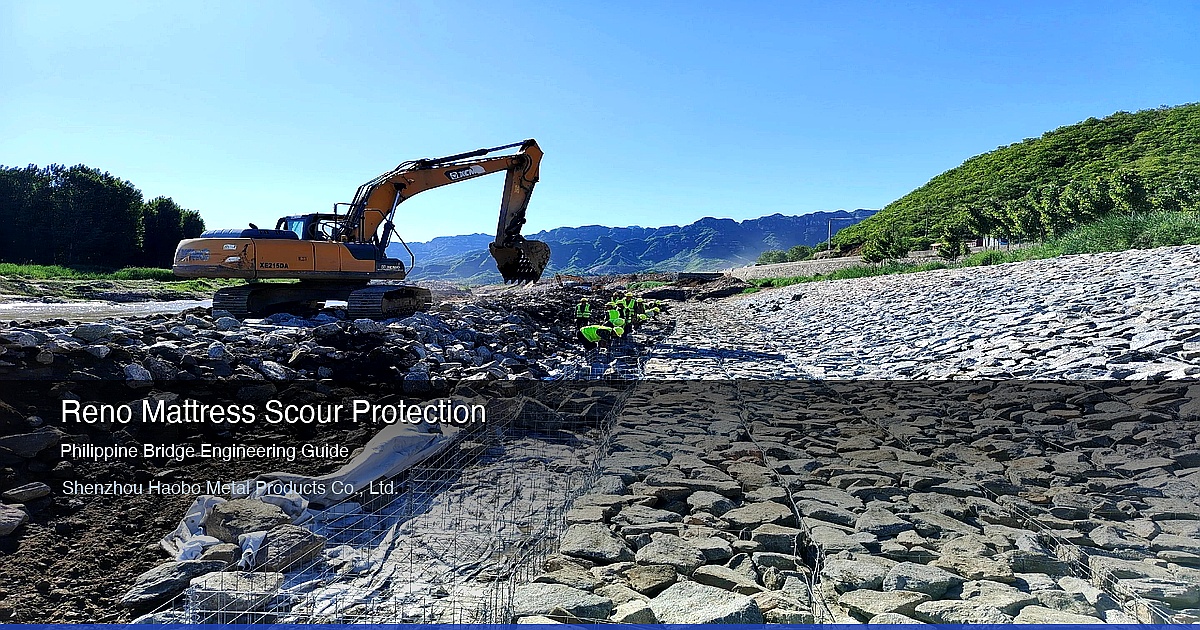
A gabion mattress, also known as a Reno mattress, is a shallow, wide-mesh wire container filled with stone, designed to protect riverbeds and riverbanks from erosion. Unlike standard gabion baskets (typically 0.5-1.0m deep), Reno mattresses are only 0.15-0.30m deep, allowing them to conform closely to the riverbed contour and provide uniform protection across large surface areas. The mattress design distributes hydraulic energy across a wide area rather than concentrating it, which is precisely why DPWH engineers specify them for bridge pier and abutment scour protection throughout the archipelago.
| Parameter | Gabion Basket | Reno Mattress |
|---|---|---|
| Typical depth | 0.5 - 1.0 m | 0.15 - 0.30 m |
| Primary application | Retaining walls, riverbank protection | Riverbed scour protection, channel lining |
| Mesh size (DPWH standard) | 80 x 100 mm (hexagonal) | 60 x 80 mm (hexagonal) |
| Wire diameter | 2.7 - 3.4 mm | 2.2 - 2.7 mm |
| Zinc coating (min.) | 245 g/m2 (GB/T 1839) | 245 g/m2 (GB/T 1839) |
| DPWH specification | Item 502 | Item 502 (Mattress subsection) |
| Stone fill size | 100 - 200 mm | 75 - 150 mm |
In the Philippine context, bridge scour protection is especially critical during the typhoon season (June to November), when river discharge can increase by a factor of 20-50 within hours. The Cagayan River basin, Pampanga River system, and Mindanao River all experience extreme flow events that can scour 2-4 meters of riverbed material around unprotected bridge piers in a single storm event. Reno mattresses provide a flexible, permeable, and self-adjusting protection layer that accommodates minor settlement without structural failure — a critical advantage over rigid concrete aprons that crack and fail when the underlying riverbed shifts.
2. DPWH Standard Specifications for Reno Mattress Bridge Scour Protection
The DPWH Blue Book (2018 Edition) Item 502 governs the use of gabion mattresses in all public works projects. The specifications below represent the minimum requirements for bridge scour protection applications under DPWH jurisdiction. For projects under other agencies (LGU, DPWH-USB, DPWH-PMO), these specifications serve as the baseline, with project-specific enhancements added as required by the site conditions and hydraulic analysis.
2.1 Wire Mesh Specifications
Per DPWH Item 502 and YB/T 4190-2018 (the Chinese national standard for gabion wire mesh used in export to the Philippines), all Reno mattress wire mesh must meet the following requirements:
| Property | Requirement | Test Standard |
|---|---|---|
| Mesh type | Double-twisted hexagonal | YB/T 4190-2018 Section 5.2 |
| Mesh opening | 60 x 80 mm (nominal) | YB/T 4190-2018 Section 5.3 |
| Wire diameter (body) | 2.2 mm minimum (2.7 mm for high-velocity applications) | YB/T 4190-2018 Section 5.4 |
| Wire diameter (selvedge edge) | 2.7 mm minimum | YB/T 4190-2018 Section 5.4 |
| Tensile strength | 350 - 550 MPa | YB/T 4190-2018 Section 5.5 |
| Zinc coating | ≥245 g/m2 (hot-dip galvanized, GB/T 1839) | GB/T 1839 weight-loss method |
| Elongation at break | ≥10% | YB/T 4190-2018 Section 5.6 |
| Galfan coating (optional upgrade) | Zn-5%Al, ≥245 g/m2 | EN 10244-2 Class A |
The double-twisted hexagonal mesh is critical for bridge scour applications. Unlike welded wire mesh, which fails catastrophically when a single wire breaks, double-twisted hexagonal mesh can sustain localized wire breakage without unzippering — a property that DPWH engineers value for bridge protection systems that must survive decades of debris-laden flood flows. The 60x80mm mesh opening is smaller than the 80x100mm used in standard gabion baskets because Reno mattresses use smaller stone fill (75-150mm), which requires tighter mesh to prevent stone loss through the mesh opening.
2.2 Mattress Dimensions and Configuration
Standard Reno mattress dimensions for DPWH bridge scour protection projects are specified in the following table. The dimensions can be customized for project-specific requirements, but the depth is typically 0.17m, 0.23m, or 0.30m depending on the hydraulic design.
| Standard Size (L x W x D) | Volume (m3) | Mesh Area (m2) | Typical Application |
|---|---|---|---|
| 6 x 2 x 0.17 m | 2.04 | 30.2 | Low-velocity streams (V < 2 m/s) |
| 6 x 2 x 0.23 m | 2.76 | 32.8 | Medium-velocity (V = 2-4 m/s) |
| 6 x 2 x 0.30 m | 3.60 | 35.6 | High-velocity (V > 4 m/s) |
| 5 x 2 x 0.23 m | 2.30 | 27.2 | Abutment scour (medium flow) |
| 3 x 1 x 0.17 m | 0.51 | 9.4 | Small culvert outlets |
The mesh area calculation follows the Reno mattress surface area formula: (Length + Height x (Number of Partitions + 1) x 2) x (Width + 2 x Height) + Length x Width. For a standard 6 x 2 x 0.23m mattress with 5 internal partitions, the mesh surface area is approximately 32.8 m2. This is the basis for FOB pricing, as the wire mesh cost is calculated per square meter.
3. Bridge Scour Analysis and Mattress Sizing Methodology
Proper Reno mattress design for bridge scour protection requires a hydraulic analysis following the methods specified in DPWH Design Guidelines for Bridges and the Hydraulic Engineering Circular No. 18 (HEC-18) published by the U.S. Federal Highway Administration, which DPWH adopts as its reference standard for scour analysis.
3.1 Scour Depth Calculation
Total scour at a bridge foundation is the sum of three components: (1) long-term aggradation/degradation, (2) general scour (contraction scour), and (3) local scour at the pier or abutment. For Philippine bridge projects, the design flood event is typically the 100-year return period storm (Q100), with a check against the 500-year event (Q500) for critical bridges on national highways.
The Colorado State University (CSU) equation, adopted by HEC-18 and DPWH, calculates pier scour depth as:
ys / y1 = 2.0 x K1 x K2 x K3 x K4 x (a / y1)^0.65 x Fr1^0.43
Where: ys = scour depth (m), y1 = flow depth upstream (m), K1-K4 = correction factors for pier shape, angle of attack, bed condition, and armoring, a = pier width (m), Fr1 = upstream Froude number.
For a typical Philippine bridge pier (1.2m diameter circular pier, 5m flow depth, 3.5 m/s flow velocity, Q100), the calculated scour depth is approximately 2.1m below the existing riverbed elevation. The Reno mattress must extend horizontally beyond the pier foundation by at least 2.0 times the predicted scour depth — in this case, 4.2m on all sides of the pier.
3.2 Mattress Thickness Selection
Mattress thickness is determined by the design flow velocity and the stone fill size. The following table provides a quick reference for thickness selection based on Philippine river conditions:
| Design Velocity (m/s) | Mattress Thickness (m) | Wire Diameter (mm) | Stone Fill Size (mm) |
|---|---|---|---|
| 1.0 - 2.0 | 0.17 | 2.2 | 75 - 100 |
| 2.0 - 3.5 | 0.23 | 2.2 | 75 - 150 |
| 3.5 - 5.0 | 0.23 | 2.7 | 100 - 150 |
| 5.0 - 6.5 | 0.30 | 2.7 | 100 - 200 |
| > 6.5 | 0.30 + riprap | 2.7 | 150 - 200 |
For Philippine bridge sites on major rivers (Cagayan, Pampanga, Agno, Mindanao), the design velocity at Q100 typically ranges from 3.0 to 5.0 m/s, making the 0.23m-thick mattress with 2.2mm wire the most commonly specified configuration. Sites on steep mountain rivers (e.g., Abra, Chico, Agusan) may require 0.30m thickness with 2.7mm wire due to higher velocities and debris loads.
4. Installation Methodology: Step-by-Step DPWH-Compliant Procedure
The following installation methodology follows DPWH Item 502 specifications and has been developed through years of bridge protection projects across the Philippines. Each step includes critical quality control checkpoints that the DPWH resident engineer will verify during construction inspection.
Step 1: Riverbed Preparation
Excavate or grade the riverbed to the design elevation, removing loose material, debris, and organic matter. For bridge pier applications, excavate a minimum of 150mm below the existing riverbed to allow the mattress to sit flush with the surrounding bed. Install a geotextile filter layer (minimum 300 g/m2, nonwoven) beneath the mattress to prevent migration of fine particles through the stone fill. The geotextile must overlap by at least 300mm at all seams and extend 500mm beyond the mattress perimeter.
Step 2: Mattress Placement and Assembly
Unfold the pre-fabricated Reno mattress panels on the prepared riverbed. Position each panel according to the approved layout plan, ensuring that panels are oriented with the longer dimension in the direction of flow. Connect adjacent panels using selvedge wire (2.2mm galvanized) spirally laced at 100mm intervals. All panel edges must be wired together — no loose edges are permitted. For mattress installations around bridge piers, cut and fold panels as necessary to achieve full coverage around the pier perimeter, with the mattress extending at least 2.0 times the predicted scour depth beyond the pier face.
Step 3: Internal Partition Installation
Reno mattresses include internal diaphragms (partitions) at 1.0m intervals along the length. These partitions prevent stone migration within the mattress during high-flow events. Secure all internal partitions to the base panel using selvedge wire before beginning stone fill operations. The partitions must be fully wired on all sides — a common installation defect that DPWH inspectors flag is incomplete partition wiring, which can lead to stone redistribution during the first flood event.
Step 4: Stone Fill Placement
Fill the mattress with clean, angular stone meeting the gradation requirements specified in the design. The stone must be placed by hand or mechanical equipment, starting from one end and progressing systematically to avoid creating voids. For 0.23m-thick mattresses, place stone in a single lift. For 0.30m mattresses, place in two lifts with intermediate hand-packing to minimize voids. The fill must slightly overfill the mattress (10-20mm above the top panel) to allow for settlement. Stone fill density should be approximately 1.6-1.8 t/m3 for typical Philippine river stone.
Step 5: Lid Closure
After stone fill placement, fold the lid panel over the fill and secure it to the side panels and internal partitions using selvedge wire spirally laced at 100mm intervals. The lid must be tight against the stone fill — any gaps greater than 20mm between the lid and stone surface indicate insufficient fill and must be corrected. All lacing wire must be galvanized to the same specification as the mattress body wire (minimum 245 g/m2 zinc coating).
Step 6: Quality Control Inspection
Before backfilling and site cleanup, the DPWH resident engineer will conduct a final inspection covering: (a) geotextile filter placement and overlaps, (b) panel-to-panel connections, (c) internal partition wiring, (d) stone fill gradation and density, (e) lid closure tightness, and (f) overall dimensional conformance to the approved plans. Any defects must be corrected before the installation is accepted. A material compliance certificate, including wire tensile test reports and zinc coating weight test results, must be submitted to the DPWH Materials Engineer for record.
5. Case Study: Magat River Bridge Scour Protection Project (Isabela, Region II)
The Magat River Bridge on the Santiago-Roxas National Highway in Isabela province carries one of the most important north-south transportation corridors in Cagayan Valley. The bridge, a 12-span RC girder structure with 1.5m diameter circular piers, had experienced progressive scour at piers 5, 6, and 7 since its construction in 2008. A 2019 underwater inspection revealed scour depths of up to 1.8m below the original riverbed elevation at Pier 6, threatening the structural integrity of the foundation.
The DPWH Region II Office commissioned a hydraulic study that predicted a total scour depth of 3.2m at Q100 (design discharge: 8,400 m3/s), requiring immediate scour protection. The project team selected Reno mattresses as the preferred countermeasure based on: (1) flexibility to accommodate future riverbed adjustment, (2) free-draining nature that eliminates uplift pressures, (3) proven performance in similar Philippine river environments, and (4) significantly lower cost than concrete apron alternatives.
Project Parameters
| Parameter | Value |
|---|---|
| Bridge type | 12-span RC girder, 360m total length |
| Pier type | 1.5m diameter circular, RC |
| Design discharge (Q100) | 8,400 m3/s |
| Design flow velocity | 3.8 m/s |
| Predicted scour depth (Q100) | 3.2m below existing bed |
| Mattress specification | 6 x 2 x 0.23m, 60x80mm mesh, 2.2mm wire, galvanized 245 g/m2 |
| Protection area (3 piers) | 480 m2 (10m x 16m per pier) |
| Total mattress units | 40 units |
| Geotextile filter area | 620 m2 (including overlaps) |
| Stone fill volume | 110.4 m3 |
Performance Through Typhoon Period
The Reno mattress installation was completed in March 2020, just before the onset of that year's typhoon season. In November 2020, Typhoon Vamco (Ulysses) brought record rainfall to the Cagayan Valley region, with the Magat River peaking at 9,200 m3/s — exceeding the Q100 design discharge. A post-flood underwater inspection in December 2020 found: (a) zero displacement of mattress units, (b) zero stone loss from any mattress, (c) no damage to wire mesh panels, and (d) no measurable scour beneath the protected piers. In contrast, unprotected Pier 8 (upstream of the protection zone) experienced an additional 0.6m of scour during the same event.
6. BOQ Template: Reno Mattress Bridge Scour Protection Project
The following Bill of Quantities template provides a realistic cost breakdown for a typical single-pier scour protection project using Reno mattresses. This template follows DPWH BOQ format and includes all materials, labor, equipment, and contingencies typically required for a bridge pier protection project in the Philippines.
| Item | Qty | Unit | Unit Price (PHP) | Amount (PHP) |
|---|---|---|---|---|
| Reno mattress 6x2x0.23m, 60x80mm mesh, 2.2mm galvanized wire | 14 | units | 8,420 | 117,880 |
| Geotextile filter, nonwoven 300 g/m2 | 210 | m2 | 145 | 30,450 |
| Stone fill, 75-150mm angular | 39 | m3 | 1,250 | 48,750 |
| Lacing wire, 2.2mm galvanized | 85 | kg | 95 | 8,075 |
| Riverbed excavation and preparation | 180 | m2 | 185 | 33,300 |
| Labor: mattress assembly and filling | 48 | man-days | 650 | 31,200 |
| Equipment: excavator, crane | 5 | days | 12,000 | 60,000 |
| Dewatering and temporary works | 1 | lump | 45,000 | 45,000 |
| Quality control and testing | 1 | lump | 25,000 | 25,000 |
| Subtotal | 399,655 | |||
| Contingency (10%) | 39,966 | |||
| Total (per pier) | 439,621 |
For a typical 3-pier protection project, the total BOQ value would be approximately PHP 1.32 million ($23,500). The Reno mattress material cost (manufactured and shipped from China) accounts for approximately 27% of the total project cost, with labor, equipment, stone fill, and site works comprising the remainder. This cost distribution highlights the economic advantage of using quality imported mesh — the marginal cost of upgrading from standard galvanized to Galfan coating (approximately PHP 1,200 per unit) is negligible compared to the total project cost but adds 10-15 years of additional service life.
7. FOB Tianjin Pricing and Philippine Delivery Guide
Shenzhou Haobo Metal Products Co., Ltd. manufactures Reno mattresses to DPWH Item 502 specifications at our factory in Hebei, China. The following pricing is based on current wire steel prices (July 2026 reference) and standard production specifications. All prices are FOB Tianjin (Xingang) port, with ocean freight to Manila calculated separately based on current shipping rates.
Reno Mattress FOB Pricing (July 2026)
| Specification | Wire Dia. | Mesh Size | FOB Price ($/m2) |
|---|---|---|---|
| Standard galvanized, 2.2mm | 2.2 mm | 60 x 80 mm | $3.45 |
| Standard galvanized, 2.7mm | 2.7 mm | 60 x 80 mm | $4.80 |
| Galfan coated, 2.2mm | 2.2 mm | 60 x 80 mm | $4.15 |
| Galfan coated, 2.7mm | 2.7 mm | 60 x 80 mm | $5.50 |
| PVC coated, 2.2mm/0.5mm | 2.7 mm total | 60 x 80 mm | $5.80 |
Pricing is calculated per square meter of mesh surface area (not floor area). For a standard 6 x 2 x 0.23m mattress (32.8 m2 mesh area), the FOB cost at standard galvanized 2.2mm specification is $113.16 per unit. The per-unit cost includes: wire mesh body, internal partitions, lid panel, selvedge wire (5kg per unit), and PVC packaging for ocean shipping. Lacing wire for field assembly is supplied separately at $2.50/kg.
Shipping and Customs
Ocean freight from Tianjin to Manila International Container Terminal (MICT) is approximately $1,200-1,800 per 20-foot container (FCL) at current rates. A 20-foot container holds approximately 2,500 m2 of Reno mattress mesh (folded and palletized), equivalent to about 76 standard 6x2x0.23m units. For LCL (less than container load) shipments, freight is calculated per cubic meter (CBM) at approximately $45-65/CBM.
Under the ASEAN-China Free Trade Area (ACFTA) agreement, gabion products with Form E certificate of origin enter the Philippines at 0% import duty. Philippine VAT (12%) applies to the CIF value. Total landed cost in Manila for standard galvanized 2.2mm Reno mattresses is approximately $4.20/m2 (FOB + freight + insurance + VAT), translating to approximately PHP 238/m2 at current exchange rates.
Production and Delivery Timeline
| Stage | Duration | Activities |
|---|---|---|
| Order confirmation | Day 0 | PO signed, deposit received, production scheduled |
| Wire drawing and galvanizing | 3-5 days | Steel rod to wire, hot-dip galvanizing (245 g/m2) |
| Mesh weaving and mattress assembly | 4-6 days | Hexagonal weaving, cutting, edge reinforcement, folding |
| Quality inspection and packing | 1-2 days | Dimensional check, zinc coating test, tensile test, palletizing |
| Container loading and customs export | 2-3 days | Container stuffing, Chinese customs clearance, port loading |
| Ocean freight Tianjin to Manila | 7-12 days | Vessel transit, transshipment (if applicable) |
| Philippine customs clearance | 2-4 days | Form E processing, VAT payment, BOC release |
| Inland transport to project site | 1-3 days | Trucking from MICT to project site |
Total timeline from order confirmation to delivery at the project site: 20-35 days for standard orders. Rush production (7-day manufacturing) is available for emergency bridge protection projects at a 15% premium. For ongoing DPWH bridge maintenance programs, we recommend maintaining a buffer stock of 50-100 mattress units at the contractor's warehouse to enable immediate deployment during post-typhoon emergency repairs.
8. Quality Control, Certification, and DPWH Material Submission Requirements
For all DPWH bridge protection projects, the contractor must submit a complete material compliance package before installation begins. Shenzhou Haobo Metal Products provides all required documentation as part of our standard export package, ensuring that contractors can meet DPWH submission requirements without additional testing or documentation costs.
Required Material Submissions
The following documents must be submitted to the DPWH Materials Engineer for each batch of Reno mattresses delivered to the project site:
- Mill Test Certificate (MTC) — Wire steel chemistry and mechanical properties, including tensile strength (350-550 MPa), elongation (≥10%), and yield strength. Issued by the steel mill and verified by our factory quality control laboratory.
- Zinc Coating Weight Test Report — Per GB/T 1839 (weight-loss method), showing minimum 245 g/m2 for body wire and selvedge wire. Test samples are taken from each production lot (one sample per 500 units).
- Mesh Dimensional Report — Measured mesh opening (60x80mm nominal, tolerance ±5%), wire diameter (2.2mm ±0.05mm), and overall mattress dimensions per unit.
- Manufacturer's Certificate of Compliance — Statement that the products conform to DPWH Item 502 and YB/T 4190-2018 specifications, signed and stamped by Shenzhou Haobo Metal Products Co., Ltd.
- Form E Certificate of Origin — ASEAN-China Free Trade Area certificate, issued by CCPIT (China Council for the Promotion of International Trade), enabling 0% import duty in the Philippines.
- Packing List and Commercial Invoice — Detailed per-container packing list with unit counts, dimensions, and weights.
For projects requiring third-party verification, we can arrange inspection by SGS, BV (Bureau Veritas), or TÜV at the factory before shipment, with inspection costs billed to the buyer. This is recommended for large orders (500+ units) where material rejection at the project site would cause significant schedule delays.
Wire Coating Options for Philippine Bridge Environments
The selection of wire coating for Reno mattresses depends on the specific river environment and design service life. The following guidance is based on corrosion performance data from installed projects across various Philippine river conditions:
| Coating Type | Service Life (PH rivers) | Cost Premium | Recommended For |
|---|---|---|---|
| Standard galvanized (245 g/m2) | 25-35 years | Base price | Most freshwater rivers (Cagayan, Pampanga, Mindanao) |
| Galfan (Zn-5%Al, 245 g/m2) | 40-55 years | +20% | Brackish water, high-acidity rivers, critical bridges |
| PVC coated (galvanized + 0.5mm PVC) | 50-60+ years | +68% | Tidal zones, saline water, industrial discharge areas |
For most DPWH bridge projects on freshwater rivers, standard galvanized coating provides adequate service life at the lowest cost. Galfan coating is recommended for bridges in estuarine zones (where rivers meet the sea) or in areas with known water acidity from mining or agricultural runoff. PVC coating is reserved for the most aggressive environments — tidal zones, coastal bridges, and industrial discharge areas — where the additional cost is justified by the extended service life and reduced maintenance requirements.
It is worth noting that the wire coating does not affect the hydraulic performance of the Reno mattress — the same stone fill, mesh opening, and mattress dimensions are used regardless of coating type. The coating selection is purely a corrosion protection decision based on the water chemistry and desired service life of the installation.
For project-specific quotations, technical data sheets, or assistance with DPWH material submissions, contact Shenzhou Haobo Metal Products Co., Ltd. at WhatsApp +86 15076321111 or email yangshaotian311@gmail.com. Our engineering team can provide detailed hydraulic analysis support, BOQ preparation assistance, and coordination with your DPWH project engineer to ensure a smooth material approval process.
Need Reno Mattresses for Bridge Scour Protection?
Send us your bridge parameters — pier dimensions, design discharge, flow velocity, and riverbed conditions. Our engineering team provides Reno mattress specifications, scour depth analysis, and FOB Tianjin quotation within 48 hours.
www.haobomesh.com | Shenzhou Haobo Metal Products Co., Ltd.