School Perimeter Security Fencing Guide for Philippine Public Schools: DepEd Standard and 656 Double Wire Mesh Specifications 2026
1. Philippine Public School Security Context
The Department of Education (DepEd) manages over 47,000 public schools across the Philippines, serving more than 27 million students from Kindergarten to Grade 12. With such a vast network of facilities spread across urban centers, rural communities, and remote barangays, perimeter security is a critical operational concern. DepEd data shows that school property theft, vandalism, and unauthorized entry account for approximately PHP 180 million in annual losses nationwide.
Key Takeaways
- DepEd Educational Facilities Manual requires minimum 2.0m fence height with anti-climb characteristics for all public schools — 656 double wire mesh meets this standard at PHP 2,596/m installed
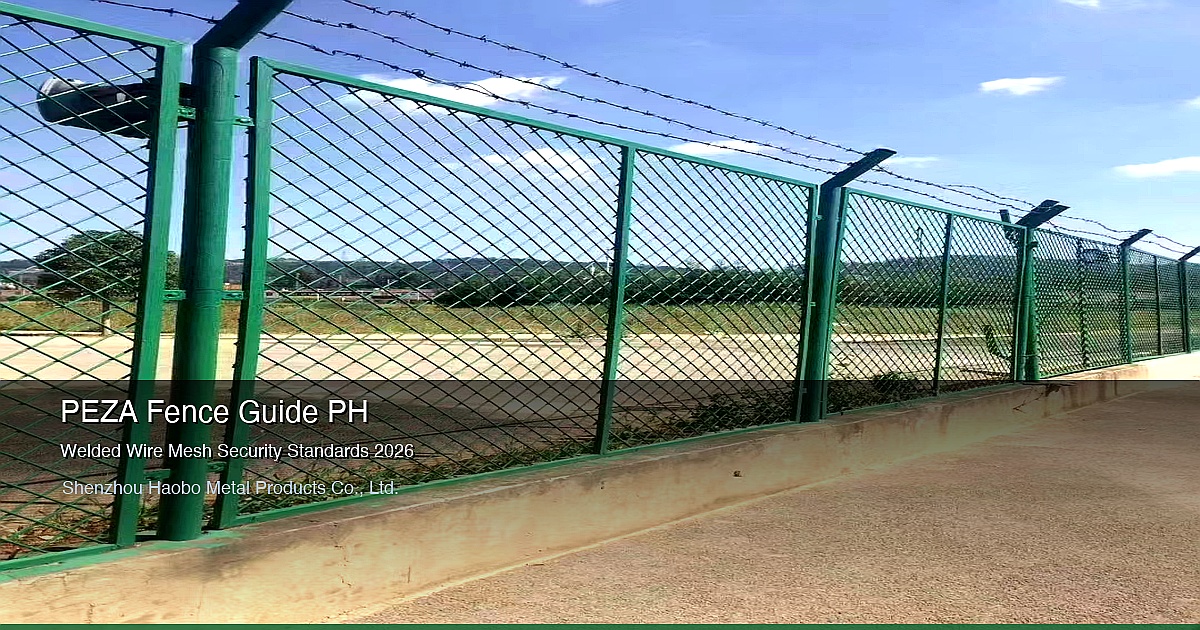
- 656 mesh (6/5/6mm wire, 50x200mm opening) provides high anti-climb and anti-cut performance while maintaining excellent visibility for natural surveillance — a key CPTED principle
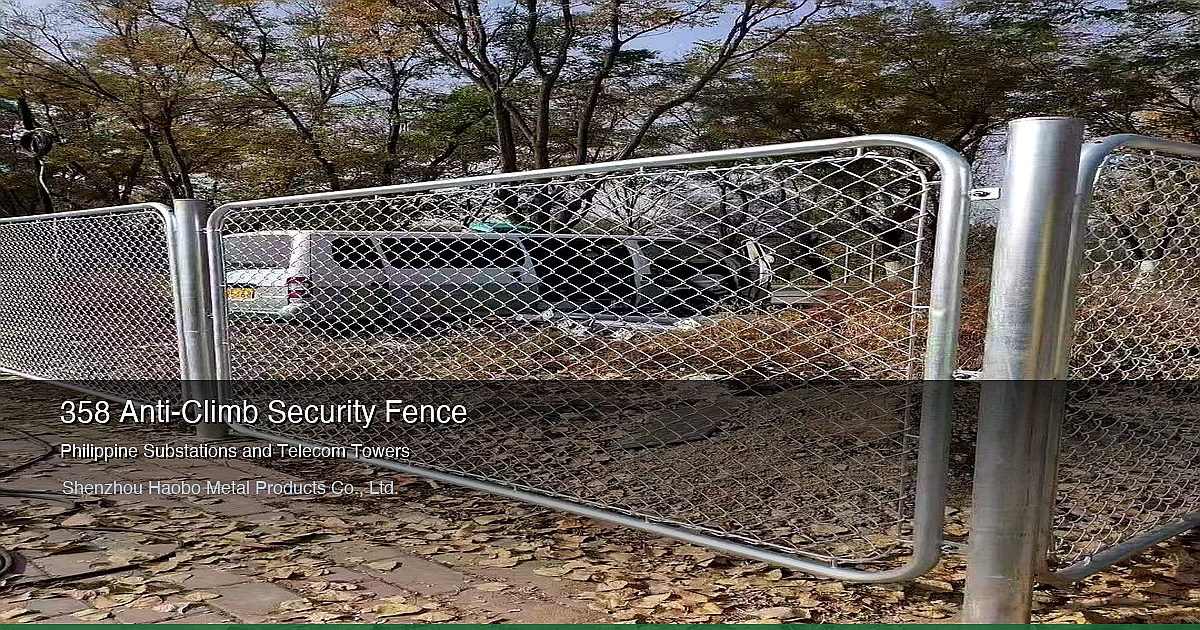
- For schools in high-risk areas, 358 mesh offers superior security (very high anti-climb/anti-cut) at PHP 3,400-4,500/m; chain link is NOT recommended for perimeter security
- Typhoon-resistant design: post spacing and section must match NSCP 2015 wind zone — 2.5m spacing with 60x40x2.5mm posts in Wind Zone II (250 kph), 2.0m with 80x60x3mm in Zone IV (350 kph)
- FOB Tianjin pricing: $28.50/panel for 656 standard (2.5x2.0m), 18-22 day delivery to Manila including production, shipping, and customs clearance
Table of Contents
- 1. Philippine Public School Security Context
- 2. 656 Double Wire Mesh Specifications
- 3. 656 vs 358 Mesh: Which is Right for Schools?
- 4. Typhoon-Resistant Installation Design
- 5. Corrosion Protection for Philippine School Environments
- 6. BOQ Template for 200-Meter School Perimeter
- 7. DepEd Procurement Process for School Fencing Projects
- 8. Ordering Fence Mesh from China for DepEd Projects
DepEd Order No. 56, s. 2016 (School-Based Management Framework) and DepEd Order No. 19, s. 2018 (School Safety and Preparedness) establish the framework for school security infrastructure. While these orders do not prescribe specific fencing specifications, they mandate that all public schools maintain "adequate perimeter security" to protect students, staff, and school property. The DepEd Educational Facilities Manual (7th Edition, 2019) provides more specific guidance: schools should have perimeter fencing with minimum 2.0-meter height, anti-climb characteristics, and durable construction suitable for the local climate.
For school divisions in typhoon-prone regions (which includes most of the Philippines), the fencing must also withstand wind loads exceeding 200 kph. This dual requirement — security and typhoon resistance — makes 656 double wire mesh fencing an ideal solution for Philippine public school perimeters.
| School Type | Min. Fence Height | Typical Perimeter | Special Requirements |
|---|---|---|---|
| Elementary (K-6) | 2.0m | 150-300m | Anti-climb, visibility from street |
| Junior High (7-10) | 2.4m | 300-500m | Anti-climb, gate security |
| Senior High (11-12) | 2.4m | 400-600m | Anti-climb, vehicle gate |
| Integrated School (K-12) | 2.4m | 500-800m | Multi-gate, zone security |
| Vocational/Tech | 2.4m | 300-500m | Equipment security, anti-cut |
2. 656 Double Wire Mesh Specifications
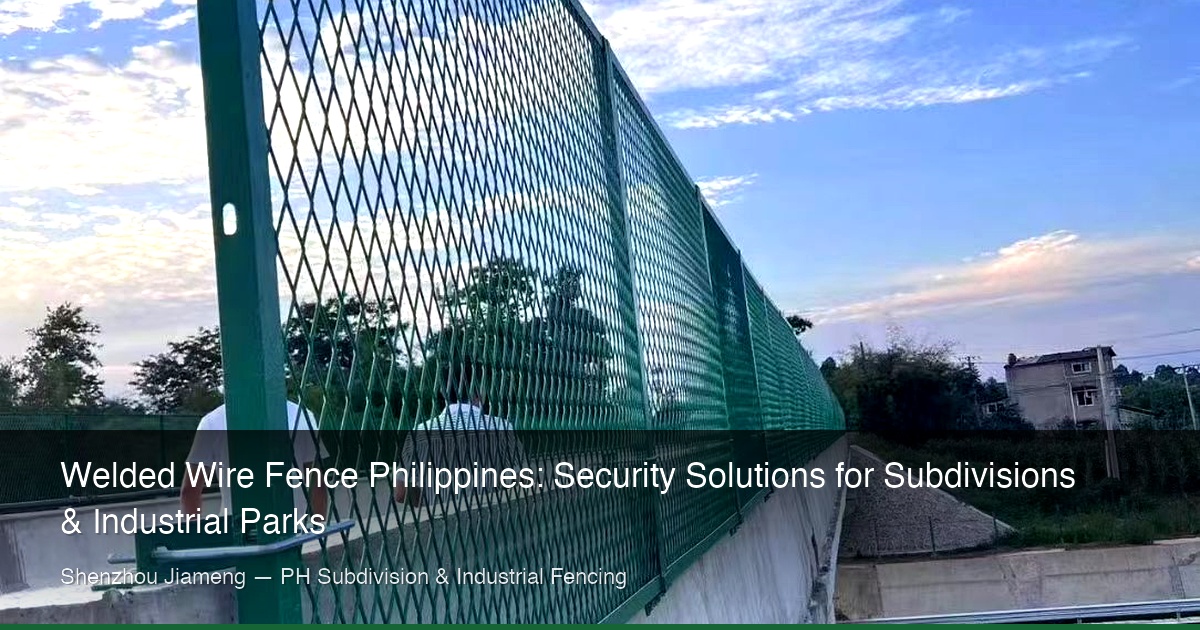
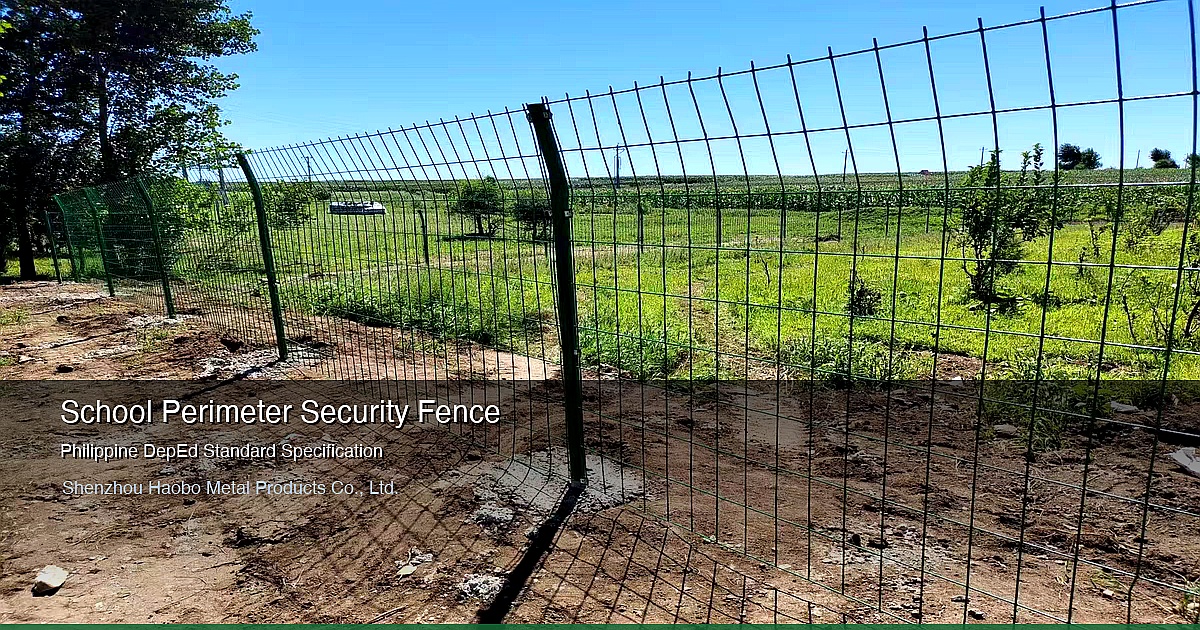
The 656 double wire mesh system is a welded wire mesh panel featuring twin horizontal wires welded at each intersection with a single vertical wire. The designation "656" refers to the mesh geometry: 6mm horizontal wires, 5mm vertical wire, 6mm horizontal wires — creating a robust panel with 50mm x 200mm mesh openings. This configuration provides excellent anti-climb performance while maintaining visibility for natural surveillance from the street.
Why 656 mesh is superior to chain link for school fencing:
- Anti-climb: The 50mm x 200mm opening is too narrow for foothold insertion, and the rigid panel cannot be deformed like chain link
- Anti-cut: Twin 6mm horizontal wires require heavy-duty bolt cutters to breach — significantly more effort than cutting chain link wire
- Rigidity: Double wire construction creates a rigid panel that cannot be peeled back or lifted at the bottom
- Visibility: 50mm x 200mm mesh allows clear visibility through the fence for natural surveillance — a key CPTED principle
- Aesthetics: Clean, uniform panel appearance enhances school campus visual appeal
- Lifespan: Hot-dip galvanized and powder-coated panels provide 25+ years service in tropical conditions
| Specification | 656 Standard | 656 Heavy Duty | 868 Heavy Duty |
|---|---|---|---|
| Horizontal wire | 6mm (2x) | 6mm (2x) | 8mm (2x) |
| Vertical wire | 5mm | 6mm | 8mm |
| Mesh opening | 50 x 200mm | 50 x 200mm | 50 x 200mm |
| Panel width | 2.5m (standard) | 2.5m (standard) | 2.5m (standard) |
| Panel height | 1.0-2.4m | 1.0-2.4m | 1.0-3.0m |
| Coating | Galvanized + powder coat | Galvanized + powder coat | Galvanized + powder coat |
| Zinc coating | min. 42 microns | min. 70 microns | min. 70 microns |
| Powder coat thickness | min. 60 microns | min. 80 microns | min. 80 microns |
3. 656 vs 358 Mesh: Which is Right for Schools?
Both 656 and 358 mesh systems are used for security fencing in the Philippines, but they serve different security levels. Understanding the differences is critical for selecting the right system for each school application.
| Factor | 656 Mesh | 358 Mesh | Chain Link |
|---|---|---|---|
| Mesh opening | 50 x 200mm | 76 x 12.7mm | 50 x 50mm |
| Wire diameter | 6/5/6mm | 4.0mm | 3.0-4.0mm |
| Anti-climb rating | High | Very High | Low |
| Anti-cut rating | High | Very High | Low |
| Visibility through fence | Excellent | Good | Good |
| Cost per panel (2.5m x 2.0m) | PHP 1,800-2,400 | PHP 2,600-3,400 | PHP 900-1,300 |
| Typical use | Schools, parks, residential | Substations, telecom, military | Low-security perimeters |
| DepEd recommendation | Yes for standard schools | Yes for high-risk areas | Not recommended |
Recommendation: For standard Philippine public schools in low to moderate risk areas, 656 mesh provides the best balance of security, visibility, and cost. For schools in high-risk areas (near conflict zones, high-crime neighborhoods, or with valuable equipment), 358 mesh is recommended for its superior anti-climb and anti-cut performance.
4. Typhoon-Resistant Installation Design
The Philippines experiences an average of 20 typhoons per year, with 8-9 making landfall. The DepEd requires that all school infrastructure, including fencing, be designed to withstand typhoon wind loads. The National Structural Code of the Philippines (NSCP) 2015 specifies wind load design for various regions of the country.
NSCP 2015 Wind Zone Classification for School Fencing:
| Wind Zone | Basic Wind Speed (kph) | Regions | Post Spacing | Post Section |
|---|---|---|---|---|
| I (Low) | 200 | Metro Manila, Central Luzon (inland) | 3.0m | 60x40x2mm |
| II (Medium) | 250 | Visayas, most of Luzon | 2.5m | 60x40x2.5mm |
| III (High) | 300 | Bicol, Eastern Visayas, Northern Mindanao | 2.5m | 80x60x2.5mm |
| IV (Very High) | 350 | Catanduanes, Samar, Leyte coastal | 2.0m | 80x60x3mm |
Critical typhoon-resistant design elements:
1. Post Foundation Design: Fence posts must be embedded in concrete foundations designed for the wind load. For 2.0m fence height in Wind Zone II (250 kph), minimum foundation dimensions are 300mm diameter x 600mm deep. In Wind Zone IV (350 kph), foundations should be 400mm diameter x 800mm deep. Use concrete with minimum 28-day compressive strength of 20 MPa (3,000 psi).
2. Post Material: Use rectangular hollow sections (RHS) rather than round posts for better wind resistance. The flat face of RHS provides a larger bearing surface for panel attachment and better resistance to wind-induced bending. All posts must be hot-dip galvanized per ASTM A123 (minimum 70 microns zinc) before powder coating.
3. Panel-to-Post Connection: Use tamper-resistant security fixings (e.g., one-way security bolts) rather than standard nuts and bolts. This prevents unauthorized panel removal and ensures connections remain secure during wind events. Minimum 4 fixings per panel per post (2 per side).
4. Wind Load Relief: In extreme wind zones (Zones III and IV), consider installing wind relief panels at 50m intervals. These are panels designed to detach at a predetermined wind load (e.g., 280 kph) to prevent progressive collapse of the entire fence line.
5. Corrosion Protection for Philippine School Environments
Philippine public schools are located in diverse environments — from coastal areas with salt spray to inland areas with acid rain from volcanic activity. The corrosion protection system for school fencing must be selected based on the local environment to achieve the expected 25-year service life.
| Environment | Corrosivity | Coating System | Expected Life | Cost Premium |
|---|---|---|---|---|
| Inland, dry (e.g., Central Luzon) | Low (C2) | Galvanized + powder coat (standard) | 25-30 years | Base price |
| Urban, moderate humidity | Medium (C3) | Galvanized (70 micron) + powder coat | 25-30 years | +5% |
| Coastal (within 1km of sea) | High (C4) | Galfan + powder coat (80 micron) | 30-35 years | +15% |
| Coastal, salt spray direct | Very High (C5) | Galfan + PVC coat (min 1.0mm) | 35-40 years | +30% |
6. BOQ Template for 200-Meter School Perimeter
The following BOQ is for a representative Philippine public school perimeter fencing project: 200 linear meters of 656 double wire mesh fencing, 2.4m height, including one 4.0m wide vehicle gate and one 1.2m wide pedestrian gate. All prices are in Philippine Pesos (PHP) and include contractor markup of 15%.
| Item | Description | Qty | Unit | Unit Price | Amount |
|---|---|---|---|---|---|
| 1 | 656 mesh panel, 2.5m x 2.4m, galv+powder coat | 76 | pcs | 2,200 | 167,200 |
| 2 | Fence post, 60x40x2mm RHS, 3.0m length, galv+powder | 78 | pcs | 850 | 66,300 |
| 3 | Post foundation, 300mm dia x 600mm deep concrete | 78 | pcs | 650 | 50,700 |
| 4 | Security fixing bolts (tamper-resistant) | 624 | pcs | 18 | 11,232 |
| 5 | Vehicle gate, 4.0m wide, 2.4m high, 656 mesh | 1 | set | 28,000 | 28,000 |
| 6 | Pedestrian gate, 1.2m wide, 2.4m high, 656 mesh | 1 | set | 12,000 | 12,000 |
| 7 | Gate posts, 100x60x3mm RHS, 3.2m length | 4 | pcs | 1,450 | 5,800 |
| 8 | Gate hardware (hinges, latches, stoppers) | 1 | lot | 8,500 | 8,500 |
| 9 | Excavation and backfill | 12 | m3 | 450 | 5,400 |
| 10 | Concrete, 20 MPa | 5.5 | m3 | 4,800 | 26,400 |
| 11 | Labor: installation | 200 | m | 350 | 70,000 |
| 12 | Subtotal | 451,532 | |||
| 13 | Contractor markup (15%) | 67,730 | |||
| 14 | GRAND TOTAL | 519,262 |
Unit cost: PHP 2,596 per linear meter (approximately USD 46/m) for 2.4m height 656 mesh school fencing with gates. Total project cost with 20% contractor markup and 10% contingency: approximately PHP 687,000 for 200 meters.
7. DepEd Procurement Process for School Fencing Projects
The DepEd procurement process follows Republic Act 9184 (Government Procurement Reform Act). School fencing projects are typically funded through the School Building Program (SBP) or the Basic Educational Facilities Fund (BEFF). The procurement follows these steps:
1. Project Identification: School head submits a project proposal to the Schools Division Office (SDO) detailing the fencing requirement, site conditions, and budget estimate. The SDO prioritizes schools based on security risk assessment and available budget allocation.
2. Technical Design and Cost Estimate: The Division Engineer prepares detailed engineering design drawings and a Program of Works and Cost Estimates (POWCE) based on DepEd standard designs for school fencing. The POWCE must follow DPWH costing guidelines for government infrastructure projects.
3. Public Bidding: For projects exceeding PHP 500,000, competitive public bidding is required. The Invitation to Bid is published in the Philippine Government Electronic Procurement System (PhilGEPS) and a newspaper of general circulation. Pre-bid conference is held 12 days before bid submission deadline.
4. Bid Evaluation and Award: The Bids and Awards Committee (BAC) evaluates bids based on technical compliance and calculated bid price. The Lowest Calculated and Responsive Bid (LCRB) is recommended for award. Contract is awarded within 15 days from bid opening.
5. Construction and Inspection: Construction period typically 60-90 days for school fencing projects. The SDO Engineer conducts site inspection at foundation stage, mid-construction, and project completion. Certificate of Completion is issued after passing final inspection.
8. Ordering Fence Mesh from China for DepEd Projects
Shenzhou Haobo Metal Products Co., Ltd. supplies 656 and 868 double wire mesh fence panels to Philippine school fencing projects through local contractors and direct government procurement agents. Our products meet DPWH materials specifications and include complete test certificates (wire tensile, zinc coating, panel dimensions).
| Product | Specification | FOB Tianjin (USD/panel) | Landed Manila (PHP/panel) |
|---|---|---|---|
| 656 Standard (2.5m x 2.0m) | 6/5/6mm, galv+powder coat | 28.50 | 1,880 |
| 656 Heavy Duty (2.5m x 2.0m) | 6/6/6mm, galv+powder coat | 34.00 | 2,240 |
| 868 Heavy Duty (2.5m x 2.0m) | 8/8/8mm, galv+powder coat | 45.00 | 2,960 |
| RHS Post (60x40x2mm, 3.0m) | Galvanized + powder coat | 12.00 | 790 |
| Shipping (per 40ft container) | Tianjin to Manila | 3,500-4,200 | — |
Ordering process: Send your school fencing project specifications (perimeter length, height, wind zone, coating preference) to our sales team. We provide a detailed quotation within 24 hours including FOB pricing, estimated shipping cost, delivery timeline, and complete technical data sheets. For DepEd bidding support, we can provide manufacturer certificates, test reports, and DPWH-compliant documentation packages.
Need School Fencing for DepEd Projects?
Send us your school perimeter dimensions, height requirements, wind zone, and coating preference. We provide 656 or 358 mesh fence specifications with complete technical documentation, test certificates, and FOB Tianjin pricing within 24 hours.
www.haobomesh.com | Shenzhou Haobo Metal Products Co., Ltd.