Rockfall Protection Net for Philippine Mountain Highways: DPWH Geo-Hazard Mitigation Design Guide 2026
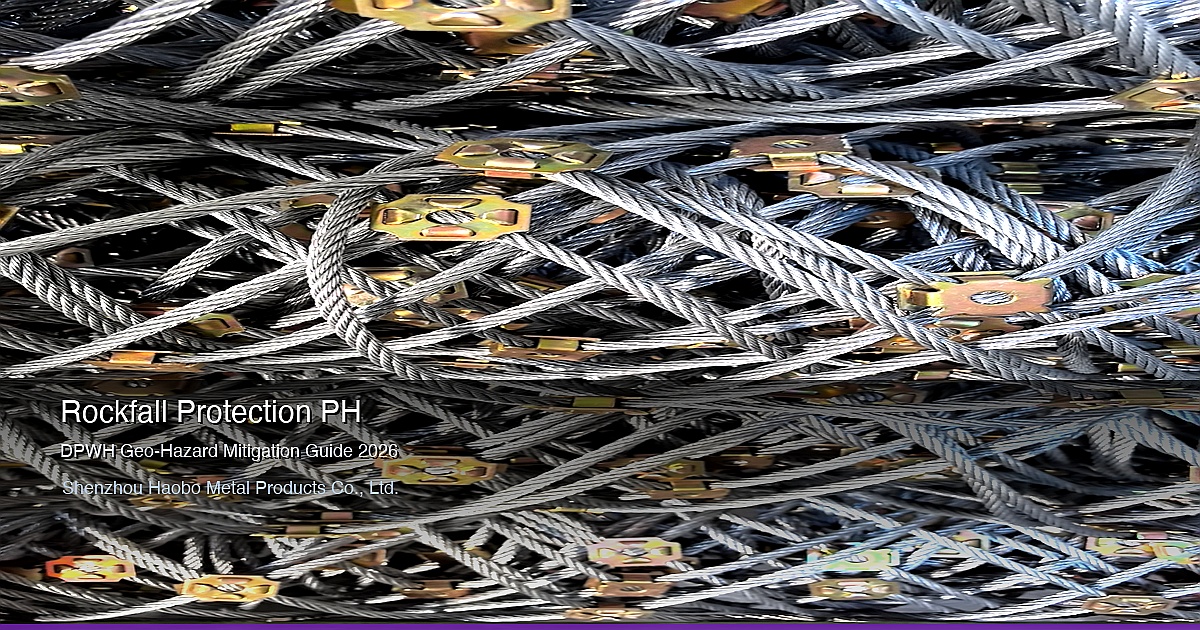
The Philippines is one of the most landslide-prone countries in the world. With its rugged topography — the Cordillera Central in Northern Luzon, the Sierra Madre range along the eastern seaboard, and the volcanic mountain systems of Mindanao — combined with annual typhoon rainfall exceeding 3,000mm in many areas, rockfall and landslide events cause an average of 200+ fatalities per year and disrupt critical highway corridors for weeks at a time.
The Department of Public Works and Highways (DPWH) has identified over 1,200 km of national highways as geo-hazard zones, where rockfall protection systems are mandatory for new construction and major rehabilitation projects. This guide covers the engineering design, system selection, and installation of rockfall protection nets for Philippine mountain highways — with specific reference to DPWH Bureau of Research guidelines, the Mines and Geosciences Bureau (MGB) slope stability assessment framework, and international standards including ETAG 027 (European Technical Approval Guideline for Rockfall Kits).
1. Philippine Geo-Hazard Landscape: Why Rockfall Protection Matters
The Philippine archipelago sits on the Pacific Ring of Fire, with active subduction zones on both the eastern (Philippine Trench) and western sides. This tectonic activity has created steep, rugged mountain ranges with highly fractured rock masses — ideal conditions for rockfall events.
Key geo-hazard corridors in the Philippines:
- Halsema Highway (Baguio to Bontoc): Often called the "most dangerous highway in the Philippines," this 150km mountain road through the Cordillera Central experiences dozens of rockfall events annually. The steep volcanic and metamorphic rock slopes, combined with heavy monsoon rainfall, create continuous rockfall hazard.
- Marlboro Highway (Cagayan to Kalinga): Fractured limestone and shale formations along this corridor produce frequent rockfall events, particularly during the wet season (June to October).
- Andaya Highway (Camarines Sur): The Sierra Madre mountain section experiences deep-seated landslides and rockfall, often blocking this critical Bicol Region corridor for days.
- Surigao-Davao Coastal Road: Volcanic rock formations with columnar jointing produce rockfall events that threaten both the highway and mining operations.
- Kennon Road (Baguio City access): This historic mountain road experiences an average of 15-20 major rockfall events per year, with some individual events exceeding 500 cubic meters of debris.
DPWH Geo-Hazard Risk Assessment Program: Since 2017, the DPWH Bureau of Research has conducted systematic geo-hazard mapping along all national highways. Each identified hazard section is classified into three risk levels:
| Risk Level | Rockfall Volume | Impact Energy | Required Protection |
|---|---|---|---|
| Low | Up to 5 m3 | Up to 100 kJ | Active mesh + anchor bolts |
| Medium | 5-50 m3 | 100-500 kJ | Active mesh + passive barrier (500 kJ) |
| High | 50-500 m3 | 500-2,000 kJ | Passive barrier (1,000-2,000 kJ) |
| Very High | Over 500 m3 | Over 2,000 kJ | Multi-row passive barriers + active mesh |
2. Active vs Passive Rockfall Protection: System Selection
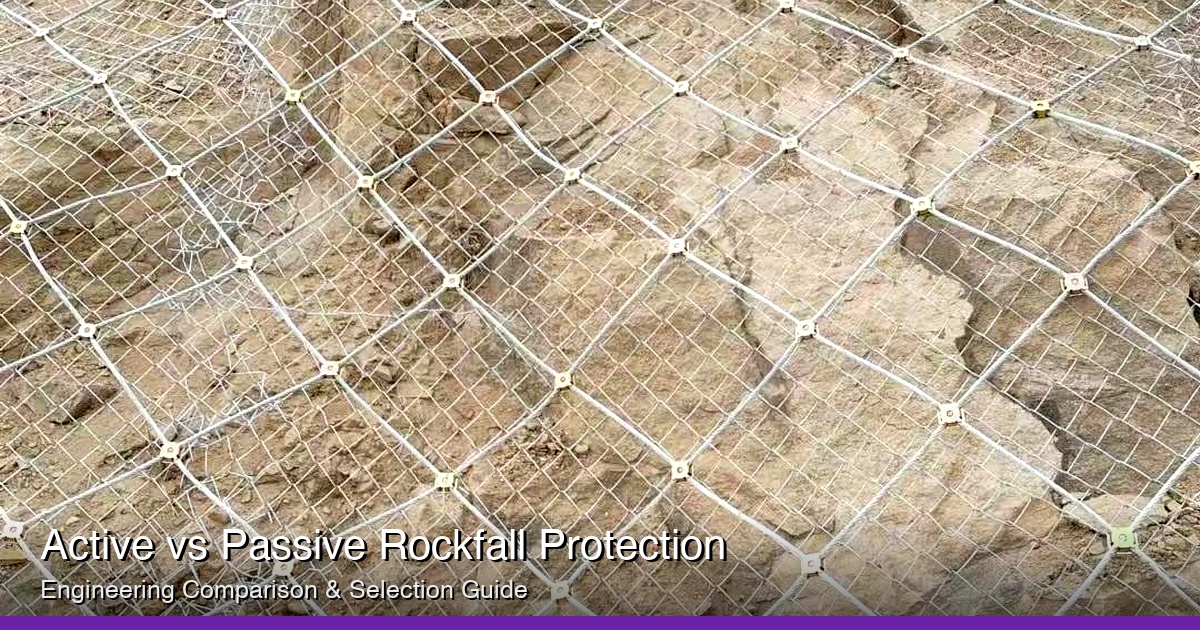
Rockfall protection systems are divided into two categories: active systems that prevent rockfall by holding the rock mass in place, and passive systems that catch falling rocks before they reach the roadway. The selection depends on slope geometry, rock mass characteristics, and the required level of protection.
Active Systems (Slope Stabilization Mesh):
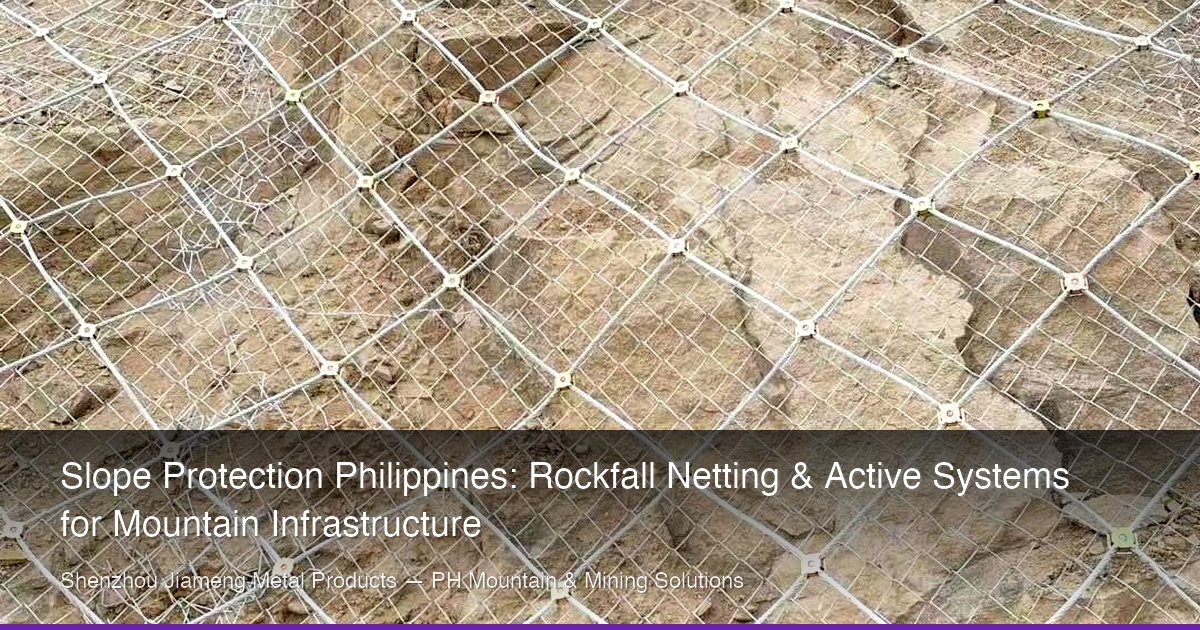
Active systems are installed directly on the slope surface to prevent rocks from detaching. They are used on slopes where the rock mass is moderately fractured but generally stable — the mesh holds loose blocks in place and prevents progressive loosening.
- TECCO G65/3 System: High-tensile steel wire mesh (3mm diameter, 65mm aperture) with IBO R32 self-drilling anchors at 2-3m spacing. Used for slopes up to 70 degrees. Design life: 50+ years with Galfan coating.
- TECCO G65/3 with Spike Plates: Same mesh with specialized spike plates that transfer load from the mesh to the anchors. Used for slopes with larger, heavier rock blocks.
- Ring Net System (RHR/RHRV): Interlocking ring nets made from high-tensile steel wire (3mm, 350mm ring diameter). More flexible than TECCO mesh, conforming to irregular slope surfaces. Used for slopes with highly irregular geometry.
- Double-Twisted Hexagonal Mesh: Lower-cost option for low-risk slopes. 2.7mm wire diameter, 80x100mm mesh opening. Suitable for slopes under 60 degrees with small rock fragment sizes.
Passive Systems (Rockfall Barriers):
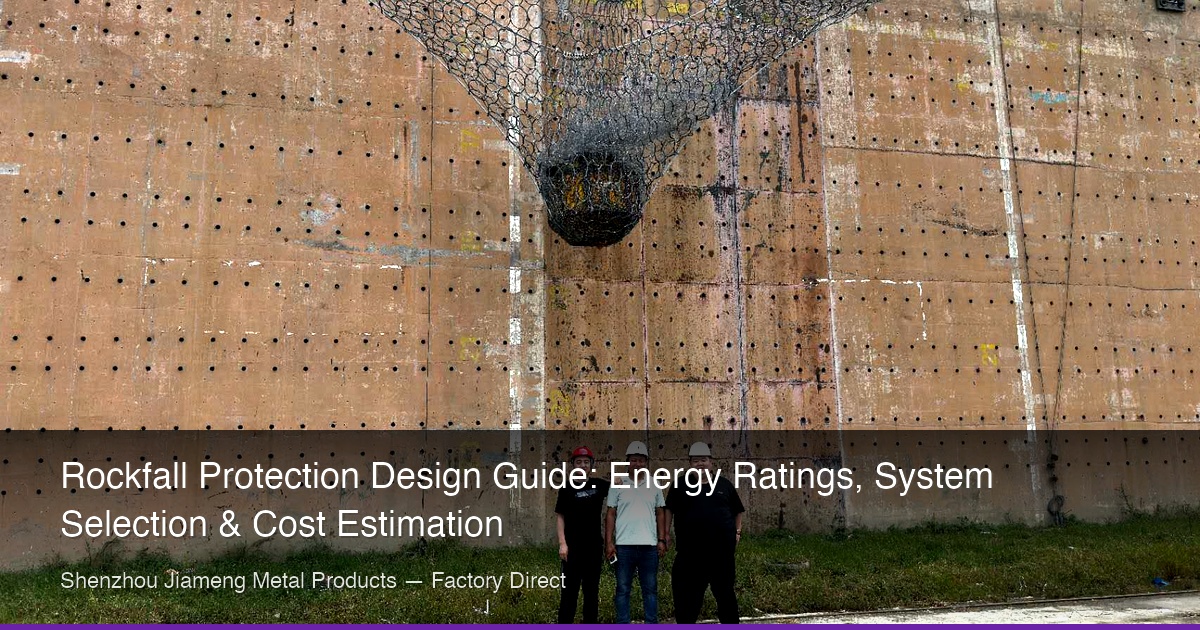
Passive systems are installed at the base of the slope or at intermediate benches to catch falling rocks. They are classified by their energy absorption capacity, ranging from 100 kJ (low-energy) to 5,000+ kJ (high-energy).
- Low-energy barriers (100-500 kJ): Consist of double-twisted hexagonal mesh or ring net panels supported by steel posts at 10-12m spacing. Used for small rockfall volumes on low-to-medium height slopes.
- Medium-energy barriers (500-1,000 kJ): Ring net panels with brake elements (friction brakes or compression brakes) that absorb impact energy by controlled deformation. Steel posts at 10m spacing with upslope anchor cables.
- High-energy barriers (1,000-3,000 kJ): Heavy-duty ring nets with multiple brake elements per panel. Steel posts at 8-10m spacing with both upslope and downslope anchor cables. Used for major highway protection in high-risk corridors.
- Attenuator systems: A hybrid approach where the mesh is not anchored at the base, allowing rocks to slide down the mesh and be guided to a collection area. Used on slopes where regular maintenance access is available.
| System Type | Energy Capacity | Max Slope Height | Typical PH Application |
|---|---|---|---|
| Active TECCO mesh | N/A (prevention) | Up to 70 degrees | Halsema Highway cut slopes |
| Passive 500 kJ barrier | 500 kJ | 30-50m | Kennon Road sections |
| Passive 1,000 kJ barrier | 1,000 kJ | 50-100m | Andaya Highway |
| Passive 2,000 kJ barrier | 2,000 kJ | 100-200m | Marlboro Highway |
| Attenuator system | 500-1,500 kJ | Unlimited | Surigao coastal road |
3. Rockfall Energy Level Calculation and Design
Designing a rockfall protection system requires calculating the kinetic energy of the design rockfall event. The design rock is selected based on a site-specific rockfall hazard assessment — typically the 95th percentile rock size observed on the slope, with a minimum design block size of 0.5 m3 (approximately 1,350 kg for typical limestone).
Energy calculation formula:
The total kinetic energy of a falling rock consists of translational and rotational components:
E_total = E_translational + E_rotational = (1/2) x m x v2 + (1/2) x I x omega2
Where:
- m = mass of the rock (kg), calculated as volume x density (typical Philippine limestone: 2,700 kg/m3; volcanic rock: 2,800 kg/m3)
- v = translational velocity at the impact point (m/s)
- I = moment of inertia (kg.m2), approximately (2/5) x m x r2 for a sphere
- omega = angular velocity (rad/s), typically 3-8 rad/s for rolling rocks
In practice, the rotational energy is typically 10-20% of the translational energy, and the simplified design formula is:
E_design = 1.15 x (1/2) x m x v2
The velocity (v) at the barrier location is determined by rockfall simulation software (such as RocFall by Rocscience, or CRSP by the Colorado Department of Transportation). For preliminary design, the following empirical velocities are used for Philippine conditions:
| Slope Angle | Slope Surface | Typical Velocity (m/s) | Energy for 1 m3 block (kJ) |
|---|---|---|---|
| 45 degrees | vegetated soil | 8-12 | 100-230 |
| 55 degrees | Bare rock | 15-20 | 350-620 |
| 65 degrees | Bare rock | 20-28 | 620-1,200 |
| 75 degrees | Smooth rock | 25-35 | 970-1,900 |
Design example: For a 1.0 m3 limestone block (2,700 kg) falling on a 55-degree bare rock slope, with a velocity of 18 m/s at the barrier location: E_design = 1.15 x 0.5 x 2,700 x 18^2 = 1.15 x 437,400 = 503 kJ. A 500 kJ barrier is the minimum acceptable; a 1,000 kJ barrier provides a safety factor of approximately 2.0.
4. Active Mesh Installation for Philippine Mountain Slopes
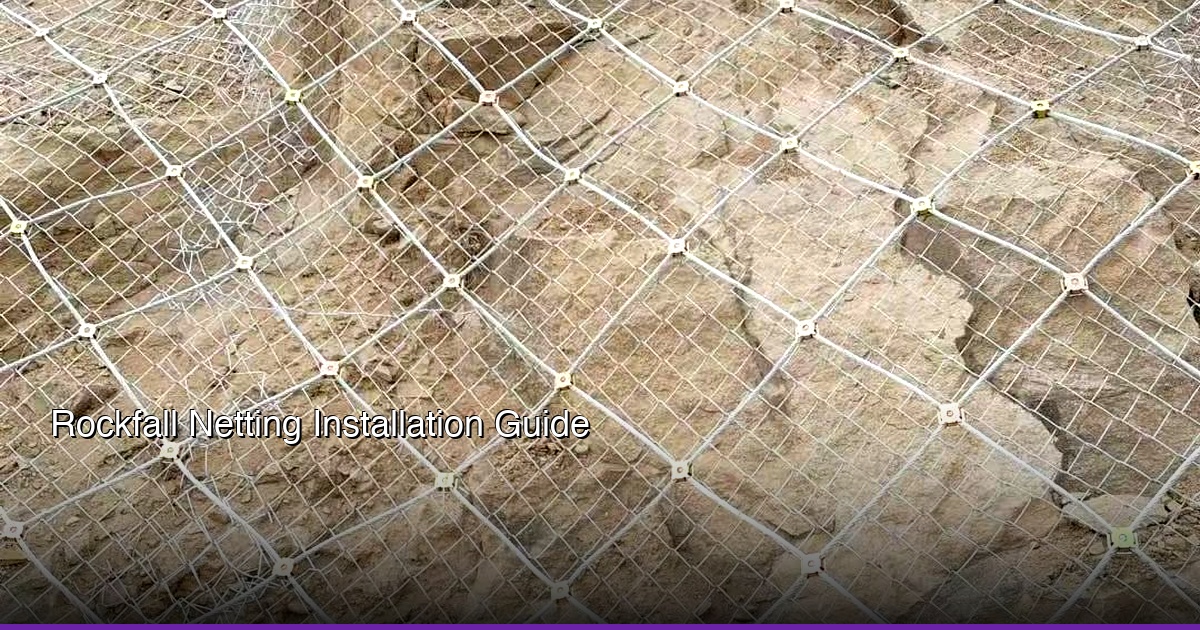
Active slope stabilization mesh is installed directly on the rock face to prevent rock detachment. The installation procedure varies by system type, but the general sequence is as follows.
Installation procedure:
- Slope preparation: Remove loose debris, vegetation, and unstable rock blocks from the slope surface. Use hand scaling (barring down) for small blocks and controlled blasting for larger unstable masses. The slope surface should be reasonably clean and regular.
- Anchor installation: Drill anchor holes using a rock drill (pneumatic or hydraulic). For TECCO systems, use IBO R32 self-drilling anchors at 2-3m spacing in a grid pattern. Drill depth: 3-5m depending on rock quality. Install anchors with cement grout (minimum 28-day compressive strength: 30 MPa).
- Mesh deployment: Unroll the mesh panels down the slope from the top. For steep slopes, use a crane or helicopter to position the mesh. Overlap adjacent panels by a minimum of one mesh opening.
- Mesh tensioning: Pull the mesh taut and secure it to the anchors using bearing plates and nuts. The mesh must be in firm contact with the rock surface — gaps exceeding 50mm between the mesh and the rock face must be addressed by adding intermediate anchors or grouting.
- Perimeter anchoring: Install a continuous perimeter anchor line (top, bottom, and sides) using 25mm diameter anchors at 1.0m spacing. This prevents water and debris from getting behind the mesh.
- Inspection: Verify that all anchors are properly tensioned, the mesh is in contact with the rock surface, and there are no tears or damage in the mesh.
Philippine-specific installation challenges:
- Access: Many Philippine mountain highway slopes are extremely steep and inaccessible by road. Equipment and materials must be transported by foot, helicopter, or specialized cable systems. Plan for a minimum 30% labor cost premium for difficult-access sites.
- Weather windows: Installation should be scheduled during the dry season (November to May in most of the Philippines). Working on steep slopes during typhoon season is extremely dangerous and often impossible.
- Rock variability: Philippine volcanic rocks (andesite, basalt) can be highly variable in strength and fracturing within a single slope. Each anchor location must be field-verified by the geotechnical engineer — do not rely solely on the design grid if rock conditions differ from the investigation data.
5. Passive Rockfall Barrier Installation
Passive rockfall barriers are installed at the base of slopes or on intermediate benches. The installation requires careful foundation preparation, post erection, and net panel deployment.
Installation procedure:
- Foundation preparation: Excavate foundation pads for each steel post. For 1,000 kJ+ barriers, concrete foundation pads (1.0m x 1.0m x 0.8m depth) are required. For lower energy barriers, direct anchor foundations may be sufficient.
- Post installation: Erect steel posts (typically I-beam or H-beam sections, 200-300mm depth) at the design spacing (8-12m). Plumb and temporarily brace each post.
- Upslope anchor installation: Install upslope anchor cables (typically 16mm or 20mm diameter galvanized steel wire rope) at each post. Anchors must be installed in competent rock — minimum embedment 3m for 500 kJ barriers, 5m for 2,000 kJ barriers. Use cement grout anchors or mechanical expansion anchors.
- Post-base connection: Connect the post base to the foundation. For energy-absorbing barriers, the base connection uses a hinge mechanism that allows the post to rotate backward during impact, extending the deceleration distance and reducing peak force.
- Net panel installation: Lift the ring net panels (pre-assembled at ground level) into position between the posts using a crane or tirfor winch. Connect the net panels to the upslope cables using energy-absorbing brake elements.
- Lateral cable installation: Install lateral support cables connecting the posts to side anchors at each end of the barrier line. These cables prevent lateral displacement during impact.
- Brake element installation: Install the appropriate number of brake elements (friction brakes or compression brakes) per panel. The number and type depend on the design energy level. Each brake element activates at a specific force threshold and absorbs energy through controlled deformation.
- Tensioning and adjustment: Tension all cables to the specified pre-tension force using a calibrated tensioner. Verify that all connections are secure and all brake elements are in their correct position.
6. Maintenance and Inspection Requirements
Rockfall protection systems require regular inspection and maintenance to ensure continued performance. In the Philippines, where typhoon season (June to November) generates the majority of rockfall events, inspections should be conducted at specific intervals.
Inspection schedule:
- Post-typhoon inspection: Within 48 hours after any typhoon or major rainfall event (over 150mm in 24 hours), inspect all barriers for impact damage, deformation, and debris accumulation.
- Quarterly inspection: Every 3 months, inspect all components including mesh, posts, anchors, cables, and brake elements. Check for corrosion, loose connections, and mesh tears.
- Annual comprehensive inspection: Once per year (ideally before typhoon season, in May), conduct a detailed engineering inspection by a qualified geotechnical engineer. This includes measuring brake element deformation, checking anchor pull-out capacity (sample testing), and assessing overall system condition.
Maintenance actions:
- Clear accumulated rock debris from behind barriers after each significant rockfall event. Do not allow debris to accumulate above 30% of the barrier height, as this reduces the effective energy absorption capacity.
- Replace deformed brake elements after any impact event. Brake elements are single-use components — once activated, they must be replaced.
- Repair mesh tears using approved repair kits (matching wire diameter, mesh type, and coating). Do not use welding or wire ties for structural repairs.
- Re-tension sagging cables and replace any cables showing signs of corrosion (loss of more than 10% of the nominal diameter).
- Re-tighten anchor nuts and replace any anchors showing signs of pull-out or corrosion.
7. MGB Mining Slope Protection Requirements
In addition to highway protection, rockfall protection systems are mandatory for mining operations in the Philippines. The Mines and Geosciences Bureau (MGB) requires all operating mines to implement slope protection measures as part of their Final Mine Rehabilitation and Decommissioning Plan (FMRDP).
Key MGB requirements:
- All pit walls exceeding 30 degrees and 15m height must have active slope stabilization mesh installed within 12 months of pit development.
- All access roads to mining facilities must have passive rockfall barriers at identified hazard sections, with minimum energy capacity of 500 kJ.
- Stockpile and waste dump slopes must have erosion control mesh (double-twisted hexagonal mesh) installed on all slopes exceeding 25 degrees.
- Annual geo-hazard inspection by MGB-accredited geotechnical engineer is mandatory for all operating mines.
- Mining companies must maintain a rockfall protection system maintenance log, updated after each inspection.
Major Philippine mining regions requiring rockfall protection: Surigao del Norte (nickel), Benguet (gold/copper), Compostela Valley (gold), Zambales (nickel/chromite), and Cebu (copper/gold). These operations typically require 15,000-40,000 m2 of active mesh per mine, replenished every 3-5 years as pits expand.
8. Cost Estimation and Procurement
Rockfall protection system costs vary significantly based on system type, energy level, slope height, and site access conditions. The following cost ranges are based on 2026 Philippine market rates for direct import from China (FOB Tianjin) plus local installation.
| System | Material Cost (PHP/m2) | Installation (PHP/m2) | Total (PHP/m2) |
|---|---|---|---|
| Active hexagonal mesh (2.7mm) | 450-650 | 200-400 | 650-1,050 |
| Active TECCO G65/3 system | 800-1,200 | 400-800 | 1,200-2,000 |
| Passive 500 kJ barrier (per linear meter) | 8,000-12,000 | 3,000-5,000 | 11,000-17,000 |
| Passive 2,000 kJ barrier (per linear meter) | 20,000-30,000 | 8,000-12,000 | 28,000-42,000 |
Procurement note: When importing rockfall protection systems from China, ensure that the manufacturer provides ETAG 027 certification (European Technical Approval) or equivalent. All system components — mesh, anchors, brake elements, cables, and posts — must be from the same manufacturer to ensure compatibility. Do not mix components from different suppliers, as this voids the system certification and may result in performance below the rated energy level.
Contact us for detailed specifications, ETAG 027 certified products, and FOB Tianjin pricing for your specific project requirements.
📋 Table of Contents
- 1. Philippine Geo-Hazard Landscape: Why Rockfall Protection Matters
- 2. Active vs Passive Rockfall Protection: System Selection
- 3. Rockfall Energy Level Calculation and Design
- 4. Active Mesh Installation for Philippine Mountain Slopes
- 5. Passive Rockfall Barrier Installation
- 6. Maintenance and Inspection Requirements
- 7. MGB Mining Slope Protection Requirements
- 8. Cost Estimation and Procurement
Get Your Rockfall Protection System Quotation
ETAG 027 certified products. Active mesh, passive barriers, and complete systems. FOB Tianjin to Manila in 15-25 days.
www.haobomesh.com | Shenzhou Haobo Metal Products Co., Ltd.