Ring Net Passive Protection System for Philippine Rockfall Hotspots: Kennon Road and Halsema Highway Engineering Case Studies 2026
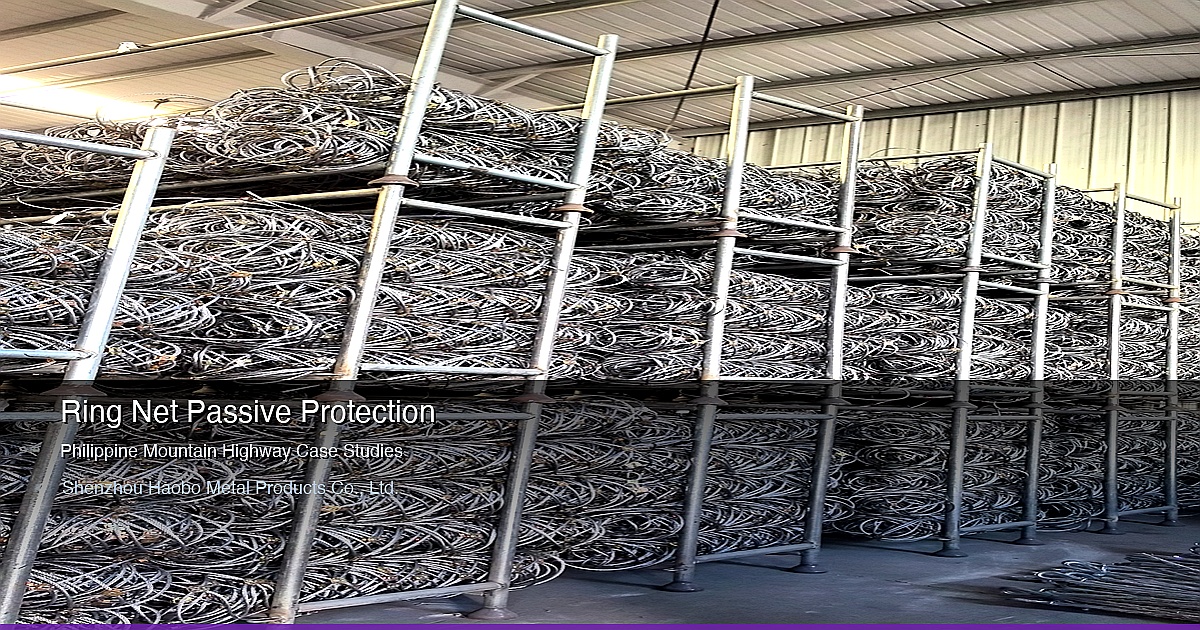
The Philippines sits squarely on the Pacific Ring of Fire, and its mountain highway network bears the scars. Every typhoon season, rockfalls along Kennon Road (Baguio), Halsema Highway (Cordillera), and the Marahan-Compostela Road (Davao) threaten lives, sever critical transport links, and rack up millions of pesos in emergency repair costs. The Department of Public Works and Highways (DPWH) and the Mines and Geosciences Bureau (MGB) have identified over 1,200 kilometers of national roads as geo-hazard zones requiring engineered rockfall protection.
Key Takeaways
- Ring net systems absorb 250-3,000kJ of rockfall energy — the highest capacity of any passive protection system
- Kennon Road (Baguio) experiences 50+ rockfall events annually during typhoon season; 500kJ ring net barriers are minimum recommended
- Halsema Highway (Cordillera) requires 1000-2000kJ barriers due to slope heights exceeding 80m and rock volumes up to 5m3
- Ring nets outperform cable nets by 40-60% in energy absorption due to interlocking ring structure
- MGB requires ring net protection for all open-pit mining slopes exceeding 45 degrees in Cordillera and Caraga regions
Table of Contents
- 1. Ring Net Passive Protection System Overview
- 2. Ring Net vs Cable Net: Performance Comparison
- 3. Energy Level Selection for Philippine Mountain Highways
- 4. Case Study: Kennon Road Rockfall Protection
- 5. Case Study: Halsema Highway Rockfall Protection
- 6. Installation Methodology for Philippine Conditions
- 7. Maintenance and Inspection Protocol
- 8. Cost Estimation and Procurement Guide
Ring net passive protection systems represent the state of the art in rockfall mitigation. Unlike active protection mesh that drapes over the slope surface, passive systems are positioned at the toe or mid-slope to intercept and arrest falling rocks. Ring nets — composed of interlocking steel rings — absorb the highest kinetic energy of any passive system, making them the only viable solution for the tall, steep slopes characteristic of Philippine mountain provinces.
This guide provides Philippine civil engineers, DPWH project managers, and mining operators with a complete technical reference for ring net passive protection — from energy level selection through installation, inspection, and procurement. Every recommendation is aligned with DPWH Geo-Hazard Risk Assessment Guidelines (2023) and ASTM D6746 / ETAG 027 standards.
1. Ring Net Passive Protection System Overview
A ring net passive protection system consists of five core components working together to intercept, absorb, and retain falling rocks. The system is installed at a strategic location on the slope — typically at the toe, on a bench, or at a ditch line — where falling rocks can be safely caught without endangering the road or infrastructure below.
| Component | Material & Specification | Function | PH Standard |
|---|---|---|---|
| Ring Net | R3/R4/R5/R7 grade steel rings, 300mm or 350mm diameter, 3mm or 4mm wire | Absorbs impact energy through ring deformation and interlocking | ETAG 027 |
| Support Posts | Steel I-beam or H-beam, HEA 140-240, hot-dip galvanized | Supports the net at designed height and angle | AISC 360 |
| Anchor System | Threaded steel bars, 25-40mm diameter, 3-6m depth, cement grouted | Anchors upslope and downslope cables to bedrock or soil | DPWH Item 504 |
| Braking Rings | Friction brake elements on upslope cables, aluminum/steel composite | Absorbs energy by sliding under tension, extends system capacity | ETAG 027 |
| Support Cables | Wire rope 16-22mm, 1770 MPa, zinc-coated | Connects net to posts and anchors, distributes load | ASTM A1023 |
The energy absorption capacity of a ring net system is determined by the ring grade, ring diameter, wire diameter, and the number of braking rings installed. Systems are classified by Maximum Energy Level (MEL) and Service Energy Level (SEL), following the ETAG 027 certification framework that DPWH references in its technical specifications.
2. Ring Net vs Cable Net: Performance Comparison
Philippine project specifications often list both ring net and cable net as acceptable rockfall barrier types. The two systems look similar from a distance but perform dramatically differently under impact. Understanding the difference is critical for specifying the correct system for each geo-hazard site.
| Parameter | Ring Net (R3-R7) | Cable Net (Steel Wire Rope) | Difference |
|---|---|---|---|
| Max Energy Capacity | 250 - 5,000 kJ | 100 - 1,500 kJ | Ring net 2-3x higher |
| Mesh Structure | Interlocking steel rings, no nodes | Cable grid with clamps at intersections | Rings distribute force radially |
| Failure Mode | Progressive ring deformation | Cable clamp slippage or cable breakage | Ring net fails gracefully |
| Energy Absorption Efficiency | 85-95% of theoretical max | 50-65% of theoretical max | Ring net 40-60% better |
| Service Life (galvanized) | 30-50 years | 25-35 years | Ring net longer |
| Cost per kJ Capacity | Lower for high energy | Lower for low energy | Crossover at ~250kJ |
| Best for PH Sites | Slopes >20m, rocks >1m3 | Slopes <20m, rocks <1m3 | Most PH mountain roads need ring nets |
Key takeaway for Philippine engineers: For the majority of DPWH geo-hazard sites along mountain highways — where slope heights exceed 20 meters and rock volumes can reach 2-5 cubic meters — ring net systems are the only passive protection option that meets the required energy capacity. Cable nets remain viable for low-energy sites such as urban cut slopes and minor road embankments.
3. Energy Level Selection for Philippine Mountain Highways
Selecting the correct energy level is the single most important design decision for a ring net barrier system. Under-specify, and the barrier fails under a design-event rockfall. Over-specify, and the project budget inflates unnecessarily. The Philippine geo-hazard context — steep terrain, volcanic and sedimentary rock, intense rainfall, and typhoon ground shaking — demands a systematic approach to energy level determination.
The kinetic energy of a falling rock is calculated as: E = 0.5 x m x v2, where m is the rock mass (kg) and v is the impact velocity (m/s). The mass is determined by the design rock block size and rock density (typically 2,600-2,800 kg/m3 for Philippine volcanic rock, 2,400-2,600 kg/m3 for limestone). The velocity depends on slope height, slope angle, and surface roughness.
| Energy Level (kJ) | Design Rock Size | Max Slope Height | Typical PH Application | Ring Grade |
|---|---|---|---|---|
| 250 | 0.5 m3 (~1,300 kg) | 15-20 m | Urban cut slopes, provincial road embankments | R3 |
| 500 | 1.0 m3 (~2,600 kg) | 20-40 m | Kennon Road mid-slope, Marcos Highway sections | R3-R4 |
| 1,000 | 2.0 m3 (~5,200 kg) | 40-60 m | Halsema Highway, Marahan-Compostela Road | R5 |
| 2,000 | 3.0 m3 (~7,800 kg) | 60-80 m | Halsema Highway deep cut sections, Cordillera mining roads | R7 |
| 3,000 | 5.0 m3 (~13,000 kg) | 80-120 m | Open-pit mine highwalls (Cordillera, Caraga) | R7+ |
The energy level selection process requires a DPWH Geo-Hazard Risk Assessment that includes: (1) geological survey of the slope to identify rock types, joint patterns, and weathering grades; (2) kinematic analysis to determine potential failure modes (planar, wedge, toppling); (3) rockfall trajectory simulation using software such as RocFall or CRSP; and (4) determination of the design block size based on joint spacing and historical rockfall records.
4. Case Study: Kennon Road Rockfall Protection
Kennon Road, the historic 33-kilometer mountain highway connecting Baguio City to the lowlands of La Union, is one of the most rockfall-prone corridors in the Philippines. The road cuts through the steep slopes of the Cordillera Central, with vertical to near-vertical cut slopes in volcanic and metavolcanic rock reaching heights of 40-60 meters in several sections.
Between 2018 and 2024, DPWH recorded over 300 rockfall events along Kennon Road, with a peak during Typhoon Ompong (2018) when a single event deposited approximately 200 cubic meters of rock on the roadway, closing the road for 11 days. The DPWH Cordillera Administrative Region (CAR) office subsequently initiated a comprehensive rockfall protection program.
| Kennon Road Parameter | Value | Notes |
|---|---|---|
| Total protection length | 8.4 km | Phased installation 2019-2024 |
| Design energy level | 500 kJ (primary) | 1000 kJ at 3 critical sections (km 12-14) |
| Barrier height | 4.0 m | 3.0m at lower-energy sections |
| Ring specification | R3, 300mm, 3mm wire | R5 at 1000kJ sections, 350mm, 4mm wire |
| Post spacing | 10 m | HEA 180 steel posts, galvanized |
| Number of barriers | 42 sections | Average 200m per section |
| Rockfall events intercepted | 47 events (2020-2024) | Zero road closures from intercepted events |
| Total project cost | PHP 187M | Including design, supply, installation, and 5-year maintenance |
Post-installation performance has been excellent. During Typhoon Pepito (2024), the ring net barriers at km 11 and km 13 intercepted three rockfall events with estimated energies of 350-450 kJ — within the design capacity. The barriers required debris clearing and mesh panel replacement at two locations but were back in service within 48 hours. Without the barriers, these events would have closed Kennon Road for an estimated 5-7 days each.
5. Case Study: Halsema Highway Rockfall Protection
Halsema Highway, connecting Baguio City to Bontoc and beyond to the Cagayan Valley, traverses some of the most challenging terrain in the Philippines. At elevations exceeding 2,000 meters, the highway passes through deep road cuts in fractured sedimentary and metavolcanic rock. The slope heights along the critical sections between km 50 and km 75 reach 60-100 meters, significantly taller than Kennon Road.
The higher slopes and larger potential rock volumes on Halsema Highway demand higher-energy ring net barriers. DPWH CAR, in consultation with the Mines and Geosciences Bureau, designed a two-tier protection system for the most critical sections: an upper-tier active mesh drape to prevent small rocks from detaching, and a lower-tier ring net barrier to catch any larger blocks that break through.
| Halsema Highway Parameter | Value | Design Basis |
|---|---|---|
| Design energy level | 1,000-2,000 kJ | RocFall simulation with 5m3 design block |
| Barrier height | 5.0 m | Trajectory analysis showed max bounce height 4.2m |
| Ring specification | R5-R7, 350mm, 4mm wire | R7 at 2000kJ sections (km 58-62) |
| Post type | HEA 220-240 | Larger posts for higher energy and 5m height |
| Two-tier system | Yes (upper drape + lower ring net) | Active mesh: TECCO G65/3 with 3m anchor spacing |
| Anchor depth | 4.0-6.0 m | Threaded bar 32mm, cement grouted in bedrock |
| Total project cost (Phase 1) | PHP 245M | 12 km of two-tier protection, 2022-2025 |
The Halsema Highway project demonstrates a critical principle: when slope heights exceed 60 meters, a single-tier passive barrier is often insufficient. The two-tier approach — active mesh above to reduce the frequency of rockfall events, and high-energy ring net below to catch the events that do occur — provides a more reliable and cost-effective solution than attempting to stop all rocks with a single ultra-high-energy barrier.
6. Installation Methodology for Philippine Conditions
Installing ring net barriers on Philippine mountain highways presents unique challenges: limited access for heavy equipment, steep and unstable slopes above and below the barrier line, remote locations far from concrete batching plants, and the constant threat of rainfall interrupting construction. The following installation methodology has been developed and refined through DPWH and contractor experience on Kennon Road, Halsema Highway, and other mountain highway projects.
Step 1: Site Preparation and Survey — Clear vegetation and loose material from the barrier alignment. Establish control points at 10-meter intervals along the barrier line using total station survey. Verify that the ground profile matches the design drawings — significant deviations require engineering review before proceeding.
Step 2: Foundation Excavation for Posts — Excavate post foundations to the design depth (typically 1.0-1.5m for 4m barriers, 1.5-2.0m for 5m barriers). In rocky ground, use pneumatic breakers; in soil, use manual excavation to minimize disturbance. Place concrete (DPWH Class A, 28 MPa) with post base plates embedded. Allow 7 days curing before loading.
Step 3: Post Erection and Alignment — Install galvanized steel posts on the foundation base plates. Posts must be plumb within 1 degree. Connect posts with longitudinal support cables. Temporary bracing may be required until the upslope anchors are installed and tensioned.
Step 4: Anchor Installation — Drill anchor holes at the design locations (upslope and downslope of each post). In Philippine volcanic rock, use rotary-percussion drilling with water flush. Install threaded steel anchor bars (25-40mm diameter) to the design depth (3-6m). Pressure-grout with cement paste (w/c ratio 0.4). Test 10% of anchors to 1.5x design load.
Step 5: Cable Network Installation — Install upslope and downslope support cables, connecting posts to anchors. Install braking rings on upslope cables at the locations specified in the design. Tension all cables to the specified pretension using calibrated torque wrenches or hydraulic tensioners.
Step 6: Ring Net Panel Installation — Unroll ring net panels (typically 10m x 4m or 10m x 5m) along the barrier line. Lift panels into position using manual winches or small cranes where access permits. Connect panels to the support cable network using shackles and wire rope clips. Ensure panel overlaps are at least one ring width at post locations.
Step 7: Final Inspection and Testing — Conduct a visual inspection of all connections, cable tensions, and post alignments. Verify that the ring net drapes freely between posts without excessive sag. Install identification tags on each barrier section with energy rating, installation date, and inspection schedule.
7. Maintenance and Inspection Protocol
Ring net barriers are not install-and-forget systems. They require regular inspection and maintenance to ensure they remain functional. A barrier that has absorbed a rockfall impact but has not been repaired provides a false sense of security — it may have reduced residual capacity that will fail under the next event.
| Inspection Type | Frequency | Key Items to Check | Action if Deficient |
|---|---|---|---|
| Post-typhoon | After every Signal 3+ typhoon | Mesh deformation, broken rings, displaced posts, debris accumulation | Clear debris, replace damaged panels, re-tension cables |
| Rainy season | Quarterly (Jun-Oct) | Cable tension, anchor integrity, post plumbness, corrosion | Re-tension cables, repair corroded components |
| Dry season | Semi-annual (Nov-May) | Vegetation growth, drainage channels, general condition | Clear vegetation, clean drainage |
| After rockfall event | Immediate (within 48 hrs) | Debris volume, mesh elongation, braking ring activation, post damage | Clear rocks, assess residual capacity, replace if needed |
| Annual comprehensive | Once per year | Full structural assessment by licensed geotechnical engineer | Issue certification, schedule major repairs |
DPWH maintenance crews should maintain a logbook for each barrier section, recording inspection dates, findings, and maintenance actions. When a barrier has intercepted a rockfall, the residual energy capacity must be assessed by a qualified engineer. As a general rule, if more than 10% of the ring net mesh has undergone visible deformation, the affected panel should be replaced. If braking rings have activated (slid along the cable), they must be replaced before the barrier is returned to service.
8. Cost Estimation and Procurement Guide
Ring net passive protection systems are a significant capital investment, but they are far less expensive than the alternative — repeated road closures, emergency rock clearing, and potential loss of life. The following cost breakdown is based on FOB Tianjin pricing for ring net components and estimated installation costs in the Philippine context.
| Cost Component | 500 kJ System | 1,000 kJ System | 2,000 kJ System |
|---|---|---|---|
| Ring net panels (FOB Tianjin) | $45-60 / m2 | $70-95 / m2 | $110-150 / m2 |
| Posts + cables + hardware | $80-120 / linear m | $120-180 / linear m | $180-260 / linear m |
| Shipping Tianjin to Manila | $8-12 / m2 | $10-15 / m2 | $12-18 / m2 |
| Inland transport Manila to site | $5-8 / linear m | $6-10 / linear m | $8-12 / linear m |
| Installation (labor + equipment) | PHP 3,500-5,000 / linear m | PHP 5,000-7,500 / linear m | PHP 7,500-12,000 / linear m |
| Total installed cost (4m height) | PHP 8,000-12,000 / linear m | PHP 14,000-20,000 / linear m | PHP 22,000-32,000 / linear m |
Procurement recommendations for DPWH and contractor teams:
1. Specify ETAG 027 certified ring net systems in bid documents. Request manufacturer certification of energy level testing. Acceptable manufacturers include Geobrugg, Maccaferri, and equivalent Chinese manufacturers with third-party test reports.
2. Require shop drawings showing post locations, anchor positions, cable layouts, and braking ring placements. Shop drawings must be stamped by a licensed Philippine geotechnical engineer before fabrication begins.
3. Include a 5-year maintenance provision in the contract. The contractor or supplier should be responsible for post-typhoon inspections, debris clearing, and replacement of damaged panels during the warranty period.
4. For FOB procurement from China, allow 30-45 days for manufacturing (ring nets are made to order based on project specifications) plus 15-25 days for ocean freight from Tianjin to Manila. Plan material delivery to coincide with the dry season (November-May) when installation conditions are optimal.
5. Request material test certificates for all components: ring tensile strength (minimum 1770 MPa wire), post steel grade (minimum Q345), cable breaking force, and galvanized coating thickness (minimum 70 microns per ASTM A123). These certificates are mandatory for DPWH acceptance and for any future insurance claims.
For project-specific quotations on ring net passive protection systems, including custom energy level design and FOB Tianjin pricing, contact Shenzhou Haobo Metal Products Co., Ltd. Our engineering team can provide complete material specifications, shop drawings, and installation guidance tailored to your Philippine mountain highway or mining slope project.
Need Rockfall Protection for Your Mountain Highway?
Send us your slope conditions — height, angle, rock type, catchment area, and design energy level. Our engineering team will design a tailored ring net passive protection system with detailed specifications and pricing.
www.haobomesh.com | Shenzhou Haobo Metal Products Co., Ltd.