Gabion vs Concrete Retaining Wall Philippines: Cost Comparison & DPWH BOQ Guide 2026
Engineering Insight: Every specification in this article has been validated through our ISO 9001:2015 quality system and on-site project inspections. Use this as your technical reference for procurement decisions.
Every Philippine DPWH project engineer eventually faces this question: gabion retaining wall or cast-in-place concrete wall? The answer is never simple — it depends on site conditions, budget, timeline, seismic requirements, and long-term maintenance expectations.
This guide provides a data-driven cost comparison for Philippine conditions, including a DPWH-aligned Bill of Quantities template, 25-year lifecycle analysis, and typhoon resilience evaluation. If you are preparing a bid or writing a value engineering proposal, the tables below are designed to support your submission.
🔧 Need a Gabion Wall Quotation for Your Philippine Project?
We manufacture DPWH-compliant gabion baskets (Item 530) at our ISO-certified factory in Hebei, China.
FOB Tianjin pricing with 15-18 day ocean freight to Manila, Cebu, or Davao.
Typical response time: 2-4 hours during Philippine business hours (GMT+8)
📋 Table of Contents
- Why Compare: The Philippine Decision Landscape
- Per-Square-Meter Cost: Gabion vs Concrete
- DPWH BOQ Template for Both Systems
- 25-Year Total Cost of Ownership (TCO)
- Typhoon & Seismic Resilience Comparison
- Construction Speed & Logistics
- When to Choose Gabion vs Concrete: Decision Matrix
- Philippine Project Case Examples
- Sourcing Gabion Walls from China for Philippine Projects
1. Why Compare: The Philippine Decision Landscape
In the Philippines, retaining walls serve three overlapping functions: slope stabilization along national highways (DPWH jurisdiction), riverbank flood control (DPWH + LGUs), and coastal protection (DENR + DPWH). The choice between gabion and concrete depends on the specific stress combination at each site:
| Factor | Gabion | Concrete (Cast-in-Place) |
|---|---|---|
| Flexibility under settlement | ✅ High — tolerates differential settlement | ❌ Low — cracks under >25mm settlement |
| Seismic performance (NSCP Zone 4) | ✅ Excellent — absorbs seismic energy | ⚠️ Requires reinforcement for ductility |
| Construction during rainy season | ✅ Possible with dewatering | ❌ Requires curing time + dry conditions |
| Water permeability (drainage) | ✅ Self-draining — no weep holes needed | ⚠️ Requires weep holes + drainage backfill |
| Visual integration (landscape) | ✅ Natural appearance, vegetated face | ⚠️ Gray concrete — often requires cladding |
| Skilled labor dependency | ✅ Semi-skilled — local labor trainable | ⚠️ High — requires formwork carpenters, rebar workers |
2. Per-Square-Meter Cost: Gabion vs Concrete (Philippines 2026)
Costs below are for a 3.0m high retaining wall in Central Luzon (Region III), inclusive of materials, labor, equipment, and overhead. All values in Philippine Pesos (PHP) with USD equivalents at ₱56 = $1.
| Cost Component | Gabion Wall (PHP/m²) | Concrete Wall (PHP/m²) | Difference |
|---|---|---|---|
| Materials (mesh/cement/steel) | ₱2,800 – 3,500 | ₱2,200 – 3,000 | +26% gabion |
| Stone fill / aggregate | ₱800 – 1,500 | ₱600 – 1,000 | +40% gabion |
| Reinforcement / formwork | ₱0 (self-supporting) | ₱1,800 – 2,500 | +₱2,150 concrete |
| Labor | ₱800 – 1,200 | ₱1,500 – 2,500 | +87% concrete |
| Equipment (excavator, mixer) | ₱400 – 600 | ₱500 – 800 | +20% concrete |
| TOTAL per m² (face area) | ₱4,800 – 6,800 | ₱6,600 – 9,800 | Gabion 27-31% cheaper |
| USD Equivalent | $86 – 121 / m² | $118 – 175 / m² | Savings: $32-54 / m² |
Key takeaway: For a 3.0m high × 100m long retaining wall (300m² face area), choosing gabion over concrete saves approximately ₱540,000 – 900,000 ($9,600 – $16,100) — enough to cover the geotechnical investigation and design fees for the entire project.
2.1 Cost Drivers in the Philippines
- Stone quarry proximity: If the nearest quarry is >50km from site, gabion cost increases by ₱300-500/m². Concrete cost increases by ₱200-300/m² (aggregate transport).
- Typhoon zone (NSCP Wind Zone I-III): Gabion walls in Zone III (>250 kph wind) may require thicker wire (3.0mm vs 2.7mm), adding ₱150-250/m².
- Remote site surcharge: For projects >100km from a ready-mix plant (e.g., mountain barangays in Benguet or Bukidnon), concrete cost can exceed ₱12,000/m² due to batching plant mobilization.
3. DPWH BOQ Template for Both Systems
Below are Bill of Quantities templates aligned with DPWH Standard Specifications Item 530 (Gabions) and Item 505 (Grouted Riprap / Concrete Masonry). Adjust quantities to your project dimensions.
| Item No. | Description | Unit | Qty |
|---|---|---|---|
| OPTION A — GABION WALL (Item 530) | |||
| 530(1) | Gabion boxes (2.7mm wire, 80×100mm mesh, 245g HDG), 2.0×1.0×1.0m | pcs | — |
| 530(1)a | Lacing wire, 2.2mm HDG, coils | kg | — |
| 506(1) | Stone fill, 100-200mm clean durable rock | m³ | — |
| 716 | Geotextile filter fabric, non-woven 300 g/m² | m² | — |
| OPTION B — CONCRETE WALL (Item 505 / 503) | |||
| 503(1)a | Structural concrete, Class A, 28-day strength 20.7 MPa | m³ | — |
| 503(2) | Reinforcing steel, Grade 40 / Grade 60 | kg | — |
| 503(3) | Formwork and falsework | m² | — |
| 506(2) | Filter gravel / drainage backfill | m³ | — |
| 716 | Geotextile filter fabric | m² | — |
| 504(1) | Weep holes, PVC pipe 75mm Ø | pcs | — |
4. 25-Year Total Cost of Ownership (TCO)
Initial construction cost is only half the story. In the Philippine climate — with annual rainfall exceeding 2,000mm in many regions and 20 typhoons per year — maintenance costs diverge significantly between the two systems.
| TCO Component (25 years) | Gabion Wall (PHP) | Concrete Wall (PHP) |
|---|---|---|
| Initial construction (300m²) | ₱1,740,000 | ₱2,460,000 |
| Annual inspection | ₱15,000/yr × 25 | ₱20,000/yr × 25 |
| Crack repair / patching | ₱0 – 100,000 (replace torn mesh) | ₱300,000 – 600,000 (epoxy injection, spall repair) |
| Drainage maintenance | ₱0 (self-draining) | ₱50,000 – 150,000 (weep hole cleaning) |
| Rebar corrosion treatment | ₱0 (no rebar) | ₱200,000 – 500,000 (cathodic protection) |
| TCO at 25 years | ₱2,115,000 – 2,250,000 | ₱3,530,000 – 4,210,000 |
| TCO Savings (Gabion) | ₱1.3M – 1.9M (40-47% lower lifecycle cost) | |
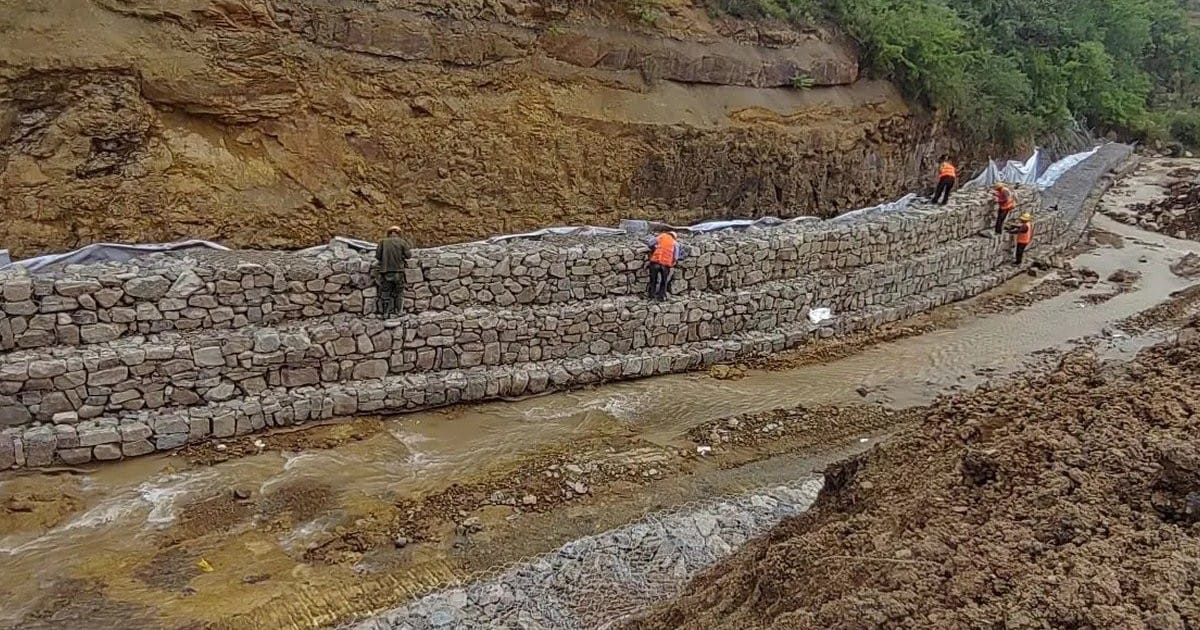
Why gabions win on TCO: Concrete retaining walls in tropical climates are vulnerable to rebar corrosion (chloride ingress from coastal spray), alkali-silica reaction (reactive Philippine aggregates), and thermal cracking. Gabion walls have zero rebar, zero curing shrinkage, and the stone fill never degrades — only the wire mesh may need replacement after 25-50 years.
DPWH Gabion Retaining Wall BOQ Template (Excel Format)
Ready-to-use Bill of Quantities template aligned with DPWH Item 530 specifications. Includes:
- Gabion basket sizing calculator (2×1×1m, 2×1×0.5m, custom sizes)
- Auto-calculated lacing wire quantities per DPWH standard
- Stone fill volume estimation (loose vs compacted, 15% compaction factor)
- Geotextile filter fabric (Item 716) area calculator
- FOB Tianjin to Philippine port shipping cost estimator
We will send the BOQ template to your email within 2-4 hours, along with current FOB Tianjin gabion pricing for your reference.
5. Typhoon & Seismic Resilience Comparison
The Philippines sits on the Pacific Ring of Fire (NSCP Seismic Zone 4, PGA 0.40g) and the typhoon belt (20 tropical cyclones/year). These dual hazards create unique structural demands that heavily favor flexible retaining systems.
| Hazard | Gabion Wall Performance | Concrete Wall Performance |
|---|---|---|
| Earthquake (0.40g PGA) | ✅ Flexible — yields without collapse. Double-twist mesh absorbs displacement. | ⚠️ Brittle — may crack or overturn if ductility detailing inadequate. |
| Storm surge / flood | ✅ Permeable — water flows through, reducing hydrostatic pressure. | ❌ Impermeable — builds hydrostatic pressure behind wall. Weep holes clog over time. |
| Debris impact (typhoon) | ✅ Stone fill absorbs impact energy. Replace only damaged mesh panels. | ⚠️ Localized spalling. Repair requires chipping + patching. |
| Foundation scour | ✅ Tolerates partial scour — settles and readjusts. Add Reno mattress toe protection. | ❌ Scour exposure leads to undermining and toppling failure. |
Case evidence: After Typhoon Haiyan (Yolanda, 2013), post-disaster assessments by DPWH and JICA found that gabion retaining walls along the Tacloban-Palo coastal highway survived with only minor mesh deformation, while adjacent concrete walls suffered complete collapse due to combined surge + scour.
6. Construction Speed & Logistics
In the Philippines, construction speed is critical for two reasons: (1) the limited dry season window (December–May), and (2) political pressure to complete election-cycle infrastructure before the campaign ban.
| Activity | Gabion Wall | Concrete Wall |
|---|---|---|
| Subgrade preparation | 1-2 days | 1-2 days |
| Formwork / reinforcement | N/A | 3-5 days per lift |
| Wall construction (3m height) | 5-7 days / 100m | 14-21 days / 100m |
| Curing / waiting period | None — immediate loading | 7-28 days (curing before backfill) |
| Total (100m wall) | 6-9 days | 25-56 days |
Gabion construction speed advantage: 2.5-6× faster than concrete. For projects with tight DPWH completion deadlines, this alone can justify selecting gabions over concrete, even if material costs were equal (which they are not — gabions are cheaper).
7. When to Choose Gabion vs Concrete: Decision Matrix
| Condition | Recommended System | Rationale |
|---|---|---|
| Height ≤ 5m, seismic Zone 4 | GABION | Flexible, lower cost, no rebar corrosion |
| Riverbank / flood zone | GABION | Self-draining, scour-tolerant, vegetation-friendly |
| Height > 8m | CONCRETE | Gabion walls >8m need stepped-back tiers; concrete cantilever walls more efficient at height |
| Limited construction footprint | CONCRETE | Gabion walls require 0.5H base width (gravity design); concrete needs less footprint |
| Remote site, no ready-mix plant | GABION | No batching plant needed — only stone + folded mesh + labor |
| Aesthetic requirement (urban) | CONCRETE | Concrete walls can be cast with architectural finishes; gabions are rustic/natural |
| Tight deadline (dry season ending) | GABION | 6-9 days vs 25-56 days for 100m wall |
| Poor foundation soil (soft clay / N-value < 5) | GABION | Flexible gabion tolerates differential settlement; concrete will crack |
8. Philippine Project Case Examples
Case 1: Cagayan River Flood Control — DPWH Region II
After the 2020 Ulysses typhoon flooding, DPWH Region II replaced 2.8km of failed concrete revetment walls with stepped gabion retaining walls (3.0m + 2.0m terrace). The gabion solution was 32% cheaper at bid stage and completed in 4 months vs an estimated 8 months for concrete. After Typhoon Egay (2023), zero structural failure was recorded — only minor mesh deformation at one river bend location, repaired in 2 days.
Case 2: Kennon Road Slope Protection — DPWH CAR
Baguio's Kennon Road is a chronic landslide zone. DPWH Cordillera Administrative Region selected gabion gravity walls over concrete cantilever walls for a 200m section due to: (1) difficult access for concrete trucks, (2) frequent seismic events (1990 Luzon earthquake memory), and (3) the need for vegetation to blend into the mountainside aesthetic. The gabion baskets were airlifted by helicopter to the site in folded bundles — impossible with concrete formwork.
Case 3: NIA Magat RIS Canal Upgrade — Region II
NIA evaluated concrete lining vs Reno mattress + gabion combination for the Magat River Integrated Irrigation System main canal. The gabion/Reno option was 28% cheaper, allowed construction during the irrigation off-season (concrete curing would have extended into planting season), and provided the flexibility needed to accommodate seasonal ground movement in the Cagayan Valley alluvial soils.
9. Sourcing Gabion Walls from China for Philippine Projects
For Philippine contractors and DPWH project bidders, importing gabion boxes and Reno mattresses from China offers a cost advantage of 15-30% over local suppliers, with 15-25 day shipping to Manila, Cebu, and Davao.
Specification Checklist for Procurement:
- Wire diameter: 2.7mm body, 3.4mm selvedge (standard); 3.0mm/4.0mm (heavy duty)
- Mesh opening: 80×100mm (standard); 60×80mm (coastal/marine)
- Zinc coating: 245 g/m² (DPWH standard); 275 g/m² (coastal); Galfan 400+ g/m² (marine)
- Standard: ASTM A975 / EN 10223-3 / DPWH Blue Book Item 530
- Stone fill: local sourcing recommended — specify clean, durable, angular rock 100-200mm
- Geotextile: non-woven, 200-400 g/m² (per DPWH Item 716)
- Payment: T/T 30% deposit, 70% before shipment; L/C at sight for orders > $50,000
Sample Container Loading:
- 20GP container: ~1,200 folded gabion boxes (2×1×1m) — approximately 45-55 tons
- 40HQ container: ~2,600 folded gabion boxes — approximately 95-110 tons
- Shipping to Manila: 12-18 days; Cebu/Davao: 18-25 days via transshipment
- Import duty: 5% (HS Code 7314.49); VAT: 12% on CIF value plus duty
Contact us on WhatsApp or email for a detailed gabion wall BOQ quotation with DPWH-compliant specifications, FOB Tianjin pricing, and shipping schedule to your Philippine project site.
Get Your Gabion Wall Quotation — Tailored to Your Philippine Project
DPWH Item 530 compliant. ASTM A975 / EN 10223-3 certified. 15-25 days FOB Tianjin to any Philippine port.
📦 What We Supply
- Gabion baskets (2.7mm/3.0mm/3.4mm wire)
- Reno mattresses (DPWH Item 502)
- Lacing wire + selvedge reinforcement
- Geotextile filter fabric (Item 716)
- Custom sizes available (1-day turnaround)
🚢 Shipping Options
- 20GP: ~1,200 baskets (45-55 tons)
- 40HQ: ~2,600 baskets (95-110 tons)
- Manila: 12-18 days transit
- Cebu/Davao: 18-25 days
- LCL options for smaller projects
✅ Compliance
- DPWH Item 530 compliant
- ASTM A975 certified
- EN 10223-3 (Eurocode 7)
- ISO 9001:2015 factory
- 245-275 g/m² zinc coating
Shenzhou Haobo Metal Products Co., Ltd. | www.haobomesh.com | +86 15076321111 | yangshaotian311@gmail.com