Welded Wire Mesh Fence for Philippine Industrial Parks: PEZA Perimeter Security Standards and Cost Guide 2026
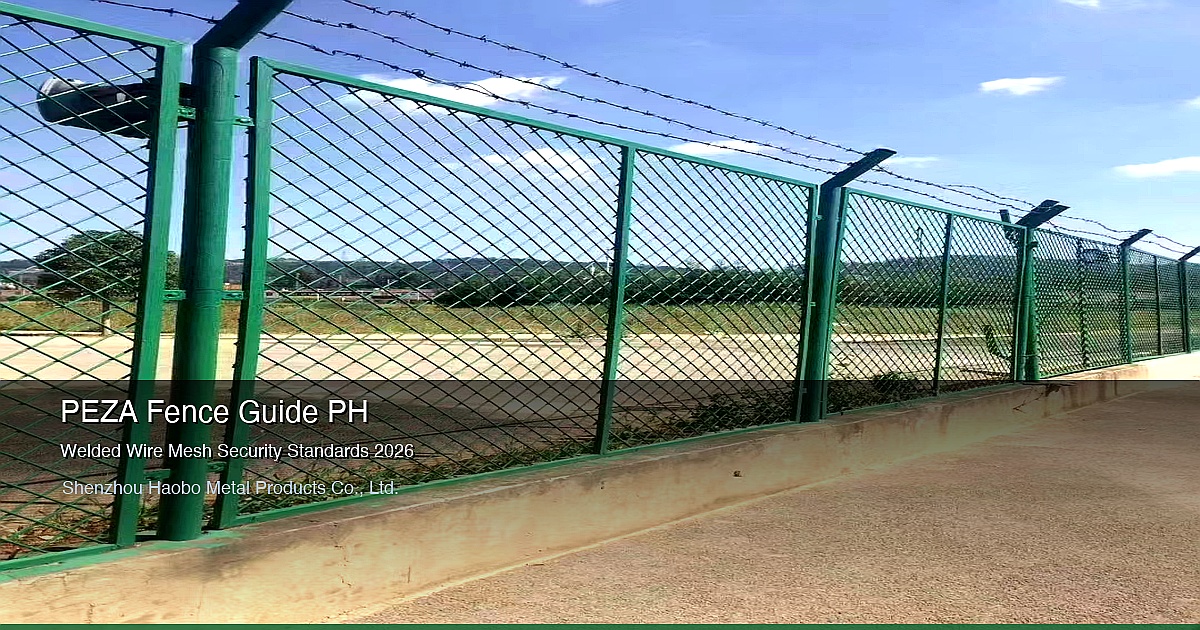
The Philippine Economic Zone Authority (PEZA) oversees over 400 economic zones across the country, from manufacturing estates in Calabarzon to IT parks in Metro Manila and agro-industrial zones in Mindanao. Every PEZA-registered economic zone requires a perimeter security fence that meets specific standards for height, material strength, anti-climb capability, and corrosion resistance. Welded wire mesh fencing has become the preferred perimeter solution for Philippine industrial parks due to its combination of security, visibility, durability, and cost-effectiveness.
This guide provides a complete specification framework for welded wire mesh fencing in PEZA industrial parks — covering PEZA perimeter security requirements, wire gauge selection for Philippine typhoon zones, hot-dip galvanizing specifications, installation costs per linear meter, and a ready-to-use Bill of Quantities (BOQ) template for both DPWH and private development projects.
1. PEZA Perimeter Security Standards and Requirements
PEZA establishes minimum perimeter security standards for all registered economic zones. These standards are enforced through the PEZA Police and the zone administrator, and non-compliance can result in sanctions including suspension of PEZA incentives.
PEZA minimum perimeter fence requirements:
- Minimum height: 2.4 meters (8 feet) above finished ground level. For zones handling high-value goods (electronics, pharmaceuticals), the minimum height is 3.0 meters.
- Material: Welded wire mesh with minimum 4.0mm wire diameter (8 SWG) for standard zones, and minimum 5.0mm (6 SWG) for high-security zones.
- Mesh opening: Maximum 75mm x 75mm (3 inch x 3 inch). Smaller openings (50mm x 50mm) are required for zones where anti-climb capability is a priority.
- Anti-climb feature: The mesh opening must be small enough that a person cannot insert fingers or toes for climbing. PEZA recommends welded wire mesh with V-profile (also called 3D fence panels) that creates a horizontal bend, making the fence more difficult to climb.
- Anti-cut feature: The wire diameter must be thick enough to resist hand-operated bolt cutters. The minimum 4.0mm wire diameter meets this requirement for standard zones.
- Corrosion protection: Hot-dip galvanized after welding (minimum zinc coating: 70 microns / 500 g/m2). For zones within 5km of the coastline, PVC-coated galvanized wire is required (in addition to galvanizing).
- Post spacing: Maximum 3.0 meters between posts. For high-security zones, reduce to 2.5 meters.
- Gate requirements: Main entrance gates must be sliding or swing gates matching the fence height and mesh specification. Guardhouse with CCTV coverage is required at all vehicle access points.
Additional PEZA security requirements:
- Clear zone of 3 meters on both sides of the perimeter fence, free of vegetation and structures.
- Adequate lighting along the entire perimeter (minimum 20 lux at fence line).
- CCTV coverage of the entire perimeter fence line, with camera spacing not exceeding 50 meters.
- Intrusion detection system for high-security zones (infrared beam detectors or vibration sensors on the fence mesh).
- Barbed wire or razor wire topping for zones designated as "high-security" by PEZA (typically 3 strands of barbed wire on angled brackets above the fence).
2. Wire Gauge Selection for Philippine Typhoon Zones
The Philippines experiences an average of 20 tropical cyclones per year, with wind speeds exceeding 200 km/h in the eastern seaboard (Bicol, Eastern Visayas, Northern Mindanao). Selecting the appropriate wire gauge and post specification is critical for ensuring the fence survives typhoon conditions without failure.
Typhoon wind zones in the Philippines (per NSCP 2015):
| Wind Zone | Basic Wind Speed (3-sec gust) | Regions | Recommended Spec |
|---|---|---|---|
| I | 200 km/h | Metro Manila, Central Luzon (west) | 4.0mm wire, 2.5mm post |
| II | 250 km/h | Calabarzon, Western Visayas | 4.5mm wire, 3.0mm post |
| III | 300 km/h | Bicol, Eastern Visayas, Cagayan | 5.0mm wire, 3.5mm post |
| IV | 350 km/h | Catanduanes, Eastern Samar | 5.0mm wire + PVC, 4.0mm post |
Post specification for typhoon resistance:
The fence posts are the most critical structural element for wind resistance. For Philippine conditions, use rectangular hollow section (RHS) steel posts rather than round pipes, as RHS posts provide better resistance to wind loading and are easier to attach the mesh panels to.
- Standard zone (Wind Zone I): 40mm x 40mm x 2.0mm RHS posts at 2.5m spacing, with 4.0mm welded wire mesh panels.
- Medium-risk zone (Wind Zone II): 50mm x 50mm x 2.5mm RHS posts at 2.5m spacing, with 4.5mm welded wire mesh panels.
- High-risk zone (Wind Zone III): 60mm x 60mm x 3.0mm RHS posts at 2.0m spacing, with 5.0mm welded wire mesh panels. Add horizontal reinforcement rails.
- Extreme-risk zone (Wind Zone IV): 60mm x 60mm x 4.0mm RHS posts at 2.0m spacing, with 5.0mm PVC-coated welded wire mesh panels. Add double horizontal reinforcement rails and concrete post foundations.
3. Hot-Dip Galvanizing Specification for Tropical Climate
The Philippine tropical climate — with high humidity, salt-laden air in coastal areas, and acid rain in industrial zones — creates an extremely corrosive environment for steel fencing. Proper galvanizing is not optional; it is essential for achieving the expected 25+ year service life of the fence.
Galvanizing standards and specifications:
| Specification | Standard | Min Zinc Coating | Application |
|---|---|---|---|
| Standard galvanized | ASTM A123 | 70 microns (500 g/m2) | Inland, non-corrosive |
| Heavy galvanized | ASTM A123 | 85 microns (610 g/m2) | Coastal (within 5km) |
| Galfan (Zn-5%Al) | ASTM A856 | 250 g/m2 | Marine, 50yr design life |
| PVC-coated galvanized | ASTM F1043 | 70 microns + 0.5mm PVC | Coastal, industrial, aesthetic |
Galvanizing after welding (critical): The mesh panels must be hot-dip galvanized after welding, not before. Pre-galvanized wire that is welded creates uncoated spots at every weld point — these are the first points of corrosion failure. Galvanizing after welding ensures complete coverage, including all weld joints. This is a PEZA requirement and a non-negotiable quality standard.
PVC coating specifications: For PEZA zones requiring PVC-coated fencing (coastal areas or aesthetic requirements), the PVC coating must meet the following standards:
- Minimum thickness: 0.4mm (preferably 0.5mm) over the galvanized wire
- UV-stabilized compound (must not degrade under Philippine tropical sun within 15 years)
- Adhesion test: No peeling or flaking after 1,000 hours of salt spray testing (ASTM B117)
- Standard colors: Green (RAL 6005), black (RAL 9005), or grey (RAL 7016)
4. Fence Installation Procedure for Industrial Parks
Proper installation is critical for fence performance, particularly in typhoon-prone Philippines. The following procedure covers the complete installation process for a typical PEZA industrial park perimeter fence.
Step 1: Survey and Layout
- Conduct a topographic survey of the perimeter line. Identify changes in grade, existing structures, utility lines, and drainage features.
- Set out fence line using survey pegs at 50m intervals. Verify the fence line is within the property boundary by at least 0.5m.
- Mark post locations at the design spacing (2.0m or 2.5m) using spray paint or wooden pegs.
Step 2: Post Foundation Excavation
- Excavate post holes using an auger. Hole diameter: 250mm for 40mm posts, 300mm for 50mm posts, 350mm for 60mm posts.
- Hole depth: minimum 0.6m for 2.4m fence height, 0.8m for 3.0m fence height. In soft soils, increase depth to 1.0m or use concrete bell footings.
- For gate posts, excavate larger foundations: 0.5m x 0.5m x 1.0m depth for sliding gate posts.
Step 3: Post Setting
- Place a 100mm layer of crushed stone at the bottom of each hole for drainage.
- Set the post in the hole, plumb and aligned. Use temporary bracing to hold the post in position.
- Pour concrete (Class A: 1:2:4 cement:sand:gravel mix) around the post. Vibrate to eliminate air pockets. Finish the concrete surface with a slight slope away from the post to prevent water accumulation.
- Allow concrete to cure for a minimum of 7 days before attaching fence panels. In rainy conditions, cover the concrete with plastic sheeting.
Step 4: Panel Installation
- After concrete curing, attach the welded wire mesh panels to the posts using panel clips or security fasteners (tamper-resistant bolts). Minimum 4 clips per panel for 2.0m post spacing, 5 clips for 2.5m spacing.
- For V-profile (3D) panels, ensure the V-bend faces outward (away from the secure area) to enhance anti-climb performance.
- Install horizontal reinforcement rails (if required by the wind zone specification) using post-mounted rail brackets. Rails are typically 40mm x 40mm RHS at mid-height and top of the fence.
- Install barbed wire or razor wire topping (if required) using angled brackets at 45 degrees on top of the posts. Use 3 strands of 12.5 gauge galvanized barbed wire at 150mm spacing.
Step 5: Gate Installation
- Install gate tracks (for sliding gates) or hinges (for swing gates) on the gate posts.
- Hang the gate panels and adjust for smooth operation. Gate panels must match the fence height and mesh specification.
- Install gate hardware: latches, locks, stops, and safety devices.
- For automated gates, install the gate motor, control panel, safety sensors, and remote control system per the manufacturer's specifications.
5. Cost Estimation and BOQ Template
The following Bill of Quantities provides indicative pricing for a 1-kilometer perimeter fence for a PEZA industrial park in the Calabarzon region (Wind Zone II). Prices are in Philippine Pesos (PHP) and reflect 2026 market rates.
| BOQ Item | Unit | Unit Cost (PHP) | Qty (per km) | Total (PHP) |
|---|---|---|---|---|
| Welded mesh panel (4.5mm, 75mm mesh, 2.4m H, HDG) | panel | 1,800-2,400 | 400 | 720,000-960,000 |
| RHS post (50x50x2.5mm, 3.0m length, HDG) | pc | 350-500 | 400 | 140,000-200,000 |
| Concrete foundation (0.3m dia x 0.8m deep) | pc | 200-300 | 400 | 80,000-120,000 |
| Panel clips and fasteners | set | 15-25 | 400 | 6,000-10,000 |
| Barbed wire (3 strands, top) | lm | 15-25 | 3,000 | 45,000-75,000 |
| Labor (installation) | lm | 150-250 | 1,000 | 150,000-250,000 |
| Equipment and tools | lm | 30-50 | 1,000 | 30,000-50,000 |
| Total per kilometer | 1,171,000-1,665,000 |
Cost per linear meter: PHP 1,170-1,665 per linear meter for a standard 2.4m height PEZA-compliant welded wire mesh fence with barbed wire topping. This includes materials, labor, and equipment but excludes gates, CCTV, lighting, and intrusion detection systems.
6. Comparison with Alternative Fencing Systems
While welded wire mesh fencing is the most common choice for PEZA industrial parks, it is worth comparing with alternative fencing systems to understand the trade-offs.
| Fence Type | Cost (PHP/lm) | Anti-Climb | Visibility | Typhoon Resistance |
|---|---|---|---|---|
| Welded wire mesh (4.5mm) | 1,170-1,665 | Good | Excellent | Excellent |
| Chain link fence (3.4mm) | 600-900 | Poor | Good | Moderate |
| Palisade fence | 1,500-2,500 | Excellent | Poor | Good |
| 358 anti-climb mesh | 2,000-3,500 | Excellent | Moderate | Excellent |
| Concrete wall | 3,500-6,000 | Excellent | None | Excellent |
Why welded wire mesh is preferred for PEZA zones: It offers the best balance of security, visibility (critical for CCTV surveillance), typhoon resistance (wind passes through the mesh rather than pushing against a solid surface), and cost-effectiveness. The open mesh design also allows natural ventilation and light penetration, reducing the need for artificial lighting along the perimeter.
7. Procurement Guide: Importing from China vs Local Supply
For Philippine PEZA developers and contractors, the decision between importing welded wire mesh fencing from China versus sourcing locally depends on project size, timeline, and quality requirements.
Cost comparison (FOB Tianjin vs local Philippine supply):
| Cost Component | China Import (PHP/m2) | Local Supply (PHP/m2) |
|---|---|---|
| Mesh panel (4.5mm, HDG after welding) | 180-260 | 350-500 |
| Ocean freight + insurance | 20-35 | 0 |
| Import duty (5% HS 7314.41) | 9-13 | 0 |
| VAT (12%) | 25-37 | 42-60 |
| Customs clearance + port charges | 5-10 | 0 |
| Inland transport (Manila port to site) | 10-20 | 10-20 |
| Landed cost (per m2) | 249-375 | 402-580 |
Savings from China import: Approximately 35-40% on material cost, even after factoring in freight, duty, and VAT. For a 1-kilometer fence (approximately 2,400 m2 of mesh), the savings amount to PHP 360,000-480,000.
Lead time comparison: China import requires 15-25 days (production 7-10 days + ocean freight 7-10 days + customs clearance 2-3 days). Local supply can deliver within 3-7 days. For projects with tight timelines, consider splitting the order: order the first 30% locally for immediate installation start, and import the remaining 70% from China.
Quality assurance: When importing from China, require the following documentation with every shipment:
- Mill test certificate for wire tensile strength and zinc coating weight
- Weld shear strength test report (minimum 50% of wire tensile strength)
- Hot-dip galvanizing certificate (ASTM A123 compliance)
- Dimensional inspection report (wire diameter, mesh opening, panel dimensions)
- Pre-shipment inspection by a third-party agency (SGS, Bureau Veritas, or TUV) for orders exceeding 5,000 m2
Contact us for a detailed FOB Tianjin quotation with PEZA-compliant specifications, complete documentation package, and third-party inspection arrangements. We support custom panel dimensions, mesh sizes, wire diameters, and coating types to meet any PEZA project specification.
📋 Table of Contents
- 1. PEZA Perimeter Security Standards and Requirements
- 2. Wire Gauge Selection for Philippine Typhoon Zones
- 3. Hot-Dip Galvanizing Specification for Tropical Climate
- 4. Fence Installation Procedure for Industrial Parks
- 5. Cost Estimation and BOQ Template
- 6. Comparison with Alternative Fencing Systems
- 7. Procurement Guide: Importing from China vs Local Supply
Get Your PEZA-Compliant Fence Quotation
FOB Tianjin to Manila in 15-25 days. Hot-dip galvanized after welding. Custom mesh sizes, wire gauges, and coatings available.
www.haobomesh.com | Shenzhou Haobo Metal Products Co., Ltd.