Active vs Passive Rockfall Protection Systems: Engineering Comparison, Standards, and Cost Analysis
Rockfall hazards threaten highways, railways, mining operations, and residential communities built near steep terrain. Every year, rockfall incidents cause billions of dollars in infrastructure damage and, more critically, put human lives at risk. Engineers have developed two fundamentally different approaches to manage this hazard: active protection systems that reinforce the slope itself and passive protection systems that intercept falling rocks before they reach vulnerable targets. Understanding the differences between these two philosophies is essential for selecting the right solution for your project.
- Active = prevention: High-tensile nets anchored into the slope hold loose rock in place — prevents rockfall before it starts
- Passive = containment: Drapery mesh covers the slope face, guiding falling rocks into catchment ditches or barriers at the toe
- Energy class drives selection: 500kJ for small rocks on low slopes; 3000kJ for large boulders on steep slopes — calculate via rockfall simulation software
- Galfan coating strongly recommended: For slope applications in mountain environments, Zn-5%Al coating resists snow, ice, and wet-dry cycling 2-3× longer
1. Understanding Active vs Passive Rockfall Protection
Rockfall protection engineering divides solutions into two categories based on where the intervention occurs in the rockfall trajectory:
- Active Protection: Systems installed on the slope face that prevent rock detachment in the first place. They work by reinforcing unstable rock masses, containing loose blocks, and controlling surface erosion. Active systems are proactive — they address the hazard at its source.
- Passive Protection: Systems installed at the toe of the slope or at intermediate benches that intercept falling rocks after they have detached. They work by absorbing kinetic energy and containing debris within a designated catchment area. Passive systems are reactive — they manage the consequences of rockfall events.
The choice between active and passive protection depends on multiple factors: slope geometry, rockfall energy levels, accessibility for installation, long-term maintenance requirements, and — critically — the acceptable level of residual risk. In many large-scale projects, engineers design hybrid solutions combining both active and passive elements for layered protection.
The following table summarizes the fundamental differences:
| Protection Philosophy | Prevent rock detachment | Intercept falling rocks |
| Installation Location | On the slope face | At slope toe or benches |
| Key Standards | ETAG 027 (System D) | ETAG 027 (System A-C) |
| Typical Energy Range | 50–500 kJ (containment) | 100–8,000 kJ (absorption) |
| Maintenance Requirement | Lower — no debris clearance | Higher — debris must be cleared |
2. Active Protection Systems: Drape Mesh and Ring Net Technology
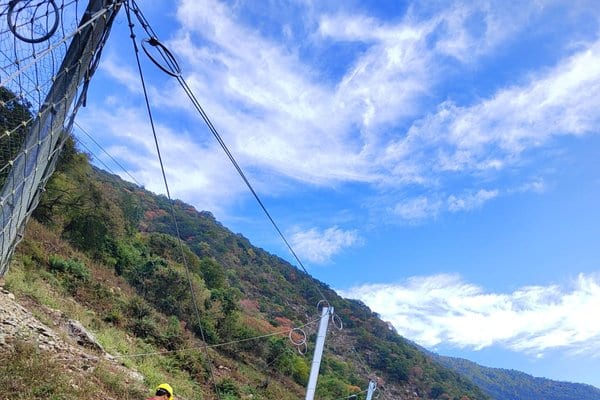
Active rockfall protection systems are anchored directly to the slope face. They apply confining pressure to unstable rock masses, preventing individual blocks from detaching. The two dominant technologies are drape mesh systems and ring net systems, each with distinct engineering principles.
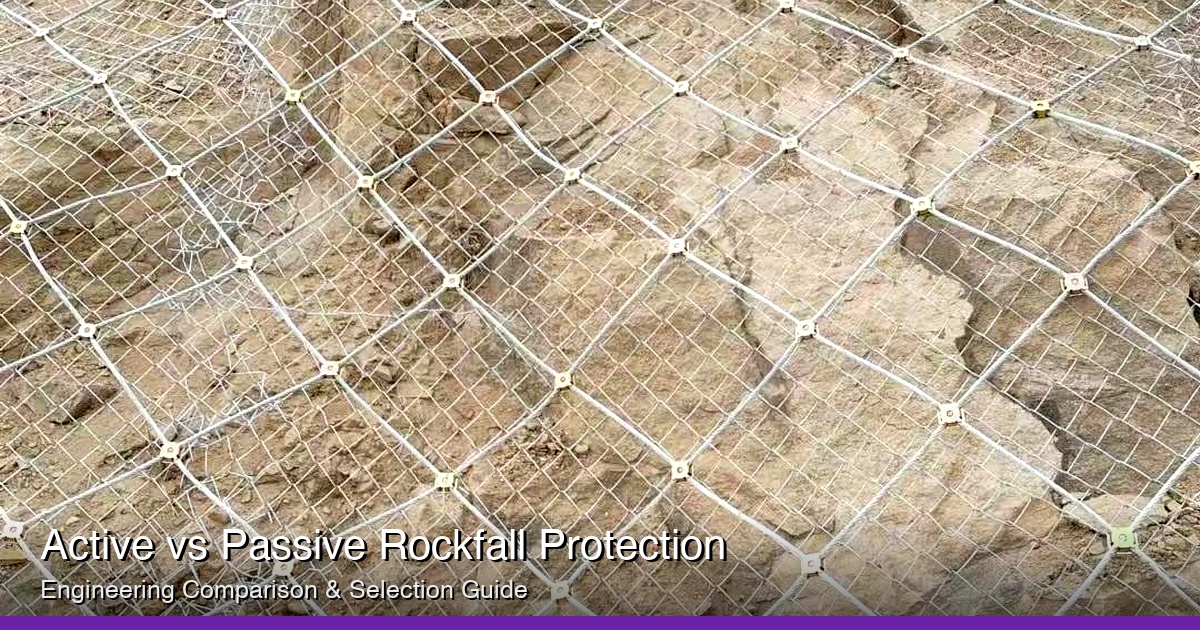
Drape Mesh Systems (Simple Drapery): A steel wire mesh is draped over the slope surface and anchored at the top with a continuous anchor beam or individual rock anchors. The mesh hangs freely over the rock face, guiding any detached fragments downward into a catchment area at the toe. The mesh acts primarily as a guide — its energy absorption comes from friction between the mesh and the rock surface rather than from the mesh's own tensile strength. Typical specifications include:
- Mesh Type: Double-twist hexagonal mesh (8×10cm opening) or high-tensile chain-link mesh
- Wire Diameter: 2.7–3.0mm for standard drape; 3.0–4.0mm for high-energy applications
- Coating: Zn-5%Al (Galfan) or Zn-10%Al for extended corrosion protection
- Anchoring: Top-anchored with post-tensioned rock bolts (φ25–32mm, embedment depth 3–5m)
- Coverage: Full slope coverage from crest to toe, with overlap panels of 20–30cm
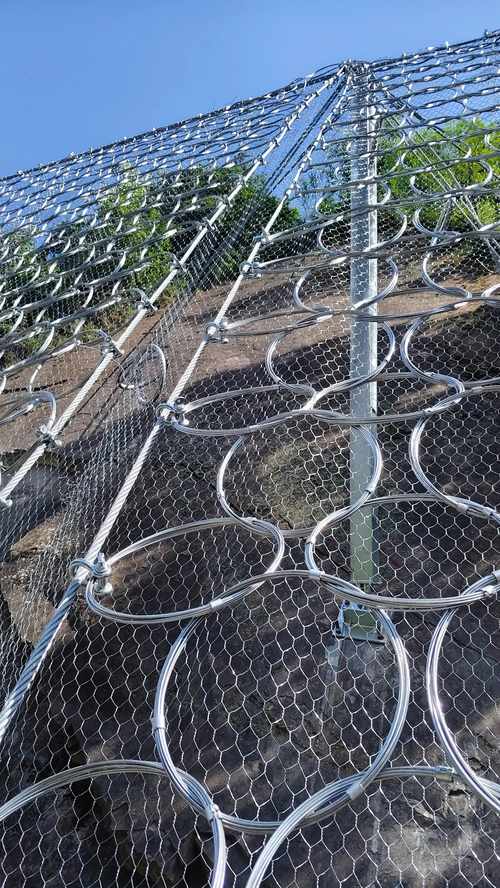
Ring Net Systems (TECCO / High-Tensile): Ring nets use interlinked high-tensile steel rings to create a flexible, high-strength net that is pre-tensioned against the slope face using spike plates and systematically spaced rock anchors. Unlike drape mesh, the ring net applies active compressive force to the rock mass, preventing small blocks from loosening while providing very high energy absorption for larger events. Key specifications include:
- Ring Diameter: 300–350mm, made from φ3.0–4.0mm high-tensile steel wire (1,770 MPa minimum)
- Mesh Tensile Strength: 150–250 kN/m (compared to 50–80 kN/m for standard drape)
- Anchoring Pattern: Systematic grid (typically 3m×3m to 4m×4m) with spike plates
- Pretension: 30–50 kN per anchor to create uniform surface pressure
- Best Applications: Blocky rock formations, highly fractured slopes, areas with active spalling
3. Passive Protection Systems: Catch Fences and Rockfall Barriers
Passive rockfall protection systems are engineered barriers positioned downhill from the hazard zone. Their function is to intercept falling rocks, absorb the kinetic energy through controlled deformation, and retain the debris behind the barrier. These systems are categorized by their energy absorption capacity under ETAG 027 (European Technical Approval Guideline).
Energy Absorption Classification (ETAG 027):
| 100–250 kJ | 2.0–3.0 | 8–10 | Low-height slopes, small block sizes, roadside ditches |
| 500–1,000 kJ | 3.0–4.0 | 8–10 | Standard highway protection, medium-energy rockfall |
| 1,500–3,000 kJ | 4.0–5.0 | 8–10 | High-energy slopes, mining benches, large boulder hazards |
| 5,000–8,500 kJ | 5.0–7.0 | 10 | Extreme energy events, critical infrastructure, avalanche combine |
Barrier Component Breakdown:
- Interception Structure (Primary Net): The energy-absorbing mesh panel, typically made from high-tensile steel rings (φ350mm, 3×3 rings per post bay) or spiral rope mesh. This is the primary energy-dissipating element.
- Energy Dissipation Devices (Brake Rings): Steel rings that deform plastically under load, absorbing kinetic energy through material yielding. Each brake ring absorbs 50–100 kJ, and barriers typically have 4–8 brake rings in the upslope cables.
4. Energy Absorption Capacity Comparison
Energy absorption is the single most important performance metric for any rockfall protection system. It is measured in kilojoules (kJ) — the maximum kinetic energy the system can absorb without exceeding its serviceability limit. For context, a 500 kg boulder falling from 10 meters has a kinetic energy of approximately 50 kJ. A 2,000 kg boulder falling from 50 meters carries about 1,000 kJ.
Active System Energy Performance:
| Simple Drape Mesh | 50–200 kJ | High — mesh can stretch 30–50% | Mesh tearing at edges, anchor pullout |
| Reinforced Drape (with ropes) | 200–500 kJ | Moderate — rope reinforcement limits stretch | Rope rupture, mesh overload |
| Ring Net (TECCO-style) | 500–1,000 kJ | Low — pretension prevents sagging | Ring failure, spike plate pull-through |
Passive System Energy Performance:
| MEL 100 | 100 kJ | 33 kJ | ≥50% H | 250 kg at 40m fall |
| MEL 500 | 500 kJ | ≥50% H | 1,000 kg at 50m fall | |
| MEL 1000 | 1,000 kJ | 333 kJ | ≥50% H | 1,500 kg at 70m fall |
| MEL 3000 | 3,000 kJ | 1,000 kJ | ≥50% H | 3,000 kg at 100m fall |
| MEL 5000 | 5,000 kJ | ≥50% H | 5,000 kg at 100m fall |
Note the distinction between MEL (Maximum Energy Level) and SEL (Service Energy Level). MEL represents the system's ultimate capacity — one-time impact absorption after which major repairs are required. SEL represents the energy level at which the system can be hit repeatedly without functional degradation. The SEL is typically one-third of the MEL.
5. Installation Cost and Terrain Suitability
Cost is often the deciding factor in system selection, but it must be evaluated in the context of total lifecycle cost, not just initial installation expense. The following analysis covers both direct installation costs and long-term operational considerations.
Direct Installation Cost Comparison (per square meter of protected slope):
| Simple Drape Mesh (2.7mm) | 8–12 | 15–25 | 23–37 |
| Reinforced Drape (with ropes) | 12–18 | 20–30 | 32–48 |
| Ring Net (TECCO-style, pretensioned) | 25–40 | 30–50 | 55–90 |
| Passive Barrier MEL 500 | 80–120 | 140–220 | |
| Passive Barrier MEL 1000 | 120–180 | 80–120 | 200–300 |
Terrain Suitability Factors:
- Slope Angle: Active drape mesh can be installed on slopes from 30° to near-vertical. Passive barriers require sufficient horizontal space at the base — typically a minimum of 3–5 meters between the barrier line and any infrastructure being protected.
- Access: Active systems require rope-access technicians (IRATA/SPRAT certified) for installation on steep terrain. Passive barriers can often be installed with conventional construction equipment if access roads exist at the slope toe.
- Rock Quality: Active ring net systems need competent rock for anchor embedment (RQD > 50%). Highly fractured or weathered rock may not hold the required anchor loads, necessitating alternative solutions.
- Vegetation: Heavily vegetated slopes complicate active system installation — trees and shrubs must be cleared before mesh placement, adding significant cost. Passive barriers are less affected by overlying vegetation.
The decision between active and passive rockfall protection should be driven by a systematic risk assessment, not cost alone. Follow this decision framework:
Step 1 — Hazard Characterization:
- Perform a rockfall trajectory analysis using software such as RocFall (Rocscience) or CRSP (Colorado Rockfall Simulation Program)
- Calculate the kinetic energy distribution at the impact zone
- Determine bounce heights, velocities, and runout distances
- Classify the rockfall hazard according to the project's risk matrix
Step 2 — System Screening:
- If the primary hazard is small, frequent rockfall from a fractured face → active ring net is likely the best solution
- If the hazard includes large, high-energy boulders with unpredictable trajectories → passive barrier is necessary
- If the slope is too unstable for anchor installation → passive is the only option
- If the slope toe has limited space (< 3m) → active or hybrid solution required
Step 3 — Lifecycle Cost Analysis:
- Active systems: higher initial investment, lower maintenance, longer service life (30–50 years with Galfan coating)
- Passive systems: moderate initial investment, periodic debris clearance required after events, potential barrier replacement after MEL-level impacts
- Include access costs: rope-access work for active systems is significantly more expensive than ground-based installation for passive barriers
Step 4 — Hybrid Solutions: In practice, many large-scale projects combine both approaches. A typical highway protection scheme might use active drape mesh on the upper slope to control small rockfalls, combined with a MEL 500–1000 passive barrier at the toe to catch any material that bypasses the drape. This layered approach provides defense-in-depth and is often the most cost-effective long-term strategy.