Galvanized Wire Mesh Fence for Philippine Agricultural and Livestock Applications: Chain Link vs Welded Panel Selection, NSCP Wind Design, and Installation Guide 2026

## Wire Mesh Fencing for Philippine Agricultural and Livestock Applications
The Philippines' agricultural sector accounts for approximately 9% of GDP and employs 24% of the national workforce. With over 5.4 million farms nationwide and a growing livestock industry (cattle inventory: 2.56 million head; swine: 12.7 million; goat: 3.8 million; poultry: 175 million birds as of DA-BAS 2025), proper fencing infrastructure is critical for:
- **Property delineation** and crop protection from trespassing and wildlife intrusion
- **Livestock containment** — preventing animals from straying onto roads, neighboring farms, or protected areas
- **Predator exclusion** — protecting poultry, goats, and calves from feral dogs, pythons, and monitor lizards
- **Biosecurity** — controlling movement at farm perimeters per DA Administrative Order No. 5 (Animal Disease Control)
Galvanized wire mesh fencing is the dominant fencing type for Philippine farms due to its cost-effectiveness, durability in tropical conditions, and versatility across agricultural applications. This guide provides Philippine farmers, ranchers, DA (Department of Agriculture) project officers, and agricultural contractors with a comprehensive selection, specification, and installation framework compliant with the National Structural Code of the Philippines (NSCP 2015), DA-BAI (Bureau of Animal Industry) guidelines, and Philippine Agricultural Engineering Standards (PAES).
### Philippine Agricultural Fencing Context
| Farm Type | Typical Size (ha) | Fencing Need | Common Hazards |
|---|---|---|---|
| Rice farm (lowland) | 1-3 | Boundary + crop protection | Rats, waterbirds, carabao trespass |
| Corn farm | 2-5 | Boundary + livestock exclusion | Wild pigs, cattle, carabao |
Coconut plantation | 5-50 | Boundary | Cattle, goats, trespass |
| Cattle ranch (Mindanao) | 20-200 | Livestock containment | Escape, predator (feral dogs) |
| Goat farm | 1-10 | Predator exclusion + containment | Feral dogs, pythons, theft |
| Poultry (broiler layer) | 0.5-5 | Biosecurity perimeter | Wild birds, feral animals, disease vectors |
| Swine farm (commercial) | 2-20 | Biosecurity + containment | ASF (African Swine Fever) vectors, feral pigs |
| Highland vegetable farm | 1-5 | Wildlife exclusion | Wild pigs, monkeys, deer |
## Wire Mesh Fence Types for Agricultural Applications
### Type 1: Chain Link Fence
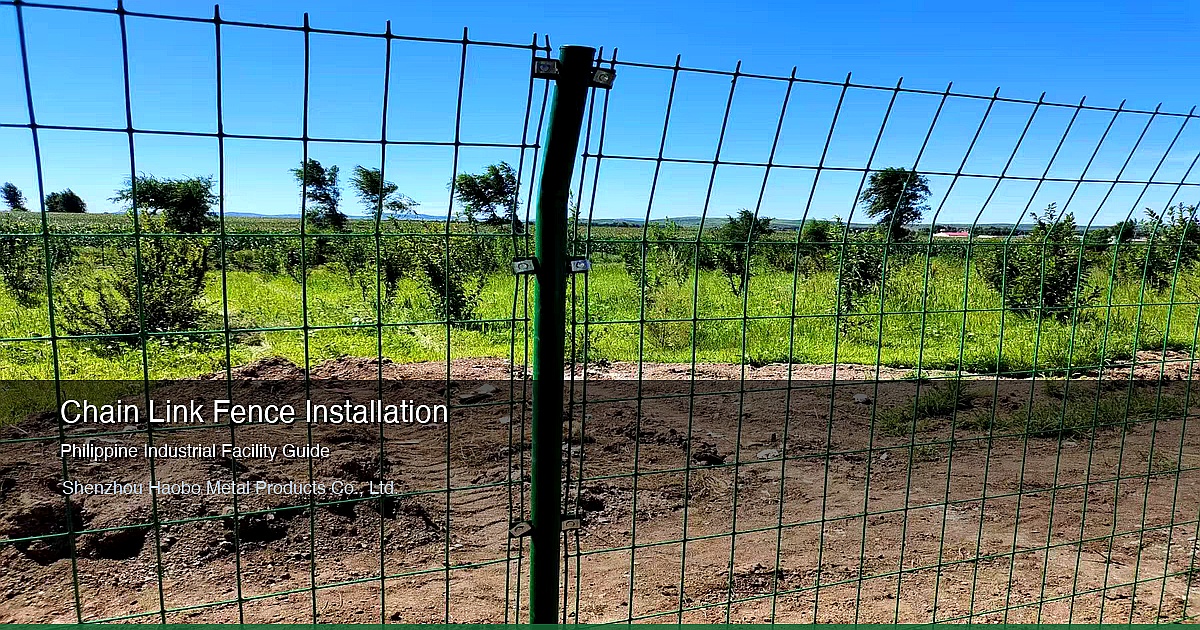
The most common agricultural fence in the Philippines, chain link fabric consists of interlocking helical wires forming a diamond mesh pattern. Manufactured from 1.6mm-3.0mm galvanized steel wire with mesh openings of 25mm, 50mm, or 60mm.
**Specifications for agricultural use:**
| Application | Wire Diameter | Mesh Size | Height | Post Spacing | Galvanizing |
|---|---|---|---|---|---|
| Poultry perimeter | 2.0mm | 25mm (1") | 1.8m | 2.0m | HDG ≥ 275 g/m² |
| Goat/sheep | 2.2mm | 50mm (2") | 1.2m | 2.0m | HDG ≥ 275 g/m² |
| Cattle boundary | 2.7mm | 50mm (2") | 1.5m | 2.5m | HDG ≥ 245 g/m² |
| Swine biosecurity | 2.2mm | 25mm (1") | 1.8m | 2.0m | HDG ≥ 275 g/m² |
**Cost**: PHP 280-450 per linear meter (including posts and installation)
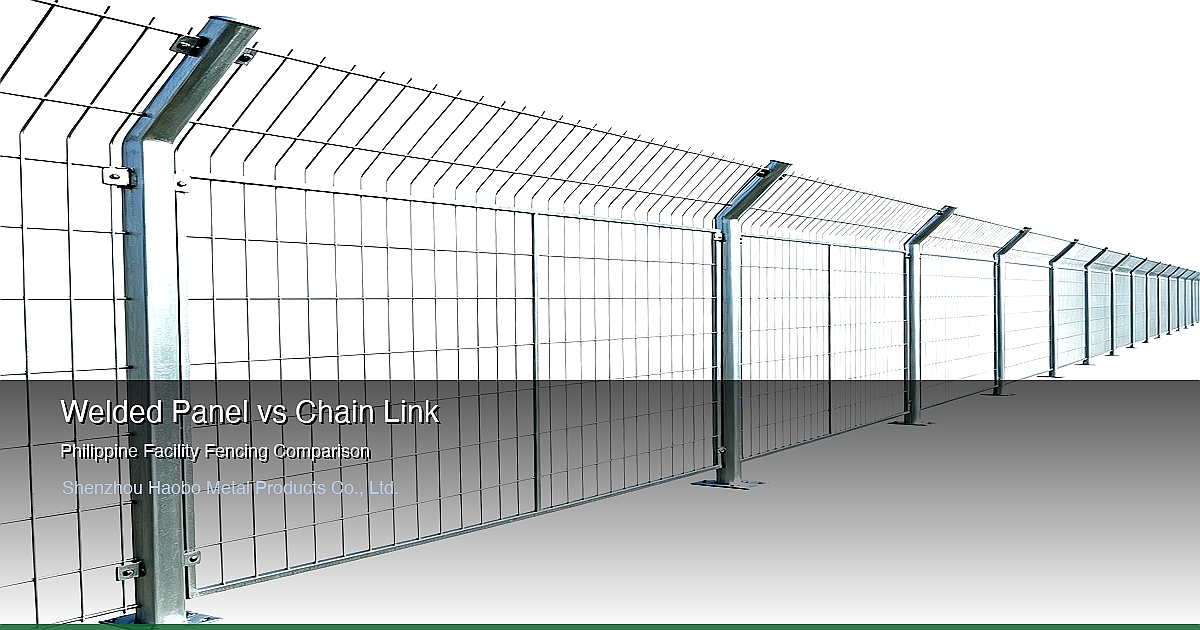
### Type 2: Welded Wire Mesh Panel Fence
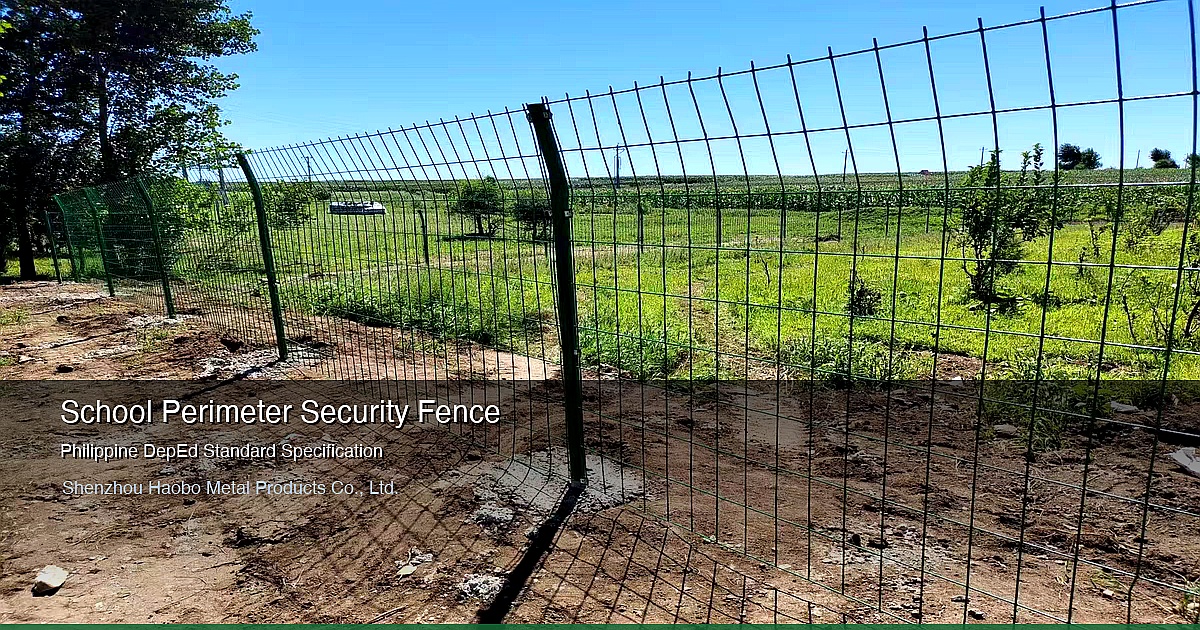
Increasingly popular for commercial farms, this system uses rigid welded mesh panels (typically 2.5m × 2.0m) framed with horizontal rails. Panel wire diameters range from 3.0mm to 5.0mm with mesh openings of 50×50mm, 50×100mm, or 50×200mm.
**Specifications for agricultural use:**
| Application | Wire Diameter | Mesh Opening | Panel Size | Post Type | Coating |
|---|---|---|---|---|---|
| Cattle/horse ranch | 4.0mm | 50×100mm or 50×200mm | 2.5m × 1.8m | Φ60×2.0mm tube | Galfan + powder coat |
| Swine perimeter | 3.5mm | 50×50mm | 2.5m × 1.8m | Φ60×2.0mm tube | HDG ≥ 275 g/m² |
| Vegetable garden | 2.5mm | 25×25mm | 2.0m × 1.0m | Φ48×1.5mm tube | HDG ≥ 245 g/m² |
| Poultry biosecurity | 3.0mm | 25×25mm | 2.5m × 1.8m | Φ60×2.0mm tube | HDG ≥ 275 g/m² |
**Cost**: PHP 450-800 per linear meter (including posts and installation)
### Type 3: Field Fence (Hinge-Joint / Fixed Knot)
Common for cattle ranches in Mindanao, this system uses vertical and horizontal wires joined by hinge-joint knots, allowing the fence to flex without wire breakage. Wire diameters range from 1.6mm to 2.5mm, with graduated mesh spacing (small at bottom, large at top).
**Typical specifications for cattle:**
- Height: 1.2m (47")
- Vertical wire spacing: 150mm (6")
- Horizontal spacing: graduated (50mm at bottom → 200mm at top)
- Wire: 2.0mm high-tensile (minimum 900 MPa), galvanized ≥ 275 g/m²
- Post spacing: 5.0m (steel T-posts or wooden posts)
**Cost**: PHP 200-350 per linear meter (including posts)
### Type 4: Electric Fence
Supplementary system used in combination with physical fences for cattle containment. Not a standalone fence but an addition to any of the above.
- Energizer output: 0.5-3.0 Joules
- Wire: 2.5mm galvanized high-tensile wire
- Post spacing: 10-15m (insulated)
- Voltage: 3,000-8,000V pulse
**Cost**: PHP 150-250 per linear meter (excluding energizer, PHP 3,500-8,000)
## Galvanizing Types and Philippine Tropical Performance
### Coating Comparison
The Philippines has an ISO 9223 atmospheric corrosivity classification of C3 (urban/industrial) to C4 (coastal), with rural inland areas at C2-C3 and all coastal/estuarine areas at C5-M (marine, very high). Fencing material coating selection must match the site corrosivity.
| Coating Type | Coating Weight | Service Life (C3, rural) | Service Life (C5-M, coastal) | Cost Premium |
|---|---|---|---|---|
| Pre-galvanized (electroplated) | 20-60 g/m² | 3-5 years | 1-2 years | Baseline |
| Hot-dip galvanized (HDG) Class 1 | 70-150 g/m² | 8-12 years | 3-5 years | +15-20% |
| Hot-dip galvanized (HDG) Class 3 | ≥ 245 g/m² | 20-25 years | 8-12 years | +25-30% |
| Galfan (Zn-5%Al) | ≥ 275 g/m² | 30-40 years | 15-20 years | +35-40% |
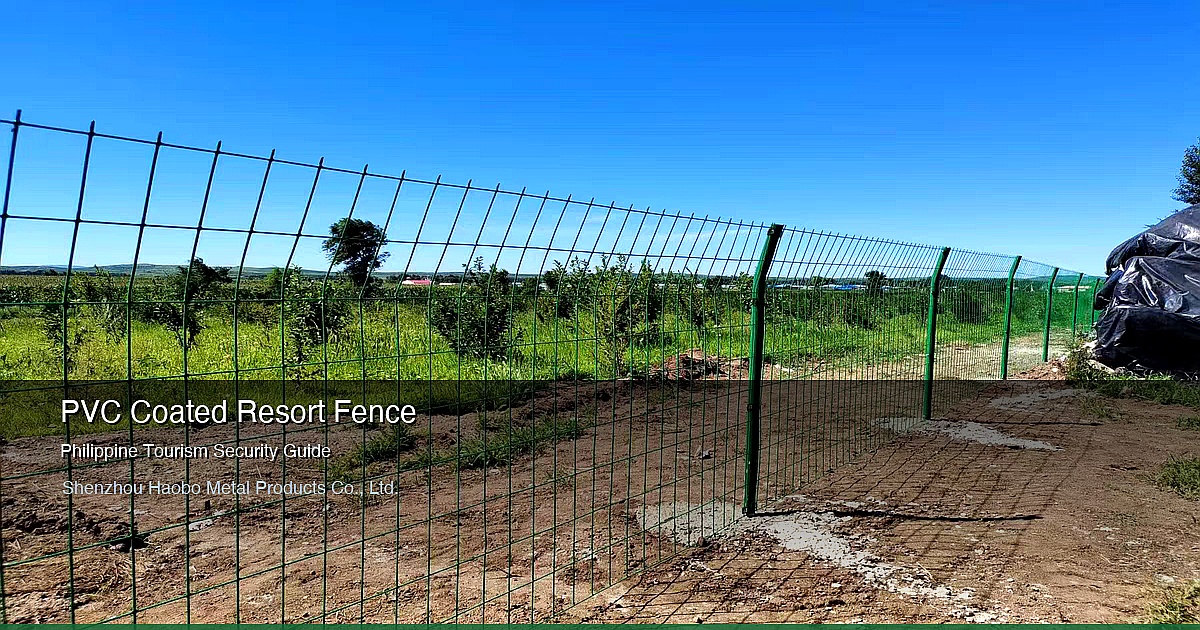
| PVC-coated HDG | HDG + 0.5mm PVC | 25-35 years | 20-25 years | +45-55% |
**PAES 218:2016 requirement**: The Philippine Agricultural Engineering Standard for "Wire Fencing Materials" specifies a minimum of Class 1 galvanizing (70 g/m²) for agricultural fencing. However, for installations in coastal municipalities (within 5km of coastline), Class 3 (245 g/m²) or Galfan (275 g/m²) is strongly recommended by DA-BPI (Bureau of Plant Industry) field manuals.
**Practical recommendation**: For most Philippine farms, HDG Class 3 (≥245 g/m²) provides the best cost-to-service-life ratio. Galfan should be specified for:
- Farms within 5km of coastline (all of Palawan, coastal Mindanao, Bicol coast, Eastern Visayas)
- Swine/poultry biosecurity fences requiring 20+ year service life
- Farms in high-rainfall areas (>3,000mm/year: Eastern Mindanao, Northern Luzon cordillera)
## NSCP 2015 Wind Load Design for Agricultural Fences
The Philippines is in the world's most active typhoon zone, with wind speeds reaching 250-315 kph (super typhoon category). Agricultural fences must resist wind loads calculated per NSCP 2015 Section 207 (Wind Loads):
### Wind Pressure Calculation
For a fence panel (solid or porous), the wind pressure is:
> p = qz × Cp × Cf
Where:
- qz = velocity pressure at height z = 0.613 × Kz × Kzt × Kd × V² (Pa)
- Cp = pressure coefficient (1.2 for solid walls, 0.8 for porous fences with >50% porosity)
- Cf = force coefficient (1.3 for solid walls, 0.65-0.85 for chain link mesh)
For NSCP Zone II (V = 250 kph = 69.4 m/s, Exposure B - agricultural terrain):
- qz at 2.0m height: 0.613 × 0.57 × 1.0 × 0.85 × 69.4² = 0.613 × 0.57 × 0.85 × 4,816 = 1,430 Pa = 1.43 kPa
For a 2.0m height chain link fence (50mm mesh, ~75% porosity, effective solidness = 0.25):
- Net wind force = 1.43 × 0.25 × 0.8 × 0.85 = **0.24 kPa** (equivalent to 0.24 kN per m² of fence face)
### Post Design for Wind Load
For a 2.0m height chain link fence with 2.0m post spacing:
- Wind force per post: 0.24 × 2.0 (height) × 2.0 (spacing) = 0.96 kN
- Moment at post base: 0.96 × 1.0 (average moment arm) = 0.96 kN·m
For a Φ48×1.5mm steel tube post:
- Section modulus: Z = π × (D⁴ - d⁴) / (32 × D) = π × (48⁴ - 45⁴) / (32 × 48) = 4,135 mm³
- Bending stress: σ = M/Z = 960,000 / 4,135 = 232 MPa → **EXCEEDS** yield stress of 235 MPa for Q235 steel
**Conclusion**: Standard Φ48×1.5mm tube posts fail at 250 kph wind. Upgrading to:
- Φ60×2.0mm tube: Z = 8,580 mm³, σ = 112 MPa → Safe
- Or Φ48×2.5mm tube: Z = 6,600 mm³, σ = 145 MPa → Safe
**Recommended post specification for typhoon zones**:
- Diameter: Φ60mm minimum
- Wall thickness: 2.0mm minimum
- Post spacing: 2.0m (chain link) or 2.5m (welded panel)
- Embedment depth: 0.6m in concrete (Class A, 28 MPa)
## Installation Guide for Agricultural Wire Mesh Fence
### Step 1: Site Survey and Layout
- Mark fence line using stakes at 20m intervals
- Check property boundaries per DENR cadastral maps
- Identify utilities (water lines, electrical conduits) before digging
- Set corner posts first (these are the primary structural elements)
- Intermediate posts are set on straight lines between corners
### Step 2: Post Installation
**Corner and gate posts** (structural):
- Dig holes: 0.6m diameter × 0.6m depth (in soil) or 0.3m × 0.6m (in rock)
- Use heavy-duty posts: Φ76×2.5mm or 100×100×3mm SHS
- Install with diagonal brace posts at 45° angle (Φ48×1.5mm, 2.0m length)
- Cast concrete (Class A, 28 MPa) to 50mm above ground level, sloped away for drainage
- Cure 3 days minimum before tensioning
**Intermediate posts** (line posts):
- Dig holes: 0.3m diameter × 0.6m depth
- Use standard posts: Φ60×2.0mm (typhoon zone) or Φ48×1.5mm (sheltered area)
- Set in concrete (Class A) or driven into firm soil (if soil bearing capacity ≥ 150 kPa)
- Spacing: 2.0-2.5m depending on fence type and wind exposure
### Step 3: Wire Mesh Installation (Chain Link)
1. **Attach tension wire**: Run 2.5mm galvanized wire along bottom and top of fence line, secured to each post with tie wire. Tension to 500N using a fence stretcher.
2. **Roll out chain link fabric**: Starting at a corner post, roll the chain link along the fence line. Stand the fabric vertically and lean against posts.
3. **Attach top rail or tension wire**: If using a top rail (Φ42×1.5mm tube), slide the chain link knuckles over the rail. If using tension wire, tie the chain link to the tension wire at 300mm intervals using 1.6mm galvanized tie wire.
4. **Tension the fabric**: Use a fence puller (come-along) attached to a stretcher bar inserted in the fabric end. Tension until the fabric is taut (approximately 500N per meter of height). Secure to the end/gate post with tension bars and bands.
5. **Tie to line posts**: Secure the chain link fabric to each line post at 3 points (top, middle, bottom) using 1.6mm galvanized tie wire.
### Step 4: Wire Mesh Panel Installation (Welded Panel)
1. **Set panels on posts**: Place each welded mesh panel between two posts, resting on ground level or 50mm above ground (to prevent corrosion from soil contact).
2. **Secure panels**: Use panel clips (3 per side, galvanized steel spring clips) or self-tapping screws (Φ5.5×25mm, galvanized) through the panel frame into the post.
3. **Install horizontal rails**: For multi-panel height (e.g., 2.0m = 2× 1.0m panels), connect panels with a horizontal rail (Φ42×1.5mm tube) bolted to posts at the panel junction.
### Step 5: Gate Installation
- **Single gate**: For 1.0-1.5m gate openings, use a single swing gate with 2× heavy-duty hinges on a 100×100×3mm gate post
- **Double gate**: For 3.0-5.0m openings (tractor access), use double swing gates with a drop-down center latch
- **Gate frame**: Welded from Φ42×2.0mm tube with the same mesh type as the fence line
- **Hinges**: Heavy-duty barrel hinges (Φ20mm pin, galvanized), 3 sets per gate leaf for gates > 2.0m height
## Cost Comparison: Total Installed Fence Cost per Application
### Rice/Corn Farm Boundary (1 km perimeter)
| Component | Specification | Quantity | Unit Cost (PHP) | Total (PHP) |
|---|---|---|---|---|
| Chain link fabric | 2.0mm, 50mm, 1.2m H, HDG 275 g/m² | 1,000 m | 180/m | 180,000 |
| Line posts | Φ48×1.5mm, 1.8m, 2.0m spacing | 500 pcs | 220 | 110,000 |
| Corner/brace posts | Φ76×2.5mm, 2.0m, with brace | 8 sets | 1,800 | 14,400 |
| Top rail | Φ42×1.5mm, 3.0m length | 334 pcs | 180 | 60,120 |
| Tension wire | 2.5mm, 2 lines (top+bottom) | 2,000 m | 8/m | 16,000 |
| Tie wire | 1.6mm galvanized | 20 rolls | 120 | 2,400 |
| Concrete | Class A, 28 MPa, 0.3×0.6m holes | 500 holes | 85 | 42,500 |
| Gates | 2× 3.0m double swing | 2 sets | 8,500 | 17,000 |
| Labor | Installation | 1,000 m | 120/m | 120,000 |
| **Total** | | **1,000 m** | | **562,420** |
| **Per linear meter** | | | | **PHP 562/m** |
### Cattle Ranch Boundary (5 km perimeter, Mindanao)
| Component | Specification | Quantity | Unit Cost (PHP) | Total (PHP) |
|---|---|---|---|---|
| Welded mesh panel | 4.0mm, 50×100mm, 2.5m×1.8m, Galfan | 2,000 panels | 1,250 | 2,500,000 |
| Line posts | Φ60×2.0mm, 2.4m, 2.5m spacing | 2,000 pcs | 350 | 700,000 |
| Corner/gate posts | 100×100×3mm SHS, 2.4m | 12 sets | 3,500 | 42,000 |
| Concrete | Class A, for post holes | 2,000 holes | 85 | 170,000 |
| Gates | 4× 5.0m double swing (tractor) | 4 sets | 12,000 | 48,000 |
| Hardware | Clips, bolts, hinges | lot | | 75,000 |
| Labor | Installation | 5,000 m | 150/m | 750,000 |
| **Total** | | **5,000 m** | | **4,285,000** |
| **Per linear meter** | | | | **PHP 857/m** |
## Common Fencing Failures and Prevention
### Failure 1: Post Wind-Over (Typhoon)
**Symptoms**: Entire fence line leans or collapses after a typhoon event, with posts bent or uprooted.
**Root cause**: Posts are undersized (Φ48×1.0mm) and/or embedded too shallow (<0.4m). One of the most common failures in Philippine agricultural fencing.
**Prevention**: Use Φ60×2.0mm posts minimum in typhoon zones (NSCP Zone II+), embed 0.6m in concrete. For exposed coastal sites, reduce post spacing to 1.8m and add horizontal wind braces (Φ12mm bar) between posts at mid-height.
### Failure 2: Wire Corrosion at Ground Contact
**Symptoms**: Chain link fabric rusts through at ground level within 3-5 years, creating gaps that allow livestock to escape and predators to enter.
**Root cause**: Soil moisture and organic acids accelerate zinc coating loss at the ground contact zone. Standard pre-galvanized wire (20-60 g/m²) has only 2-3 years of life in soil contact.
**Prevention**:
- Specify HDG Class 3 (≥245 g/m²) for all agricultural fencing
- Keep chain link fabric 50mm above ground level (do not bury)
- For predator exclusion (where bottom gaps are unacceptable), install a PVC-coated bottom rail or concrete sill at ground level
### Failure 3: Gate Post Leaning
**Symptoms**: Gate posts lean inward under the weight of the gate, causing the gate to drag and not close properly.
**Root cause**: Gate posts are the same size as line posts, but they carry concentrated load (gate weight + wind load on gate leaf).
**Prevention**: Use gate posts 2 sizes larger than line posts (e.g., if line posts are Φ60×2.0mm, use Φ89×2.5mm gate posts). Install diagonal brace posts at 45° in both directions from the gate post. Embed gate posts 0.8m in concrete (deeper than line posts).
### Failure 4: Livestock Damage to Welded Mesh Panels
**Symptoms**: Cattle push through or break welds on mesh panels, especially in holding pens or high-pressure areas.
**Root cause**: Panel wire diameter too thin (≤3.0mm) for cattle pressure. Cows can exert 300-500N of sustained horizontal force against a fence.
**Prevention**: Use 4.0mm or 5.0mm wire diameter welded panels for cattle areas. For holding pens and raceways, use 5.0mm horizontal wires with 50×200mm mesh (wide horizontal openings discourage animals from getting their heads stuck). Install a single 5.0mm horizontal rail at 1.0m height (nose height for cattle) to distribute impact loads.
## Sourcing Galvanized Wire Mesh Fence from China
### Standard Export Specifications
**Chain link fabric**:
- Wire diameter: 2.0mm, 2.2mm, 2.7mm (select by application)
- Mesh size: 25mm, 50mm, 60mm
- Height: 1.0m, 1.2m, 1.5m, 1.8m, 2.0m
- Roll length: 15m, 18m, 25m (standard export)
- Galvanizing: HDG ≥ 275 g/m² (specify Class 3, not Class 1)
- PVC coating: Optional (gray, green — 0.4-0.5mm thickness over HDG)
- Standard: PAES 218:2016 / ASTM A392
**Welded wire mesh panels**:
- Wire diameter: 3.0mm, 3.5mm, 4.0mm, 5.0mm
- Mesh opening: 50×50mm, 50×100mm, 50×200mm
- Panel size: 2.0m × 1.0m, 2.5m × 1.0m, 2.5m × 1.8m, 2.5m × 2.0m
- Frame: Optional (20×20×1.5mm, 25×25×2.0mm SHS frame)
- Coating: HDG ≥ 275 g/m² or Galfan ≥ 275 g/m² + powder coat (optional)
- Standard: PAES 219:2016 / ASTM A185
**Steel posts**:
- Type: Round tube (Φ48, Φ60, Φ76, Φ89, Φ100) or SHS (50×50, 75×75, 100×100)
- Wall thickness: 1.5mm, 2.0mm, 2.5mm, 3.0mm
- Length: 1.8m, 2.0m, 2.4m, 3.0m
- Coating: HDG ≥ 275 g/m² (hot-dip galvanized after fabrication)
- Standard: ASTM F1043 / ASTM F1083
### Shipping and Importation
| Parameter | Detail |
|---|---|
| FOB port | Tianjin, China |
| Destination | Manila / Cebu / Davao |
| Container | 40' HQ (for chain link rolls + posts) or 20' GP (for welded panels only) |
| Chain link capacity | 1,500-2,000m per 40' HQ (depending on wire/mesh) |
| Welded panel capacity | 500-700 panels per 40' HQ |
| Post capacity | 1,500-2,000 pieces per 40' HQ |
| Ocean freight | USD 1,200-1,800 per 40' HQ (Tianjin → Manila) |
| Import duty | 5% (HS 7314.42 — welded mesh, HS 7314.19 — chain link) |
| VAT | 12% on CIF + duty |
| Transit time | 10-15 days port-to-port |
### FOB Tianjin Pricing (2026 Reference)
| Product | Specification | FOB Price (USD) |
|---|---|---|
| Chain link fabric | 2.0mm, 50mm, 1.8m H, HDG 275 g/m² | 1.80-2.20/m |
| Chain link fabric | 2.7mm, 50mm, 1.8m H, HDG 275 g/m² | 2.80-3.50/m |
| Welded mesh panel | 4.0mm, 50×100mm, 2.5×1.8m, HDG | 12-16/panel |
| Welded mesh panel | 4.0mm, 50×100mm, 2.5×1.8m, Galfan + PC | 18-24/panel |
| Round post | Φ60×2.0mm, 2.4m, HDG | 8.50-11.00/pc |
| Round post | Φ48×1.5mm, 2.0m, HDG | 4.50-6.00/pc |
## Key Takeaways
1. For most Philippine agricultural applications, chain link fence with 2.0mm wire, 50mm mesh, 1.2-1.8m height, and HDG Class 3 galvanizing (≥245 g/m²) provides the best balance of cost (PHP 280-450/m installed) and service life (15-20 years in rural C3 conditions). For cattle ranches and commercial operations requiring higher durability, welded mesh panels (4.0mm, Galfan coating) at PHP 600-900/m installed provide 25-35 year service life with minimal maintenance.
2. Post specification is the most common failure point in Philippine agricultural fencing. For typhoon zones (NSCP Zone II, V=250 kph), the minimum post must be Φ60×2.0mm at 2.0m spacing, embedded 0.6m in concrete. The standard Φ48×1.5mm post will bend at 250 kph wind — this is not a theoretical risk but a documented failure observed after every major typhoon.
3. Galvanizing quality determines service life more than wire diameter. Pre-galvanized (20-60 g/m²) chain link has 3-5 year life in Philippine tropical conditions and is not suitable for permanent installations. HDG Class 3 (≥245 g/m²) should be the minimum specification for all agricultural fencing. For coastal farms (within 5km of shoreline), Galfan (≥275 g/m²) or PVC-coated HDG is strongly recommended.
4. Gate posts must be 2 sizes larger than line posts and installed with diagonal braces. The most common gate failure is not the gate itself but the post leaning under load. A 1.5m wide cattle gate weighs 40-60 kg and experiences wind load during typhoons — a Φ48×1.5mm gate post cannot sustain this load and will lean within the first year.
5. Biosecurity fencing for swine and poultry operations requires 25mm mesh (not 50mm) to prevent small animal and bird entry that may carry ASF, AI (Avian Influenza), or NCD (Newcastle Disease). The perimeter fence is the first line of biosecurity per DA-BAI guidelines — a gap in the perimeter can be more costly than the entire fence system cost if it allows a disease outbreak.
Need Wire Mesh Fencing for Your Agricultural Project?
Send us your farm type, perimeter length, fence height requirement, and site location (coastal or inland). We provide galvanized chain link fabric, welded mesh panels, and steel posts with FOB Tianjin pricing within 48 hours. HDG Class 3 and Galfan options for 15-40 year service life in Philippine tropical conditions. 40' HQ containers to Manila, Cebu, or Davao.
www.haobomesh.com | Shenzhou Haobo Metal Products Co., Ltd.