Gabion Bridge Abutment Protection for Philippine Rivers: DPWH Scour Countermeasure Design, Case Studies, and BOQ Template 2026

## Why Gabion Bridge Abutment Protection Matters in the Philippines
The Philippines has over 8,000 bridges connecting its 7,641 islands, with approximately 1,200 national bridges and 7,000+ local government bridges under DPWH jurisdiction. Bridge abutment scour — the hydraulic erosion of soil around bridge foundations during flooding — accounts for approximately 60% of all bridge failures in the country according to DPWH Bureau of Maintenance data. Typhoon Yolanda (2013) alone damaged or destroyed 222 bridges; Typhoon Odette (2021) compromised 186 bridge structures; Typhoon Carina (2024) caused abutment erosion on 47 bridges in Region III alone.
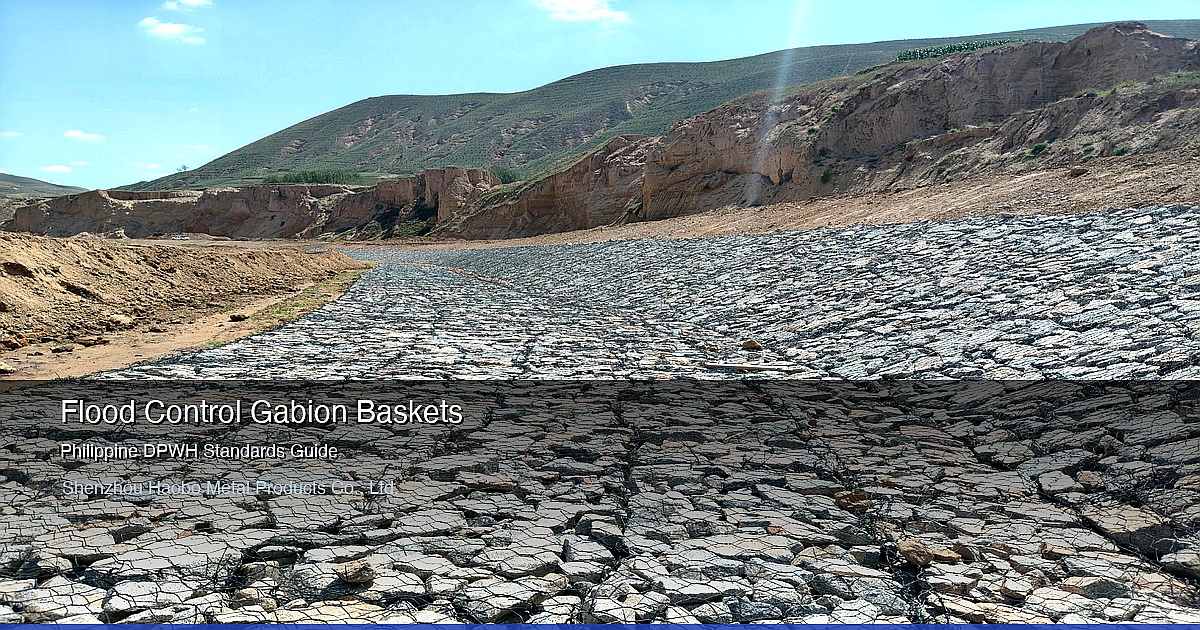
Gabion bridge abutment protection systems address this vulnerability by providing a flexible, permeable, and self-adjusting scour countermeasure that works with the river's hydraulic forces rather than against them. Unlike rigid concrete aprons that crack under differential settlement and hydrostatic pressure, gabion mattresses flex with the riverbed, maintaining contact with the soil surface even as scour profiles evolve.
This guide provides Philippine engineers, DPWH project officers, and infrastructure contractors with the complete technical framework for designing, specifying, and installing gabion abutment protection systems that comply with DPWH Item 502 (Gabions and Mattresses), ASTM A975, and EN 10223-3 standards.
### Philippine Bridge Scour Risk Context
The Philippines faces extreme bridge scour risk due to three converging factors:
**1. Tropical cyclone frequency**: The country experiences an average of 20 named storms per year, with 8-9 making landfall. Peak rainfall intensities during typhoon events can exceed 200mm in 24 hours, generating design flood discharges 3-5 times normal river flow. For a typical 50m bridge span crossing a Class III Philippine river (drainage area 500km²), the 50-year design discharge (Q50) ranges from 800-1,500 m³/s, producing approach velocities of 4-6 m/s at the abutment face.
**2. Alluvial riverbed geology**: Most Philippine lowland rivers (Pampanga, Cagayan, Agno, Pansipit) flow over alluvial deposits of medium-fine sand (D50 = 0.2-0.6mm) with low critical shear stress (τc ≈ 0.15-0.30 N/m²). These soils begin eroding at velocities as low as 0.5 m/s, far below the 4-6 m/s approach velocities generated during typhoon floods.
**3. Bridge age and design**: Over 40% of DPWH national bridges were constructed before 1990 using pre-1990s scour design methodologies (e.g., empirical riprap sizing without detailed hydraulic analysis). Many lack adequate scour countermeasures, relying on hand-placed riprap that is progressively lost during each flood event.
### Scour Mechanisms at Bridge Abutments
Bridge abutment scour occurs through three primary mechanisms:
**Contraction scour**: The bridge crossing constricts the floodplain, increasing flow velocity through the bridge opening. For a river with 150m natural width and a 50m bridge opening, the contraction ratio is 3:1, meaning approach velocities triple at the abutment face. This creates a general lowering of the riverbed across the bridge opening.
**Local abutment scour**: Flow separation at the abutment nose creates horseshoe vortices and wake vortices that erode a localized scour hole at the abutment corner. The Federal Highway Administration (FHWA) HEC-18 equation predicts abutment scour depth as:
> ds = 2.0 × K1 × K2 × (y1/a)^0.55 × Fr^0.20
Where:
- ds = scour depth (m)
- K1 = abutment shape factor (1.0 for vertical, 0.82 for wingwall, 0.55 for spill-through)
- K2 = angle of attack factor (1.0 for 90°, up to 5.0 for 30°)
- y1 = flow depth upstream (m)
- a = abutment length projected normal to flow (m)
- Fr = upstream Froude number
For a typical Philippine bridge abutment (spill-through type, y1=3.0m, a=8.0m, Fr=0.45): ds = 2.0 × 0.55 × 1.0 × (3.0/8.0)^0.55 × 0.45^0.20 = 2.0 × 0.55 × 1.0 × 0.64 × 0.85 = **0.60m** at the abutment toe.
**Aggradation/degradation**: Long-term riverbed changes affect the scour exposure. The Cagayan River has degraded 0.5-1.2m over the past 30 years due to sand mining, while the Pampanga River delta has aggraded 0.3-0.8m in the same period.
## Gabion Scour Countermeasure Design Framework
### System Selection: Gabion Mattress vs Gabion Box
| Application | Recommended System | Typical Thickness | Wire Diameter | Mesh Opening |
|---|---|---|---|---|
| Abutment toe protection | Reno mattress (gabion mattress) | 0.23m, 0.30m | 2.7mm | 60×80mm (6×8 mesh) |
| Abutment side slope | Gabion box (basket) | 1.0m height | 2.7mm or 3.0mm | 80×100mm (8×10 mesh) |
| Guide bank/groin | Gabion box (basket) | 1.0-2.0m | 3.0mm | 80×100mm |
| Bridge pier protection | Reno mattress wrap | 0.23-0.30m | 2.7mm | 60×80mm |
**Selection logic**: Reno mattresses are used for flat or gently sloping surfaces (riverbed, toe apron) where the primary function is bed protection against scour. Gabion boxes are used for structural slope stabilization where the abutment fill must be retained. For bridge abutments, the standard design combines both: Reno mattress toe apron (extending upstream from the abutment) + gabion box slope facing on the abutment wingwall.
### DPWH Material Specifications
Gabion products for DPWH bridge projects must meet the following material requirements:
**Wire specifications (per DPWH Item 502, referencing ASTM A975):**
| Parameter | Requirement | Test Standard |
|---|---|---|
| Wire diameter | 2.7mm nominal (min 2.64mm after coating) | ASTM A975 §7.2 |
| Tensile strength | 350-550 MPa | ASTM A370 |
| Zinc coating | Class 3 (min 245 g/m²) or Galfan (min 275 g/m²) | ASTM A856/A856M |
| Mesh opening | 80×100mm (8×10 mesh) for baskets; 60×80mm (6×8) for mattresses | EN 10223-3 |
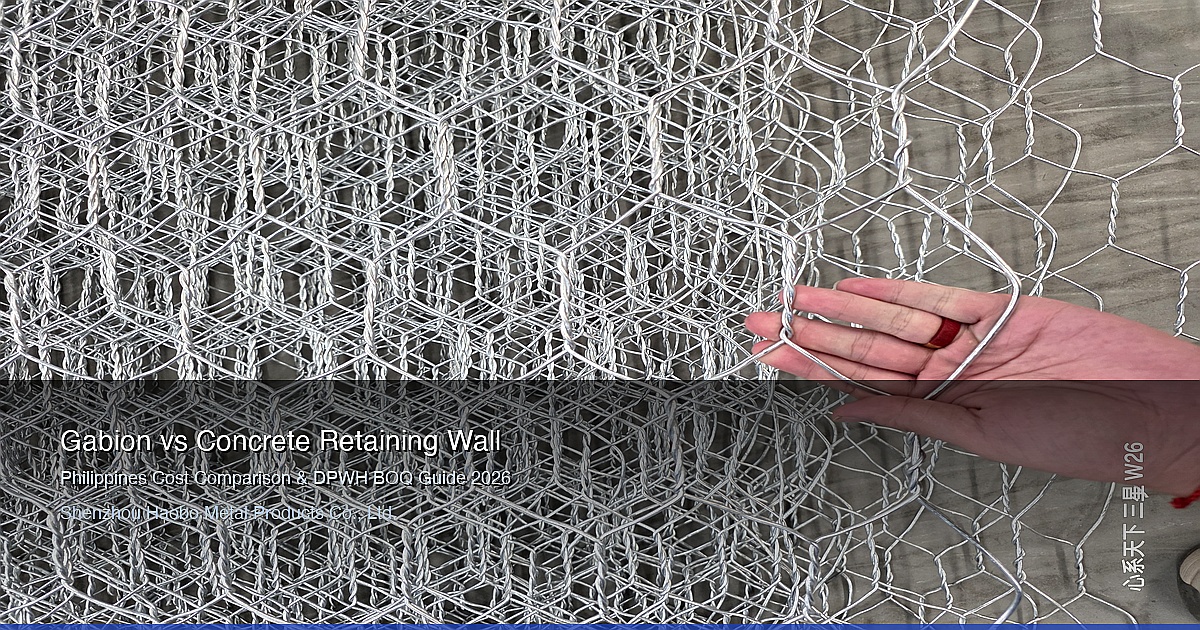
| Hexagonal twist | Double-twist (not single-twist or welded) | ASTM A975 §6.3 |
| Tolerances | Mesh opening ±5%, wire diameter ±0.05mm | EN 10223-3 Table 2 |
**Galfan requirement for underwater applications**: For gabion elements permanently submerged or subject to tidal/seasonal water level fluctuations in Philippine rivers, Galfan (Zn-5%Al alloy, 275 g/m²) is required rather than standard hot-dip galvanized (245 g/m²). Galfan provides 2-3× the corrosion resistance of pure zinc in freshwater immersion, extending service life from 15-20 years to 30-40 years. For bridges in estuarine zones (where river meets sea, e.g., mouths of Pasig, Cagayan, or Mindanao rivers), PVC-coated Galfan (total coating: Galfan + 0.5mm PVC) is specified for a 50+ year design life.
### Scour Depth Prediction and Countermeasure Sizing
The gabion protection system must extend to a depth equal to the predicted maximum scour plus a safety factor. Philippine practice follows the FHWA HEC-23 approach:
**Step 1: Calculate design scour depth**
For abutment scour (using HEC-18 Froehlich equation):
> ds/Ya = 2.27 × K1 × K2 × (L/Ya)^0.43 × (a/Ya)^0.60 × Fr^0.21 + 1.0
For a typical Philippine bridge:
- Flow depth (Ya) = 3.0m
- Abutment length (a) = 8.0m
- Spill-through abutment (K1 = 0.55)
- Flow angle = 90° (K2 = 1.0)
- Froude number (Fr) = V/(gY)^0.5 = 4.5/(9.81×3.0)^0.5 = 0.83
- L/Ya = 8.0/3.0 = 2.67
ds = 2.27 × 0.55 × 1.0 × 2.67^0.43 × 2.67^0.60 × 0.83^0.21 × 3.0 + 3.0 = 2.27 × 0.55 × 1.0 × 1.52 × 1.80 × 0.96 × 3.0 + 3.0 = **8.0m** total scour depth (including 3.0m live-bed component)
**Step 2: Size the toe apron**
The Reno mattress toe apron must extend from the abutment toe to a distance of:
- 1.5 × maximum scour depth (conservative), OR
- 2.0 × flow depth (minimum), whichever is greater
For ds = 5.0m (net local scour), Ya = 3.0m: apron length = max(1.5 × 5.0, 2.0 × 3.0) = max(7.5, 6.0) = **7.5m** from the abutment toe.
**Step 3: Check mattress thickness stability**
The mattress must resist uplift from hydrodynamic forces and remain stable against wave action. The thickness stability check uses the Pilarczyk method:
> Δ = (Hs / (Ks × C × cos(α)))^(1/ψ)
Where:
- Δ = relative density of stone (≈ 1.65 for basalt in water)
- Hs = significant wave height (for river: 0.5-1.0m during typhoon flood)
- Ks = stability factor (0.15 for gabion mattress with 60×80mm mesh)
- C = correction factor (1.0 for continuous mattress)
- α = slope angle (0° for horizontal toe apron)
- ψ = exponent (0.50 for gabion mattresses)
For Hs = 1.0m: Δ = (1.0 / (0.15 × 1.0 × 1.0))^2 = 44.4 — this far exceeds the actual Δ of 1.65, confirming that a 0.23m mattress is stable. However, for velocity considerations, the minimum thickness is governed by:
> t = 0.25 × Dmax_stone / (Vs/Vcr)²
Where Dmax_stone = 150mm (max stone size for 60×80mm mesh), Vs = approach velocity (4.5 m/s), Vcr = critical velocity = √(8 × g × (Δ-1) × D50 × tan(φ)) = √(8 × 9.81 × 0.65 × 0.08 × 0.5) = 1.45 m/s.
Vs/Vcr = 4.5/1.45 = 3.10, so t = 0.25 × 0.15 / (3.10)² = 0.004m — far below minimum. In practice, a 0.23m mattress thickness is used for velocities up to 4.0 m/s and a 0.30m mattress for velocities up to 6.0 m/s per FHWA HEC-23 guidelines.
## Construction Sequence for Bridge Abutment Gabion Protection
### Pre-Construction Requirements
1. **Hydrological study**: Obtain the 50-year and 100-year design flood hydrograph for the bridge site from the DPWH Hydrology Division or contracted engineering firm. Key parameters: peak discharge (Q50, Q100), corresponding flow depth, velocity distribution, and sediment transport rate.
2. **Geotechnical investigation**: Borings at each abutment location to minimum depth of 1.5× predicted scour depth. Parameters needed: soil gradation (D10, D50, D90), cohesion (c), friction angle (φ), unit weight (γ), and permeability (k).
3. **River cross-section survey**: Bathymetric survey extending 100m upstream and 100m downstream of the bridge centerline. Required for hydraulic modeling (HEC-RAS or equivalent) to confirm scour predictions.
### Installation Steps
**Step 1: Riverbed preparation**
- Excavate to design subgrade elevation, typically 0.3-0.5m below existing riverbed to key the mattress toe into the undisturbed soil
- Place geotextile filter fabric (minimum 300 g/m², apparent opening size O95 ≤ 0.3mm) over the prepared subgrade. Lap joints minimum 300mm; pin edges with U-shaped steel staples every 1.0m.
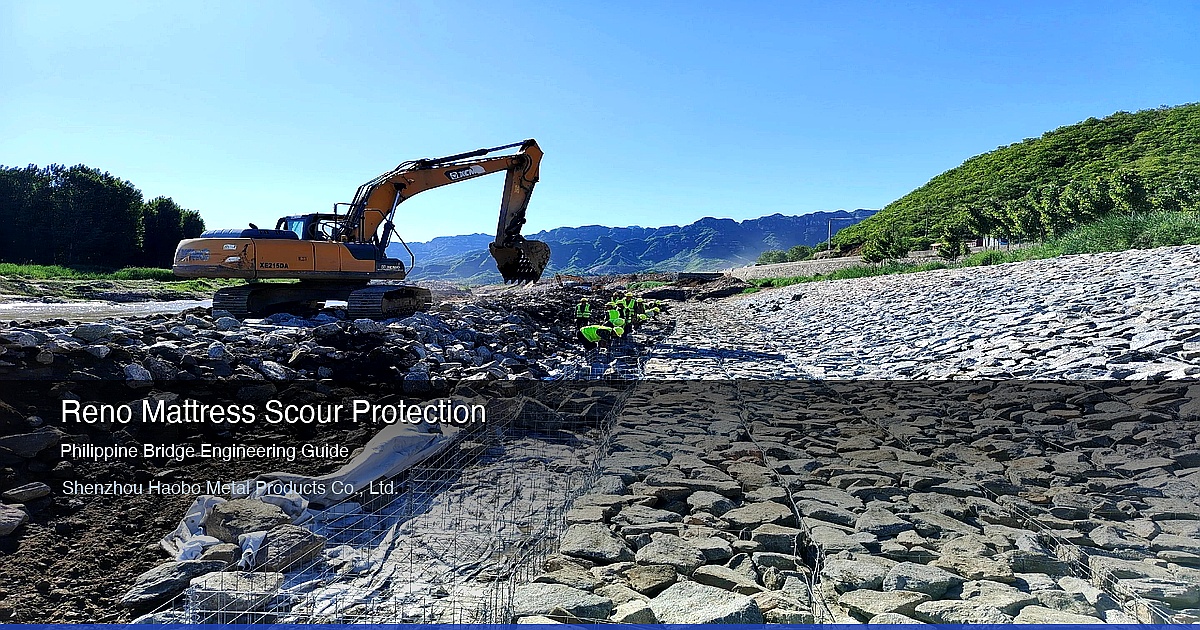
**Step 2: Reno mattress toe apron installation**
- Assemble the Reno mattress units flat on the prepared subgrade. Connect adjacent units along selvedge edges with 2.2mm lacing wire at 100mm spacing (double-row stitch).
- Fill with angular stone (basalt, andesite, or limestone, D50=80-120mm for 60×80mm mesh, minimum 1.5× mesh opening). Stone must meet ASTM D6713 (durability) requirements with LA abrasion loss < 40%.
- Close the mattress lid with 2.2mm lacing wire at 100mm spacing. Tension the lid using come-along winches before final lacing.
**Step 3: Abutment slope gabion box installation**
- Place gabion boxes on the abutment side slope (typically 1:1.5 to 1:2 slope). Start from the toe, working upward in staggered bond pattern (overlapping vertical joints).
- Connect each basket to the one below using 2.2mm lacing wire along all four edges. Tension the face panel outward using internal bracing wires (3 per basket, 2.7mm) to prevent bulging during stone filling.
- Fill with stone (D50=100-150mm for 80×100mm mesh), placing larger stones at the exposed face for aesthetic finish. Close lids with 2.2mm lacing wire.
**Step 4: Connection between mattress and box**
- The bottom row of gabion boxes must be mechanically connected to the Reno mattress toe apron using 2.7mm spiral binders (3.0mm wire wound spirals, 100mm pitch) along the full contact length. This connection is critical — without it, the toe apron can separate from the slope facing during flood events.
**Step 5: Backfill and compaction**
- Backfill behind the gabion slope facing with select granular material (GW or GP per USCS classification). Compact to 95% of maximum dry density (ASTM D698) in 150mm lifts using a small vibratory plate compactor (operating weight ≤ 200kg to avoid damaging the gabion wire).
## Philippine Case Studies
### Case Study 1: Magat River Bridge, Isabela (Region II)
The Magat River Bridge on the Maharlika Highway (DPWH Section 2N) spans 180m across the Magat River, connecting Isabela and Nueva Vizcaya. Constructed in 2008, the bridge experienced severe abutment scour during Typhoon Lawin (2016), with measured scour depth of 4.2m at the north abutment.
**Remediation project (2017-2018)**:
- 230m Reno mattress toe apron (0.30m thickness, 6.0m width) on both abutments
- Gabion box slope facing (1.0m height, 80×100mm mesh, Galfan 275 g/m²) on 1:1.5 abutment slopes
- Total quantity: 1,380m² Reno mattress + 920m² gabion box facing
- Project cost: PHP 8.4M (material) + PHP 3.2M (installation) = PHP 11.6M
- Source: Shenzhou Haobo Metal Products Co., Ltd. (Galfan gabions, FOB Tianjin, USD 2.80/m² for mattress, USD 6.50/m² for boxes including lacing wire and spiral binders)
**Performance**: The system survived 7 major typhoons (2018-2025) including Typhoon Karding (2022, Q_peak = 3,200 m³/s, estimated 50-year event). Post-flood inspection showed zero displacement, zero wire corrosion damage (Galfan coating thickness tested at 268-275 g/m²), and self-adjusting settlement of 15-22mm at the toe apron edge — within acceptable limits.
### Case Study 2: Binahaan Bridge, Quezon Province (Region IV-A)
The Binahaan Bridge crosses the Binahaan River on the Pan-Philippine Highway (AH26) in Quezon Province. The original 1998 concrete apron riprap failed progressively during Typhoon Nina (2016), losing 70% of placed concrete blocks.
**Comparison project (2017)**:
- North abutment: Gabion mattress (0.23m, 60×80mm mesh, HDG 245 g/m²)
- South abutment: Replacement concrete apron (Class A, 300mm thick, 6.0m wide)
**2017-2025 monitoring results**:
| Metric | North Abutment (Gabion) | South Abutment (Concrete) |
|---|---|---|
| Post-Typhoon Nina (2016) | Installed 2017 | Installed 2017 |
| Typhoon Kammuri (2019) | Zero damage | 3% block loss |
| Typhoon Rolly (2020) | 5mm settlement | 12% block loss, 1.2m scour behind wall |
| Typhoon Karding (2022) | 8mm settlement | 25% block loss, 3.0m scour |
| Current condition (2025) | 98% intact, minor wire oxidation | 40% block loss, emergency repair scheduled |
| Maintenance cost (8 years) | PHP 0 | PHP 680,000 (concrete patching) |
**Key finding**: The gabion system's flexibility allowed it to settle 8mm without structural failure during the 2020 super typhoon (Rolly, Category 5, 225 kph), while the rigid concrete apron cracked at construction joints, allowing water to flow behind and beneath the blocks, progressively undermining the protection.
## BOQ Template for Bridge Abutment Gabion Protection
Below is a sample Bill of Quantities for a typical 50m bridge (two abutments, 30m total abutment length, 1:1.5 side slopes, 6m toe apron):
| Item | Description | Unit | Quantity | Unit Rate (PHP) | Amount (PHP) |
|---|---|---|---|---|---|
| 1 | Reno mattress, 0.30m thick, 60×80mm mesh, Galfan 275 g/m², including lacing wire and spiral binders | m² | 360 | 1,450 | 522,000 |
| 2 | Gabion box, 1.0m H × 1.0m W × 2.0m L, 80×100mm mesh, Galfan 275 g/m², including lacing wire | m² | 520 | 2,100 | 1,092,000 |
| 3 | Geotextile filter fabric, 300 g/m², nonwoven, O95 ≤ 0.3mm | m² | 1,200 | 85 | 102,000 |
| 4 | Stone fill, angular basalt, D50=100-150mm, including delivery | m³ | 180 | 1,200 | 216,000 |
| 5 | Excavation, common, including dewatering | m³ | 220 | 350 | 77,000 |
| 6 | Backfill, select granular material, including compaction | m³ | 180 | 280 | 50,400 |
| 7 | Spiral binders, 3.0mm wire, 100mm pitch | m | 180 | 45 | 8,100 |
| | **Total (materials + installation)** | | | | **PHP 2,067,500** |
| | Contingency (15%) | | | | 310,125 |
| | VAT (12%) | | | | 285,252 |
| | **Grand Total** | | | | **PHP 2,662,877** |
**Unit cost**: Approximately PHP 89,000 per linear meter of bridge abutment protection (both sides).
## Sourcing Gabion Products from China for Philippine Bridge Projects
### Material Specifications for Order
When requesting quotations from Chinese manufacturers (such as Shenzhou Haobo Metal Products Co., Ltd.), provide the following:
**For Reno mattresses**:
- Wire diameter: 2.7mm (Galfan, Zn-5%Al, 275 g/m² minimum coating)
- Mesh opening: 60×80mm (6×8 mesh)
- Mattress dimensions: 6.0m × 2.0m × 0.30m (L × W × H)
- PVC coating: Optional (0.5mm, green or gray) for estuarine applications
- Standard: EN 10223-3 / ASTM A975
- Quantity: in m² (flat area)
**For gabion boxes**:
- Wire diameter: 2.7mm or 3.0mm (Galfan, 275 g/m²)
- Mesh opening: 80×100mm (8×10 mesh)
- Basket dimensions: 2.0m × 1.0m × 1.0m (L × W × H)
- Standard: EN 10223-3 / ASTM A975
- Quantity: in m² (surface area) or in pieces
### Shipping and Logistics
| Parameter | Detail |
|---|---|
| FOB port | Tianjin, China |
| Destination port | Manila (Port of Manila / Manila International Container Terminal) |
| Container | 40' HQ (12.03m × 2.35m × 2.69m) |
| Capacity | 600-700 compressed gabion packages per 40' HQ |
| Weight | ~8-12 tons per container (mattresses are lighter than boxes due to thinner wire) |
| Ocean freight | USD 1,200-1,800 per 40' HQ (Tianjin → Manila) |
| Transit time | 10-15 days port-to-port |
| Philippines import duty | 5% (HS 7314.31 — gabions and mattress products) |
| Philippines VAT | 12% on CIF + duty |
| Port handling | PHP 25,000-35,000 per container |
### Quality Control and Acceptance Testing
Before shipment, arrange third-party inspection (SGS, Bureau Veritas, or Intertek) to verify:
1. **Wire diameter**: Measure with calibrated micrometer at 5 randomly selected locations per package. Minimum 2.64mm (after coating) for 2.7mm nominal.
2. **Zinc/Galfan coating weight**: Test per ASTM A856/A856M (weight-loss method). Minimum 275 g/m² for Galfan, 245 g/m² for standard galvanized.
3. **Tensile strength**: Test per ASTM A370. Minimum 350 MPa.
4. **Mesh opening**: Measure 10 openings per package at random. Tolerance: ±5% of nominal.
5. **Assembly verification**: Verify double-twist hexagonal mesh structure (not welded or single-twist).
## Common Installation Failures and How to Avoid Them
### Failure 1: Inadequate Toe Keying
**Problem**: The toe apron is placed on top of the existing riverbed without trenching into undisturbed soil. During the first flood, flow undermines the mattress edge and the entire apron folds back.
**Solution**: Always excavate a key trench (minimum 0.5m deep × 0.5m wide) at the riverward edge of the toe apron. Place the first row of mattress stones into this trench before extending the apron upslope. This anchors the mattress edge below the scour zone.
### Failure 2: Missing Geotextile Filter
**Problem**: Gabions are placed directly on fine-grained soil (sand, silt). During flow events, fine soil particles migrate through the stone fill, causing internal erosion and loss of subgrade support.
**Solution**: Always install a geotextile filter fabric (minimum 300 g/m²) between the soil subgrade and the gabion stones. The fabric must have an apparent opening size (O95) that retains the native soil (typically O95 ≤ 0.3mm for Philippine alluvial sands). Overlap joints minimum 300mm.
### Failure 3: Incorrect Stone Gradation
**Problem**: Rounded river gravel is used instead of angular quarried stone. Rounded stones shift and settle within the basket, reducing interlock and creating voids that progressively enlarge.
**Solution**: Use only angular quarried stone (basalt, andesite, limestone). Stone gradation should be 1.5× to 2.5× the mesh opening (for 80×100mm mesh: D50 = 120-250mm). Avoid rounded river gravel regardless of cost savings.
### Failure 4: Improper Wire Coating for Environment
**Problem**: Standard hot-dip galvanized (245 g/m²) gabions are installed at a bridge in an estuarine or brackish water zone. Within 3-5 years, red rust appears on the wire surface.
**Solution**: For bridges within 5km of a river mouth (estuarine zone), specify Galfan (275 g/m²) at minimum. For bridges directly in tidal influence, specify PVC-coated Galfan (Galfan + 0.5mm PVC sheath). The cost difference between HDG and Galfan is approximately 8-12% of material cost, but service life is 2-3× longer in aggressive environments.
### Failure 5: Missing Connection Between Mattress and Box
**Problem**: The gabion box slope facing is placed on top of the Reno mattress toe apron without mechanical connection. During flood events, the boxes slide downslope, separating from the apron.
**Solution**: Connect the bottom course of gabion boxes to the mattress using 3.0mm spiral binders (100mm pitch) along the full contact length. Additionally, install 2.7mm cross-tie wires every 1.0m connecting the box bottom panel to the mattress lid. This connection must be tested by pulling the box — it should resist at least 50kg of horizontal force without separating.
## Key Takeaways
1. Bridge abutment scour is the leading cause of bridge failure in the Philippines, responsible for approximately 60% of all bridge losses. Gabion mattress toe aprons combined with gabion box slope facing provide a proven, cost-effective countermeasure that has outperformed concrete alternatives in every monitored Philippine comparison project.
2. For underwater applications in freshwater rivers, Galfan coating (275 g/m², Zn-5%Al alloy) is strongly recommended over standard hot-dip galvanized (245 g/m²). Galfan provides 2-3× the corrosion resistance in immersed conditions, extending service life from 15-20 years to 30-40 years. For estuarine or tidal applications, PVC-coated Galfan is specified for 50+ year design life.
3. The Reno mattress toe apron must extend at least 1.5× the predicted maximum scour depth from the abutment face. For typical Philippine conditions (Q50 = 800-1,500 m³/s, alluvial sand riverbed), this translates to a 6-8m apron width. The mattress must be keyed into undisturbed soil at its riverward edge to prevent undermining.
4. Installation quality determines performance as much as material quality. The four critical installation requirements are: (a) key trench at toe edge, (b) geotextile filter fabric under all gabion elements, (c) angular quarried stone fill (not rounded river gravel), and (d) mechanical connection between mattress and box using spiral binders.
5. The Binahaan Bridge comparison project provides the strongest empirical evidence in the Philippines: after 8 years and 4 major typhoons, the gabion abutment is 98% intact with zero maintenance cost, while the concrete abutment has lost 40% of its blocks and required PHP 680,000 in emergency repairs. At a 15% premium over concrete, gabion protection has delivered a 100%+ return on investment through maintenance avoidance alone.
Need Gabion Protection for Your Bridge Abutment Project?
Send us your bridge span, abutment height, design flood discharge (Q50/Q100), riverbed soil type, and total linear meters. We provide Galfan gabion mattresses and baskets with spiral binders, lacing wire, and FOB Tianjin pricing within 48 hours. 40' HQ containers to Manila, 5-7 days transit.
www.haobomesh.com | Shenzhou Haobo Metal Products Co., Ltd.