Active Slope Protection Netting for Philippine Hillside Residential Developments: Spider System Design, Soil Nail Engineering, and Case Studies 2026

The Philippines has experienced rapid hillside residential development over the past two decades, driven by urban population growth and the expansion of master-planned communities into mountainous terrain. From the hillside subdivisions of Antipolo and Rizal overlooking Metro Manila, to the mountain estates of Baguio and Benguet, to the upscale hillside developments of Cebu and Davao — thousands of hectares of sloped terrain have been converted into residential lots. This development pattern has created a growing demand for engineered slope protection systems that protect homes, infrastructure, and lives from rainfall-induced landslides.
Key Takeaways
- Active slope protection systems prevent landslides at the source by containing surface material and distributing load through soil nails — unlike passive systems that catch falling rocks below the slope. For shallow translational landslides (0.5-2.0m depth, 75% of Philippine events), active systems are the technically superior and more cost-effective solution
- The #1 design failure is omitting drainage: water pressure building behind the mesh and soil nails reduces effective stress and triggers the exact landslide the system is designed to prevent. Horizontal drain pipes (50mm slotted PVC at 2m spacing) and surface interceptor drains are MANDATORY — the mesh must never be covered with shotcrete or impermeable material
- The Antipolo TECCO project (850m, 1,700 soil nails, PHP 34M, 2022) survived Typhoon Karding with zero movement — while the adjacent shotcrete-faced subdivision experienced a 120m slope failure destroying 3 houses and requiring PHP 18M emergency reconstruction under identical conditions
- Active systems cost 25-45% less than reinforced concrete retaining walls while providing superior performance in Philippine conditions: they combine structural capacity (soil nails + high-tensile mesh), drainage (70-80% open mesh), and flexibility (survive seismic and settlement without cracking) at PHP 4,500-8,500 per m² installed
Table of Contents
- 1. The Philippine Hillside Residential Landslide Challenge
- 2. Active Slope Protection System Types and Components
- 3. Design Methodology for Active Slope Protection Systems
- 4. Philippine Standards and Regulatory Requirements
- 5. Case Study 1: Antipolo Hillside Subdivision — Rizal Province
- 6. Case Study 2: Baguio City Mountain Estate — Benguet Province
- 7. Installation Methodology for Active Slope Protection Systems
- 8. Maintenance and Inspection Schedule
- 9. Sourcing Active Slope Protection Materials from China
- 10. Cost Comparison: Active Systems vs Alternative Approaches
- Conclusion
The Philippines ranks among the most landslide-prone countries in the world. The Asian Disaster Reduction Center reports that between 2015 and 2025, the country experienced 237 major landslide events, killing over 1,800 people and causing PHP 18 billion in property damage. The Mines and Geosciences Bureau (MGB) of the Department of Environment and Natural Resources (DENR) has identified 31 provinces as "highly susceptible" to rainfall-induced landslides, with the Cordillera Administrative Region, Northern Luzon, and the eastern seaboard of the Visayas being the most vulnerable.
Active slope protection netting — engineered wire mesh and wire rope net systems that drape over and mechanically anchor to the slope surface — provides a proven, cost-effective alternative to rigid concrete retaining walls and shotcrete facings. Unlike passive systems that catch falling rocks below the slope (covered in our companion article on passive rockfall barriers), active systems prevent the slope failure from occurring in the first place by containing surface material, distributing load through soil nails, and controlling surface erosion.
This guide provides Philippine civil engineers, geotechnical consultants, subdivision developers, and homeowners' associations with a comprehensive resource for designing, specifying, and installing active slope protection systems for hillside residential applications.
1. The Philippine Hillside Residential Landslide Challenge
Philippine hillside residential landslide risk is driven by three converging factors:
1.1 Extreme Rainfall
The Philippines receives some of the world's highest annual rainfall, with mountainous areas averaging 3,000-4,500mm per year and individual typhoon events delivering 200-500mm in 24 hours. The critical rainfall threshold for shallow landslide initiation in Philippine residual soils is approximately 200mm/24 hours (based on University of the Philippines National Institute of Geological Sciences research). This threshold is exceeded 3-8 times per year in the most landslide-prone provinces.
1.2 Geological Conditions
Philippine hillside residential developments typically sit on residual soils — weathered volcanic andesite, basalt, or sedimentary formations — that form steep slopes (30-60°) with thin soil cover (2-5m depth). These soils have low cohesion when saturated, making them highly susceptible to translational and rotational landslides. The MGB geohazard maps show that many existing subdivisions in Rizal, Antipolo, and Benguet are built on slopes with "high" to "very high" landslide susceptibility ratings.
1.3 Construction Practices
Cut-and-fill slope modifications for residential lot development commonly create steep, unsupported slope faces that exceed the natural stable angle of repose. Inadequate surface drainage, unmanaged groundwater seepage, and the removal of natural vegetation further destabilize these modified slopes. The combination of modified geometry, disturbed soil, and extreme rainfall creates the perfect conditions for landslide initiation.
| Landslide Type | Typical Depth | Trigger | Active System Effectiveness |
|---|---|---|---|
| Shallow translational (most common) | 0.5-2.0m | Rainfall infiltration, surface erosion | Excellent — soil nails + mesh contain and stabilize |
| Rotational (slump) | 2.0-5.0m | Groundwater buildup, slope saturation | Good — requires deeper soil nails + drainage |
| Rockfall (joint-controlled) | 0-3.0m | Weathering, root wedging, seismic | Excellent — wire rope net contains blocks |
| Deep-seated (>5m) | 5-15m | Groundwater, tectonic | Insufficient — requires deep anchors/retaining walls |
Active slope protection systems are most effective for the shallow translational and rockfall landslide types — which together account for over 75% of Philippine hillside residential landslide events. For deep-seated failures, more extensive engineering interventions (deep ground anchors, reinforced concrete retaining walls, or slope regrading) are required.
2. Active Slope Protection System Types and Components
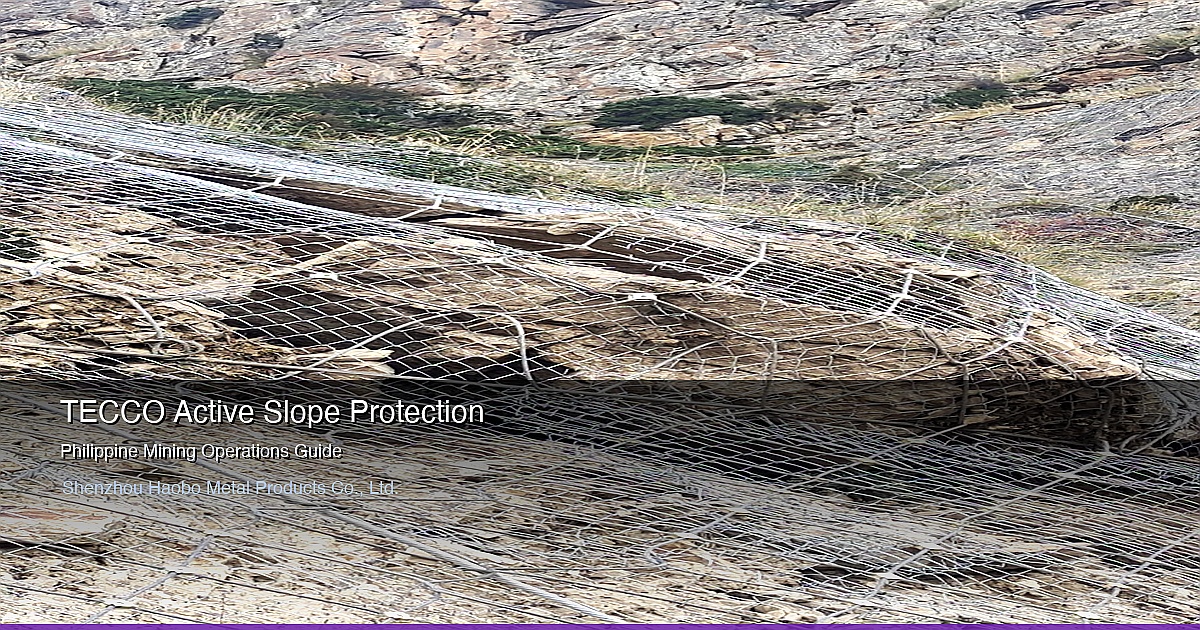
2.1 Tecco System (High-Tensile Steel Wire Mesh)
The TECCO system uses a high-tensile steel wire mesh (wire diameter 3.0mm, tensile strength ≥ 1,770 MPa) installed over the slope surface and anchored with soil nails at regular grid spacing. The mesh is designed as a structural element — not just an erosion control blanket — and carries the tensile loads generated by potential slope movement. System components:
- TECCO mesh: Diamond-shaped high-tensile wire mesh, roll width 3.3m, standard roll length 10-30m
- Soil nails: Threaded steel bars (diameter 25-32mm, Grade 500), installed in drilled boreholes and grouted
- Bearing plates: Steel plates (200×200×10mm) with spike nails for mesh engagement
- Perimeter rope: Steel wire rope (diameter 8mm or 12mm) at mesh boundaries for edge tensioning
- Grid pattern: Soil nails at 2.0m × 2.0m or 2.5m × 2.5m spacing, depending on slope angle and soil conditions
2.2 Spider System (Wire Rope Net + Double-Twisted Mesh)
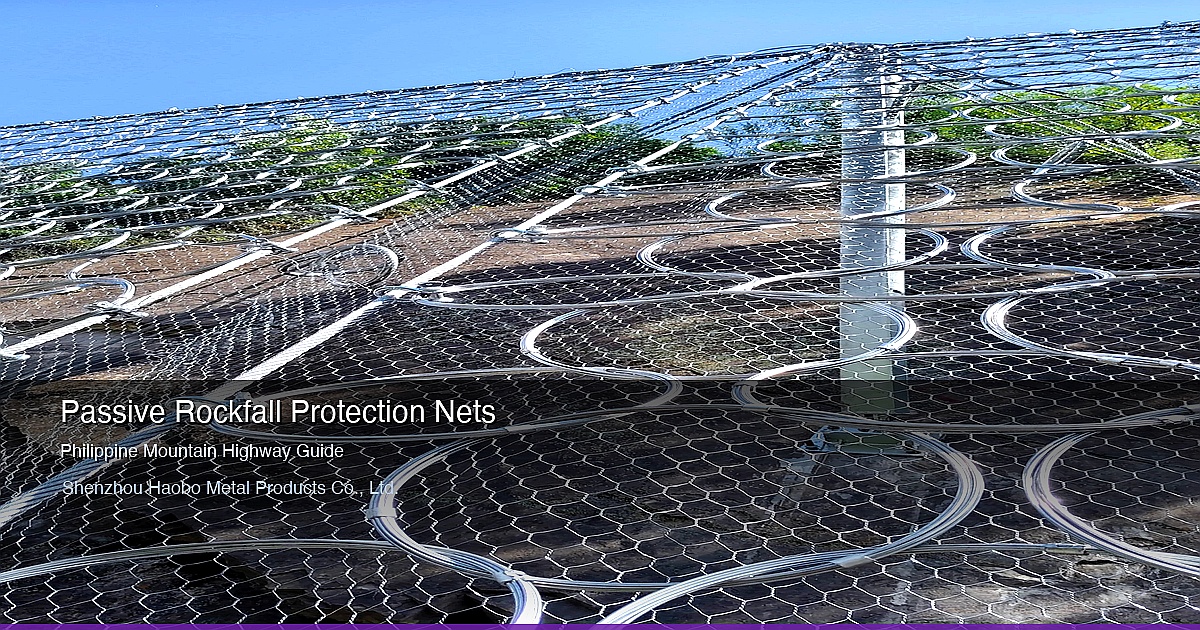
The Spider system uses a heavier wire rope net for steeper slopes and larger potential rock blocks. It combines a double-twisted hexagonal mesh (wire diameter 2.7-3.0mm) with an overlay of wire rope net panels (wire rope diameter 8mm, mesh opening 300×300mm). System components:
- Wire rope net panels: 8mm diameter steel wire rope, 300×300mm mesh, panel size 4×4m or 5×5m
- Double-twisted hexagonal mesh: 2.7-3.0mm wire, 80×100mm mesh (gabion-type mesh, installed beneath wire rope net)
- Soil nails or rock bolts: Threaded bars 25-32mm, or fully grouted rock anchors for rocky slopes
- Edge tensioning rope: 12mm wire rope around the perimeter, anchored at corners and spaced along edges
- Spike plates: Heavy-duty bearing plates with spikes that penetrate both mesh layers
2.3 Ring Net System (for higher energy / steeper / rock slopes)
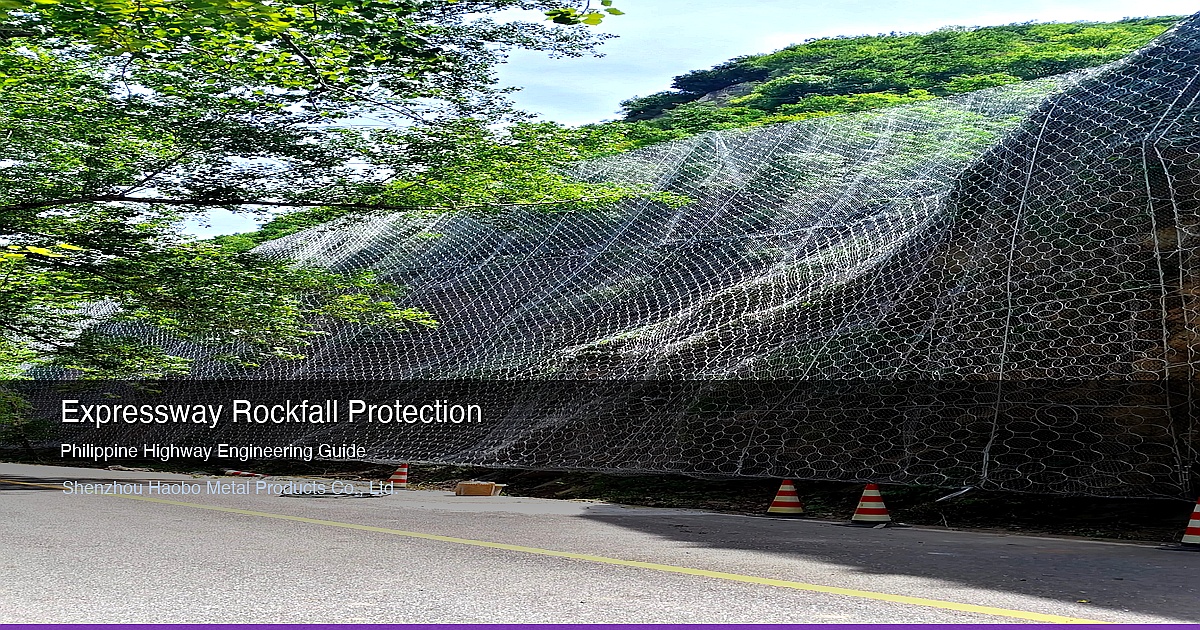
For very steep (50-80°) slopes with larger potential rock blocks (>500mm), ring net panels are used in an active configuration. The ring net consists of interlocking steel rings (diameter 300mm, wire rope 3mm × 12 loops per ring or 5mm × 5 loops per ring) draped over the slope and anchored with soil nails or rock bolts. This is the heaviest-duty active system, used for rock slopes rather than soil slopes.
2.4 Erosion Control Mesh (Low-Load Systems)
For gentle slopes (20-35°) with only surface erosion risk (no deep landslide potential), a lighter system using double-twisted hexagonal mesh (2.2mm wire, 80×100mm mesh) installed with shallow ground anchors (steel bars 16-20mm, 1.0-2.0m depth) at 2.0m grid spacing provides cost-effective surface stabilization. This system is NOT designed to resist landslide forces — only to prevent surface erosion and shallow rilling.
3. Design Methodology for Active Slope Protection Systems
3.1 Site Investigation Parameters
Before selecting and designing an active slope protection system, the following site-specific parameters must be determined through geotechnical investigation:
- Slope geometry: Height, angle, total surface area, slope profile (planar, convex, concave)
- Soil/rock type: Field classification (residual soil, colluvium, weathered rock, competent rock)
- Rock Mass Rating (RMR): For rock slopes — RMR < 30 requires heavier systems
- Soil strength parameters: Cohesion (c) and friction angle (φ) from triaxial testing
- Groundwater conditions: Depth to water table, seepage locations, perched water levels
- Potential failure surface: Depth, geometry, and volume of potential slide mass
- Design rock block size: For rock slopes — joint spacing survey, GSI (Geological Strength Index)
3.2 System Selection Matrix
| Slope Condition | Recommended System | Soil Nail Depth | Grid Spacing |
|---|---|---|---|
| Soil, 20-35°, erosion only | Erosion control mesh (2.2mm) | 1.0-2.0m | 2.0m × 2.0m |
| Soil, 30-45°, shallow slide risk | TECCO system (3.0mm) | 2.0-4.0m | 2.0m × 2.0m |
| Soil/rock, 40-55°, moderate rockfall | Spider system (mesh + rope net) | 3.0-5.0m | 2.5m × 2.5m |
| Rock, 50-80°, large block potential | Ring net (active) | Rock bolts 3.0-6.0m | 2.0m × 2.0m |
3.3 Soil Nail Design
The soil nail design follows the methodology in FHWA-NHI-14-007 (Geotechnical Engineering Circular No. 7 — Soil Nail Walls) and the Philippine Geotechnical Engineering practice. Key design parameters for a typical Philippine hillside residential slope:
- Nail bar: Threaded steel bar, diameter 25mm (Grade 500, fy = 500 MPa)
- Nail length: Minimum 0.7× slope height for shallow stabilization; typical 2.0-4.0m for Philippine residual soils
- Drill hole: Diameter 75-100mm, drilled rotary or percussion
- Grout: Cement-bentonite grout, water-cement ratio 0.45-0.50, compressive strength ≥ 21 MPa at 28 days
- Pullout resistance: Design bond stress 50-100 kPa for Philippine residual soils (verified by proof test)
- Nail spacing: 2.0m × 2.0m typical; reduce to 1.5m × 1.5m for higher-risk slopes
- Inclination: 10-20° below horizontal (to facilitate grouting and use gravity for grout flow)
The design nail tensile capacity is calculated as:
T_design = min(T_bar, T_grout, T_bond)
where:
T_bar = π × d²/4 × fy = 3.14 × (0.025)²/4 × 500,000 = 245 kN (bar capacity)
T_grout = π × D × L_grout × f_bond = 3.14 × 0.075 × 2.0 × 80 = 37.7 kN (bond, 2m grouted length)
T_design = 37.7 kN (governed by soil bond)
3.4 Mesh Selection and Load Capacity
The mesh must resist the tensile forces generated by the potential slide mass pressing against the mesh between soil nails. For a typical Philippine residential slope (slope angle 35°, potential slide depth 1.0m, soil unit weight 18 kN/m³):
F = γ × d × (sin β - cos β × tan φ) × S²
where: γ = 18 kN/m³, d = 1.0m, β = 35°, φ = 25° (saturated residual soil), S = 2.0m grid
F = 18 × 1.0 × (sin35° - cos35° × tan25°) × 4.0 = 18 × (0.574 - 0.819 × 0.466) × 4.0 = 18 × 0.193 × 4.0 = 13.9 kN
TECCO mesh (3.0mm wire, 1,770 MPa tensile) has a longitudinal tensile capacity of approximately 55 kN/m — well above the calculated demand of 13.9 kN over a 2m × 2m panel, giving a Factor of Safety of 55/(13.9/2.0) = 7.9. This generous FS allows the system to handle unexpected surcharge loads and larger slide masses without failure.
3.5 Drainage Integration
Proper drainage is the single most important factor in Philippine hillside slope stability — and active slope protection systems MUST include drainage provisions. Water pressure building behind the mesh and soil nails can reduce the effective stress and trigger the exact landslide the system is designed to prevent. Required drainage components:
- Surface drainage: Interceptor and collector drains at the slope crest, mid-slope bench, and toe — designed for 100-year/1-hour rainfall intensity (typically 120-150 mm/hour for Philippine mountain areas)
- Subsurface drainage: Horizontal drain pipes (50mm diameter slotted PVC) installed through the mesh at 2.0m spacing, extending 3-5m into the slope, discharging at the slope face
- Mesh drainage: The open mesh (70-80% open area for TECCO, 90%+ for wire rope net) allows surface water to pass through — this is critical; the mesh must NOT be covered with shotcrete or impermeable material
- Geotextile beneath mesh: A non-woven geotextile (≥ 200 g/m²) beneath the mesh prevents soil piping (fine particle washout) while allowing water to drain
4. Philippine Standards and Regulatory Requirements
4.1 NSCP 2015 Structural Requirements
The National Structural Code of the Philippines (NSCP) 2015, Volume I (Buildings) and Volume V (Geotechnical Engineering), provide the regulatory framework for hillside slope protection design. Key requirements:
- Seismic loading: Design for PGA 0.40g (Zone II, most of Luzon and Visayas) or 0.30g (Zone I, Mindanao and Palawan)
- Wind loading: Design for 250 kph (Zone II) or 200 kph (Zone I) 3-second gust — critical for mesh tensioning design
- Factor of Safety: Minimum FS = 1.5 for sliding, 1.5 for global stability (Bishop's method), 2.0 for bearing
- Geotechnical investigation: Required for all slopes > 3m height or supporting residential structures within a horizontal distance equal to slope height
4.2 MGB-DENR Geohazard Assessment
The Mines and Geosciences Bureau requires a geohazard assessment for all hillside residential subdivisions before development approval. The assessment classifies the site's landslide susceptibility as Low, Moderate, High, or Very High — and the classification directly affects the required level of slope protection engineering. For sites classified as High or Very High, engineered active slope protection systems with soil nails and structural mesh are typically required by the local government unit (LGU) building official before issuing a development permit.
4.3 Product Standards
| Component | Standard | Key Requirements |
|---|---|---|
| Steel wire mesh (TECCO type) | JT/T 528-2022 | Wire ≥ 3.0mm, tensile ≥ 1770 MPa, zinc ≥ 245 g/m² |
| Wire rope (Spider/ring net) | GB/T 8918 | Wire rope ≥ 8mm, tensile ≥ 1770 MPa |
| Soil nail bars | ASTM A615 / GB 1499.2 | Grade 500, diameter 25-32mm |
| Grout | ASTM C150 / PNS 25 | Type I Portland cement, f'c ≥ 21 MPa |
| Geotextile | AASHTO M288 | Non-woven ≥ 200 g/m², filtration grade |
5. Case Study 1: Antipolo Hillside Subdivision — Rizal Province
A 12-hectare hillside residential subdivision in Antipolo City, Rizal, developed in 2020-2022, required engineered slope protection for 850m of cut slopes ranging from 4m to 12m in height. The site sits on residual volcanic soil (andesite bedrock weathering) with slope angles of 35-50° and was classified as "High" landslide susceptibility by the MGB geohazard assessment.
| Parameter | Value |
|---|---|
| Total slope length | 850m (various heights 4-12m) |
| Slope area | 6,800 m² |
| System selected | TECCO system (3.0mm mesh + 25mm soil nails at 2.0m grid) |
| Soil nail length | 3.0-4.0m (varies by slope height) |
| Total soil nails installed | 1,700 |
| Mesh coverage | 6,800 m² TECCO G65/3 (Galfan-coated) |
| Drainage | Horizontal drains at 2m spacing + crest interceptor canal |
| Total cost | PHP 34 million (PHP 5,000/m² installed) |
| Performance (2022-2025) | Survived Typhoon Karding (2022) and Egay (2023) — zero slope movement, zero damage |
The Antipolo project was particularly notable because an adjacent subdivision (built in 2018 with shotcrete slope facing and no soil nails) experienced a 120m slope failure during Typhoon Karding in September 2022, destroying 3 houses and requiring PHP 18 million in emergency reconstruction. The TECCO-protected slopes immediately adjacent showed zero movement — a direct, visible comparison of the two approaches under identical conditions.
6. Case Study 2: Baguio City Mountain Estate — Benguet Province
A high-end residential mountain estate in Baguio City, situated on weathered sedimentary rock slopes at 1,400m elevation, required slope protection for 420m of cut slopes with heights of 6-18m and angles of 45-65°. The site sits on moderately weathered shale and sandstone with RMR 35-50, with winter monsoon rainfall exceeding 4,000mm/year.
| Parameter | Value |
|---|---|
| Total slope length | 420m |
| Slope area | 4,200 m² |
| System selected | Spider system (wire rope net + double-twisted mesh + rock bolts) |
| Rock bolt length | 4.0-6.0m, fully grouted |
| Bolt grid | 2.0m × 2.0m |
| Wire rope net | 8mm wire rope, 300×300mm mesh, 4×4m panels |
| Mesh beneath | Double-twisted 2.7mm, 80×100mm, Galfan-coated |
| Total cost | PHP 29.4 million (PHP 7,000/m² installed) |
| Performance (2021-2025) | Survived multiple typhoons + 2023 Magnitude 6.4 Abra earthquake — zero damage |
The Baguio project demonstrated the value of the Spider system for harder rock conditions: the wire rope net panels conformed to the irregular rock surface and contained multiple small rockfall events that were observed during inspections but never dislodged from the mesh face. The double-twisted mesh beneath prevented small fragment fallout between the rope net openings.
7. Installation Methodology for Active Slope Protection Systems
7.1 Step 1: Site Preparation
- Clear the slope surface of vegetation, loose material, and organic debris — BUT preserve any established vegetation root systems where possible
- Trim and grade the slope face to a reasonably uniform profile — remove overhangs and protruding rocks that would bridge the mesh
- Install surface drainage (interceptor canal at crest, collector drain at toe) before mesh installation
- Install geotextile filter fabric (≥ 200 g/m² non-woven) over the prepared slope surface, with 150mm overlaps at seams
7.2 Step 2: Soil Nail / Rock Bolt Installation
- Mark nail locations on the slope surface using spray paint, verifying the grid spacing (2.0m × 2.0m typical)
- Drill boreholes to the design depth and diameter — use rotary drilling for soil, percussion drilling for rock
- Install threaded steel bars with centralizers in the borehole, ensuring the bar extends to the full design depth
- Grout the borehole with cement-bentonite grout (w/c ratio 0.45-0.50), pumping from the bottom up until clean grout returns at the surface
- Allow grout to cure minimum 3 days before applying tension or installing bearing plates
- Proof testing: Test 5% of nails (minimum 3 per slope) to 1.5× design load — any nail failing the test must be replaced by two new nails at 0.5m offset
7.3 Step 3: Mesh Installation
- Unroll the mesh from the slope crest downward — work from the top, allowing gravity to assist
- Position the mesh over the geotextile filter, aligning mesh openings over the soil nail locations
- Install bearing plates and spike nuts over the mesh at each soil nail, tensioning the mesh to a snug but not rigid condition (the mesh should conform to the slope surface without sagging)
- Install perimeter edge rope (8-12mm wire rope) around the mesh boundary, anchored at corners and every 3m along edges
- Overlap mesh rolls by a minimum of 100mm at seams and tie with 3.0mm lacing wire at 150mm spacing
7.4 Step 4: Final Drainage and Vegetation
- Install horizontal drain pipes (50mm slotted PVC) through the mesh at 2.0m spacing, extending 3-5m into the slope
- Apply hydroseeding (native Philippine grass species + fertilizer + tackifier) over the mesh surface — the mesh provides an excellent substrate for vegetation establishment
- Install surface collector drains at the slope toe, connecting to the site stormwater system
- Conduct final inspection: verify all nail locations are plate-tensioned, mesh is in continuous contact with slope surface, drainage is functioning, and vegetation is established
8. Maintenance and Inspection Schedule
| Frequency | Inspection Items | Action |
|---|---|---|
| Monthly (rainy season) | Drainage function, surface erosion, mesh tension | Clear drains, re-tension loose mesh, repair erosion |
| Quarterly | Vegetation condition, nail bearing plates, rust inspection | Trim vegetation, replace corroded plates, document findings |
| Post-typhoon | Full visual + survey of nail heads + drain flow test | Replace damaged components, clear drains, re-tension |
| Annual (licensed engineer) | Comprehensive structural + geotechnical inspection | Issue certification, plan remedial works |
| 5-year | Pullout test of 2 sacrificial nails, mesh tensile sample | Verify residual capacity, replace if degraded |
9. Sourcing Active Slope Protection Materials from China
Shenzhou Haobo Metal Products Co., Ltd. manufactures all components of active slope protection systems in compliance with JT/T 528-2022 (Chinese standard for slope protection netting systems) and GB/T 8918 (wire rope standard). For Philippine hillside residential projects, we supply:
| Component | Specification | Standard |
|---|---|---|
| High-tensile steel wire mesh (TECCO type) | 3.0mm wire, tensile ≥ 1770 MPa, mesh 65×65mm or 80×100mm | JT/T 528-2022 |
| Double-twisted hexagonal mesh | 2.7-3.0mm wire, 80×100mm mesh, Galfan 275 g/m² | YB/T 4190-2018 |
| Wire rope net panels | 8mm wire rope, 300×300mm mesh, 4×4m panels | GB/T 8918 |
| Ring net panels | Ring diameter 300mm, wire rope 3mm×12 loops or 5mm×5 loops | JT/T 528-2022 |
| Spike bearing plates | 200×200×10mm steel, hot-dip galvanized | ISO 1461 |
| Wire rope (perimeter) | 8-12mm, 6×19+FC construction, Galfan-coated | GB/T 8918 |
9.1 Logistics: Tianjin → Manila
- Packaging: Mesh rolls wrapped in woven polyethylene, wire rope coiled on wooden reels, plates on pallets
- Container loading: TECCO mesh: 3,000-4,000 m² per 20' container; Spider system: 1,500-2,000 m² per 20' container
- Lead time: 2-3 weeks for standard specifications; 3-4 weeks for Galfan-coated
- Transit: Tianjin → Manila MICT, 5-7 days
- Total delivery: 4-6 weeks from order to Manila port
10. Cost Comparison: Active Systems vs Alternative Approaches
| Approach | Unit Cost (PHP/m²) | Service Life | Key Advantage | Key Limitation |
|---|---|---|---|---|
| Shotcrete facing | 3,500-4,500 | 15-25 years | Rigid, familiar | No drainage, cracks under seismic, traps water |
| RC retaining wall | 8,000-15,000 | 30-50 years | High structural capacity | Very expensive, requires excavation, rigid |
| Erosion control mesh | 1,200-1,800 | 15-25 years | Low cost | No structural capacity, erosion only |
| TECCO system (active) | 4,500-6,500 | 25-35 years | Structural + drainage + flexible | Requires geotechnical investigation |
| Spider system (active) | 6,000-8,500 | 25-35 years | Heavier loads, rock conditions | Higher cost than TECCO |
Conclusion
Active slope protection systems — TECCO mesh, Spider wire rope net, and ring net configurations — provide Philippine hillside residential developments with a superior engineering solution to landslide risk. They combine structural load capacity (soil nails + high-tensile mesh), drainage (open mesh allows water to pass freely), and flexibility (survive seismic and settlement movements that crack rigid alternatives) at a cost 25-45% below reinforced concrete retaining walls.
The two Philippine case studies — Antipolo (TECCO, soil slopes) and Baguio (Spider, rock slopes) — demonstrate that properly designed active systems survive Category 4-5 typhoons and moderate earthquakes with zero damage, while adjacent rigid structures fail catastrophically. The key success factors are: thorough geotechnical investigation, correct system selection based on slope angle and soil/rock type, proper soil nail design and proof testing, and integration of surface and subsurface drainage.
Shenzhou Haobo Metal Products Co., Ltd. supplies all components of active slope protection systems — TECCO mesh, Spider wire rope net panels, ring nets, spike bearing plates, and perimeter rope — manufactured to JT/T 528-2022 and GB/T 8918 standards, with Galfan coating for Philippine tropical environments. Send us your slope parameters (height, angle, soil type, and project location) and we will provide a complete material specification with FOB Tianjin pricing within 48 hours.
Need Active Slope Protection for Your Hillside Development?
Send us your slope parameters — height, angle, soil type, RMR, and MGB geohazard classification. Our engineering team provides TECCO or Spider system specifications with soil nail design, drainage plan, and FOB Tianjin pricing within 48 hours. Galfan-coated mesh for 25-35 year service life in Philippine tropical climate.
www.haobomesh.com | Shenzhou Haobo Metal Products Co., Ltd.