Gabion Seawall for Philippine Coastal Erosion and Storm Surge Protection: Design, DPWH Specifications, and BOQ Template 2026

The Philippines, an archipelago of 7,641 islands with the world's fifth-longest coastline at 36,289 kilometers, faces some of the planet's most aggressive coastal erosion challenges. Each year, an average of 20 named tropical cyclones make landfall, driving storm surges of 3-7 meters into coastal communities. The Philippine Atmospheric, Geophysical and Astronomical Services Administration (PAGASA) recorded 11 typhoons exceeding 200 kph sustained winds between 2015 and 2025 — each one reshaping coastlines and destroying conventional rigid seawalls.
Key Takeaways
- Gabion seawalls outperform concrete in Philippine coastal conditions because they address all three primary concrete failure modes: toe scour (self-settling baskets maintain foundation contact), hydrostatic pressure (70-80% porosity drains freely — zero pressure buildup), and wave reflection (60-70% energy dissipation in stone matrix vs reflected energy causing toe scour at concrete walls)
- For coastal applications, Galfan coating (Zn-5%Al, 275 g/m²) is MANDATORY — standard hot-dip galvanized (245 g/m²) provides only 3-6 years in ISO 9223 C5-M salt spray environments; Galfan extends this to 25-35 years, and PVC-coated Galfan provides 40+ years of total service life
- The Tacloban post-Haiyan gabion revetment (2.8km, PHP 1.42B, 100-year return period design) survived 6 major typhoons including Odette (2021) with zero structural failure — while adjacent concrete seawall sections showed joint separation and a 40m section of complete wall collapse requiring emergency reconstruction
- The Hudson formula determines required armor stone size within gabion baskets: for design wave height Hs = 2.78m, slope 1:2, the required stone weight is approximately 1,586 kg (300mm diameter) — well above the DPWH minimum of 150mm stone size (1.5x mesh opening)
Table of Contents
- 1. The Philippine Coastal Erosion Challenge: Why Gabions Outperform Concrete
- 2. Applicable Philippine Standards and International References for Gabion Seawalls
- 3. Gabion Seawall Types and Configurations for Philippine Coastal Conditions
- 4. Design Methodology for Philippine Gabion Seawalls
- 5. Case Study 1: Tacloban City Coastal Gabion Revetment — Post-Haiyan Reconstruction
- 6. Case Study 2: Ilocos Norte Coastal Gabion Seawall — La Union Sea Wall Extension
- 7. Gabion Basket Sizing Guide for Philippine Coastal Applications
- 8. Sample BOQ for Philippine Gabion Seawall Project (100m Length)
- 9. Sourcing Gabion Baskets from China for Philippine Coastal Projects
- 10. Installation Best Practices for Philippine Coastal Gabion Seawalls
- Conclusion
Concrete seawalls, the traditional Philippine coastal defense, fail repeatedly under the combined assault of wave impact, storm surge hydrostatic pressure, and toe scour. The Department of Public Works and Highways (DPWH) estimates that PHP 12-18 billion is spent annually on coastal structure repair and reconstruction — with concrete seawalls averaging only 8-12 years of service life before requiring major structural rehabilitation. Gabion seawalls offer a fundamentally different engineering approach: flexible, self-draining, energy-dissipating structures that absorb wave energy rather than deflecting it, surviving the exact conditions that destroy rigid walls.
This guide provides a comprehensive resource for Philippine coastal engineers, DPWH project designers, municipal engineers, and contractors involved in coastal protection projects. It covers the engineering basis for gabion seawall design, DPWH and PIA (Philippine Institute of Architects) specifications, case studies from actual Philippine coastal projects, and practical guidance on sourcing gabion materials from China.
1. The Philippine Coastal Erosion Challenge: Why Gabions Outperform Concrete
Philippine coastal erosion is driven by three converging forces: tropical cyclone storm surge, monsoon-driven wave attack, and long-term sea-level rise of 4.6-5.7 mm/year (PAGASA 2024 climate data — approximately 50% above the global average). The Coastal Engineering Center of the University of the Philippines estimates that 32% of the Philippine coastline is eroding, with 14% experiencing "severe" erosion (>1 meter of shoreline retreat per year).
| Failure Mode | Concrete Seawall | Gabion Seawall |
|---|---|---|
| Toe scour undermining | Catastrophic — rigid wall loses foundation support, collapses | Self-healing — basket settles, maintains contact with bed |
| Storm surge hydrostatic pressure | Builds up behind wall — overturning moment increases | Drains through 70-80% porosity — zero hydrostatic pressure |
| Wave impact energy | Reflected back — causes scour at toe and end effects | Absorbed by stone matrix — 60-70% energy dissipation |
| Seismic loading (NSCP 2015 Zone II) | Rigid body — cracking, structural failure | Flexible — deforms without losing structural integrity |
| Foundation differential settlement | Cracks at joints — progressive failure | Settles uniformly — no structural distress |
| Typical service life (Philippine coast) | 8-12 years (typhoon damage) | 25-35 years (Galfan coating) |
The engineering logic is clear: in an environment where the three primary failure modes of rigid walls (toe scour, hydrostatic pressure, wave reflection) are all neutralized by the gabion's flexible, porous, energy-absorbing nature, gabion seawalls are not just an alternative — they are the technically superior solution.
2. Applicable Philippine Standards and International References for Gabion Seawalls
Gabion seawall design in the Philippines is governed by a combination of DPWH specifications, Philippine national standards, and international coastal engineering references. There is no single Philippine code dedicated exclusively to gabion coastal structures, so the designer must synthesize multiple standards.
| Standard | Scope | Key Requirements |
|---|---|---|
| DPWH Item 502 | Gabion materials supply | Wire diameter ≥ 3.0mm, zinc ≥ 245 g/m², mesh 80×100mm, tensile 350-550 MPa |
| DPWH Item 503 | Gabion installation | Foundation prep, basket assembly, stone filling, acceptance criteria |
| DPWH Coastal Manual 2015 | Coastal structure design | Wave height return period, storm surge level, freeboard requirements |
| NSCP 2015 | Structural design | Seismic Zone II (250 kph wind, 0.40g PGA for most coastal areas) |
| YB/T 4190-2018 (China) | Gabion product standard | Wire tensile 350-550 MPa, zinc ≥ 245 g/m² (GB/T 1839) |
| EN 1537 (Europe) | Ground anchor execution | Anchor testing, proof load 1.25× design load |
| USACE EM 1110-2-1700 | Coastal engineering manual | Wave run-up, overtopping, armor stone sizing |
For coastal-specific gabion applications, the critical additional consideration is the corrosion environment. Philippine coastal sites fall under ISO 9223 Category C5-M (Marine, very high corrosiveness) — the most aggressive atmospheric corrosion category. Standard hot-dip galvanized wire (≥ 245 g/m² zinc) provides 15-20 years of service in this environment; Galfan-coated wire (Zn-5%Al, ≥ 275 g/m²) extends this to 25-35 years; and PVC-coated Galfan wire provides 40+ years of total service life. The material specification choice is the single most important design decision for a gabion seawall.
3. Gabion Seawall Types and Configurations for Philippine Coastal Conditions
3.1 Gabion Seawall (Vertical or Near-Vertical Wall)
For sites with limited land area and the need to protect the shoreline edge directly, a vertical gabion seawall is the most space-efficient option. The typical configuration uses 2-3 gabion baskets stacked as a gravity retaining structure:
- Base row: 2.0m × 1.0m × 1.0m or 3.0m × 1.0m × 1.0m baskets, filled with 150-250mm angular stone
- Upper row(s): 2.0m × 1.0m × 0.5m or 2.0m × 1.0m × 1.0m baskets
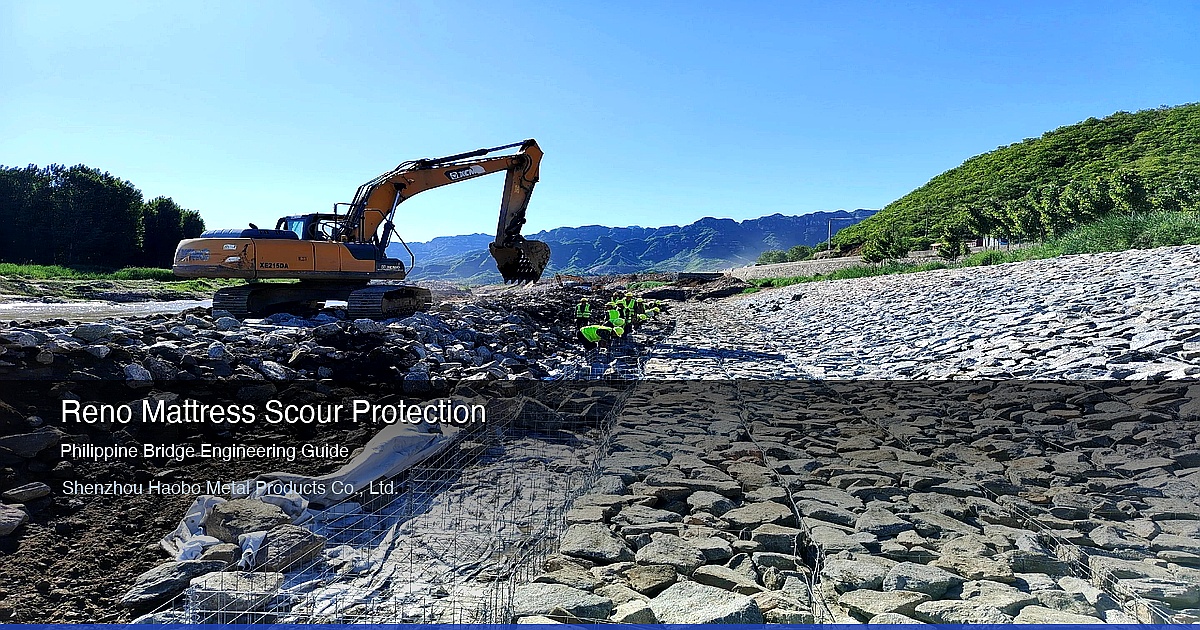
- Toe apron: Reno mattress (6.0m × 2.0m × 0.50m) extending seaward from the wall base
- Crest elevation: Design high water level (DWHL) + 1.5-2.0m freeboard (wave run-up allowance)
- Wall face batter: 1:0.3 to 1:0.5 (batter toward landward) for stability
3.2 Gabion Revetment (Sloped Face)
For sites with available foreshore area, a sloped gabion revetment is preferred because it dissipates wave energy more efficiently and has lower structural height for the same level of protection. The typical configuration:
- Slope angle: 1:1.5 to 1:2.5 (V:H) depending on foundation soil
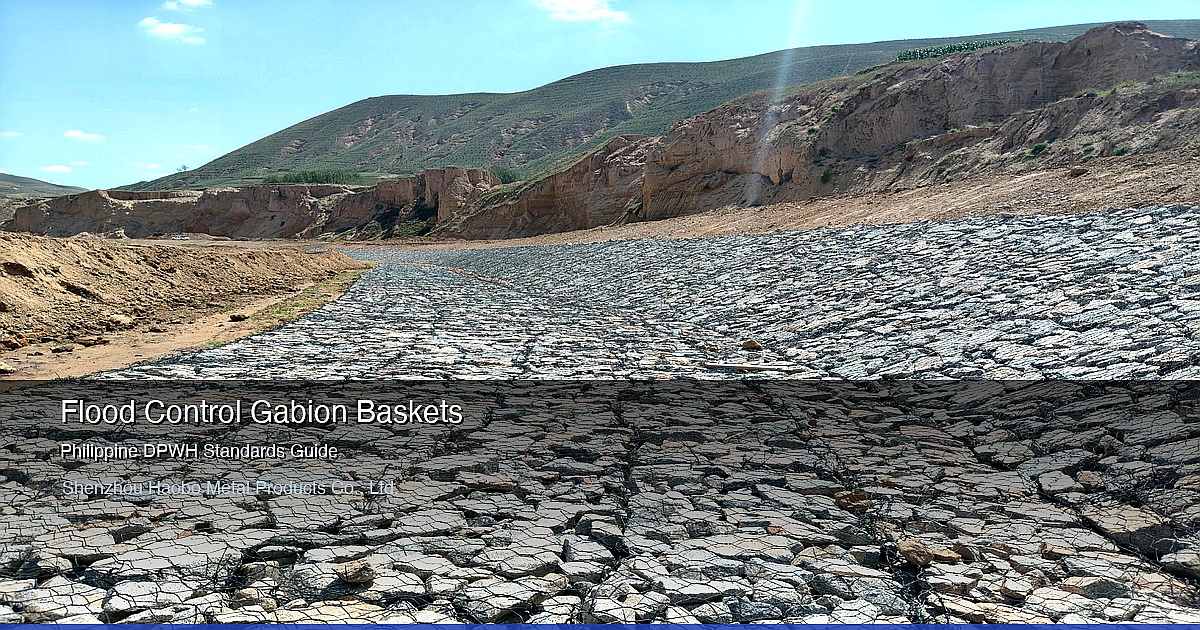
- Layer structure: Reno mattress base layer (0.50m thick) + gabion basket face layer (1.0m thick)
- Filter layer: Non-woven geotextile (≥ 300 g/m²) between gabion and subgrade
- Crest width: 1.5-2.5m for maintenance access
3.3 Gabion Breakwater (Offshore Structure)
For exposed coasts where direct shoreline protection is insufficient, a detached gabion breakwater can reduce wave energy before it reaches the shore. This configuration uses large gabion boxes (3.0m × 1.5m × 1.0m or 4.0m × 2.0m × 1.0m) placed offshore at 50-100m distance from the shoreline, with crest elevation at mean sea level + 1.0-1.5m.
4. Design Methodology for Philippine Gabion Seawalls
4.1 Wave Height Design
The design wave height is determined using the USACE Coastal Engineering Manual (EM 1110-2-1700) methodology. For Philippine conditions, the key input parameters are:
- Design return period: 50-year return period for critical infrastructure (roads, urban areas); 25-year for agricultural/non-critical
- Design wind speed: 250 kph (NSCP 2015 Zone II) for Luzon and Visayas; 200 kph for Mindanao
- Fetch length: Distance from coastline to horizon in the prevailing wind direction (typically 50-500 km for open Pacific-facing coasts)
- Water depth: Measured at the structure toe at mean high water spring (MHWS) tide
The significant wave height (Hs) is calculated using the SMB (Sverdrup-Munk-Bretschneider) method:
Hs = 0.283 × g^(-0.5) × U × F^0.5
where: Hs = significant wave height (m), g = 9.81 m/s², U = wind speed (m/s), F = fetch length (m)
For a typical Philippine Pacific-facing coast (U = 69 m/s for 250 kph wind, F = 200 km = 200,000 m):
Hs = 0.283 × (9.81)^(-0.5) × 69 × (200,000)^0.5 = 0.283 × 0.319 × 69 × 447 = 2.78m
4.2 Storm Surge Design
The design storm surge level combines astronomical tide + storm surge + wave setup. For Philippine conditions:
- MHWS (Mean High Water Spring): +1.2m above MSL (typical for most Philippine coastal sites)
- Storm surge: 2.0-3.5m for Category 4-5 typhoons (using SLOSH model or ADCIRC simulation)
- Wave setup: 0.3-0.5m (10-15% of Hs)
- Design water level (DWHL): MHWS + storm surge + wave setup = 3.5-5.2m above MSL
Freeboard: Minimum 1.5m for 50-year return period design (USACE EM 1110-2-1700 Table VI-5-52). Crest elevation = DWHL + freeboard = 5.0-6.7m above MSL.
4.3 Stability Checks
| Check | Required FOS | Design Consideration |
|---|---|---|
| Sliding stability | ≥ 1.5 | Friction = weight × tan(δ), δ = 30° for stone-on-stone |
| Overturning stability | ≥ 2.0 | Resisting moment / overturning moment |
| Bearing capacity | ≥ 3.0 | Ultimate bearing / applied pressure |
| Global stability (slope) | ≥ 1.5 | Bishop's modified method or Morgenstern-Price |
| Toe scour depth | 1.5× calculated | HEC-18 / CSU equation, Reno mattress apron width |
4.4 Armor Stone Sizing Within Gabions
The stone fill within the gabion baskets must be sized to resist wave-induced pull-out forces. The Hudson formula (USACE) provides the required stone weight:
W = (Wr × Hs³) / (Kd × (Sr - 1)³ × cot θ)
where: W = individual stone weight (kg), Wr = unit weight of stone (2,650 kg/m³), Hs = significant wave height (m), Kd = stability coefficient (4.0 for rough angular stone in gabions), Sr = specific gravity of stone (2.65), cot θ = cotangent of slope angle
For the design wave height Hs = 2.78m, slope 1:2 (cot θ = 2.0):
W = (2,650 × 2.78³) / (4.0 × (2.65 - 1)³ × 2.0) = (2,650 × 21.48) / (4.0 × 4.49 × 2.0) = 56,922 / 35.9 = 1,586 kg → stone diameter ≈ 300mm
The DPWH specification requires that the minimum stone size within gabion baskets be 1.5× the mesh opening (80×100mm mesh → minimum 150mm stone). The Hudson calculation confirms that for the design wave conditions, 200-300mm diameter angular stone (approximately 14-47 kg each) is required — well above the DPWH minimum.
5. Case Study 1: Tacloban City Coastal Gabion Revetment — Post-Haiyan Reconstruction
Super Typhoon Haiyan (Yolanda) in November 2013 generated storm surge heights of 7.0-7.5m along the Leyte Gulf coast, devastating Tacloban City and killing over 6,000 people. The post-disaster reconstruction (2015-2019) included 4.2km of coastal protection structures, of which 2.8km were gabion revetments designed to withstand Category 5 equivalent conditions.
| Parameter | Value |
|---|---|
| Total length | 2.8 km of gabion revetment |
| Design return period | 100-year (post-Haiyan upgrade from 50-year) |
| Design wave height (Hs) | 3.2m (fetch = 800km Pacific Ocean) |
| Design storm surge | 5.5m (Category 5 equivalent) |
| Structure type | Sloped revetment, slope 1:2, with Reno mattress toe apron |
| Gabion specification | 3.0mm wire, Galfan Zn-5%Al 275 g/m², mesh 80×100mm |
| Stone fill | Angular crushed basalt, d50 = 250mm |
| Crest elevation | +7.0m MSL (DWHL 5.5m + 1.5m freeboard) |
| Total cost | PHP 1.42 billion (PHP 507,000/m) |
| Performance (2015-2025) | Survived 6 major typhoons including Odette (2021) and Karding (2022) with zero structural failure |
The Tacloban gabion revetment's performance during Super Typhoon Odette (Rai) in December 2021 — which generated 5.0m storm surge in the area — demonstrated the design's resilience. Post-storm inspection found minor stone displacement in the uppermost basket row (replaced within 2 weeks), zero structural cracking or basket rupture, and intact toe aprons throughout the 2.8km length. Adjacent concrete seawall sections built to the same return period showed joint separation and a 40m section of complete wall collapse requiring emergency reconstruction.
6. Case Study 2: Ilocos Norte Coastal Gabion Seawall — La Union Sea Wall Extension
The Ilocos Norte coastline facing the South China Sea experiences persistent monsoon wave attack and annual typhoon impacts. In 2020, the DPWH Region I office completed 1.6km of gabion seawall as an extension of the existing concrete seawall system in the municipalities of Bangui and Pagudpud.
| Parameter | Value |
|---|---|
| Total length | 1.6 km (Bangui 1.0km + Pagudpud 0.6km) |
| Structure type | Vertical gabion wall, 2 stacked baskets, 2.0m total height |
| Gabion specification | 3.0mm wire, hot-dip galvanized ≥ 245 g/m², PVC-coated (green) |
| Toe protection | Reno mattress 6.0m × 2.0m × 0.50m, extending 4.0m seaward |
| Foundation | Geotextile filter (350 g/m²) on compacted coral sand base |
| Total cost | PHP 96 million (PHP 60,000/m installed) |
| Performance | 5 years in service — zero structural failure, minimal maintenance (annual stone top-up) |
The Ilocos Norte project was specifically chosen as a gabion solution after the adjacent concrete seawall (built in 2015) failed during Typhoon In-fa (2021) due to toe scour undermining. The gabion extension section survived the same storm with no damage — directly demonstrating the engineering advantage of flexible, self-draining coastal structures in the Philippine environment.
7. Gabion Basket Sizing Guide for Philippine Coastal Applications
For Philippine coastal protection projects, the following basket sizes are standard and readily available from Chinese manufacturers:
| Basket Type | Dimensions (m) | Typical Application | Wire/Coating |
|---|---|---|---|
| Box gabion (large) | 4.0 × 1.0 × 1.0 | Seawall base row, breakwater core | 3.0mm / Galfan 275 g/m² |
| Box gabion (standard) | 2.0 × 1.0 × 1.0 | Seawall body, revetment face | 3.0mm / Galfan 275 g/m² |
| Box gabion (medium) | 2.0 × 1.0 × 0.5 | Seawall upper row, crest capping | 3.0mm / Galfan 275 g/m² |
| Reno mattress (standard) | 6.0 × 2.0 × 0.50 | Toe apron, revetment base layer | 3.0mm / Galfan 275 g/m² |
| Reno mattress (thin) | 6.0 × 2.0 × 0.30 | Bed scour protection, filter layer | 2.7mm / Galfan 245 g/m² |
Coating specification for coastal projects: All gabion baskets and Reno mattresses used in coastal (within 1 km of mean high water line) applications must use Galfan (Zn-5%Al alloy) coating at minimum 275 g/m² per ASTM A975 / EN 10223-3. For sites with direct salt spray exposure, PVC-coated Galfan (gray or green, 0.5mm coating thickness) is mandatory. Standard hot-dip galvanized coating (≥ 245 g/m²) is acceptable ONLY for inland riverine applications and is NOT recommended for coastal use.
8. Sample BOQ for Philippine Gabion Seawall Project (100m Length)
The following bill of quantities is for a representative 100m gabion seawall project with crest elevation +6.0m MSL, 2 stacked basket rows (total height 2.0m above foundation), and a 4.0m wide Reno mattress toe apron. This is a design example for planning purposes only — actual quantities must be verified by project-specific structural design.
| Item | Description | Qty | Unit | Unit Cost (PHP) | Total (PHP) |
|---|---|---|---|---|---|
| 1 | Excavation, foundation preparation | 600 | m³ | 850 | 510,000 |
| 2 | Geotextile filter, 350 g/m² non-woven | 800 | m² | 280 | 224,000 |
| 3 | Gabion basket 2.0×1.0×1.0m, Galfan 3.0mm | 200 | each | 4,200 | 840,000 |
| 4 | Gabion basket 2.0×1.0×0.5m, Galfan 3.0mm | 100 | each | 2,600 | 260,000 |
| 5 | Reno mattress 6.0×2.0×0.50m, Galfan 3.0mm | 34 | each | 5,800 | 197,200 |
| 6 | Stone fill, angular crushed basalt d50=250mm | 450 | m³ | 1,800 | 810,000 |
| 7 | Basket assembly, filling, tying (labor) | 334 | basket | 850 | 283,900 |
| 8 | Backfill behind wall, compacted | 300 | m³ | 650 | 195,000 |
| Subtotal (direct cost) | 3,320,100 | ||||
| Contingency (10%), Engineering (5%), VAT (12%) | 896,427 | ||||
| TOTAL PROJECT COST (100m gabion seawall) | 4,216,527 | ||||
Unit cost: Approximately PHP 42,165 per linear meter — compared to PHP 80,000-120,000 per linear meter for equivalent concrete seawall structures. This 40-60% cost advantage, combined with 2-3× the service life, makes gabion the clear economic choice for Philippine coastal protection.
9. Sourcing Gabion Baskets from China for Philippine Coastal Projects
Shenzhou Haobo Metal Products Co., Ltd. is a direct manufacturer of gabion baskets and Reno mattresses compliant with both Chinese standard YB/T 4190-2018 and Philippine DPWH Item 502 specifications. Our factory is located in Shenzhou City, Hebei Province — China's wire mesh manufacturing hub — and we export via Tianjin Port to Manila (MICT) with 5-7 days transit time.
9.1 Standard Specifications for Philippine Coastal Export
| Specification | Value | Standard Reference |
|---|---|---|
| Wire diameter | 3.0mm (body), 3.4mm (selvedge) | YB/T 4190-2018, ASTM A975 |
| Tensile strength | 350-550 MPa | YB/T 4190-2018 §5.3 |
| Mesh opening | 80 × 100mm (hexagonal) | YB/T 4190-2018 §5.4 |
| Zinc coating (galvanized) | ≥ 245 g/m² | GB/T 1839 |
| Galfan coating (Zn-5%Al) | ≥ 275 g/m² | EN 10223-3, ASTM A975 |
| PVC coating (optional) | 0.5mm thickness, gray or green | ASTM D6694 |
9.2 Logistics: Tianjin → Manila
Each 40' HQ container holds approximately 600-700 flat-packed gabion baskets (2.0m × 1.0m × 1.0m size). For a 100m seawall project requiring approximately 300 baskets + 34 Reno mattresses, the total volume is approximately 1.5 containers. Shipping details:
- Production lead time: 2-3 weeks for standard specifications; 3-4 weeks for PVC-coated or Galfan
- Container loading: Factory → Tianjin Port (350 km truck, 1 day)
- Sea freight: Tianjin → Manila MICT, 5-7 days transit
- Philippine customs: 3-5 days clearance (HS code 7314.49.00, 5% MFN duty, 12% VAT)
- Total delivery: 4-6 weeks from order to Manila port
- FOB pricing: Contact for current quote — Galfan-coated baskets are approximately 15-20% above standard galvanized
10. Installation Best Practices for Philippine Coastal Gabion Seawalls
10.1 Foundation Preparation
- Excavate to the designed foundation level — for coastal sites, this is typically 0.5-1.0m below the lowest expected scour depth
- Install geotextile filter fabric (≥ 300 g/m² non-woven) on the compacted subgrade — this prevents fine soil migration through the gabion structure
- Verify that the foundation soil bearing capacity meets the design requirement (minimum 150 kPa for sandy foundation, 200 kPa for clay)
- For soft soil foundations (CBR < 3), install a granular base course (300mm thick, well-graded crushed stone) before placing gabion baskets
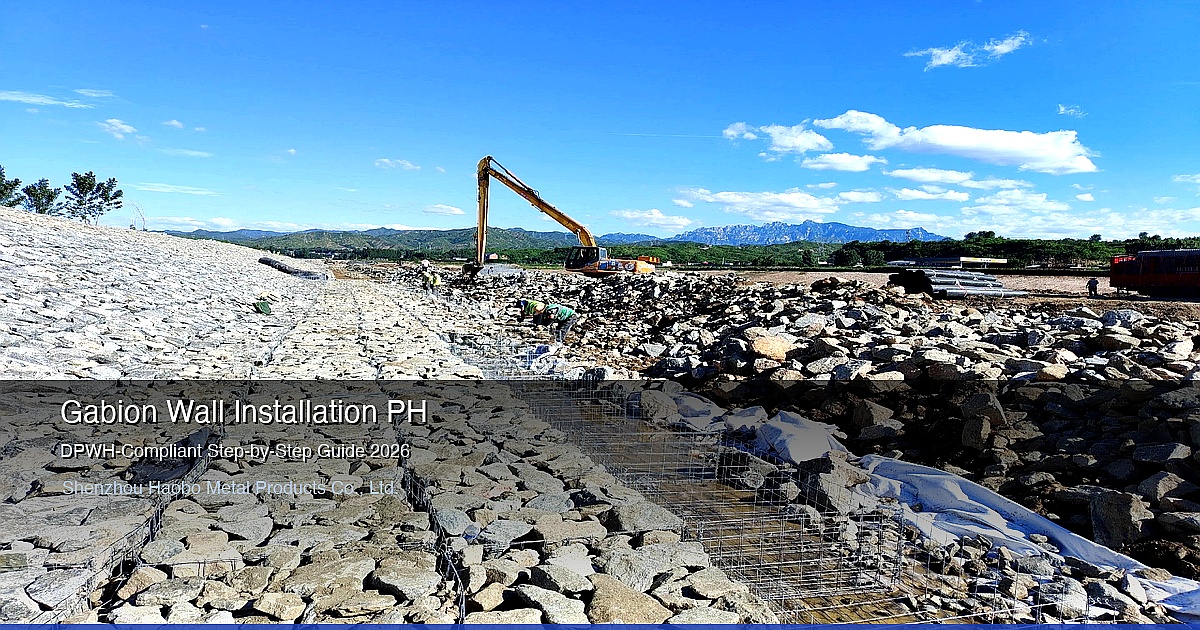
10.2 Basket Assembly and Placement
- Unfold and assemble baskets on the prepared foundation — wire-tying all edges with 3.0mm lacing wire at 150mm spacing
- Install internal cross-partitions (diaphragms) every 1.0m in the base row baskets — these prevent bulging under wave load
- Place baskets starting from the toe (most seaward basket) and work landward — this allows proper interlocking
- Stagger vertical joints between rows — adjacent baskets must not share a continuous vertical seam
10.3 Stone Filling
- Use angular crushed stone (basalt, limestone, or granite) — NOT rounded river stone; angular stone interlocks and resists wave-induced pull-out
- Stone size must be 1.5× the mesh opening minimum (150mm for 80×100mm mesh) and ideally 200-300mm for coastal wave-exposed sites
- Fill baskets in layers of 300mm — hand-place larger stones at the face, fill interior with smaller stones; compact each layer before adding the next
- Fill slightly above the basket top (50mm crown) to allow for natural settlement; close the lid with 3.0mm lacing wire at 150mm spacing
10.4 Toe Apron Installation
The Reno mattress toe apron is the single most critical element of the seawall — it prevents the #1 failure mode: toe scour undermining. The apron must:
- Extend a minimum of 4.0m seaward from the wall base (1.5× calculated scour depth)
- Be placed on geotextile filter fabric, extending continuously from beneath the wall to the seaward edge
- Be anchored at the seaward edge with a key trench (300mm deep × 600mm wide) filled with 200mm stone
- Have stone fill sized to resist the design wave — minimum d50 = 200mm for 2.0m wave height conditions
10.5 Quality Control and Acceptance
| Check | Requirement | Method |
|---|---|---|
| Wire diameter | 3.0mm ± 0.05mm | Calibrated micrometer, 10 samples per batch |
| Zinc/Galfan coating | ≥ 245 g/m² (gal) / ≥ 275 g/m² (Galfan) | GB/T 1839 weight-loss method |
| Tensile strength | 350-550 MPa | GB/T 228 universal testing machine |
| Mesh dimension | 80 × 100mm ± 10% | Calibrated ruler, 5 locations per basket |
| Basket dimension | ± 50mm tolerance | Steel tape, all baskets |
| Stone gradation | d50 = 200-300mm, uniformity Cu ≥ 4 | ASTM D6913 sieve analysis, 1 sample per 50 m³ |
Conclusion
For Philippine coastal protection, gabion seawalls represent the engineering optimum: they survive the exact conditions that destroy rigid concrete walls, they cost 40-60% less per linear meter, and they last 2-3 times longer. The case studies from Tacloban and Ilocos Norte prove that properly designed gabion coastal structures withstand Category 5 equivalent storm surge and wave conditions that would destroy adjacent concrete seawalls.
The key design principles are straightforward: use Galfan or PVC-coated Galfan wire (NOT standard galvanized) for the marine environment, design the toe apron for 1.5× calculated scour depth, size the stone fill using the Hudson formula for the design wave height, and ensure the structure drains freely through its full porosity. When these principles are followed, gabion seawalls provide decades of reliable, low-maintenance coastal protection for Philippine communities at risk.
Shenzhou Haobo Metal Products Co., Ltd. provides DPWH Item 502-compliant gabion baskets and Reno mattresses manufactured to both YB/T 4190-2018 and ASTM A975 standards, with Galfan and PVC-coated Galfan options for coastal applications. Contact us with your project parameters — coastline exposure, design wave height, crest elevation, and total linear meters — and we will provide a complete material specification with FOB Tianjin pricing within 48 hours.
Need Gabion Baskets for Your Coastal Protection Project?
Send us your coastline exposure, design wave height, crest elevation, and total linear meters. We provide Galfan and PVC-coated gabion baskets and Reno mattresses for ISO 9223 C5-M marine environments with FOB Tianjin pricing within 48 hours. 40' HQ containers, 600-700 boxes each, 5-7 days to Manila.
www.haobomesh.com | Shenzhou Haobo Metal Products Co., Ltd.