Wire Rope Net Rockfall Barrier Systems for Philippine Mining Sites: ETAG 027 Design, Surigao and Benguet Case Studies, and Sourcing Guide 2026

## Rockfall Risk at Philippine Mining Sites
The Philippines is one of the world's most mineral-rich countries, ranking in the top five globally for nickel, copper, gold, and chromite production. The mining industry operates over 40 large-scale metallic mines and 60+ quarry operations concentrated in three major mineral districts:
- **Northern Luzon (Cordillera and Ilocos)**: Copper, gold, and manganese mines in mountainous terrain with slopes exceeding 50°
- **Central Visayas (Cebu, Bohol, Negros)**: Copper and limestone quarrying on steep coastal hills
- **Eastern Mindanao (Surigao, Davao Oriental, Compostela Valley)**: Nickel laterite and chromite mining on tropical mountain slopes
These mines share a common geotechnical challenge: **rockfall hazard on excavated pit walls, haul roads, and waste dump slopes**. The Philippine Mining Act of 1995 (RA 7942) and DENR Administrative Order 2010-21 require mine operators to implement slope protection measures that protect workers, equipment, and downstream communities from rockfall events.
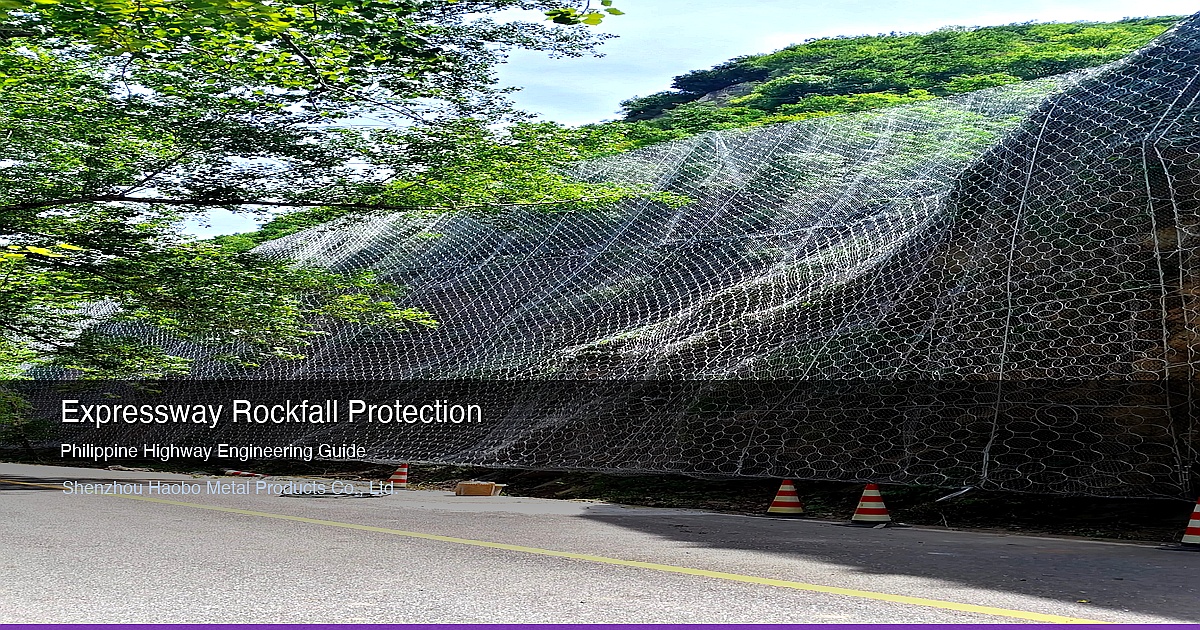
Wire rope net rockfall barrier systems — consisting of high-tensile steel ring nets, braking energy dissipaters, and steel post structures — are the internationally standardized solution for moderate to high energy rockfall events (up to 3,000 kJ). This guide provides Philippine mining engineers, safety officers, and MGB (Mines and Geosciences Bureau) inspectors with the complete technical framework for designing, specifying, and installing these systems per the European Organisation for Technical Assessment (EOTA) ETAG 027 standard.
### Why Wire Rope Nets, Not Active Mesh?
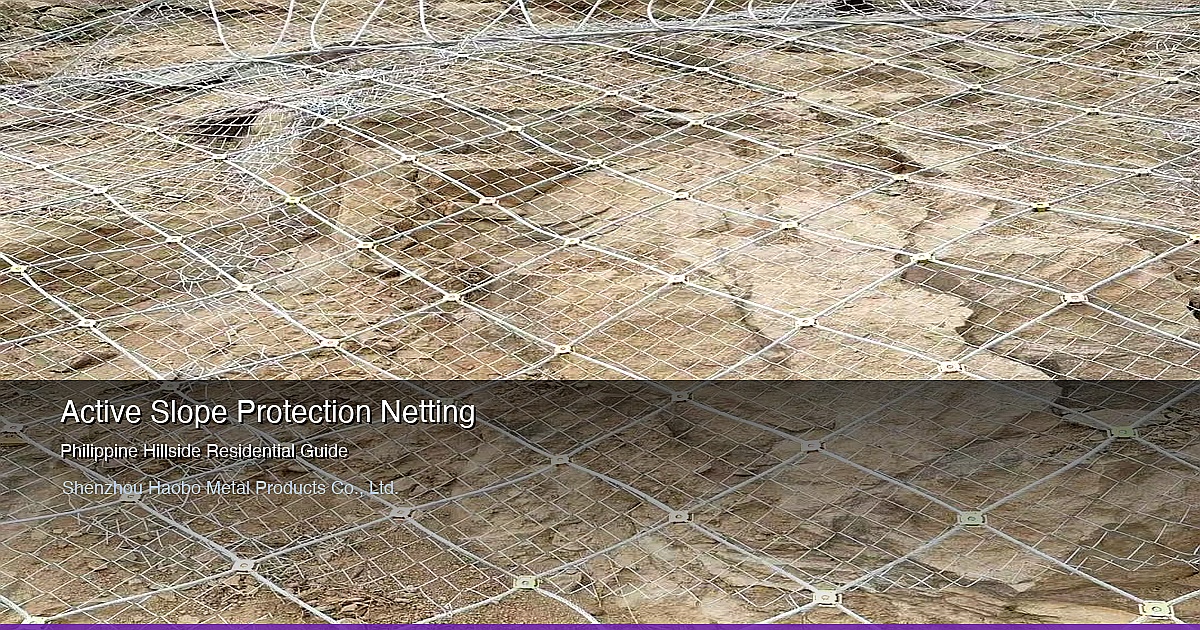
There is a fundamental distinction between **active slope protection** (mesh pinned to the slope face to prevent blocks from detaching) and **passive rockfall protection** (barriers at the slope toe to catch and stop falling blocks). Active mesh is appropriate for slopes up to 30-40° where rock blocks are small (≤0.5m) and dislodgement is a concern. Wire rope net barriers are required when:
- Slope angle exceeds 40° and rock blocks may detach and accelerate
- Design rockfall energy exceeds 100 kJ (active mesh fails at 30-50 kJ per ETAG 027)
- The slope toe has infrastructure (haul roads, processing plants, worker housing)
- Mining regulations require protection of "occupied zones" per MGB Memorandum Order 2008-07
### Philippine Mining Rockfall Context
| Mine Region | Typical Slope Height | Rock Type | Block Size (D50) | Design Energy | Common Hazard |
|---|---|---|---|---|---|
| Cordillera (Benguet, Ilocos) | 60-120m | Andesite, diorite | 0.3-1.5m | 500-2,000 kJ | Wedge failure on joint sets |
| Central Visayas (Cebu, Bohol) | 40-80m | Limestone | 0.2-0.8m | 200-800 kJ | Toppling, solution cavity collapse |
| Eastern Mindanao (Surigao) | 80-150m | Nickel laterite over ultramafic | 0.5-2.0m | 500-3,000 kJ | Plane failure along laterite contact |
| Davao Oriental (chromite) | 50-100m | Chromitite, dunite | 0.3-1.0m | 300-1,500 kJ | Planar and wedge failures |
## Wire Rope Net Barrier System Components
### System Architecture
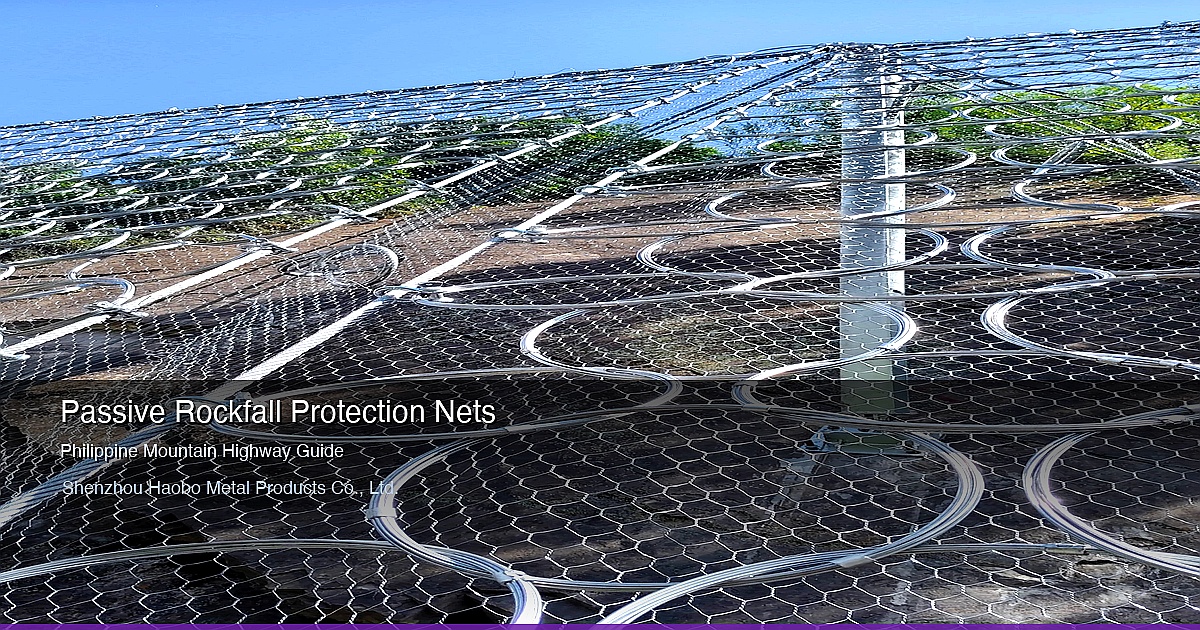
A complete wire rope net rockfall barrier system consists of five functional components:
**1. Steel posts**: Structural steel I-sections or tubular sections (typically W6×9 or equivalent) installed at 10m intervals along the barrier line. Posts are anchored to the ground using concrete footings (for free-standing barriers) or rock bolts (for pinned-to-slope installations). Post height ranges from 3m to 7m depending on design rockfall trajectory.
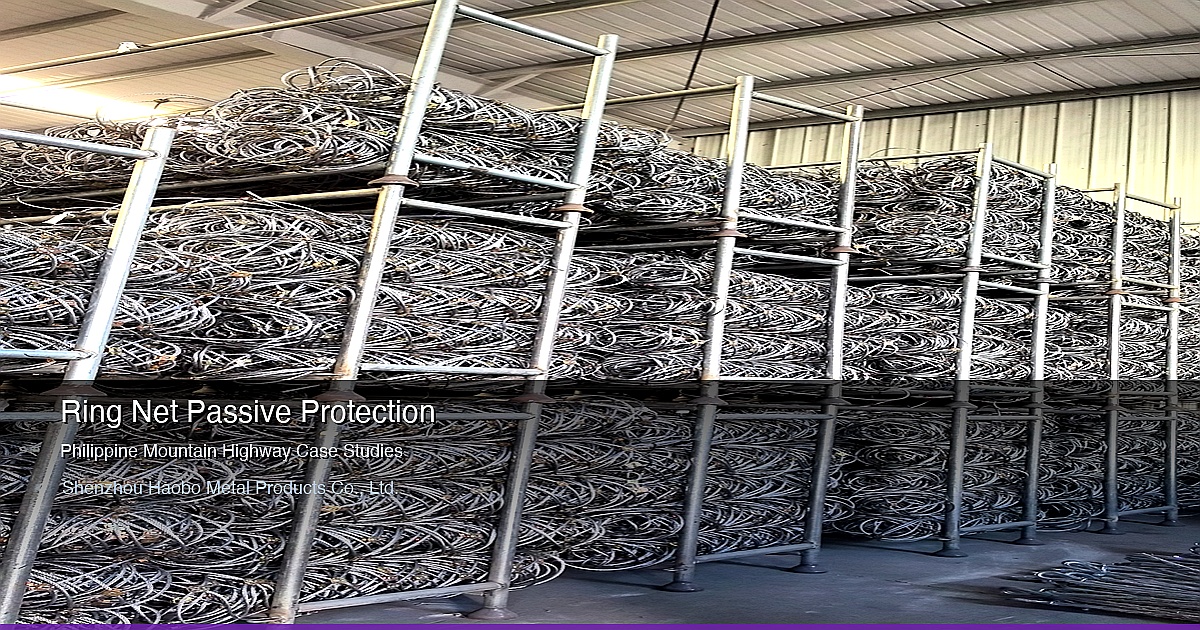
**2. Wire rope net (ring net)**: The primary catchment element, consisting of interlocking steel rings manufactured from 3.0mm or 4.0mm high-tensile steel wire (minimum tensile strength 1770 MPa per EN 12385-4). Ring diameter is typically 300mm or 350mm. The ring net is suspended between posts on longitudinal carrying ropes.
**3. Energy dissipaters (brakes)**: Proprietary friction brake devices installed in the carrying ropes and upslope anchor cables. These devices allow controlled rope extension during impact, converting kinetic energy into friction heat. Standard brake capacities range from 50 kJ to 200 kJ per brake set, with 4-8 brake sets per barrier panel.
**4. Wire rope cables**:
- Carrying ropes (top longitudinal): 16mm or 18mm diameter, 6×36 WS construction, 1770 MPa grade
- Anchor cables (upslope and lateral): 16mm diameter, same construction
- Joining ropes (connecting net to carrying rope): 8mm diameter
All wire rope must meet EN 12385-4 specifications with a minimum breaking force of 167 kN for 16mm ropes.
**5. Foundation anchors**:
- Post foundations: Concrete footings (0.8m × 0.8m × 1.0m) with 4× M24 anchor bolts, or rock-anchored base plates with 4× Φ25mm resin-grouted rock bolts (3.0m embedment)
- Upslope anchors: Φ25mm resin-grouted rock bolts, 3.0-4.0m embedment, 200 kN minimum design load
- Lateral anchors: Same specification as upslope, at 45° to barrier line
### Energy Capacity Classification
Per ETAG 027 (European Technical Assessment Guideline for Rockfall Protection Kits), barriers are classified by maximum tested energy absorption capacity:
| Energy Class | Max Energy (kJ) | Typical Application | Net Specification |
|---|---|---|---|
| 0 | 100 | Low-energy rockfall, small blocks | R7/3/300 (3mm wire, 300mm ring) |
| 1 | 250 | Moderate energy, medium blocks | R9/3/300 (3mm wire, 300mm ring) |
| 2 | 500 | Standard mining rockfall | R12/3/300 (3mm wire, 300mm ring) |
| 3 | 1,000 | High-energy mining rockfall | R19/3/300 or R12/4/300 (4mm wire) |
| 4 | 2,000 | Very high energy, large blocks | R25/4/350 (4mm wire, 350mm ring) |
| 5 | 3,000 | Extreme energy, massive rockfall | R37/4/350 or double-layer R19/4/300 |
**Philippine mine typical requirements**: Most mines in Surigao and Mindanao require Class 3 (1,000 kJ) barriers on haul roads and Class 2 (500 kJ) on lower-energy slopes. Benguet copper mines with steeper, higher walls typically require Class 4 (2,000 kJ) on primary haul roads and Class 3 on secondary benches.
## Rockfall Design Methodology
### Step 1: Rockfall Hazard Assessment
The design begins with a rockfall hazard assessment following the procedure in FHWA HEC-20 and the Austrian Standard ONR 24810:
**Geological mapping**: Map the slope face using terrestrial LiDAR or drone photogrammetry. Identify joint sets, potential failure planes, and existing unstable blocks. Key parameters: joint orientation (dip/dip direction), joint spacing, persistence, aperture, roughness (JRC), and infilling.
**Block size distribution**: For each potential failure mode (planar, wedge, toppling, circular), calculate the maximum detachable block size:
For planar failure on a single joint set:
> W = 0.5 × γ × L² × sin(β-φ) × cos(β) / sin(β)
Where W = block weight (kN), γ = rock unit weight (≈ 27 kN/m³ for andesite), L = joint spacing (m), β = slope angle (degrees), φ = joint friction angle (degrees).
For a Surigao mine slope (andesite, β=55°, φ=35°, L=2.0m): W = 0.5 × 27 × 4.0 × sin(20°) × cos(55°) / sin(55°) = 0.5 × 27 × 4.0 × 0.342 × 0.574 / 0.819 = **12.9 kN (1,314 kg, approximately 0.9m cube equivalent)**
### Step 2: Rockfall Trajectory Analysis
Rockfall trajectory is simulated using 2D or 3D rockfall modeling software (RocFall, CRSP, or RAMMS::ROCKFALL). Input parameters:
| Parameter | Andesite (Benguet) | Limestone (Cebu) | Laterite (Surigao) |
|---|---|---|---|
| Density (kg/m³) | 2,700 | 2,500 | 1,800-2,200 |
| Block shape | Angular/subangular | Angular | Subrounded |
| Slope restitution coefficient (Rn) | 0.35 | 0.30 | 0.20 |
| Tangential restitution (Rt) | 0.85 | 0.80 | 0.70 |
| Rolling friction coefficient | 0.55 | 0.50 | 0.40 |
| Vegetation factor | 0.9 (sparse) | 0.85 (sparse) | 0.7 (dense) |
The simulation generates:
- **Bounce height envelope**: Maximum height of rockfall trajectory at the barrier location
- **Kinetic energy distribution**: 95th percentile impact energy at the barrier
- **Lateral dispersion**: Required barrier lateral extent
### Step 3: Energy Calculation
The kinetic energy of a falling block at the barrier location is:
> E_k = 0.5 × m × v² + 0.5 × I × ω²
Where m = block mass (kg), v = translational velocity (m/s), I = moment of inertia (kg·m²), ω = angular velocity (rad/s).
For a 1,314 kg block (0.9m cube) with v = 15 m/s and ω = 8 rad/s:
- Translational: 0.5 × 1,314 × 225 = 147,825 J
- Rotational: 0.5 × (1/6 × 1,314 × 0.81) × 64 = 5,674 J
- **Total: ~154 kJ**
Add a safety factor of 1.5 (per ONR 24810): **Design energy = 230 kJ** → Class 1 barrier (250 kJ) is sufficient.
For the same block at v = 25 m/s (steeper Surigao slope, 80m height):
- Translational: 0.5 × 1,314 × 625 = 410,625 J
- **Total with rotational and SF: ~640 kJ** → Class 2 barrier (500 kJ) is marginal; upgrade to Class 3 (1,000 kJ).
### Step 4: Post Height and Placement
The barrier post height must exceed the 95th percentile bounce height at the barrier location. From trajectory analysis:
| Slope Height | Slope Angle | Typical Bounce Height (95th pctile) | Recommended Post Height |
|---|---|---|---|
| 40m | 45° | 1.5-2.5m | 3m |
| 60m | 50° | 2.0-3.5m | 4m |
| 80m | 55° | 3.0-5.0m | 5m |
| 120m | 60° | 4.0-6.5m | 6m |
| 150m | 65° | 5.0-7.5m | 7m |
Post spacing is typically 10m (standard) or 15m (for reduced-cost installations on lower-energy slopes). Wider spacing increases net sag and reduces effective energy capacity.
## Installation Sequence
### Step 1: Foundation Installation
**Post foundations on soil**:
- Excavate to 1.0m depth (below organic topsoil and weathered zone)
- Place 4× M24 anchor bolts (J-bolt type, 600mm embedment) on a 400mm × 400mm grid
- Cast concrete (Class A, 28 MPa, 28-day) to 100mm above ground level
- Cure 7 days minimum before post installation
**Post foundations on rock**:
- Drill 4× 38mm holes, 3.0m depth, using rotary-percussion drill
- Install 4× Φ25mm resin-grouted rock bolts with 200mm threaded tops
- Grout with cementitious grout (minimum 30 MPa), cure 3 days
- Install post base plate (20mm thick steel) with 4× M24 nuts
**Upslope anchor installation**:
- Drill at 15-25° upslope angle, 3.0-4.0m depth
- Install Φ25mm resin-grouted rock bolts
- Test each anchor to 1.3× design load (acceptance: extension < 2mm at 0.8× design load, no failure at 1.3×)
### Step 2: Post Erection
- Install steel posts on anchor bolts with base plate and nuts
- Align posts vertically using guy ropes (2× at 45° to barrier line) before tightening
- Install lateral support cables (16mm wire rope) from post top to lateral anchors at 45° to barrier line
- Tension lateral cables to 30 kN using turnbuckles (verify with calibrated tension indicator)
### Step 3: Carrying Rope and Net Installation
- Install carrying rope (16mm or 18mm wire rope) along post tops, secured with U-bolt rope clips (minimum 3 per connection)
- Install energy dissipaters on carrying rope at locations specified by system design (typically 2 per 10m panel, one on each side of post center)
- Hang the ring net panels between posts, connecting to carrying rope with 8mm joining ropes at 500mm intervals
- Install bottom retention rope (8mm) along ground level, secured to ground anchors every 5m
### Step 4: Pre-Tensioning and Testing
- Tension carrying rope to 10% of breaking force (≈ 17 kN for 16mm rope) using come-along winches
- Verify net sag (maximum 10% of post height, i.e., 0.3m for 3m posts)
- For Class 3+ systems: Conduct site-specific proof test by dropping a calibrated concrete block (500 kg) from the design bounce height, confirming the system catches and holds the block within the deflection zone
## Philippine Mining Case Studies
### Case Study 1: Surigao Nickel Mine, Eastern Mindanao
A large-scale nickel laterite mine in Surigao del Norte operates a 120m high pit wall at 55° overall slope angle. The wall consists of saprolite (top 40m, weathered ultramafic), transition zone (20m), and fresh ultramafic bedrock (bottom 60m). Rockfall events in 2023-2024 included:
- January 2024: 2.5m³ andesite block detached from the transition zone, bounced onto the primary haul road, narrowly missing a 100-ton haul truck
- March 2024: 8m³ (20,400 kg) wedge failure from the saprolite/transition contact, energy estimated at 1,800 kJ
**Design and installation (2024)**:
- Slope analysis: Trajectory modeling (RocFall2D) showed 95th percentile bounce height of 4.2m and kinetic energy of 820 kJ at the haul road level
- System selection: Class 3 (1,000 kJ) barrier, 5m post height, 10m post spacing
- Installation length: 180m along the haul road shoulder
- Components: 18 posts, 360m ring net (R19/3/300 — 3mm wire, 19 rings per 7.5m² panel), 72 energy dissipaters, 540m carrying rope
- Cost: PHP 12.8M (material) + PHP 4.2M (installation) = PHP 17.0M (PHP 94,400/m)
- Source: Shenzhou Haobo Metal Products Co., Ltd. (FOB Tianjin, USD 320/m for complete Class 3 system including posts, nets, cables, and brakes)
**Performance**: In November 2024, the system caught a 3.2m³ block (8,160 kg, estimated 1,150 kJ impact energy). The barrier deflected 2.1m (within the 3.0m maximum deflection design), brakes activated as designed, and the block was retained. Post-event inspection showed:
- Ring net: 3 rings permanently deformed (elongated 8%), replaced
- Carrying rope: 200mm permanent extension in the impact panel, within acceptable limits
- Energy dissipaters: 4 of 8 brakes in the panel fully deployed, replaced
- Posts: Zero permanent deformation
- Repair cost: PHP 85,000 (net panel + 4 brakes) — 0.5% of initial system cost
### Case Study 2: Limestone Quarry, Cebu (Central Visayas)
A cement-grade limestone quarry in Cebu operates a 70m high bench face at 65° slope angle. Rockfall events were frequent during the rainy season (June-October), with blocks of 0.3-0.8m diameter dislodging from solution cavities along bedding planes.
**Design and installation (2023)**:
- Trajectory analysis: 95th percentile bounce height 2.8m, energy 180 kJ
- System selection: Class 1 (250 kJ) barrier, 3m post height, 10m spacing
- Installation length: 95m along the quarry access road
- Cost: PHP 3.8M (material) + PHP 1.2M (installation) = PHP 5.0M (PHP 52,600/m)
**Performance**: The system has caught 47 rockfall events in 24 months (2023-2025), with maximum recorded block size of 0.6m diameter (estimated 85 kJ). Zero penetration events. Average annual maintenance cost: PHP 22,000 (net panel replacement and brake replacement after significant impacts). The quarry reports zero rockfall-related injuries since installation, compared to 3 incidents in the 2 years prior.
## Comparison: Wire Rope Net vs Other Rockfall Protection Methods
| Method | Max Energy (kJ) | Cost (PHP/m) | Maintenance | Visibility | Best Application |
|---|---|---|---|---|---|
| Wire rope net barrier (Class 3) | 1,000 | 90,000-100,000 | Low (after impact) | Good | Haul roads, processing plant areas |
| Cable net + brakes (Class 5) | 3,000 | 150,000-200,000 | Low | Moderate | High walls, massive rockfall risk |
| Attenuator net (hung curtain) | 500 | 70,000-80,000 | Very low | Low | Narrow gullies, channelized rockfall |
| Rock embankment (earth berm) | 5,000+ | 40,000-60,000 | None | Poor | Very large events, ample space |
| Rock shed (concrete tunnel) | Any | 300,000-500,000 | None | Poor | Critical infrastructure, extreme risk |
| Active mesh (TECCO/Spider) | 50 | 1,800-2,500/m² | Low | Good | Prevention on slopes <40° |
**Philippine mine selection logic**:
- For haul roads with 500-2,000 kJ design energy: Wire rope net barrier (Class 2-4)
- For narrow gullies with channelized rockfall up to 500 kJ: Attenuator net
- For slope faces where prevention is possible: Active mesh (TECCO/Spider system, see our [active slope protection guide](/news/91))
- For processing plant entrances with extreme risk: Rock shed
## Maintenance and Inspection Requirements
### Regular Inspection Schedule
| Inspection Type | Frequency | Scope | Personnel |
|---|---|---|---|
| Visual inspection | Monthly | Net condition, post alignment, anchor area | Mine safety officer |
| Post-flood/event inspection | After any rockfall event > 50 kJ | Full system assessment, brake status | Geotechnical engineer |
| Annual comprehensive inspection | Annually (before rainy season) | Wire rope corrosion, anchor pull test, bolt torque | Third-party inspector |
### Wire Rope Corrosion Assessment
For wire rope net systems installed in Philippine tropical conditions (temperature 28-35°C, humidity 70-95%, rainfall 2,000-4,000mm/year), corrosion is the primary degradation mechanism. Assessment per EN 12385-4:
**Coating inspection**: Measure remaining zinc/galfan coating thickness at 10 randomly selected locations per 100m of barrier using a magnetic thickness gauge. Minimum acceptable: 150 g/m² (60% of original 245 g/m² galvanized, or 55% of 275 g/m² Galfan). Below this threshold, the wire or rope must be replaced.
**Wire rope condition**: For 16mm wire rope (6×36 WS construction), inspect individual wire strands for:
- Section loss > 10% of original diameter → replace
- Broken wires > 10% of total wires in rope → replace
- Corrosion pitting visible to naked eye → clean and re-galvanize or replace
**Expected service life in Philippine conditions**:
- Standard galvanized (245 g/m²): 12-18 years before wire replacement required
- Galfan (275 g/m²): 20-30 years
- PVC-coated Galfan: 30-40 years (in non-UV-degraded condition)
### Post-Impact Maintenance
After any rockfall event where the barrier catches a block:
1. **Document**: Photograph the impact from 4 angles, record block dimensions and estimated mass, note brake deployment count
2. **Assess net**: Check for permanently deformed (elongated) rings. Replace any ring with > 15% elongation. A single ring replacement requires opening 4 adjacent rings and re-closing with 3.0mm lacing wire.
3. **Check brakes**: Visually verify each energy dissipater in the impact panel. Deployed brakes show visible plow marks on the friction element. Replace all deployed brakes — do NOT reset them.
4. **Carrying rope**: Measure permanent extension. If > 5% of original rope length in the impact panel, replace the rope section.
5. **Posts**: Check for permanent bending (using a straight-edge). Any bend > 1° from vertical requires post replacement.
6. **Anchors**: Check anchor area for soil cracking or rock spalling. If visible, conduct a pull test on the affected anchor to 1.0× design load.
## Sourcing Wire Rope Net Systems from China
### Complete System Specification
When requesting a quotation from a Chinese manufacturer, provide:
```
PROJECT: [Mine name], [Location], Philippines
SLOPE: Height [X]m, Angle [Y]°, Rock type [Z]
DESIGN: Energy class [kJ], Bounce height [m], Barrier length [m]
SPECIFICATION:
- Posts: [W6×9 or equivalent], height [m], galvanized [min 275 g/m²]
- Ring net: R[N]/[wire mm]/[ring mm], tensile ≥ 1770 MPa, galvanized ≥ 245 g/m²
- Carrying rope: 16mm or 18mm, 6×36 WS, 1770 MPa, galvanized ≥ 245 g/m²
- Energy dissipaters: [50/100/200 kJ per set], certified to ETAG 027
- Anchor bolts: Φ25mm, resin-grouted, 200 kN design load
- Foundation: Concrete footings or rock-anchored (specify)
- Standard: ETAG 027 (European Technical Assessment)
```
### Shipping Considerations
| Component | Volume | Weight | Container |
|---|---|---|---|
| Steel posts (180m system, 18 posts) | 4.5 m³ | 5,400 kg | 1× 40' HQ (shared) |
| Ring net (180m) | 3.2 m³ compressed | 2,800 kg | |
| Wire rope (540m carrying + anchors) | 1.8 m³ | 1,600 kg | |
| Energy dissipaters (72 sets) | 0.8 m³ | 900 kg | |
| Accessories (bolts, clips, lacing wire) | 0.5 m³ | 400 kg | |
| **Total** | **10.8 m³** | **11,100 kg** | **1× 40' HQ** |
FOB Tianjin pricing for a complete Class 3 (1,000 kJ) system: approximately USD 290-340 per linear meter (including posts, net, cables, brakes, and accessories — excluding foundation concrete and anchor bolts which are sourced locally).
## Key Takeaways
1. Wire rope net rockfall barrier systems are the standard solution for moderate to high-energy rockfall events at Philippine mining sites. They are required when design energy exceeds 100 kJ (the limit of active mesh systems) and when the slope toe has infrastructure that must be protected per MGB regulations.
2. Energy class selection must be based on trajectory analysis (RocFall or equivalent), not on slope height alone. A 70m slope at 65° in limestone may produce only 200 kJ (Class 1), while the same height at 55° in andesite can produce 800+ kJ (Class 3). The design must follow the 95th percentile energy from simulation × 1.5 safety factor per ONR 24810.
3. For Philippine tropical conditions, Galfan coating (275 g/m²) is strongly recommended over standard galvanized (245 g/m²) for all wire components. Galfan extends service life from 12-18 years to 20-30 years, reducing life-cycle replacement cost by 35-40% despite the 10-12% material cost premium.
4. Post-impact maintenance is the single most important determinant of system reliability. The Surigao case study demonstrated that a PHP 85,000 repair (3 rings + 4 brakes) restored a PHP 17M system to full functionality after catching a 1,150 kJ block. Systems without documented post-impact inspection protocols are effectively non-functional after the first significant impact.
5. Complete system sourcing from a single manufacturer (posts + net + cables + brakes) is critical. Mixing components from different manufacturers voids the ETAG 027 certification and may compromise energy capacity. Always specify the complete system from one supplier with certification documentation for each energy class.
Need Rockfall Barriers for Your Mining Operation?
Send us your slope height, angle, rock type, block size distribution, and design energy class. Our engineering team provides complete ETAG 027 certified wire rope net barrier systems (posts, ring nets, brakes, cables, anchors) with FOB Tianjin pricing within 48 hours. Class 1-5 systems, 100-3000 kJ energy capacity.
www.haobomesh.com | Shenzhou Haobo Metal Products Co., Ltd.