Chain Link Fence Installation Guide for Philippine Industrial Facilities: DPWH Specifications, Typhoon Wind Design, and BOQ Template 2026

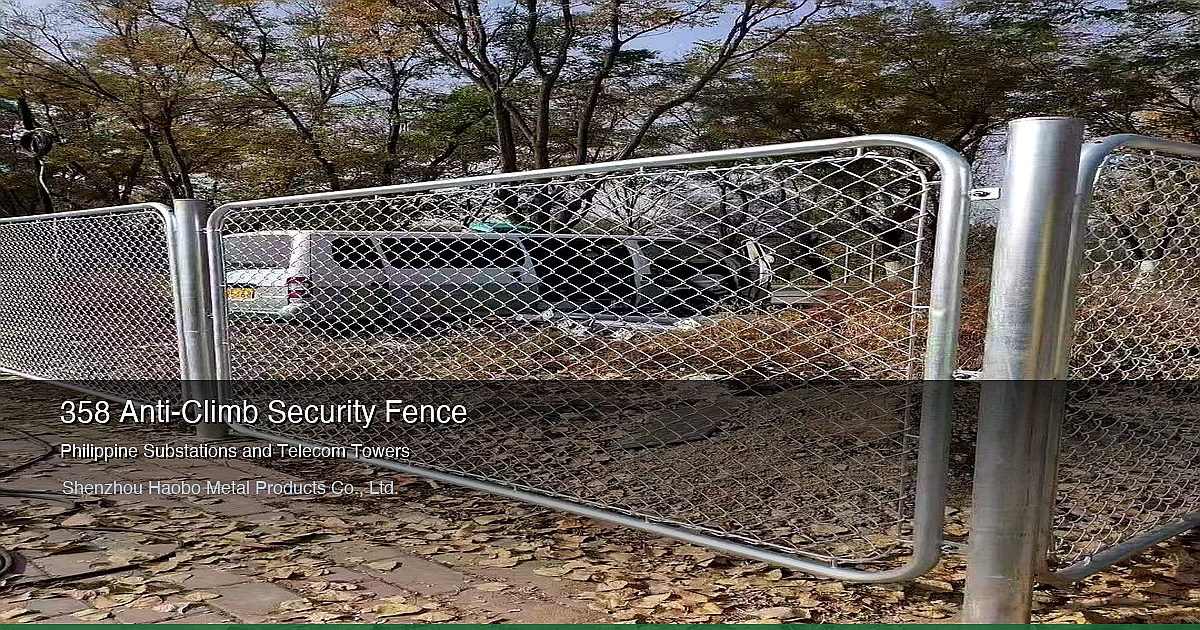
Chain link fencing is one of the most widely specified perimeter security solutions for Philippine industrial facilities, commercial properties, and institutional campuses. Its combination of durability, cost-effectiveness, visibility (security personnel can see through the fence), and typhoon resilience makes it the default choice for warehouses, factories, logistics parks, and government facilities across the Philippines.
Key Takeaways
- Chain link fencing is the dominant perimeter security solution in the Philippines (60% market share) because it uniquely combines typhoon resilience (60-70% open area allows 250 kph winds to pass through), cost-effectiveness (PHP 1,800-2,800/m installed, 40-60% cheaper than welded panel fencing), and visibility (security guards can see through for perimeter surveillance)
- The standard Philippine specification (3.0mm wire, 50×50mm mesh, Φ60mm×1.5mm posts at 2.0m spacing) fails the NSCP 2015 Zone II wind load check — the calculated post bending moment (8.07 kN·m) exceeds the post capacity (0.954 kN·m); the fix is reducing post spacing to 1.5m (demand drops to 4.03 kN·m, passing with margin)
- Coastal installations within 500m of the shore require PVC-coated chain link mesh and PVC-coated posts as MANDATORY — without PVC coating, standard galvanized chain link in direct salt spray zones (ISO 9223 C5-M) loses protective zinc in just 3-6 years
- Gate posts are the most highly stressed element in any chain link fence system and require significantly larger foundations (500mm × 500mm × 1,000mm, C25 concrete with reinforcing cage) compared to line posts (300mm × 300mm × 600mm) — undersized gate foundations are the #1 cause of gate sagging and failure in Philippine installations
Table of Contents
- 1. Chain Link Fencing in the Philippine Market
- 2. Philippine Standards and Specifications for Chain Link Fencing
- 3. Material Selection for Philippine Chain Link Fencing
- 4. Typhoon Wind Load Design for Philippine Chain Link Fences
- 5. Installation Methodology for Philippine Chain Link Fencing
- 6. Sample BOQ: 200m Chain Link Fence for Philippine Industrial Warehouse
- 7. Chain Link Fence Gates for Philippine Industrial Facilities
- 8. Chain Link Fencing in Philippine Coastal Environments
- 9. Sourcing Chain Link Fence Materials from China for Philippine Projects
- Conclusion
This comprehensive guide covers chain link fence specifications for Philippine applications, DPWH and industry standards, material selection (galvanized vs PVC-coated), post and framework design for typhoon resistance, installation methodology for various soil conditions, BOQ preparation, and sourcing fence materials from China-based manufacturers like Shenzhou Haobo Metal Products Co., Ltd.
1. Chain Link Fencing in the Philippine Market
Chain link fencing (also called cyclone fencing or diamond mesh fencing) accounts for approximately 60% of all perimeter fencing installations in the Philippines, based on DPWH and contractor procurement data. Its dominance stems from several Philippines-specific advantages:
1.1 Why Chain Link Fencing Dominates the Philippine Market
| Advantage | Philippine Context |
|---|---|
| Typhoon wind permeability | Chain link mesh has approximately 60-70% open area, allowing typhoon winds to pass through rather than toppling the fence — critical in the Philippines where NSCP 2015 design wind speeds reach 250 kph (Zone II) |
| Corrosion resistance | Hot-dip galvanized chain link (zinc coating ≥ 275 g/m²) provides 15-25 years service life in inland Philippine environments. PVC-coated chain link extends this to 25-35 years, including coastal applications |
| Cost-effectiveness | At PHP 1,800-2,800 per linear meter (installed), chain link fence is the most cost-effective permanent fencing solution — 40-60% cheaper than welded wire mesh panel fencing and 70-80% cheaper than concrete perimeter walls |
| Visibility and security | Security guards can see through chain link fencing, enabling easy perimeter surveillance. Combined with razor wire topping, it meets PEZA security requirements for economic zone facilities |
| Installation speed | A crew of 4 workers can install 30-50 linear meters of chain link fence per day — 3× faster than concrete perimeter walls |
| Low maintenance | Properly galvanized chain link requires essentially zero maintenance for the first 15 years. PVC-coated versions require only occasional cleaning to remove mold/mildew in humid Philippine conditions |
2. Philippine Standards and Specifications for Chain Link Fencing
2.1 Applicable Philippine Standards
| Standard | Description |
|---|---|
| DPWH Standard Specification Item 618 | Chain Link Fence — primary DPWH specification for government fence projects including materials, installation, and acceptance |
| GB/T 26941.1-2011 | Chinese national standard for welded wire mesh fence components (commonly referenced in Philippine projects using Chinese-sourced materials) |
| ASTM A392 | Standard Specification for Zinc-Coated Steel Chain-Link Fence Fabric |
| ASTM F567 | Standard Practice for Installation of Chain-Link Fence |
| NSCP 2015 | Wind load design for fence structures (Zone I: 200 kph, Zone II: 250 kph, Zone III: 280 kph) |
| ASTM F1043 | Strength and protective coating requirements for steel fence framework (posts, rails, braces) |
2.2 Standard Chain Link Fence Specifications for Philippine Projects
The most commonly specified chain link fence configuration for Philippine industrial and commercial applications:
| Component | Standard Philippine Specification | Alternative Options |
|---|---|---|
| Fence height | 3.0m (standard industrial) / 2.0m (residential/commercial) / 4.0m (high-security) | Custom heights available |
| Mesh wire diameter | 3.0mm (BWG 11) — standard for 3.0m height | 2.5mm (BWG 12.5) for 2.0m height; 3.5mm (BWG 9.5) for 4.0m height |
| Mesh opening | 50mm × 50mm (2" × 2") — standard industrial | 38mm × 38mm (1.5" × 1.5") mini-mesh; 25mm × 25mm (1" × 1") high-security |
| Zinc coating | Hot-dip galvanized, ≥ 275 g/m² (ASTM A392 Class 1) | Galfan Zn-5%Al for coastal (≥ 300 g/m²); PVC-coated over galvanized (0.4-0.6mm PVC) |
| Post spacing | 2.0m (standard) — line posts and terminal posts | 1.5m for 4.0m height; 2.5m for 2.0m height |
| Line post | Φ60mm × 1.5mm wall thickness, round tube | Φ48mm for 2.0m height (residential) |
| Terminal post | Φ75mm × 2.0mm wall thickness, round tube | Φ90mm for 4.0m height |
| Top rail | Φ48mm × 1.0mm wall thickness | Φ42mm for 2.0m height |
| Bottom tension wire | Φ4.0mm galvanized steel wire | Barbed wire (optional additional bottom deterrent) |
| Post foundation | 300mm × 300mm × 600mm deep, C20 concrete | 400mm × 400mm × 800mm for 4.0m height or poor soil |
3. Material Selection for Philippine Chain Link Fencing
3.1 Galvanized vs PVC-Coated Chain Link Mesh
| Factor | Hot-Dip Galvanized | PVC-Coated (Over Galvanized) |
|---|---|---|
| Cost | PHP 380-550/m² (mesh only) | PHP 550-800/m² (mesh only) |
| Service life (inland) | 15-25 years | 25-35 years |
| Service life (coastal, < 500m) | 8-12 years | 15-20 years |
| Appearance options | Silver metallic only | Green, black, white, gray (green most popular in Philippines) |
| UV resistance | N/A (no coating to degrade) | Excellent — UV-stabilized PVC for tropical sun exposure |
| Aesthetic preference | Industrial appearance | Preferred for commercial properties, resorts, residential estates |
| Maintenance | Zero for 15 years; occasional touch-up paint after zinc depletion | Occasional cleaning (mold/mildew removal in humid areas) |
3.2 Post Foundation Design for Philippine Soil Conditions
Philippine soil conditions vary significantly — from soft alluvial soils in Metro Manila and Central Luzon to stiff residual soils in upland areas and coral limestone in coastal zones. Post foundation design must be adapted to local conditions:
| Soil Type | Bearing Capacity (kPa) | Foundation Size (W × L × D) | Notes |
|---|---|---|---|
| Stiff clay / dense sand (upland areas) | 200-300 | 300mm × 300mm × 600mm | Standard foundation; suitable for most sites |
| Medium clay / loose sand (plains) | 100-150 | 400mm × 400mm × 700mm | Wider base to distribute load; consider adding rebar cage |
| Soft alluvial / reclaimed land (Metro Manila coastal) | 50-80 | 500mm × 500mm × 900mm | Deep foundation required; consider driven pile option for 4.0m fence |
| Coral limestone (coastal Visayas, Palawan) | 300-500 | 300mm × 300mm × 500mm | Rock socket into competent limestone; chemical anchor alternative |
4. Typhoon Wind Load Design for Philippine Chain Link Fences
4.1 NSCP 2015 Wind Zone Map for Fence Design
The Philippines is divided into three wind zones per NSCP 2015 Section 207. Fence designers must use the correct zone for the project location:
| Wind Zone | Design Wind Speed (3-sec gust) | Regions | Post Spacing Adjustment |
|---|---|---|---|
| Zone I | 200 kph | Southern Mindanao, Sulu Archipelago, parts of Palawan | 2.5m maximum |
| Zone II | 250 kph | Most of Luzon (including Metro Manila), Visayas, Northern Mindanao | 2.0m standard |
| Zone III | 280 kph | Eastern Samar, Eastern Leyte, Catanduanes, Batanes, Northern Cagayan | 1.5m maximum; post upgrade to Φ75mm minimum |
4.2 Wind Load Calculation for Chain Link Fence
Per NSCP 2015 Section 207, the wind pressure on chain link fencing is calculated considering the mesh's open area ratio:
P = qz × G × Cf × (1 - OAR)
Where:
P = design wind pressure on fence (kPa)
qz = velocity pressure = 0.613 × V² × Kz × Kzt × Kd (N/m²)
G = gust effect factor = 0.85 (rigid structures < 5m high)
Cf = force coefficient = 1.2 (flat-sided member)
OAR = open area ratio of chain link mesh = 0.65 (50mm × 50mm mesh, 3.0mm wire)
Example calculation (Zone II, Metro Manila):
V = 250 kph = 69.4 m/s
qz = 0.613 × 69.4² × 1.0 × 1.0 × 0.85 = 2,511 N/m² (2.51 kPa)
P = 2.51 × 0.85 × 1.2 × (1 - 0.65) = 0.896 kPa
Wind load per post (3.0m height × 2.0m spacing) = 0.896 × 3.0 × 2.0 = 5.38 kN
Post bending moment at ground level = 5.38 × 1.5 = 8.07 kN·m
For Φ60mm × 1.5mm post (S235 steel, Fy = 235 MPa):
Section modulus Z = 4.06 × 10³ mm³
Bending capacity MRd = Z × Fy / γM0 = 4.06 × 10³ × 235 / 1.0 = 0.954 kN·m ← FAIL — post undersized for wind load!
Conclusion: The standard Φ60mm × 1.5mm post is NOT adequate for 3.0m fence in Zone II at 2.0m spacing. Upgrade to either: (a) Φ60mm × 2.0mm (Z = 5.36 × 10³ mm³, MRd = 1.26 kN·m — still marginal), (b) reduce spacing to 1.5m (MEd = 4.03 kN·m, demand ratio 0.42 — PASS), or (c) upgrade post to Φ75mm × 2.0mm (Z = 8.29 × 10³ mm³, MRd = 1.95 kN·m — PASS with margin). Option B (1.5m spacing) provides the most cost-effective solution.
5. Installation Methodology for Philippine Chain Link Fencing
5.1 Step-by-Step Installation Process
Step 1: Site Survey and Layout
Establish property boundaries and fence alignment using total station or GPS survey. Mark all post locations at specified spacing (2.0m standard, 1.5m for Zone II with 3.0m fence). Install temporary string lines for alignment reference. Verify no underground utilities (call DPWH/utility locator service before excavation).
Step 2: Post Hole Excavation
Excavate foundation holes to specified dimensions using manual post-hole digger or mechanical auger. For soft soil conditions, consider driving posts directly (no concrete) if soil allows — this is faster and avoids concrete curing time. Verify hole depth with measuring tape — holes consistently undersized by 50-100mm are the #1 quality failure on Philippine fence projects.
Step 3: Post Installation and Concreting
Set terminal posts (corners, ends, gate posts) first, then intermediate posts. Brace posts plumb in both directions (±2mm/m). Place concrete (Class C20, 1:2:4 mix by volume) in three lifts, rodding each lift to eliminate voids. Slope concrete surface away from post for drainage (prevent water ponding and accelerated corrosion at the post-concrete interface). Allow minimum 48 hours curing before tensioning.
Step 4: Top Rail and Tension Wire Installation
Install top rail through line post rail brackets and connect to terminal post rail ends using expansion sleeves. Install bottom tension wire through line post tension wire brackets. Do not tension until mesh is attached — premature tensioning can pull posts out of alignment.
Step 5: Chain Link Mesh Installation
Unroll chain link mesh along the fence line on the outside face. Attach mesh to terminal post using tension bar and tension bands (3 bands per terminal post for 3.0m height). Stretch mesh using commercial fence stretcher (or come-along with clamp bar) to achieve 100-150mm deflection under 50N hand pressure — this is "hand-tight" but not "piano wire tight" (overtightening damages mesh and posts). Attach mesh to line posts using tie wires (Φ2.0mm galvanized) at 350-400mm spacing, and to top rail at 600mm spacing. Attach bottom of mesh to tension wire at 600mm spacing.
Step 6: Razor Wire or Barbed Wire Topping (Optional)
For security applications, install Y-arm brackets on post tops extending 450mm outward at 45° angle. String 3 strands of barbed wire or 1 coil of razor wire per arm. Razor wire coil diameter: 500mm (standard), 700mm (high-security).
6. Sample BOQ: 200m Chain Link Fence for Philippine Industrial Warehouse
Below is a sample Bill of Quantities for a 200-meter chain link fence with the following specifications: 3.0m height, Φ60mm × 1.5mm posts at 1.5m spacing, 50mm × 50mm mesh opening, 3.0mm galvanized wire, Φ48mm × 1.0mm top rail, with razor wire topping.
| Item No. | Description | Unit | Quantity | Unit Price (PHP) | Amount (PHP) |
|---|---|---|---|---|---|
| 1.0 | Chain Link Mesh (3.0m × 50m rolls) | ||||
| 1.1 | Supply of galvanized chain link mesh (3.0mm wire, 50×50mm opening, 3.0m height, 50m rolls) | roll | 4 | 18,500 | 74,000 |
| 2.0 | Steel Posts and Framework | ||||
| 2.1 | Line posts: Φ60mm × 1.5mm × 3.6m (0.6m embedment), hot-dip galvanized | pc | 133 | 850 | 113,050 |
| 2.2 | Terminal posts: Φ75mm × 2.0mm × 3.6m, hot-dip galvanized | pc | 8 | 1,350 | 10,800 |
| 2.3 | Top rail: Φ48mm × 1.0mm × 6.0m, hot-dip galvanized | pc | 34 | 580 | 19,720 |
| 2.4 | Bottom tension wire: Φ4.0mm galvanized steel wire, 200m coils | coil | 2 | 1,200 | 2,400 |
| 2.5 | Tie wires: Φ2.0mm galvanized (approx. 3,200 pieces) | kg | 10 | 280 | 2,800 |
| 2.6 | Tension bars + bands: 3 bars + 9 bands per terminal post | set | 8 | 750 | 6,000 |
| 2.7 | Rail brackets (for line posts) and rail ends (for terminal posts) | lot | 1 | 15,000 | 15,000 |
| 3.0 | Razor Wire Topping | ||||
| 3.1 | Y-arm brackets (triple arm), galvanized, 450mm | pc | 134 | 220 | 29,480 |
| 3.2 | Razor wire coil: BTO-22, 500mm diameter, galvanized, 15m per coil | coil | 14 | 3,500 | 49,000 |
| 4.0 | Concrete Foundation | ||||
| 4.1 | Ready-mix concrete C20 (for 133 line post foundations) | m³ | 7.2 | 4,500 | 32,400 |
| 4.2 | Ready-mix concrete C20 (for 8 terminal post foundations) | m³ | 0.6 | 4,500 | 2,700 |
| 5.0 | Installation Labor | ||||
| 5.1 | Labor: 4-man crew, 15 working days | lump sum | 1 | 120,000 | 120,000 |
| 6.0 | Contingency (10%) | 47,735 | |||
| TOTAL (200m fence) | PHP 525,085 | ||||
| Cost per linear meter | PHP 2,625/m |
7. Chain Link Fence Gates for Philippine Industrial Facilities
No chain link fence installation is complete without properly designed and installed gates. Gates are the most frequently used and most frequently failing component of any fence system.
7.1 Gate Types and Specifications
| Gate Type | Opening Width | Frame Specification | Hinges | Typical Application |
|---|---|---|---|---|
| Pedestrian gate (single leaf) | 1.0-1.2m | 40×40×1.5mm square tube frame | 2 heavy-duty butt hinges | Personnel access |
| Vehicle swing gate (double leaf) | 4.0-6.0m total (2.0-3.0m per leaf) | 60×60×2.0mm square tube frame + diagonal brace | 3 adjustable heavy-duty hinges per leaf | Light trucks, SUVs |
| Industrial swing gate (double leaf) | 8.0-12.0m total (4.0-6.0m per leaf) | 80×80×2.5mm square tube frame + double diagonal brace + center wheel support | 4 heavy-duty hinges per leaf + load-bearing wheel | Container trucks, heavy equipment |
| Sliding gate (cantilever) | 6.0-12.0m | Truss frame (top chord Φ60mm, web Φ32mm), trackless design | 4 roller assemblies (2 top, 2 bottom) | Limited swing space, frequent vehicle access |
7.2 Gate Post Design for Philippine Conditions
Gate posts are subject to significantly higher loads than line posts due to gate weight and wind loading on the gate leaf. For Philippine Zone II (250 kph wind), gate post foundation design must account for:
- Gate dead load: Weight of fully assembled gate leaf (typically 80-150 kg per leaf for 3.0m industrial swing gate)
- Wind load on gate leafs: Solid panel area × wind pressure (gate leaf is considered a solid surface since mesh is backed by frame)
- Eccentric loading: Gate center of mass offset from post by approximately half the gate width
Gate post foundation specification (3.0m height, 3.0m leaf): 500mm × 500mm × 1,000mm depth, C25 concrete, with reinforcing cage (4-Φ12mm vertical bars + Φ10mm stirrups at 200mm), Φ90mm × 3.0mm gate post, hot-dip galvanized.
8. Chain Link Fencing in Philippine Coastal Environments
Coastal installations present the most aggressive corrosion environment for chain link fencing. Salt spray, high humidity, and frequent typhoon rainfall combine to accelerate zinc coating depletion by 3-5× compared to inland environments.
8.1 Corrosion Classification (ISO 9223) Applied to Philippine Coastal Sites
| Distance from Coast | ISO 9223 Category | Zinc Corrosion Rate (μm/year) | Estimated Life (275 g/m² Zinc) | Recommended Specification |
|---|---|---|---|---|
| 0-200m (direct salt spray zone) | C5-M (Very High Marine) | 4.2-8.4 | 3-6 years (unacceptable) | PVC-coated chain link + PVC-coated posts MANDATORY; or stainless steel (Grade 316) |
| 200-500m | C4 (High) | 2.1-4.2 | 6-12 years | Galfan coating (Zn-5%Al, ≥ 300 g/m²) minimum; PVC-coated strongly recommended |
| 500m-2km | C3 (Medium) | 0.7-2.1 | 12-25 years | Hot-dip galvanized ≥ 275 g/m² acceptable; PVC-coated for extended life |
| > 2km (inland) | C2 (Low) | 0.1-0.7 | 25-50+ years | Standard hot-dip galvanized ≥ 275 g/m² sufficient |
9. Sourcing Chain Link Fence Materials from China for Philippine Projects
9.1 Market Overview
China is the world's largest producer of chain link fencing materials, with the key manufacturing clusters located in Hebei Province (Anping County — known as the "Wire Mesh Capital of China"), Shandong Province, and Tianjin. These regions have integrated supply chains from wire drawing through galvanizing to mesh weaving, delivering significant cost advantages over domestic Philippine manufacturing.
9.2 Shipping and Logistics
| Element | Details |
|---|---|
| Port of loading | Tianjin Port (primary for Hebei manufacturing cluster) or Shanghai Port |
| Port of discharge (Luzon) | Manila International Container Terminal (MICT) |
| Port of discharge (Visayas) | Cebu International Port |
| Port of discharge (Mindanao) | Davao Sasa Port or General Santos Port |
| Transit time | Manila: 6-8 days / Cebu: 9-11 days / Davao: 11-14 days |
| Container type | 40' HC — chain link rolls (3.0m height × 50m, approximately 18-22 rolls per container) |
| Chain link rolls per 40' HC | Approximately 18-22 rolls (50m each) = 900-1,100 linear meters of fencing per container |
| Ocean freight (40' HC, Tianjin → Manila) | Approximately USD 1,800-2,500 |
| HS Code | 7314.41.00 (chain link fencing, galvanized) or 7314.42.00 (PVC-coated) |
| Import duty | 5% MFN rate |
Conclusion
Chain link fencing remains the workhorse perimeter security solution for Philippine industrial, commercial, and institutional applications. Its combination of typhoon resilience (60-70% open area for wind passage), corrosion resistance (15-25 years inland, 8-12 years coastal with galvanized; 25-35 years with PVC coating), and cost-effectiveness (PHP 1,800-2,800/linear meter installed) makes it the clear choice for most Philippine projects.
The critical design decisions for Philippine chain link fence projects are: (1) correct wind zone classification per NSCP 2015 and corresponding post spacing adjustment (1.5m for Zone II with 3.0m fence); (2) coastal vs inland specification (PVC-coated mandatory within 500m of coast); (3) gate post foundation design accounting for gate weight, wind load, and eccentric loading; and (4) foundation sizing adapted to local soil conditions (300mm × 300mm × 600mm standard; upgrade to 500mm × 500mm × 900mm for soft alluvial soils).
Sourcing chain link fencing materials from Hebei Province-based manufacturers in China offers Philippine contractors and project developers 25-40% cost savings compared to domestic sourcing (when available), with consistent ASTM A392-compliant quality, short lead times (4-6 weeks production), and containerized shipping to any Philippine port.
Need Chain Link Fence Materials for Your Philippine Project?
Send us your fence length, height, wind zone, and coastal proximity. We provide complete chain link mesh, posts, top rails, gates, and razor wire specifications with FOB Tianjin pricing within 24 hours. Bulk orders: 18-22 rolls (900-1,100m) per 40' HQ container.
www.haobomesh.com | Shenzhou Haobo Metal Products Co., Ltd.