Passive Rockfall Protection Nets for Philippine Mountain Roads: Ring Net Design, Energy Capacity Selection, and Kennon Road Case Study 2026
Editor's Note: This article draws on Shenzhou Haobo Metal's 15+ years of manufacturing experience, providing practical engineering guidance for procurement professionals and civil engineers worldwide.
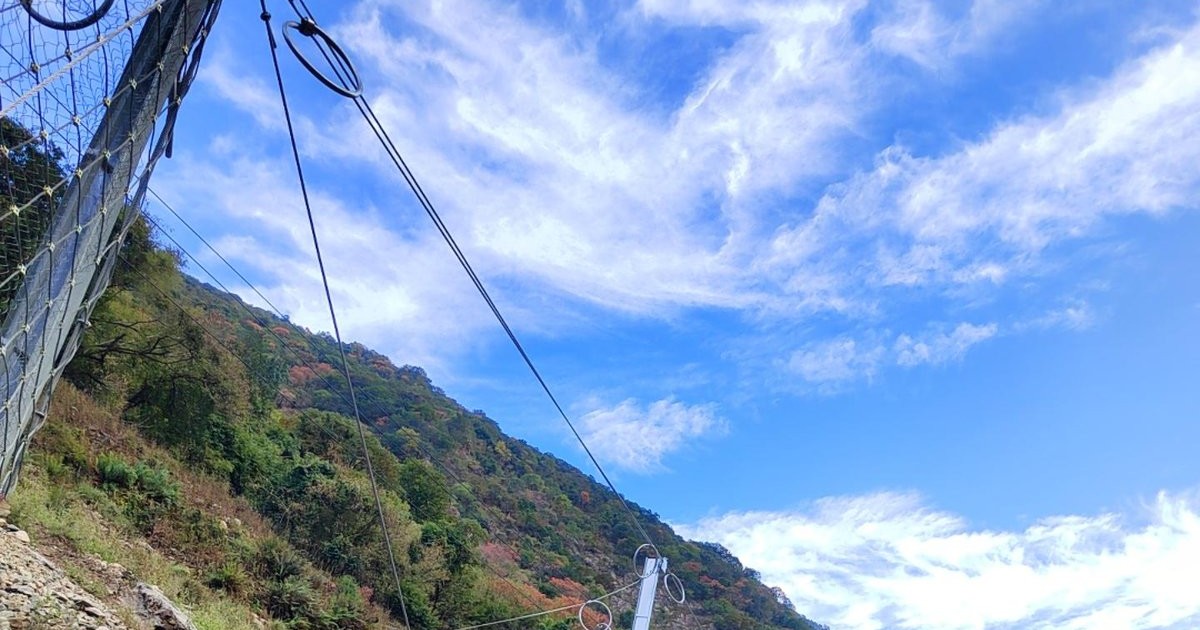
Passive rockfall protection nets — also known as ring net barriers or flexible rockfall catchment fences — are the last line of defense between unstable mountain slopes and the vehicles, passengers, and infrastructure below. On Philippine mountain highways like Kennon Road, Halsema Highway, and the mountain sections of the Pan-Philippine Highway, passive rockfall barriers have saved countless lives by intercepting falling rocks before they reach the roadway.
Key Takeaways
- Passive ring net rockfall barriers are the last line of defense between unstable mountain slopes and the road below — proven life-savers on Philippine mountain highways with 1,850m on Kennon Road and 950m on Halsema Highway intercepting dozens of rockfall events with zero fatalities
- The #1 design failure is underspecifying the energy capacity: for Cordillera mountain roads with slopes 20-50m and RMR 30-50, specify MEL 2000 minimum and upgrade to MEL 3000 where slope height > 50m or rock quality is poor — the 20-30% cost increase is trivial compared to the cost of a single rockfall fatality
- Ground anchors are the single most critical component — they transfer all impact loads into the mountain; 5% of all anchors must be sacrificial-tested to 1.5× design load, and any anchor failing the proof test must be replaced by two new anchors
- Philippine-specific design considerations are essential: typhoon wind loads (design for 250 kph per NSCP 2015 Zone II), lightning strike protection (copper grounding rods mandatory in the Cordillera with 40-60 thunderstorm days/year), and corrosion resistance (Galfan Zn-5%Al 275 g/m² in 4,000mm+ annual rainfall environment)
Table of Contents
- 1. The Philippine Mountain Highway Rockfall Challenge
- 2. How Passive Rockfall Protection Nets Work
- 3. Energy Capacity Selection for Philippine Mountain Conditions
- 4. Philippine Standards and DPWH Specifications
- 5. Case Study 1: Kennon Road Passive Rockfall Barriers — Baguio City
- 6. Case Study 2: Halsema Highway Passive Rockfall Nets — Atok to Buguias Section
- 7. Installation Methodology for Passive Rockfall Barriers on Philippine Mountain Slopes
- 8. Maintenance and Inspection Schedule
- 9. Sourcing Passive Rockfall Protection Systems for Philippine Projects
- Conclusion
This comprehensive guide covers passive rockfall net design for Philippine mountain conditions, energy capacity selection, system components, installation methodology on steep terrain, Philippine case studies (Kennon Road Baguio and Halsema Highway Benguet), DPWH standards compliance, and sourcing from China-based manufacturers like Shenzhou Haobo Metal Products Co., Ltd.
1. The Philippine Mountain Highway Rockfall Challenge
The Philippines' mountainous terrain — particularly the Cordillera Central range in Northern Luzon — hosts some of the country's most critical yet most geohazard-prone highways. High annual rainfall (2,000-4,000mm in Baguio and Benguet), frequent seismic activity (the Philippine Fault Zone runs directly through the Cordillera), and tropical weathering of fractured rock masses create ideal conditions for rockfall events.
1.1 Rockfall Risk Profile: Philippine Mountain Highways
| Highway | Location | Rockfall Risk Level | AADT | Known Rockfall Incidents (2000-2025) |
|---|---|---|---|---|
| Kennon Road | Benguet Province (Baguio-Rosario) | Very High | 12,000 | 50+ incidents, 15+ fatalities |
| Halsema Highway | Benguet-Mountain Province | Very High | 8,000 | 40+ incidents, 20+ fatalities |
| Marcos Highway (Aspiras-Palispis) | La Union-Benguet | High | 15,000 | 25+ incidents |
| Naguilian Road | La Union-Benguet | High | 10,000 | 20+ incidents |
| Bontoc-Banaue Road | Mountain Province-Ifugao | High | 3,000 | 30+ incidents |
| Calauan-Victoria Road (Sierra Madre) | Laguna-Quezon | Moderate | 5,000 | 10+ incidents |
| Pan-Philippine Highway (Southern Leyte) | Southern Leyte | Moderate-High | 8,000 | 15+ incidents |
2. How Passive Rockfall Protection Nets Work
Unlike active rockfall protection systems (e.g., TECCO mesh) that secure the rock face to prevent rockfall at the source, passive systems are installed at the base of slopes to intercept falling rocks after they detach. Think of them as the goalie — they don't prevent the shot, but they stop it from reaching the target.
2.1 System Components
| Component | Function | Material Specification |
|---|---|---|
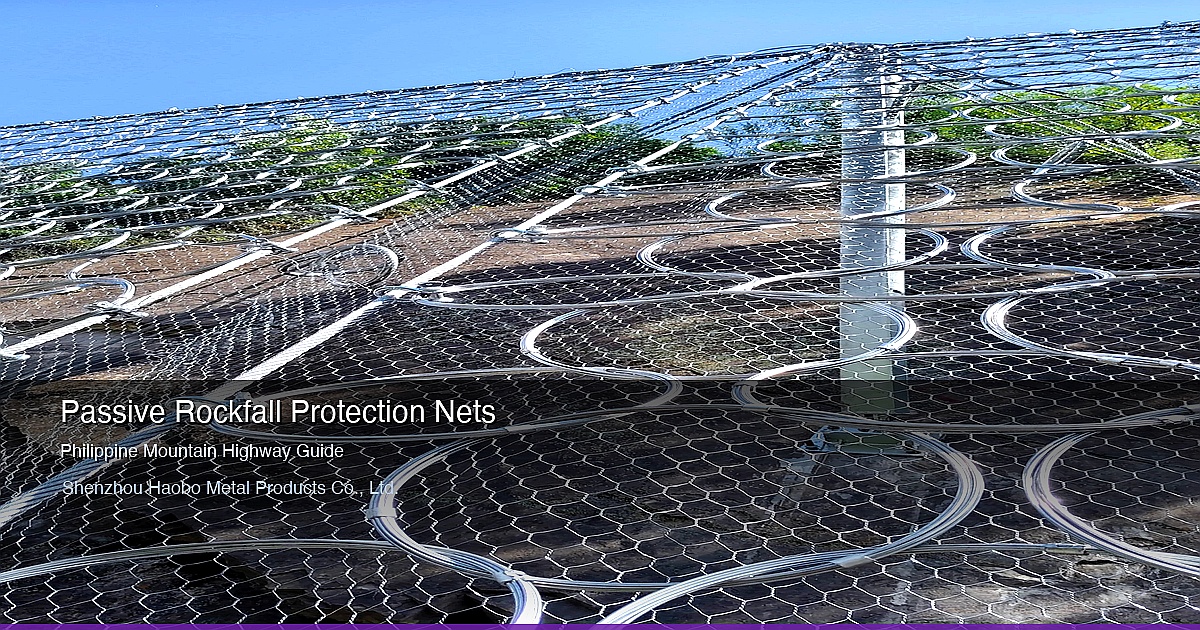
| Ring net panels | Primary energy-absorbing element; interlocking steel rings deform elastically and plastically to dissipate rockfall kinetic energy | High-tensile steel wire rope, Φ12-19mm, 1,770 MPa minimum |
| Steel posts | Support the ring net at design height; hinged base allows post to rotate forward under impact, increasing net sag for energy absorption | H-beam or tubular steel, H200×200 or Φ168mm, S355 or ASTM A572 Grade 50 |
| Energy dissipators | Brake rings or friction devices that absorb energy through controlled deformation when the support ropes are tensioned during rock impact | Steel brake ring or aluminum friction device, calibrated to specific energy rating |
| Support ropes | Top and bottom longitudinal ropes, lateral ropes, and uphill anchor ropes that transfer impact loads from the net to the anchors | Steel wire rope, Φ16-22mm, 1,770 MPa, galvanized ≥ 245 g/m² |
| Ground anchors | Transfer all loads into competent rock; the most critical element — anchor failure means complete system failure | High-tensile threaded bar, Φ25-40mm, Grade 500-700, grouted with cementitious grout (w/c 0.40) |
| Base plates | Connect posts to foundation; hinged design allows controlled post rotation | Hot-dip galvanized steel plate, t = 20-25mm |
| Intermediate mesh | Secondary mesh inside/behind ring net to catch smaller rock fragments (< 100mm) | Double-twist wire mesh, 2.7mm wire, 80×100mm or chain-link mesh |
3. Energy Capacity Selection for Philippine Mountain Conditions
The most critical design decision for passive rockfall barriers is selecting the correct energy capacity. Underspecifying the energy rating is the #1 cause of passive barrier failure on Philippine mountain roads.
3.1 Energy Capacity Classification (ETAG 027 / JT/T 528-2022)
| Energy Class | Maximum Energy (kJ) | Typical Rock Size Blocked | Barrier Height (m) | Philippine Application |
|---|---|---|---|---|
| MEL 500 | 500 kJ | Equivalent to 250 kg rock from 3m height | 2.0-3.0 | Low-traffic local roads, small cut slopes |
| MEL 1000 | 1,000 kJ | Equivalent to 500 kg rock from 4m height | 3.0-4.0 | Secondary national roads, moderate slope heights |
| MEL 2000 | 2,000 kJ | Equivalent to 1,000 kg rock from 5m height | 3.0-5.0 | Primary national roads (Kennon, Halsema), steep slopes |
| MEL 3000 | 3,000 kJ | Equivalent to 1,500 kg rock from 6m height | 4.0-5.0 | Very high-risk highway sections, large rock blocks |
| MEL 5000 | 5,000 kJ | Equivalent to 2,500 kg rock from 7m height | 5.0-6.0 | Critical infrastructure protection (bridges, tunnels) |
| MEL 8000 | 8,000 kJ | Equivalent to 4,000 kg rock from 8m height | 6.0-7.0 | Extreme hazard zones (rarely used, very expensive) |
3.2 Rockfall Energy Calculation
Design engineers must calculate the kinetic energy of potential rockfall blocks at the barrier location using rockfall trajectory analysis software (e.g., RocFall, CRSP, or Rockyfor3D).
Ekinetic = ½ × m × v²
Where:
Ekinetic = kinetic energy at barrier location (kJ)
m = mass of rock block (kg) = volume × density (typically 2,600-2,800 kg/m³ for Philippine andesite/basalt)
v = translational velocity at barrier location (m/s), typically 15-30 m/s for Philippine mountain slopes
Philippine-specific design recommendation: For Cordillera mountain roads with slope heights 20-50m and rock mass rating (RMR) 30-50, specify MEL 2000 as minimum and upgrade to MEL 3000 where slope height exceeds 50m or rock quality is poor (RMR < 30). The additional cost of upgrading from MEL 1000 to MEL 2000 (approximately 20-30%) is trivial compared to the cost of a single rockfall fatality or road closure.
4. Philippine Standards and DPWH Specifications
Passive rockfall protection barriers on Philippine highways must comply with:
| Standard | Relevance |
|---|---|
| DPWH DO No. 50, Series 2020 | Design Guidelines for Road Slope Protection Works — primary reference for rockfall protection on DPWH roads |
| DPWH DGCS Volume 2B | Geotechnical Design — slope stability analysis, rock mass classification (RMR, Q-system) |
| JT/T 528-2022 | Chinese standard for flexible protection systems (commonly adopted in Philippine projects for material specs) |
| ETAG 027 | European Technical Approval Guideline for rockfall kits — energy certification and testing methodology |
| NSCP 2015 Section 206 | Seismic loading — barriers must withstand Zone 4 (PGA = 0.40g) seismic acceleration |
| EN 1993-1-11 | Design of steel structures with tension components (wire ropes) |
5. Case Study 1: Kennon Road Passive Rockfall Barriers — Baguio City
5.1 Background
Kennon Road, the historic 33.5-km highway connecting Baguio City to the lowlands of Rosario, La Union, is arguably the most rockfall-prone highway in the Philippines. Built in 1905, it traverses steep, highly weathered diorite and andesite slopes with slope angles commonly exceeding 60 degrees. The road has been closed for extended periods multiple times due to rockfall and landslide events, most notably after the 1990 Luzon earthquake and Typhoon Pepeng (2009).
5.2 Rockfall Barrier Installation Program (2015-2020)
| Parameter | Details |
|---|---|
| Location | Camp 1 to Camp 6 sections, Kennon Road (various locations), Benguet Province |
| Barrier type | Passive ring net barriers, MEL 2000 and MEL 3000 |
| Total barrier length installed | 1,850 linear meters (20+ individual barriers) |
| Barrier heights | 3.0m (MEL 2000 sections), 5.0m (MEL 3000 sections) |
| Post spacing | 10m (standard), 8m (high-risk zones) |
| Anchor specification | Φ32mm Grade 700 threaded bar, 6.0m depth in competent rock |
| Ring net specification | Φ16mm high-tensile wire rope, 7×19 construction, 1,770 MPa, 300mm ring diameter |
| Energy dissipators | 4 brake elements per 10m panel: 2 uphill anchors + 2 lateral ropes |
| Installation contractor | DPWH Cordillera Administrative Region (CAR) with specialized rockfall contractor |
| Cost per linear meter | PHP 38,000-52,000/m (MEL 2000), PHP 55,000-75,000/m (MEL 3000) |
| Total program cost | Approximately PHP 95 million |
5.3 Performance Record (2015-2025)
- Confirmed rockfall intercepts: 23 documented rockfall events captured by barriers, with the largest event estimated at approximately 1,500 kg basalt block (approximately 1,200 kJ impact energy) at Camp 4 in 2018.
- Zero fatalities: No rockfall-related fatalities or injuries on barrier-protected sections since installation.
- Maintenance after impact: Barriers require ring net panel replacement after major impacts (rings permanently deformed). Average repair cost: PHP 150,000-350,000 per event vs. estimated PHP 2-5 million if the rock had reached the roadway.
- Corrosion performance: After 5-10 years in Baguio's high-humidity, high-rainfall environment, galvanized components show expected surface oxidation but no significant section loss. Annual inspection and touch-up coating program in place.
6. Case Study 2: Halsema Highway Passive Rockfall Nets — Atok to Buguias Section
6.1 Project Overview
The Halsema Highway (officially the Baguio-Bontoc Road), at 2,255m ASL at its highest point, is the Philippines' highest altitude highway system. The 150-km highway traverses extremely steep terrain with near-vertical rock cuts through the Central Cordillera granodiorite batholith and overlying metavolcanic rocks.
| Parameter | Details |
|---|---|
| Location | Atok, Buguias, and Bakun sections, Benguet Province |
| Barrier length installed | 950 linear meters (12 barriers) |
| Energy class | MEL 3000 (predominantly), MEL 5000 (2 critical locations) |
| Barrier height | 5.0m (MEL 3000), 6.0m (MEL 5000) |
| Post type | H200×200×8×12, S355 steel, hinged base |
| Ring net wire rope | Φ19mm, 1,770 MPa, 350mm ring diameter (MEL 3000); Φ22mm for MEL 5000 |
| Anchor depth | 7.0-8.0m into competent rock, pull-out tested to 1.5× design load |
| Installation challenges | Helicopter-assisted material transport for 4 remote barriers (no road access to slope base). Manual rock drilling at 2,000m+ elevation with limited oxygen. |
| Total cost | PHP 68 million (PHP 71,500/m average) |
| Completion | 2019-2021 (phased) |
6.2 Performance During Typhoon Egay (2023)
Super Typhoon Egay (Doksuri) in July 2023 brought over 500mm of rainfall in 48 hours to the Cordillera region. The Halsema Highway experienced multiple rockfall and landslide events. The MEL 3000 barriers intercepted 8 documented rockfall events, the largest being a 2.3-ton granodiorite block (estimated 2,200 kJ impact energy) that was successfully arrested by Barrier HS-7 at Buguias. Post-event inspection showed deformed ring nets and activated brake elements (as designed), but the barrier structure and anchors remained intact. The road remained open to single-lane traffic within 4 hours of each event.
7. Installation Methodology for Passive Rockfall Barriers on Philippine Mountain Slopes
7.1 Site Preparation and Access
- Slope clearing: Remove loose rock and vegetation from the barrier alignment zone. For slopes with active rockfall during construction, install temporary catch fences or schedule work during dry season (December-May).
- Access establishment: For accessible slopes, construct temporary access tracks. For steep/remote slopes (common on Philippine mountain roads), use rope access technicians (IRATA Level 2 or 3 certified) or helicopter-assisted material delivery.
- Survey and stakeout: Mark all anchor positions, post locations, and barrier alignment with total station survey to ±50mm accuracy. Barrie alignment must follow the natural slope contour — do NOT straight-line a barrier across a curved slope face.
7.2 Anchor Installation (Critical Step)
- Drilling: Drill anchor holes at specified diameter (typically Φ76-90mm for Φ32mm bar, or Φ90-110mm for Φ40mm bar) using hydraulic rotary-percussive drill. For rock mass with RMR < 25, consider self-drilling anchors (IBO or similar) to prevent hole collapse.
- Hole cleaning: Flush holes with compressed air and water to remove drilling debris. For anchors in fractured rock, consider pre-grouting and re-drilling to consolidate fractured zones.
- Anchor installation: Insert threaded bar with centralizer spacers every 2m to ensure uniform grout cover. Install PVC grout tube to hole bottom. Pressure grout from bottom up using cementitious grout (w/c ratio 0.40-0.45, compressive strength ≥ 30 MPa at 28 days).
- Anchor testing: After 7-day grout curing, proof-test all anchors to 1.25× design load and sacrificial-test 5% of anchors (minimum 3 per site) to 1.50× design load. Any anchor failing the proof test must be replaced with two new anchors.
7.3 Barrier Assembly and Erection
- Base plate installation: Cast reinforced concrete base plates (C30/37, 800mm × 600mm × 400mm minimum) at post locations. Install post base hinge assembly with correct orientation (hinge axis perpendicular to barrier alignment).
- Post erection: Erect steel posts and secure to base hinges. Install temporary bracing to hold posts vertical during rope tensioning. Posts must be plumb within 2mm/m.
- Support rope installation: Thread top longitudinal rope, bottom longitudinal rope, and lateral ropes through post head and base brackets. Connect uphill anchor ropes to ground anchors through energy dissipators.
- Ring net hanging: Suspend ring net panels from top longitudinal rope using shackles or carabiners (M24 or equivalent). Connect adjacent ring net panels using interlocking rings or connecting ropes.
- Tensioning: Apply specified rope tension (typically 20-30 kN for support ropes) using hydraulic tensioner or chain block. Install energy dissipators with correct pre-load settings per manufacturer specifications.
7.4 Critical Philippine-Specific Installation Considerations
| Issue | Philippine Mitigation |
|---|---|
| Typhoon wind loading | Passive barriers present significant wind area. Per NSCP 2015, design for wind speed of 250 kph (Zone II). Wind load = 0.5 × ρ × Cd × A × v² (Cd = 1.2 for open mesh, 2.0 for ring nets). Check post bending and anchor uplift under typhoon wind + seismic combination. |
| Lightning strike risk | Mountain ridges in the Cordillera are lightning-prone (Baguio averages 40-60 thunderstorm days/year). All steel components must be grounded via copper-clad grounding rods (Φ16mm, 2.4m length) connected to post bases with copper cable (35mm²). |
| Corrosion in high-rainfall environment | Annual rainfall in Baguio/Benguet exceeds 4,000mm/year — among the highest in the Philippines. Use Galfan (Zn-5%Al) coating (275 g/m²) instead of pure zinc for all wire rope and steel components. Consider stainless steel components (Grade 316) for critical anchor connections. |
| Vegetation regrowth | Philippine mountain slopes rapidly revegetate. Annual vegetation clearing around barriers is essential — climbing plants add dead load, trap moisture against steel components (accelerating corrosion), and can obstruct barrier deformation under impact. |
8. Maintenance and Inspection Schedule
| Inspection Type | Frequency | Key Checks |
|---|---|---|
| Routine visual | Monthly (roadside inspection from ground level) | Visible damage, debris accumulation behind net, missing components, corrosion signs |
| Post-typhoon | Within 72 hours after Signal No. 3+ typhoon | Activated brake elements, deformed rings, anchor displacement, post leaning, debris in net |
| Annual rope access | Every 12 months (dry season preferred) | Detailed rope inspection, ring net condition (individual ring deformation), brake element status, anchor head corrosion, bolt torque check |
| Post-impact (major) | Immediately after any rockfall event >500 kg | Replace all deformed ring net panels, replace activated brake elements, retension ropes, re-proof-test affected anchors |
9. Sourcing Passive Rockfall Protection Systems for Philippine Projects
9.1 Why Source from China?
China is the world's largest manufacturer of flexible rockfall protection systems, with extensive experience supplying systems for highway, railway, and mining projects in mountainous regions (Sichuan, Yunnan, Tibet) with geological conditions very similar to the Philippine Cordillera. Key advantages include:
- Proven technology: Chinese ring net systems are certified to ETAG 027 and JT/T 528-2022, with full-scale crash test data available for energy classes up to MEL 8000.
- Cost competitiveness: FOB pricing from China typically 30-40% lower than European-sourced equivalent systems, with comparable or equivalent performance.
- Manufacturing scale: Leading Chinese manufacturers can produce and deliver complete barrier systems for projects up to 5,000m within 8-12 weeks.
- Technical support: Many manufacturers provide design support including RocFall modeling, anchor design, and on-site installation supervision.
9.2 Shipping and Logistics
| Element | Details |
|---|---|
| Port of loading | Tianjin Port or Shanghai Port, China |
| Port of discharge | Manila (MICT) for Luzon projects / Subic Bay for Northern Luzon |
| Transit time | 5-8 days (Tianjin → Manila), 4-6 days (Shanghai → Manila) |
| Container type | 40' HQ for ring net panels (bulky, low weight); 20' GP for steel posts and anchors (heavy, compact) |
| Customs clearance | HS Code 7314.49.00 (wire netting, other than plated/coated), 5% MFN duty + 12% VAT |
Conclusion
Passive rockfall protection nets are proven, life-saving infrastructure on Philippine mountain highways. The 1,850m of barriers on Kennon Road and 950m on Halsema Highway have intercepted dozens of rockfall events with zero fatalities on protected sections — a remarkable safety record for roads that were previously among the most dangerous in the Philippines.
For DPWH project engineers and contractors, the key design decisions are: (1) correct energy capacity selection based on rockfall trajectory analysis — specify MEL 2000 minimum for Cordillera roads; (2) rigorous anchor design, testing, and quality control — this is the critical link that holds the entire system to the mountain; and (3) comprehensive post-impact maintenance budget — barriers are sacrificial and require component replacement after major rockfall events.
Sourcing complete ring net barrier systems from China-based manufacturers like Shenzhou Haobo Metal Products Co., Ltd. provides Philippine projects with ETAG 027-certified systems at 30-40% lower cost than European alternatives, with the manufacturing capacity and technical support to deliver large-scale highway protection programs.
Need Passive Rockfall Barriers for Your Highway Project?
Send us your slope parameters — height, angle, rock type (RMR), design rock block size, and AADT. Our engineering team provides ETAG 027-certified ring net specifications, anchor design, and FOB Tianjin pricing within 48 hours. MEL 2000-8000 systems available.
www.haobomesh.com | Shenzhou Haobo Metal Products Co., Ltd.