Gabion Wall Cost Guide: 2026 Price Breakdown & Budget Calculator
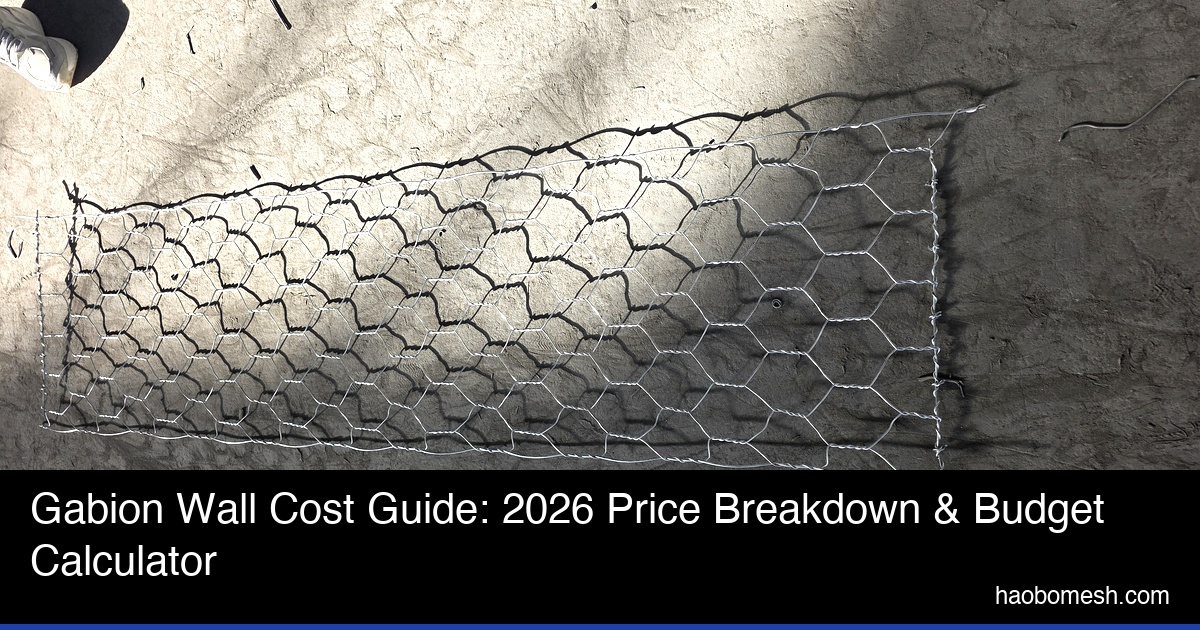
Whether you are building a retaining wall along a highway, stabilizing a riverbank, or adding a decorative landscape feature, understanding gabion wall cost is the first step to a realistic budget. In 2026, gabion prices remain competitive compared to traditional concrete and masonry, but the final invoice depends on wire specification, basket size, stone fill, transport, and installation method.
Key Takeaways
- Per m² cost range — Most gabion walls fall between $35 and $90 per m² of face area, including mesh and fill stone.
- Per m³ cost range — Gabion fill volume typically costs $60–$140 per m³, depending on stone type and local availability.
- Per linear meter — A 1 m high wall runs about $35–$75 per linear meter, while a 3 m high wall can reach $120–$250 per linear meter.
- Biggest price drivers — Wire coating (Galfan vs PVC), mesh aperture, wall height, stone fill, and installation access.
- Budget rule — Always add 10–15% contingency for stone overfill, corner bracing, and unexpected site conditions.
Table of Contents
- What Is a Gabion Wall and Why Cost Matters
- Gabion Wall Cost per Square Meter (2026)
- Gabion Wall Cost per Cubic Meter
- Gabion Wall Cost per Linear Meter
- 6 Factors That Drive Gabion Wall Price
- Gabion vs Concrete Retaining Wall Cost
- How to Get an Accurate Gabion Quote
- Cost-Saving Tips Without Sacrificing Quality
- Conclusion
1. What Is a Gabion Wall and Why Cost Matters
A gabion wall is a gravity retaining structure built from wire mesh cages filled with rock or stone. The cages are stacked in modular units, laced together with binding wire, and sometimes reinforced with internal diaphragms or geogrid. Because the wall relies on the mass of the fill for stability, gabions are both flexible and permeable, making them ideal for erosion control, slope protection, and river training works.
Cost matters because gabion walls are not a single product — they are a system. The mesh, the stone, the labor, and the logistics all move independently. A contractor who quotes only the cage price can leave you surprised by fill and installation costs. This guide breaks every component into a line item so you can compare apples to apples.
2. Gabion Wall Cost per Square Meter (2026)
The most common way contractors estimate a gabion wall is by the face area in square meters. This metric captures the visible wall surface and is easy to compare across designs of different lengths and heights.
| Wall Type | Typical Face Cost (USD/m²) | Best For |
|---|---|---|
| Economy gabion (2.7 mm galvanized, 80×100 mm mesh) | $35 – $50 | Temporary works, low visual exposure |
| Standard gabion (2.7 mm Galfan + PVC, 80×100 mm) | $50 – $70 | Permanent retaining walls, riverbanks |
| Heavy-duty gabion (4.0 mm Galfan + PVC, 60×80 mm) | $70 – $90 | High-load walls, aggressive environments |
| Welded mesh gabion (decorative face) | $80 – $120 | Landscaping, architectural facades |
Face-area pricing usually includes the gabion basket and factory-assembly lacing wire. It does not include stone fill, freight, or installation labor. If your project is in a remote area or the wall is taller than 3 m, expect the upper end of the range.
3. Gabion Wall Cost per Cubic Meter
Engineers often prefer cost per cubic meter because it reflects the actual volume of material in the wall. This is especially useful when comparing gabions with other gravity structures like rock-filled concrete or crib walls.
| Cost Component | USD/m³ | Notes |
|---|---|---|
| Gabion cage only | $25 – $45 | Depends on wire diameter and coating |
| Stone fill | $35 – $75 | Hard, durable stone; local quarry prices vary |
| Lacing and bracing wire | $3 – $8 | Included in some supplier quotes |
| Total materials | $60 – $125 | Excludes freight and installation |
| Installed wall | $100 – $180 | Includes labor, equipment, and minor earthworks |
For example, a 50 m³ gabion wall using standard 2.7 mm Galfan + PVC cages and local stone might cost $5,000–$7,500 in materials and $8,000–$12,000 installed. The total installed cost per m³ would be roughly $160–$240.
4. Gabion Wall Cost per Linear Meter
Linear-meter pricing is practical for clients who know the length of their wall and want a quick budget check. It ties directly to wall height: the taller the wall, the more cages and fill per meter of length.
| Wall Height | Typical Cost per Linear Meter (USD) | Notes |
|---|---|---|
| 1.0 m | $35 – $75 | Garden walls, low embankments |
| 1.5 m | $65 – $120 | Residential retaining walls |
| 2.0 m | $90 – $160 | Commercial and municipal projects |
| 3.0 m | $120 – $250 | Highway and heavy infrastructure |
| 4.0 m+ | $200 – $400+ | Engineered designs with geogrid |
These figures assume a standard 1 m depth of baskets. If the design calls for a wider base for extra stability, the linear-meter cost will rise proportionally.
5. 6 Factors That Drive Gabion Wall Price
Not every gabion wall is priced the same. Here are the six variables that move the needle most:
1. Wire diameter and coating. A 2.0 mm galvanized wire is cheaper than 2.7 mm Galfan wire, but it offers less durability. Galfan + PVC coating adds 5–10 years of service life and typically costs 15–25% more.
2. Mesh aperture. Smaller mesh (60×80 mm) uses more wire per square meter and requires smaller, more expensive stone. Standard 80×100 mm mesh is the cost sweet spot for most projects.
3. Stone fill quality. Hard, angular, durable stone such as granite or basalt costs more than limestone or sandstone. Stone must also be 1.5× the mesh aperture to avoid migration.
4. Basket size and shape. Standard 2×1×1 m baskets are the most economical to manufacture and freight. Custom sizes, curved sections, or stepped tiers increase both material and labor costs.
5. Freight and logistics. Gabions are bulky but lightweight before filling. Ocean freight from China to the U.S. or Europe is usually the largest logistics cost. Sea freight to a major port runs roughly $2,000–$4,000 per 20-foot container, depending on the season and destination.
6. Installation access and labor. A flat, open site with crane access is cheap to build on. Steep slopes, tight urban locations, or underwater placement require skilled labor and specialized equipment.
| Factor | Low-Cost Option | Premium Option | Price Impact |
|---|---|---|---|
| Wire coating | Galvanized only | Galfan + PVC | +15% – +25% |
| Mesh size | 80×100 mm | 60×80 mm | +10% – +20% |
| Stone source | Local quarry | Imported hard stone | +20% – +50% |
| Basket design | Standard 2×1×1 m | Custom shapes | +10% – +30% |
| Freight | Sea freight to port | Air freight | +200% – +400% |
| Installation | Open site, machine access | Confined or steep site | +30% – +60% |
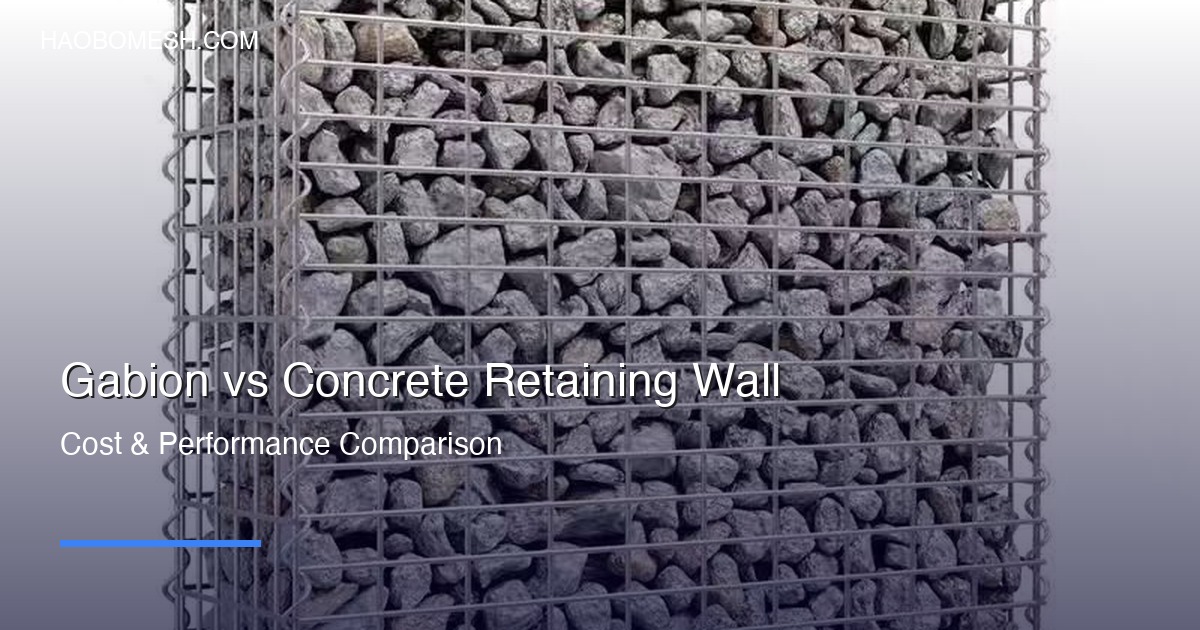
6. Gabion vs Concrete Retaining Wall Cost
Contractors often ask whether gabions are cheaper than poured concrete. The answer depends on wall height, ground conditions, and local labor costs, but gabions are usually the lower-cost option for walls under 4 m and sites with good drainage.
| Comparison | Gabion Wall | Concrete Retaining Wall |
|---|---|---|
| Material cost per m² | $35 – $90 | $80 – $200 |
| Installed cost per m² | $120 – $220 | $200 – $400 |
| Drainage | Free-draining; no weep holes needed | Requires drains and waterproofing |
| Foundation | Flexible; tolerates minor settlement | Rigid; needs engineered footing |
| Environmental impact | Lower carbon footprint | Higher cement consumption |
| Aesthetics | Natural stone appearance | Smooth or textured finish |
| Maintenance | Minimal; occasional stone refill | Crack repair, joint sealing |
For a 50 m long, 2 m high wall, gabions might save 25–40% over reinforced concrete. Savings come from lower material cost, no formwork, simpler foundations, and faster installation.
7. How to Get an Accurate Gabion Quote
To receive a precise quote from a gabion manufacturer or supplier, provide the following information:
- Total wall length, height, and approximate face area
- Basket dimensions (e.g., 2×1×1 m, 2×1×0.5 m)
- Wire diameter and coating specification (e.g., 2.7 mm Galfan + PVC)
- Mesh aperture (e.g., 80×100 mm)
- Project location and intended delivery port
- Required quantity and delivery schedule
- Any standards required (ASTM A975, EN 10223-3, etc.)
At Haobo Metal, we return detailed quotations within 24 hours, including unit price, freight estimate, and delivery timeline. We also help clients optimize basket sizing to reduce waste and simplify installation.
8. Cost-Saving Tips Without Sacrificing Quality
Here are practical ways to keep the budget under control while still meeting engineering requirements:
Standardize basket sizes. Using 2×1×1 m and 2×1×0.5 m units reduces cutting waste and speeds assembly. It also makes freight stacking more efficient.
Source stone locally. Transporting stone is expensive. If a local quarry can supply hard, durable stone that meets the 1.5× mesh rule, use it.
Order a full container. A 20-foot container holds roughly 800–1,000 m² of flat gabion panels. Filling a container lowers the per-unit freight cost significantly.
Choose Galfan for the base and PVC only when needed. In mildly corrosive environments, Galfan wire alone often lasts 30+ years. PVC coating is worth the extra cost only in marine, industrial, or very acidic soils.
Plan installation ahead. Schedule delivery so baskets are not stored on site for weeks. This reduces handling damage and theft risk.
9. Conclusion
Gabion wall cost in 2026 ranges from roughly $35 to $90 per m² of face area, or $60 to $140 per m³ of fill volume, before installation. The final price is driven by wire specification, mesh size, stone fill, basket design, freight, and site conditions. Compared with reinforced concrete, gabions are typically 25–40% cheaper for walls under 4 m, and they offer added benefits of drainage flexibility and a lower carbon footprint.
For an accurate project budget, request a detailed quote that separates cage cost, stone cost, freight, and installation labor. With the right specification, gabions deliver a durable, cost-effective retaining solution for civil, landscape, and infrastructure projects.
Frequently Asked Questions
How much does a gabion wall cost per square meter?
In 2026, gabion walls typically cost $35–$90 per m² of face area for the cages alone, and $120–$220 per m² installed including stone fill and labor.
What is the cheapest stone fill for gabions?
Local quarry stone is usually the cheapest option, provided it is hard, durable, and at least 1.5 times the mesh aperture. Avoid rounded river stone that can shift easily.
Are gabion walls cheaper than concrete?
For walls under 4 m, gabions are generally 25–40% cheaper than reinforced concrete retaining walls because they need no formwork, less concrete, and simpler foundations.
Get a Free Gabion Wall Quote
Send your wall dimensions and specifications. We will reply with a detailed cost breakdown within 24 hours.