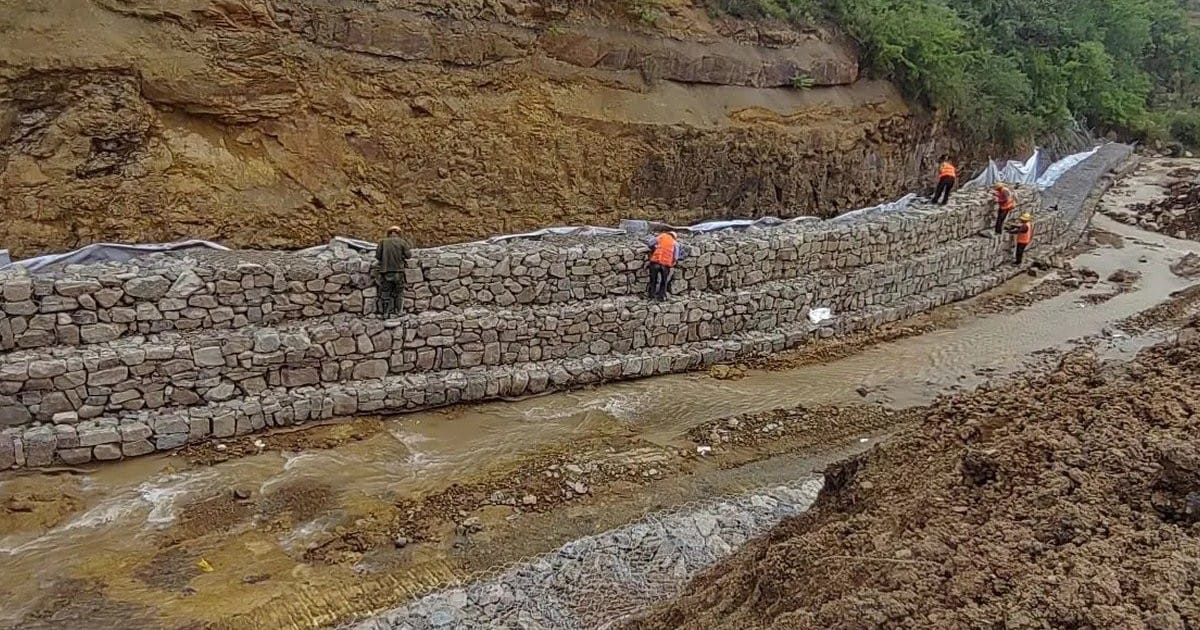
Gabion Stone Fill Requirements: Size Grading, Density, and Quality Standards for Engineers
Why This Matters: Choosing the right wire mesh specification can mean the difference between a 50-year structure and one that fails in 5. This guide is based on our direct factory experience supplying global infrastructure projects.
The stone fill inside a gabion basket is not just dead weight — it is the load-bearing skeleton, drainage medium, and aesthetic face of the structure. Selecting the wrong stone can compromise structural stability, cause premature mesh failure, and turn what should be a 50-year structure into a maintenance headache. This guide covers every aspect of stone fill specification: size grading curves, density requirements, rock quality indices, and the field testing protocols that ensure your fill meets the design intent.
📋 Key Takeaways
- 100-200mm is the sweet spot: Stone fill grading that's large enough to not pass through mesh (80×100mm) yet small enough to place efficiently
- Density matters: Fill stone should have density ≥1,700 kg/m³ — lighter stone reduces wall mass and stability, requiring wider base
- EN 13383 governs stone quality: Freeze-thaw resistance (≤1% mass loss after 80 cycles), water absorption (≤2%), and Los Angeles abrasion (≤40%)
- Angular is better than rounded: Angular stone interlocks for higher internal friction (φ ≥ 40°) — rounded stone needs 10-15% wider wall for equivalent stability
- Source stone locally: Fill typically costs $8-15/ton from nearby quarries but $25-40/ton when transported > 50km — proximity is the biggest cost driver
Table of Contents
1. Why Stone Fill Specifications Matter
Stone fill is typically 60–70% of a gabion structure's total weight and volume. It performs four critical structural functions simultaneously:
- Load-Bearing: The stone mass resists earth pressure behind retaining walls. Stone-to-stone contact transfers lateral loads through the basket, and the stone's internal friction angle (typically 35–45°) determines the structure's internal stability. Fill that is too small or poorly graded will settle and compact under load, reducing the effective height of the wall and creating uneven pressure distribution on the wire mesh.
- Drainage: The void spaces between stones allow water to pass through freely, preventing hydrostatic pressure buildup behind the wall. This is the fundamental advantage of gabion construction over solid concrete walls. Void ratio (typically 30–40%) directly determines drainage capacity — poorly graded fill with excessive fines can clog the voids and trap water.
- Mesh Protection: Properly sized stone fill prevents individual stones from passing through the mesh openings (a failure called "raveling") while also protecting the wire from abrasion. Stones that are too angular can cut the wire coating during placement or under dynamic loading.
- Erosion Resistance: For riverbank and channel applications, the stone fill must resist hydraulic forces. Stone weight and interlock determine the critical velocity at which stones begin to displace — undersized stone fill in a high-velocity channel will progressively empty the basket.
2. Stone Size Grading and Mesh Opening Relationship
The fundamental rule of gabion stone sizing: the smallest stone dimension must be at least 1.5× the mesh opening dimension. This prevents individual stones from escaping through the mesh while allowing the stone mass to settle into a dense, load-bearing configuration.
Standard Gabion Stone Size Ranges (EN 13383):
| Mesh Opening (mm) | Min. Stone Size (mm) | Max. Stone Size (mm) | Typical D50 (mm) | Application |
|---|---|---|---|---|
| 60×80 | 100 | 200 | 150 | Architectural gabions, decorative walls, landscaping |
| 80×100 | 125 | 250 | 180 | Standard retaining walls up to 6m height |
| 100×120 | 150 | 300 | 220 | Riverbank protection, channel lining, large baskets |
The 1.5× Rule in Practice: For 80×100mm mesh, the minimum stone dimension should be 80mm × 1.5 = 120mm. This means no stone should pass through a 120mm square sieve. The maximum stone dimension is typically 2× the minimum (250mm for 80×100 mesh) — stones larger than this become difficult to place by hand and may create excessively large voids.
Grading Envelope: A well-graded stone fill (not uniform size) is desirable because it reduces the void ratio and increases density. The ideal grading curve should have:
- Not more than 10% passing the minimum size sieve (120mm for 80×100 mesh)
- Not more than 10% retained on the maximum size sieve (250mm for 80×100 mesh)
- D50 (median stone weight) should represent approximately 50% of the design stone weight
- Coefficient of uniformity (Cu = D60/D10) should be between 1.5 and 2.5 — too uniform means excessive voids, too widely graded means segregation during placement
3. Rock Quality and Durability Standards
Not all rock is suitable for gabion fill. The stone must resist weathering, freeze-thaw cycling, and chemical degradation over the structure's design life. Two primary standards govern rock suitability: EN 13383 (European) and ASTM D4992 (US).
Key Rock Quality Parameters:
| Parameter | Test Method | Minimum Requirement | Significance |
|---|---|---|---|
| Unconfined Compressive Strength (UCS) | ≥ 30 MPa | Crushing resistance under lateral earth pressure | |
| Los Angeles Abrasion | ASTM C131 / EN 1097-2 | ≤ 40% loss | Resistance to impact and abrasion during placement |
| Sodium Sulfate Soundness | ASTM C88 / EN 1367-2 | ≤ 12% loss (5 cycles) | Freeze-thaw durability (simulates ice crystal expansion) |
| Water Absorption | ASTM C97 / EN 13755 | ≤ 2% by weight | Resistance to water-related degradation |
| Specific Gravity (SSD) | ASTM C127 / EN 1097-6 | ≥ 2.5 | Higher density = greater mass per volume = better stability |
Recommended Rock Types for Gabion Fill:
- Excellent (preferred): Granite, basalt, gabbro, quartzite, gneiss — dense igneous and metamorphic rocks with UCS > 100 MPa, low water absorption, excellent freeze-thaw resistance
- Good (acceptable): Hard limestone, dolomite, hard sandstone — sedimentary rocks with UCS 50–100 MPa, moderate water absorption. Avoid limestone with visible clay seams or cavities
- Marginal (case-by-case): Schist, slate, some limestones — anisotropic rocks that may split along cleavage planes. Require detailed petrographic analysis before acceptance
- Unsuitable (do not use): Shale, mudstone, chalk, weathered granite, any rock with UCS < 20 MPa, gypsum, rock with visible oxidation stains
4. Density and Void Ratio Requirements
Gabion fill density directly affects structural stability, drainage performance, and material cost estimation. The density of a filled gabion is always less than the density of the solid rock — the void spaces between stones account for 30–40% of the total volume.
Typical Density Values:
| Rock Type | Solid Density (kg/m³) | Void Ratio | Bulk Fill Density (kg/m³) |
|---|---|---|---|
| Granite / Basalt | 2,600–2,800 | 30–35% | 1,700–1,950 |
| Hard Limestone | 2,500–2,700 | 32–38% | 1,550–1,850 |
| Sandstone (hard) | 2,300–2,600 | 35–40% | 1,400–1,700 |
Estimation Formula:
Stone fill tonnage = Basket volume (m³) × Bulk fill density (tonnes/m³) × 1.05 (wastage factor)
Example: A standard gabion basket of 2m × 1m × 1m = 2.0 m³, using granite fill at 1,800 kg/m³ = 2.0 × 1.8 × 1.05 = 3.78 tonnes of stone required.
5. Field Testing and Quality Control
Laboratory specifications mean nothing if the stone delivered to site does not match. A systematic field testing program is essential for quality assurance.
Field QC Checklist:
- Visual Inspection (Every Delivery): Check for excessive fines (dust/clay coating), elongated or slab-shaped stones (length > 3× thickness = reject), and weathered or oxidized surfaces. Photograph and document each truckload.
- Sieve Analysis (1 per 500 tonnes): Use a field sieve set (120mm, 150mm, 200mm, 250mm square openings) to verify the grading envelope. Take a representative sample of 20–30 stones from the delivered stockpile, weigh each, and plot against the specified grading curve.
- Point Load Test (1 per 1,000 tonnes): The point load strength index (Is50) is a quick field proxy for UCS. Use a portable point load tester to test 10 randomly selected stones per batch. Convert Is50 to approximate UCS using: UCS ≈ 24 × Is50. Reject any batch where the average Is50 indicates UCS < 30 MPa.
- Drop Test (spot check): Drop individual stones from a height of 1.5m onto a concrete floor or steel plate. Stones that shatter, split along visible planes, or crumble should trigger batch rejection.
- Bulk Density Check (per batch): Fill a 1m³ test box with stone from the delivery using the same placement method as the actual construction. Weigh the filled box. The measured bulk density should be within 10% of the design value.
6. Fill Placement Best Practices
Even perfect stone can be ruined by poor placement. The following practices are based on decades of gabion construction observation:
- Hand Placement, Not Dumping: Stone should be hand-placed, not dumped from a loader bucket. Dumping creates segregation — smaller stones accumulate at the bottom, larger at the top — and can damage the wire mesh. For large-scale projects, use a clamshell grab with a skilled operator who can place stones gently.
- Face Stones First: Place the largest, most regular-shaped stones against the exposed face of the basket first. These "face stones" determine the aesthetic appearance and should be selected for their shape and color consistency. They should be placed with the flattest face outward and packed as tightly as possible against the mesh.
- Cross-Bracing During Filling: For baskets taller than 0.5m, install temporary internal bracing wires between opposite faces at the mid-height and near the top. This prevents the mesh from bulging outward during filling. Remove the bracing wires only after the basket is completely filled and the lid is wired shut.
- Overfilling for Settlement: Overfill each basket by approximately 25–50mm above the lid level before closing. The stone mass will settle by 5–10% of its height during the first 3–6 months as stones reorient and interlock. Without overfilling, the lid will sag, creating a depression that collects water and debris.
- Compaction (Optional): For retaining walls where settlement is unacceptable (e.g., walls adjacent to pavements), compact each layer with a plate compactor or hand tamper. Do not use vibratory rollers — the vibration can damage the zinc coating on the wire. Compaction should achieve at least 95% of the maximum dry density as determined by a field density test.
Need Gabion Stone Fill Specifications?
Send us your mesh size and project requirements. Our engineers will provide a complete stone fill specification including size grading, quality standards, and quantity estimation — free of charge.
📱 WhatsApp Inquiry Send Email Inquiry