Slope Protection Mesh — Rockfall Barriers, Drape Systems & Engineering Support
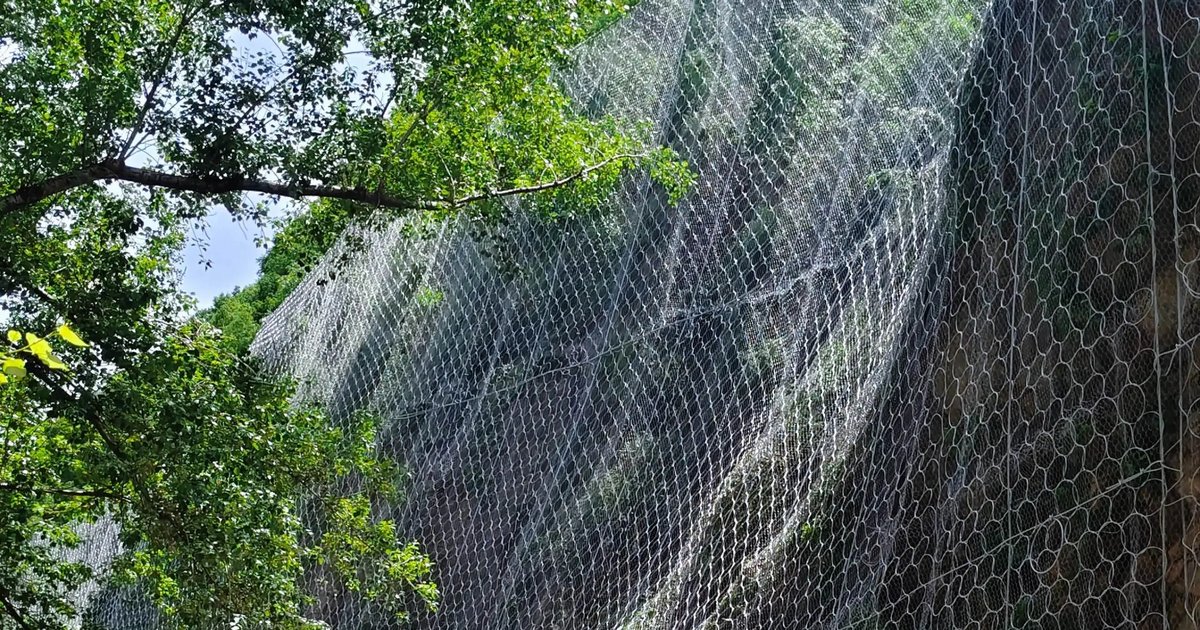
Haobo Metal's Slope Protection Mesh systems provide engineered solutions for rockfall mitigation, landslide prevention, and slope stabilization. From active tensioned drape systems to passive ring net barriers, our slope protection products meet ETAG 027 and EN 13285 standards. Whether you're securing a highway cut slope, mining bench, or railway corridor, we deliver certified mesh with full engineering support.
📋 Key Takeaways
- Three system types: Active (anchored high-tensile nets), passive (drapery mesh), and debris flow barriers (ring nets) — each for different slope conditions
- Energy class is critical: Systems rated from 500kJ to 3000kJ per EAD 340059 — choose based on calculated rockfall energy, not guesswork
- Factory-direct pricing advantage: Our integrated production (mesh + ropes + anchors) eliminates middleman markups and ensures component compatibility
- Design support included: We work with your geotechnical engineer to specify anchor patterns, rope diameters, and mesh type based on site survey data
- ETAG 027 certified: All systems tested and certified to European Technical Approval Guidelines for rockfall protection kits
📋 Table of Contents
1. Complete Product Range
2. Technical Specifications
3. How to Select the Right Slope Protection System
Selecting the correct system depends on four critical factors:
- Hazard Assessment: Conduct a rockfall trajectory analysis (RocFall™ or similar) to determine impact energy (kJ) at the barrier location. This is the single most important parameter.
- Slope Geometry: Slope height, angle, and bench configuration determine mesh type and anchor spacing. Active systems work best on slopes steeper than 60°; passive barriers suit catch benches and toe areas.
- Rock Mass Quality: RMR (Rock Mass Rating) and GSI (Geological Strength Index) values influence anchor depth and pattern. Poor-quality rock requires deeper, more frequent anchors.
- Environmental Exposure: Coastal, alpine, or chemically aggressive environments demand upgraded coating specifications (Galfan or PVC over standard Zn-Al).
4. Installation Methodology
Active Drape Mesh Installation:
- Slope scaling — remove loose rock and vegetation from installation zone
- Top anchor row installation — drill and grout anchors at 3–5m spacing along crest
- Mesh unrolling — deploy mesh from top to bottom using rope access or crane
- Spike plate installation — pattern-drive spike plates at 2m × 2m grid with pneumatic hammer
- Mesh tensioning — apply 5–10 kN tension per connection point using torque wrench
- Edge termination — secure mesh edges with boundary ropes and additional anchors
Passive Ring Net Barrier Installation:
- Foundation preparation — excavate and cast reinforced concrete foundations for posts
- Post erection — install H-beam or pipe posts with base plate connections, torque to spec
- Ring net assembly — connect ring panels on ground, hoist into position with crane
- Anchor rope installation — install uphill and lateral anchor ropes, tension to 20–30 kN
- Brake element attachment — connect energy-dissipating brake rings at anchor rope ends
- System testing — apply test load to verify brake activation threshold and net deflection
5. Project Case Studies
- Highway Slope, Malaysia (2023): 5,000m² active drape mesh installed on 70° granite cut slope along PLUS Expressway. Zero rockfall incidents in 3 years post-installation. Mesh specification: TECCO G65/3, Zn-Al coating, 2.0mm wire.
- Mining Bench Protection, Chile (2022): 2,000 kJ ring net barrier protecting haul road from 80m high pit wall. 8-post system with 19mm anchor ropes. Survived 3.2m³ rock impact event in 2024 with zero structural damage.
- Railway Corridor, Switzerland (2021): 800m of active drape mesh with integrated monitoring sensors (strain gauges + inclinometers) on alpine railway cut. Remote monitoring enables predictive maintenance scheduling.
6. Quality Assurance & Full-Scale Testing
All Haobo Metal slope protection systems undergo full-scale impact testing per ETAG 027 guidelines:
- MEL (Maximum Energy Level) Test: System must stop a standardized concrete block at specified energy without exceeding 50% of nominal height residual
- SEL (Service Energy Level) Test: Two consecutive impacts at 1/3 MEL — system must remain functional with repairable damage only
- Mesh Tensile Testing: Individual wire tensile strength and elongation tested to ISO 6892-1
- Salt Spray Corrosion: 2,000-hour neutral salt spray test per ISO 9227 for coastal/marine applications
- UV Resistance: Xenon arc accelerated weathering per ISO 4892-2 for PVC-coated systems
7. Engineering Support & Design Services
Haobo Metal provides complimentary preliminary engineering support for qualified projects:
- Rockfall trajectory analysis using RocFall™ software
- Slope stability analysis (SLIDE / SLOPE/W) with mesh reinforcement modeling
- Custom barrier design for non-standard energy levels or site constraints
- Installation methodology statements and QA/QC plans
- As-built documentation package for regulatory compliance
Secure Your Slope — Get a Custom Protection Plan
Describe your slope conditions — height, angle, rock type, and risk level. Our engineering team will design a tailored rockfall protection solution with detailed specifications and pricing.
📱 Get Slope Solution 📧 Send Email InquiryRelated Technical Guides
- Gabion Retaining Walls for India's Highway Infrastructure: Complete Engineering Guide for Bharatmala & NHDP Projects
- Gabion Retaining Walls for UK Transport Infrastructure: BS 8002 Design Guide & FOB Supply
- Gabion Retaining Walls for North American Highway Construction: AASHTO LRFD Design Guide & ASTM A975 Compliance
- Gabion River Bank Protection & Erosion Control for African Infrastructure Projects (YB/T 4190-2018 Standards)
- Rockfall Protection Netting for Middle East Mountain Highways: UAE, Oman, Saudi Arabia ETAG 027 Design Guide 2026