How to Stop Soil Erosion on a Slope: Fix Water First, Then Add Gabion Baskets
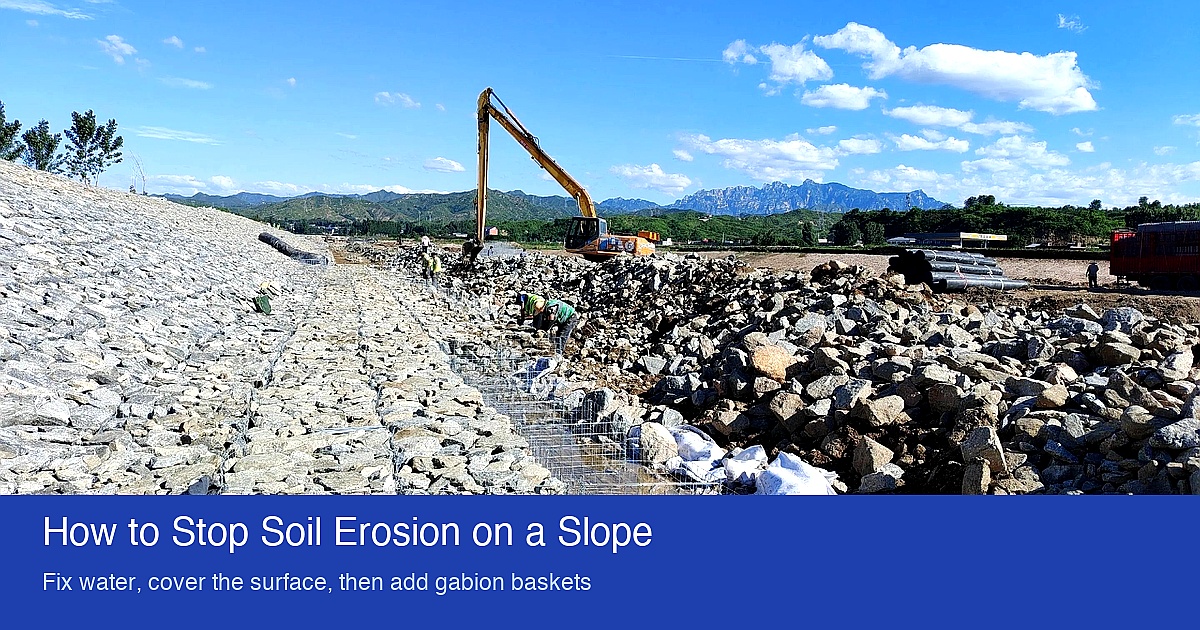
To stop soil erosion on a slope, work in this order: water first, cover second, structure last. Most failing slopes have a water problem, not a soil problem. Runoff concentrates, cuts rills, and the rills grow into gullies. Slow the water and give it a safe route, protect the surface with plants or mulch, and add a gabion wall or reno mattress only where the slope is too steep or too high to leave to vegetation alone.
Find out where the water comes from first
Before you buy any wire mesh or stone, walk the slope during or just after rain. Look upslope, not just at the damage. Water that erodes a slope often starts somewhere else: a roof downspout, a compacted driveway, a neighbor's graded yard, or a bare track above the site. Washington State University Extension puts it simply: the first step is to identify the source of the water causing the damage.[1]
Read the slope's own evidence. Rills show the path runoff prefers. A fan of sediment at the toe shows where it ends. Bare patches between plants tell you the surface cover has failed. Mark these spots with stakes or photos; every later decision — drainage, planting, or whether to install gabion baskets — depends on this map.
Slow the water before you hold the soil
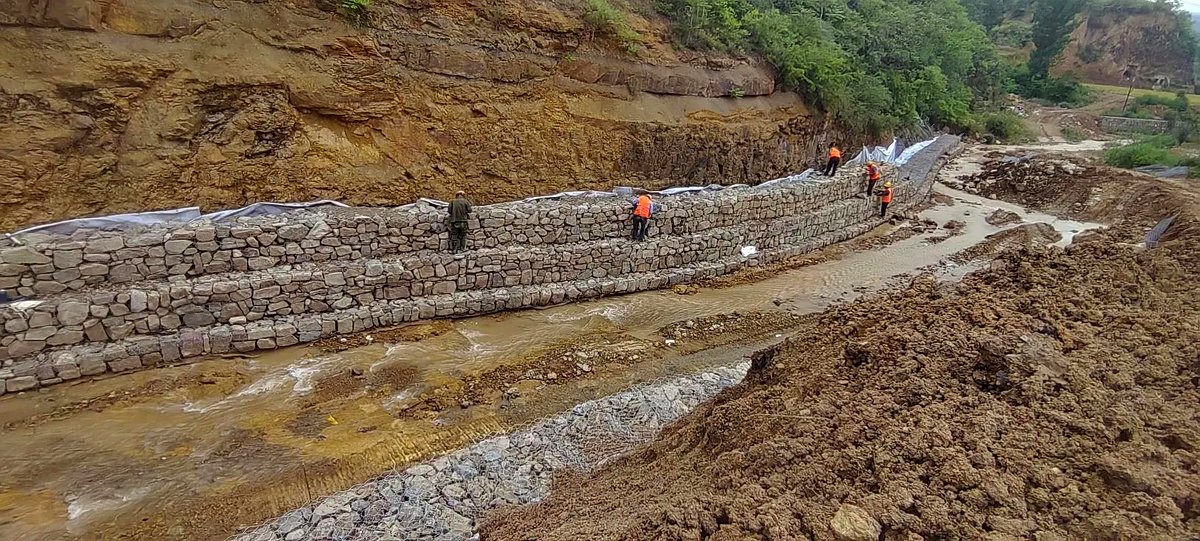
Water running downhill gains energy with every meter of slope length. Your job is to steal that energy. Proven options, roughly in order of effort:
- Redirect downspouts away from the slope with splash blocks, extensions or buried pipe, letting water dissipate into a gravel area or planting bed.[1]
- Cut a swale or dry stream. WSU Extension describes filling a low swale with 25–75 mm (1–3 in) washed river rock to direct storm water toward plants instead of letting it cut channels across the slope.[1]
- Break the slope into shorter runs. Mississippi State University Extension notes that terracing reduces erosion by breaking a long hillside into shorter, more even steps, and that stone check dams placed in gullies stop them growing.[2]
- Avoid sending your water onto someone else's land. Concentrated discharge at a property line creates the same problem downhill — and sometimes a legal one.[1]
Cover the surface with plants and mulch
Once water has a safe route, the surface needs armor. WSU Extension lists straw, grass clippings and wood chips as surface mulches that reduce erosion, and advises replanting bare soil as soon as practical.[1] Mississippi State adds that tree and shrub roots bind soil particles while stems slow rushing water — tall grasses, wildflowers and shrubs outperform lawn grass on steep ground, because lawn roots are shallow and heavy rain can strip turf away roots and all.[2]
Until plants establish, hold the surface with a temporary layer of straw, wood mulch, or an open erosion-control matting pegged to the slope. Raindrops should hit cover, not bare soil. Choose plants for the site, not the catalog: sunny slopes tolerate junipers, sedums and drought-tolerant shrubs; shady slopes take ferns, ivies and shade groundcovers.[2]
Decide when the slope needs a structure
Plants and mulch protect the surface. They cannot hold back a slope that wants to move. Consider a structure when any of these are true:
| What the slope looks like | First move | When a structure makes sense |
|---|---|---|
| Gentle slope, surface rills, no movement at the toe | Drainage + mulch + planting | Usually not needed; review after one rainy season |
| Steep garden slope, soil creeps after rain | Shorten the slope with terraces | Low terraces in timber, stone or gabion baskets |
| Cut slope beside a driveway, track or building | Map water routes, clear loose material | A gabion retaining wall — failure here can damage structures[2] |
| Gully or ditch enlarging with every storm | Armored channel or check dams | A reno mattress lining where flow is regular |
| Riverbank or creek bank washing out | Assess flow velocity and toe scour | Gabion revetment sized to the channel |
| Loose rock above a road or path | Scale loose blocks, map fall paths | Flexible slope protection mesh / rockfall netting |
One caution repeated by extension services: there is tremendous pressure from water and soil behind a retaining wall, and large walls need proper equipment, drainage and expertise.[2] USGS landslide guidance adds a practical reason to act early: an increase in soil pore water pressure is the typical trigger for the majority of landslides caused by rainfall — drainage is not decoration, it is the safety mechanism.[3]
Use gabion baskets and a reno mattress
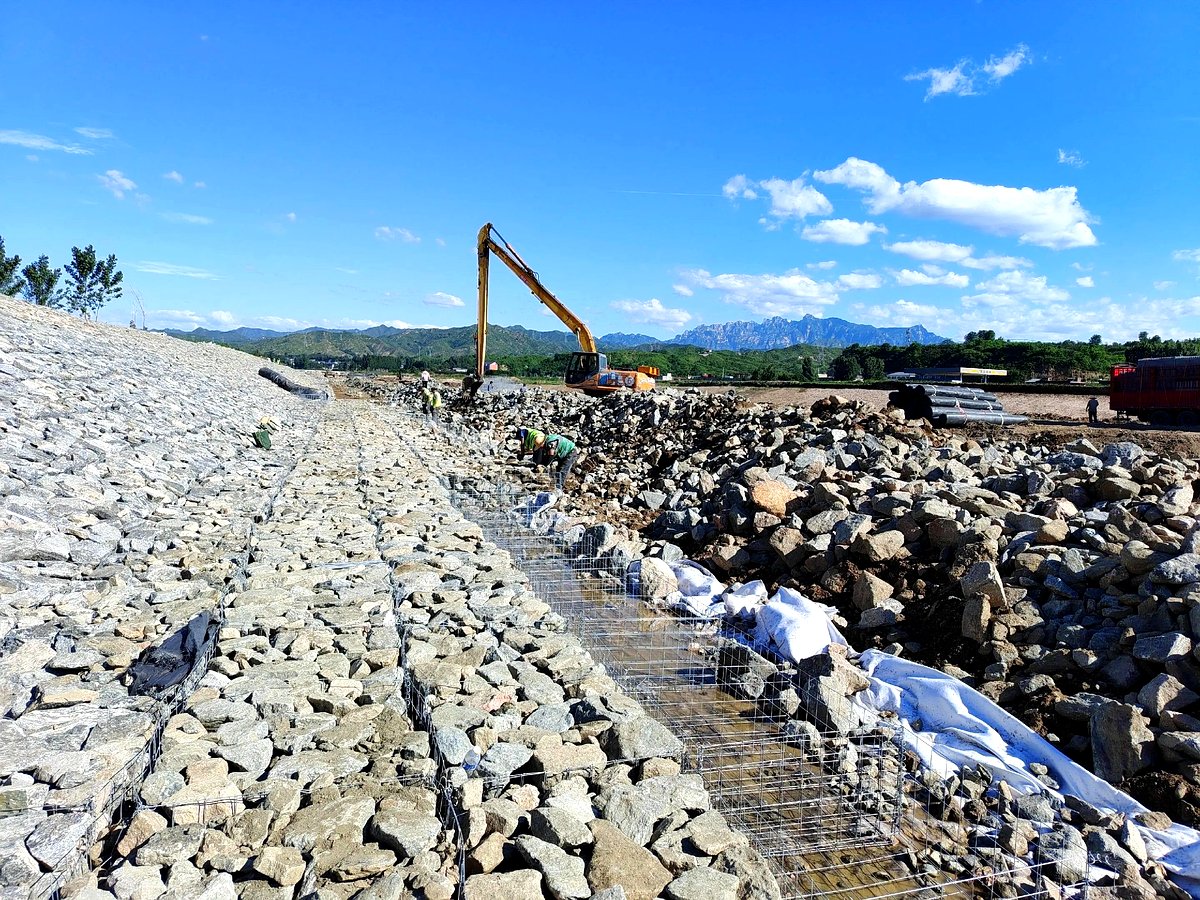
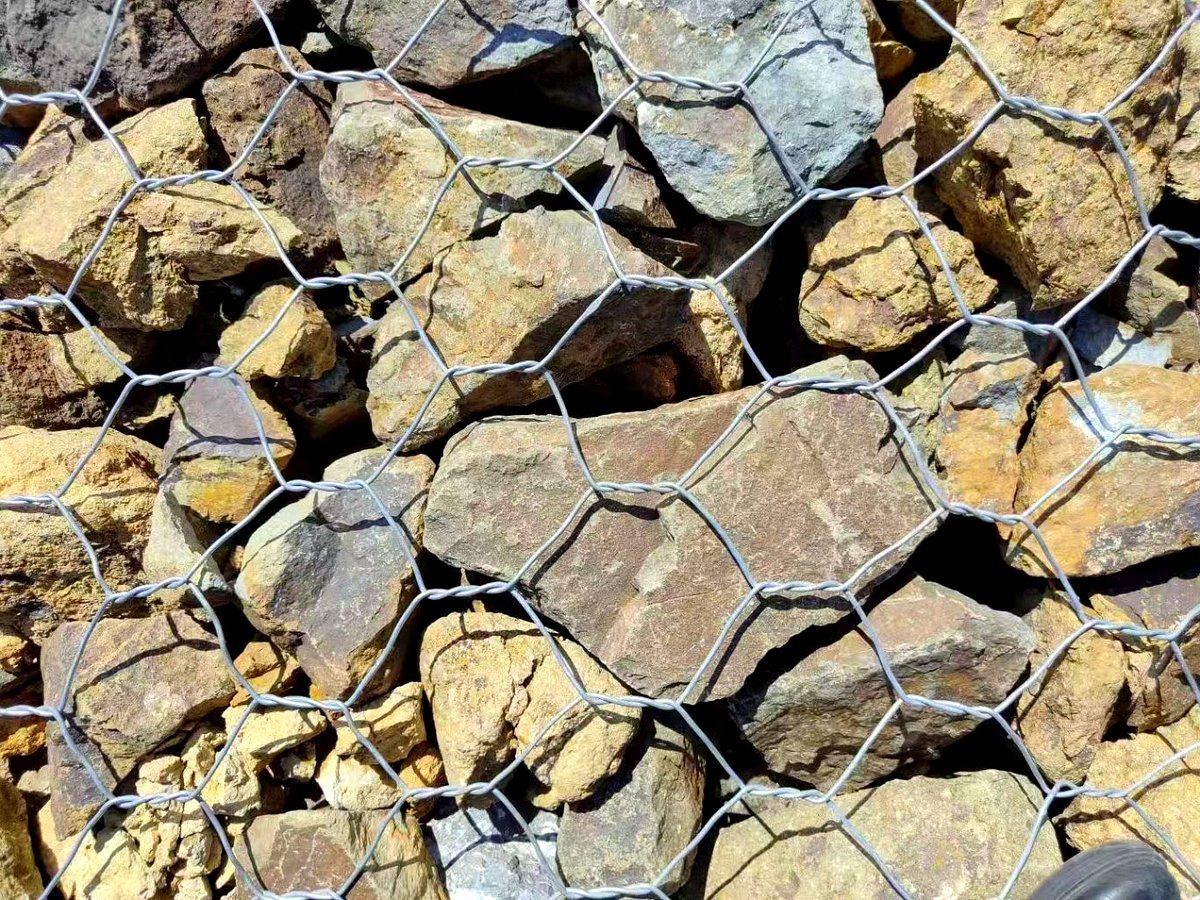
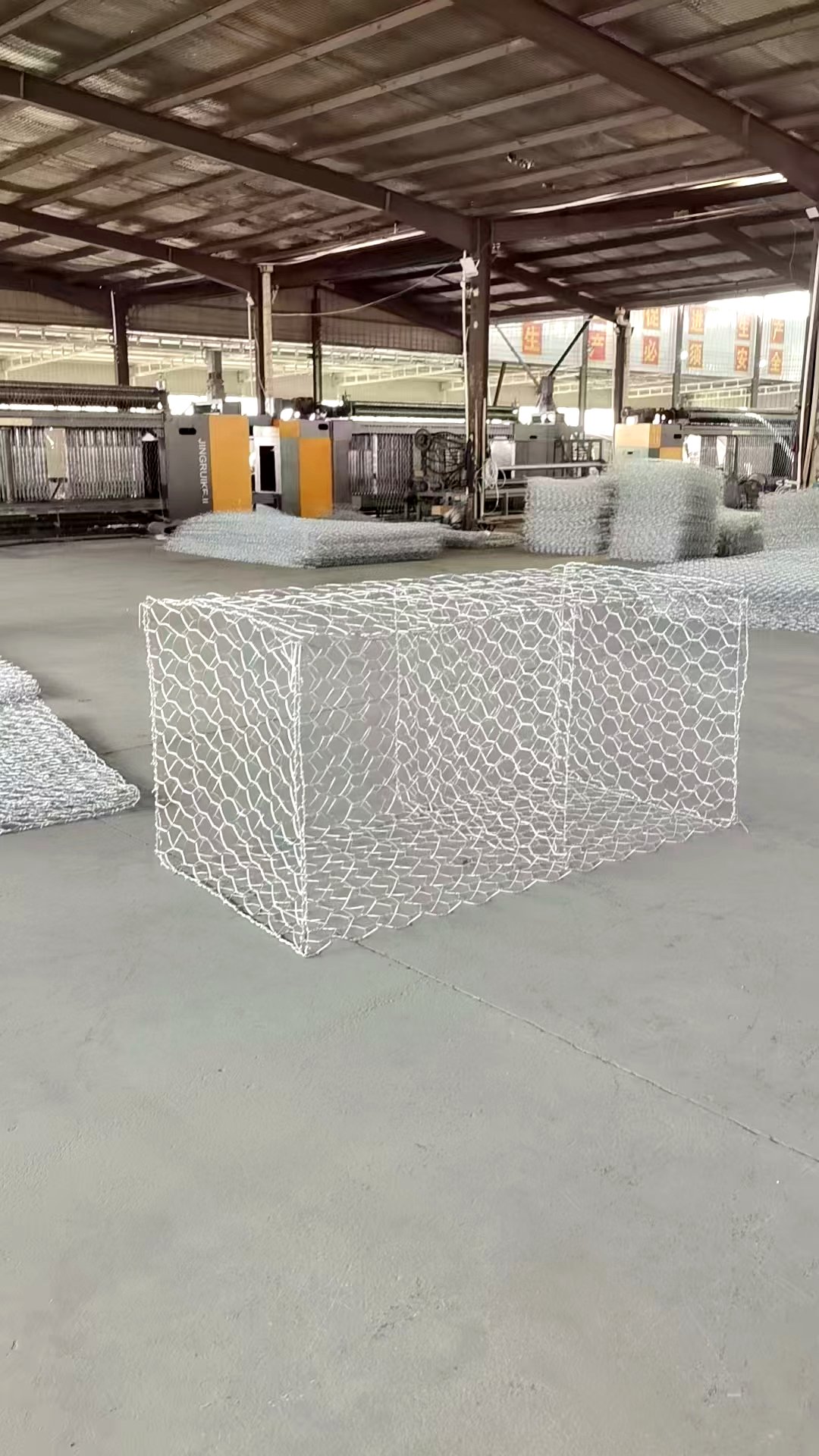
Gabion baskets are wire mesh boxes filled with stone on site. A reno mattress is the same idea in a thin, wide format for lining channels and slope faces. Both do a job concrete does badly: they are porous, so water drains through instead of building pressure behind the wall, and flexible, so the structure tolerates settlement and minor ground movement without cracking. That is why a gabion retaining wall often outperforms a rigid wall on a slope that is still settling.
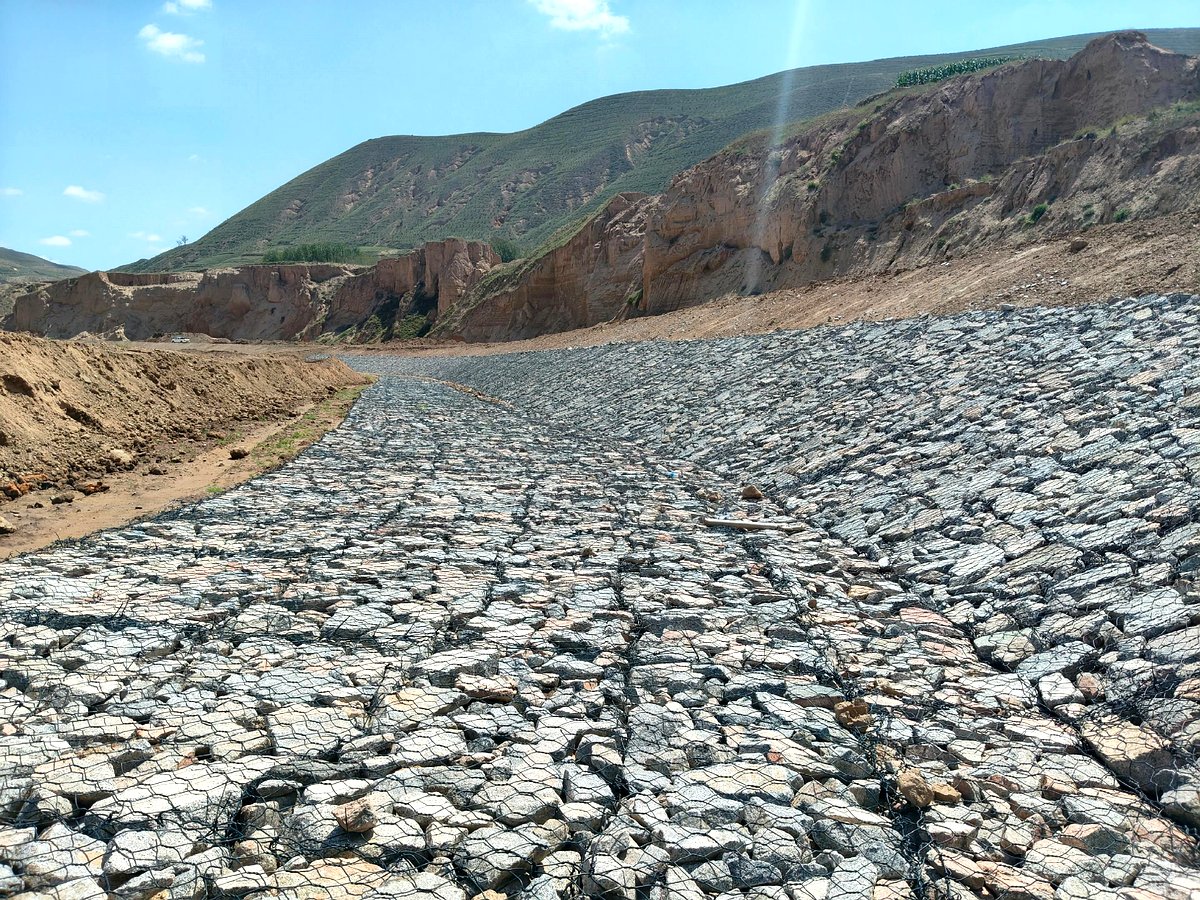
In our workshop in Shenzhou, Hebei, we weave double twist hexagonal wire mesh for gabions every day, so a few specification points are worth stating plainly:
- Mesh opening: 8×10 cm is the common choice for gabion boxes; 6×8 cm for smaller stone or reno mats. Stone must be larger than the opening or it migrates out.
- Wire diameter: 2.2 mm and 2.7 mm are the standard mesh wires; the selvedge (edge) wire runs one size heavier — 2.7 mm or 3.4 mm — because edges carry the load between baskets.
- Coating: matched to the environment — standard galvanizing around 60 g/m² for dry, sheltered sites; heavy zinc at 245 g/m² or a zinc-aluminum alloy coating for wet, buried or riverside work. The coating, not the basket shape, decides how the mesh ages.
- Common basket sizes: 2×1×1 m for gabion walls, 2×1×0.5 m and 2×1×0.3 m for stepped courses and mattresses.
Gabions are not the answer to everything. On a gentle garden slope they are overkill; on a tall engineered wall they are one component in a design, not the design itself. For the assembly sequence — foundation, filling, internal bracing, lid closing — see our step-by-step guide on how to build a gabion wall. For layout ideas, browse these gabion wall ideas. Compare material options on our gabion baskets product page. Where the problem is loose rock rather than soil, that is a different system covered by slope protection mesh, including rockfall netting installation.
Worked example: a 12 m driveway cut slope
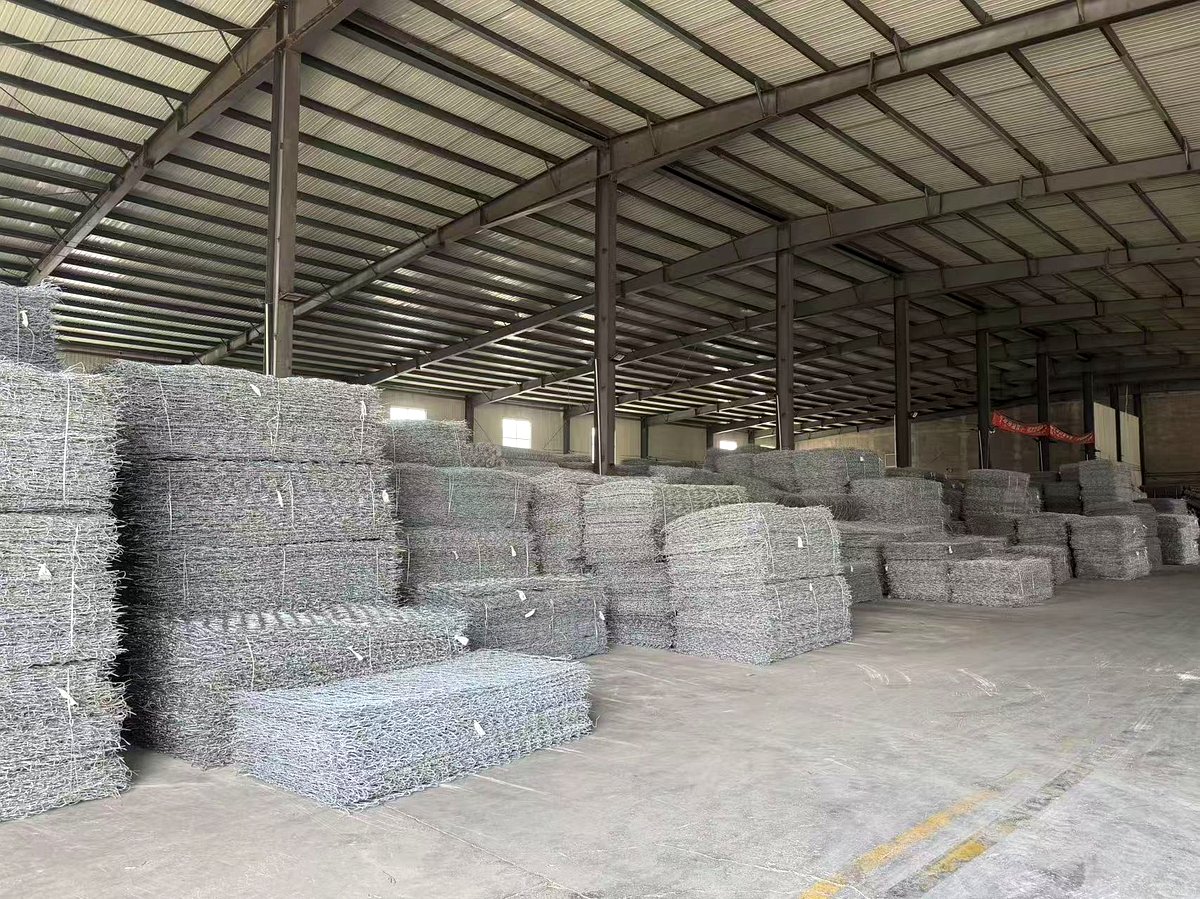
A property has a cut slope 12 m long and about 1.8 m high beside a gravel driveway. Rain cuts rills across the face and sediment washes onto the drive. The owner wants a two-step gabion wall with planting pockets on top.
Takeoff — a planning exercise, not a design
▸ Lower course: 2×1×1 m gabion baskets → 12 m ÷ 2 m = 6 baskets
▸ Upper course set back about 0.5 m: 2×1×0.5 m baskets → 6 baskets
▸ Stone fill: (6×2 m³) + (6×1 m³) = 18 m³ of hard, durable stone, each piece larger than the mesh opening
▸ Geotextile behind the wall if the backfill soil is fine and could wash through the stone voids
Before ordering, the owner still has homework: confirm where roof and driveway runoff goes, check the foundation soil is firm and level, and agree how the wall ends tie into the slope at each side. Numbers on a list are cheap; moving a wrongly placed basket is not. For how regional cost drivers change a similar job, see this rockfall netting price breakdown.
Inspect after the first big storm
No erosion repair is finished when the tools leave. Walk the site after the first heavy rain and then once or twice a year:
- New rills or sediment fans — water found a route you missed
- Undercutting at the toe of any wall or structure
- On gabions: displaced lids, bulging faces (usually a bracing or fill-grading issue), and coating condition at cut edges
- Plant survival on mulched areas — reseed bare patches before the next season
Quoting a slope? Send us these five things.
Slope length and height, side and toe photos, soil type if known, where the water comes from, and your delivery area. With those, a factory like Haobo can propose gabion basket sizes, mesh opening and coating as a complete, priced list — not a guess at a roll of mesh.
WhatsApp +86 15076321111Prefer email? yangshaotian311@gmail.com · Shenzhou Haobo Metal Products Co., Ltd.
Sources
Frequently Asked Questions
?What is the cheapest way to stop erosion on a slope?
Redirect the water source and mulch the bare ground. Straw or hay mulch costs little and works immediately while plants establish. A gabion wall is for slopes that actually move, not for slopes that only shed soil.
?Can I just throw loose rocks on the slope?
Loose riprap works on stable slopes if the stone is sized to the flow and placed on a prepared surface. Dumped randomly on a moving slope, stones simply ride the next failure downhill. If individual stones would roll, contain them in gabion baskets — that is the logic behind a stone-filled gabion.
?How steep can a slope be before it needs a retaining structure?
There is no universal angle. Mississippi State Extension treats slopes above roughly 20% as erosion-prone and notes that stability depends heavily on soil type. Height and consequences matter as much as angle: a 1 m slope above a garden is a planting problem; the same slope above a road is an engineering problem.
?Do gabion walls need drainage behind them?
Far less than solid walls, because water passes through the stone fill. You still must give surface water a route to the wall face and keep fine backfill from washing into the voids — a geotextile layer handles that where soils are silty. Good gabion retaining wall drainage starts at the design stage.
?How long do galvanized gabion baskets last?
Any honest answer starts with 'it depends on the site.' Coating mass, water exposure, soil chemistry and abrasion all control the service life — a dry garden wall and a permanently wet riverbank age very differently. Specify the coating to the exposure: standard galvanizing for mild sites, heavy zinc or zinc-aluminum alloy where conditions are aggressive, and ask for the coating mass in writing.
?When do I need an engineer?
When the wall is tall, when it protects a road, building or utility, when the slope shows cracks or previous movement, or when the local code requires it. A supplier can quote materials; only a qualified local engineer can take responsibility for the design.
Editor's note: this guide covers common homeowner and small-contractor situations. Every slope is different; where safety, structures or regulations are involved, confirm the design with a qualified local professional before building. Written by the production team at Shenzhou Haobo Metal Products Co., Ltd., where gabion baskets and reno mattresses are woven in Shenzhou, Hebei.