Welded Gabion vs Woven Gabion: Which Should You Buy? (2026 Cost & Strength Guide)
From the export desk at Haobo Metal — we weave and weld gabions in the same workshop, so unlike most articles on this topic, this one isn't written to sell you whichever product we happen to stock.
Type "gabion basket" into a supplier conversation and the first fork in the road arrives fast: welded or woven? They look similar in photos, they're both wire boxes full of rock, and yet they behave differently on site, cost differently, and fail differently. Choosing wrong doesn't just waste money — a woven basket spec'd where a welded one was needed (or vice versa) can compromise the whole structure.
Here's the honest breakdown we give buyers who ask, with 2026 pricing attached.
📋 Table of Contents
1. Quick Answer: Welded or Woven?
Skip to the version that matches your project:
- Structural retaining wall, riverbank revetment, anything engineered to hold back earth or water → woven (double-twist) gabion. It flexes, it's the spec every major civil standard recognizes, and it's cheaper per square meter.
- Architectural walls, landscaping, seating, planters, security or military barriers where clean lines matter → welded gabion. Rigid panels, square corners, rock fill you can see and arrange. It costs more — typically 20–35% more than woven for equivalent wire — and you pay it for geometry and looks, not strength.
If you're still unsure after reading that, the next six sections will settle it.

2. How Each Is Made — and Why It Changes Everything
Woven gabion starts as wire — typically 2.2mm to 4.0mm — that gets twisted together in a hexagonal double-twist pattern on weaving machines, exactly like heavy fence netting. The box is then assembled by lacing the panels together with binding wire. The twist is the magic: every wire is interlocked with its neighbors, so a cut or break in one wire doesn't unravel the mesh. Double-twist woven gabion to YB/T 4190-2018 (aligned with ASTM A975 / EN 10223-3) uses wire with tensile strength of 350–550 MPa and hot-dip galvanizing at ≥245 g/m².
Welded gabion is different from the wire up. Straight rods — usually 3.0mm to 6.0mm — are resistance-welded at every intersection into rigid flat panels. The panels become the faces of the box, joined by spirals or clips. There's no twist, no flex: what you have is a wire box that holds its shape like furniture.
One sentence to hold onto: woven is a fabric, welded is a frame. Everything else in this article follows from that.
3. Cost Comparison: What You'll Actually Pay
Woven gabion, factory-direct FOB Tianjin, 80×100mm hexagonal mesh, hot-dip galvanized (2026 market):
| Wire Diameter | Weight per m² | FOB Tianjin (per m²) | Typical Use |
|---|---|---|---|
| 2.2 mm | ≈ 0.9 kg | $0.65 – $0.80 | Mattresses, low walls |
| 2.7 mm | ≈ 1.36 kg | $0.85 – $1.05 | Standard retaining walls |
| 3.0 mm | ≈ 1.6 kg | $1.00 – $1.20 | Riverbank, higher walls |
| 3.4 mm | ≈ 2.15 kg | $1.20 – $1.50 | Heavy scour, coastal |
Welded gabion in the same market runs roughly 20–35% above woven for a comparable application. The premium comes from three places: heavier rods to give the welds enough metal, the welding process itself (machines, power, slower line speed), and the panel-and-spiral assembly. A welded box that competes with a 3.0mm woven basket for a low landscape wall will typically use 4.0–5.0mm rods — and the price follows the steel.
A caution from experience: when a welded gabion quote comes in at or below woven prices, look hard at the wire. Thin rods with weak welds are the welded-gabion equivalent of light zinc — invisible in photos, fatal on site. Weld strength should be specified as a shear load at each intersection, not left as "strong welds" on a spec sheet.
4. Strength and Failure Modes: Where Each One Breaks
This is the section most comparison articles skip, and it's the one that matters.
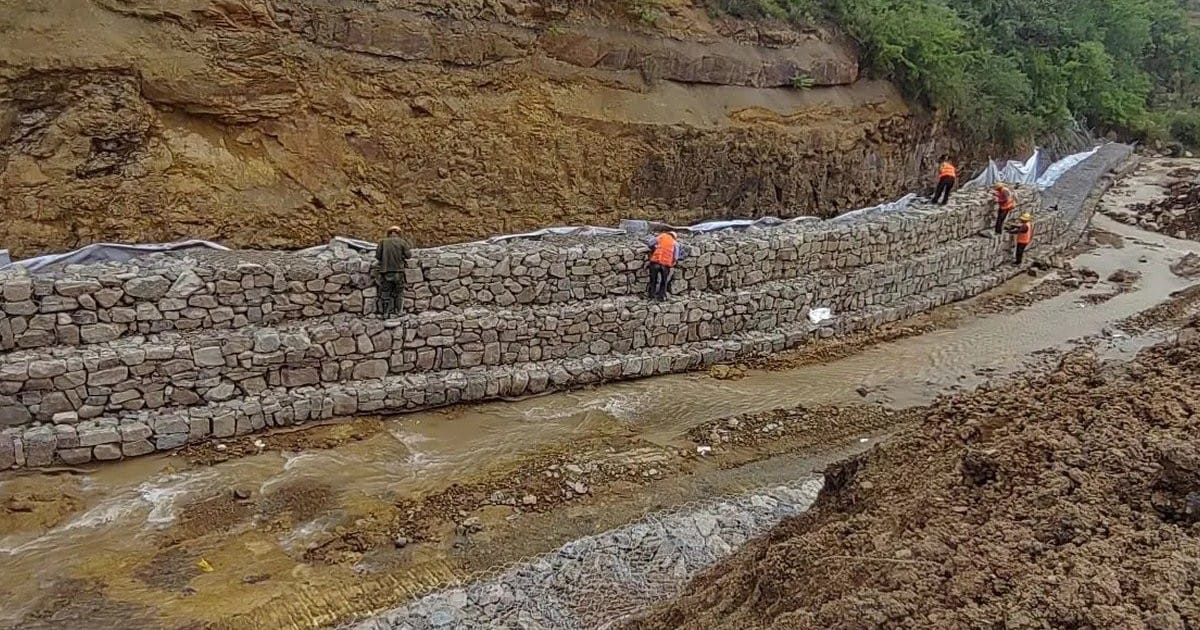
Woven fails gracefully. Load a woven gabion wall and the mesh strains, the boxes settle a few millimeters into each other, and the structure redistributes the load. That's not a defect — it's the design philosophy. Double-twist gabion walls are specified for riverbanks and highways precisely because they tolerate settlement, scour under the toe, and debris impact without progressive collapse. The wall moves a little and keeps working.
Welded holds its shape — until it doesn't. The rigid panels give you clean faces that don't bulge, which is why architects love them. But rigidity has a flip side: welded gabions don't forgive differential settlement. Put a welded wall on soft or scour-prone foundation soil and the panels can rack, stressing the welds. When a welded gabion fails, it tends to fail as a panel — visible and sudden.
Practical translation from our order book: the moment a project has an engineer of record, a government client, or water moving past the structure, the spec is almost always woven. Welded wins when the client is a landscape architect.
5. Applications: Where Each Construction Wins
| Application | Woven (double-twist) | Welded (panel) |
|---|---|---|
| Retaining walls, earth retention | ✔ The default civil spec | Limited, non-structural |
| Riverbank / scour protection | ✔ Designed for it | ✘ Avoid |
| Highway & railway slopes | ✔ Standard | Occasional, low height |
| Architectural / landscape walls | Possible, rustic look | ✔ The purpose-built choice |
| Noise barriers, security enclosures | Possible | ✔ Clean faces, easy build |
| Military / defensive barriers | ✔ Common | ✔ Common |
Notice the pattern: the more the structure relies on the mesh itself behaving structurally, the more the answer tilts woven. The more the structure is about appearance and dimensional precision, the more it tilts welded.
6. Buying Mistakes We See Every Year
- Buying welded for price-comparison wins. A supplier quotes welded boxes slightly cheaper than woven, the buyer assumes welded is simply "better," and ends up with a rigid wall on riverbank soil. If your structure faces water, insist on double-twist woven.
- Comparing welded rod diameter to woven wire diameter as equals. They're not the same animals. A 4.0mm welded rod and 4.0mm woven wire behave completely differently; compare finished-box performance (mesh strength per EN 10223-3 test), not raw wire numbers.
- Ignoring zinc on welded orders. Welded gabion is often sold into architectural markets where nobody asks about coating. The same ≥245 g/m² logic applies — frame it in the contract or watch corner welds rust first.
- Specifying PVC coating for walls that will be dry-stacked indoors or shaded. PVC over galvanized is real money. It earns its cost in marine, road-salt, and acidic-soil environments; elsewhere standard hot-dip is usually enough.
7. The Order Spec Checklist
Whatever you choose, a complete gabion order spec should pin down these seven items — this is the same list we require internally before production scheduling:
- Construction: woven double-twist or welded panel
- Wire/rod diameter (and for woven: 80×100mm mesh unless you have a reason otherwise)
- Coating: hot-dip galvanized ≥245 g/m², Galfan, or PVC-over-galvanized
- Box dimensions and diaphragm spacing (1m standard)
- Standard reference — YB/T 4190-2018 / ASTM A975 / EN 10223-3 — stated in the contract
- Mill test certificate covering tensile strength and coating weight
- Quantity, packing, and FOB / CIF terms with destination port
Send us those seven lines and you'll have a firm quotation — woven or welded, honestly compared — within 24 hours.
Still Deciding Between Welded and Woven?
Send us your project drawings or a photo of the site. We'll tell you honestly which construction fits — even if the answer is the cheaper one — and quote both FOB Tianjin within 24 hours.
📱 WhatsApp Inquiry 📧 Send Email