Razor Barbed Wire Specifications Guide: BTO-22 vs CBT-65, Factory-Direct Export Standards
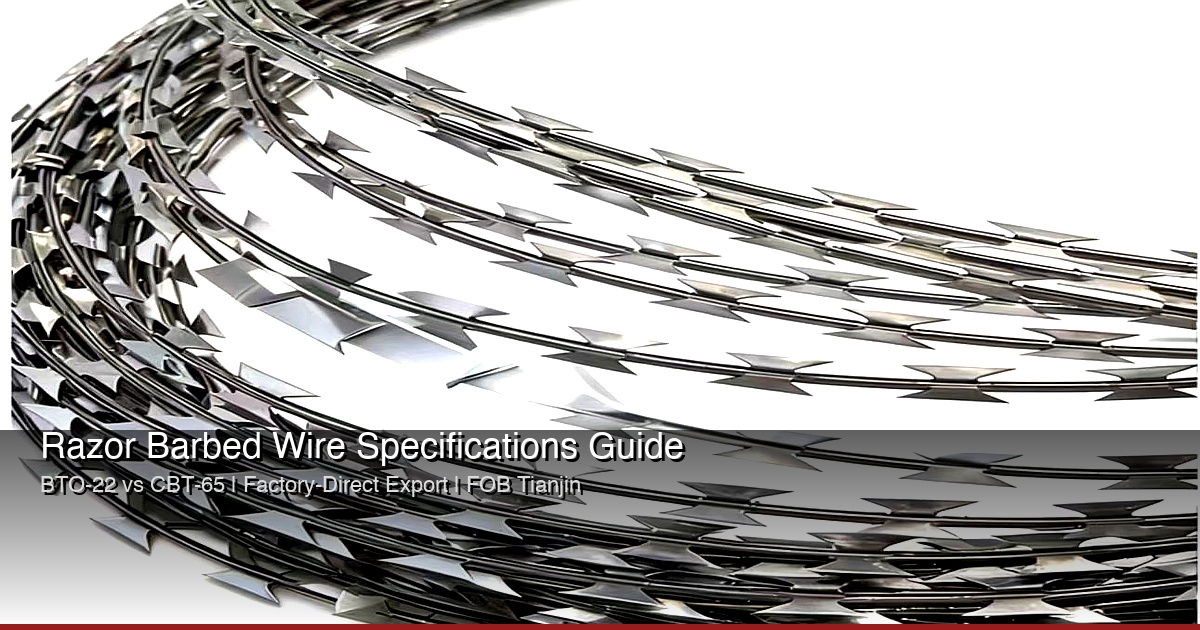
Razor barbed wire—also known internationally as concertina wire or barbed tape—is the first line of defense in high-security perimeter protection worldwide. From military bases and border walls to oil field compounds and correctional facilities, razor wire delivers a psychological and physical deterrent that conventional fencing cannot match.
For procurement managers, security contractors, and government buyers sourcing razor barbed wire from China, understanding the technical specifications is what separates a durable installation from one that rusts through in two monsoon seasons. This guide covers every specification parameter that matters: BTO-22 vs CBT-65 blade profiles, core wire diameters from 2.0mm to 4.0mm, coil diameters from 450mm to 960mm, galvanizing grades, powder coating options, and the ASTM F1910 international standard that governs quality testing.
Key Takeaway: Razor barbed wire is not a one-size-fits-all product. The blade profile determines deterrent level, the core wire diameter determines structural strength, and the galvanizing grade determines service life. This article gives you the full specification framework to issue a precise RFQ.
Table of Contents
- Understanding Razor Barbed Wire: Concertina Coil Basics
- BTO-22 vs CBT-65: Key Specification Differences
- Core Wire Diameter Selection: 2.0mm to 4.0mm
- Coil Diameter & Coverage: From 450mm to 960mm
- Surface Treatment & Corrosion Protection
- Single Coil vs Cross-Type: Which Configuration?
- International Standards & Quality Testing
- Application Scenarios: Military, Prison, Oil Field, Perimeter
- Packaging, Container Loading & Export Logistics
- How to Specify Your Razor Wire Order
1. Understanding Razor Barbed Wire: Concertina Coil Basics
Razor barbed wire consists of a high-tensile core wire wrapped with a continuous strip of punched steel tape featuring razor-sharp barbs at precise intervals. When stretched and deployed, it forms a formidable coiled barrier that is extremely difficult to climb, cut, or breach without specialized tools.
The product goes by multiple names in international procurement:
- Concertina wire — military terminology, referring to the expandable coiled configuration
- Barbed tape — emphasis on the flat steel strip from which barbs are punched
- Razor wire — civilian/commercial term, emphasizing the sharp cutting edges
- Spiral razor wire — describes the helical winding pattern
The HS code for international customs classification is 7313.00 (Barbed wire of iron or steel; twisted hoop or single flat wire, barbed or not, and loosely twisted double wire, of a kind used for fencing). This is critical for import duty calculation — razor barbed wire typically attracts 3-7% duty in most markets, though specific rates vary by country and bilateral trade agreements.

2. BTO-22 vs CBT-65: Key Specification Differences
The two dominant razor barbed wire profiles in international trade are BTO (Barbed Tape Obstacle) and CBT (Concertina Barbed Tape). Each is identified by a model number designating the profile series — the distance the sharp blade protrudes from the core wire axis.
| Specification | BTO-22 | CBT-65 |
|---|---|---|
| Blade Thickness | 0.5 ± 0.05 mm | 0.6 ± 0.05 mm |
| Blade Width | 15 ± 1 mm | 21 ± 1 mm |
| Barb Spacing | 34 ± 1 mm | 100 ± 2 mm |
| Core Wire Diameter Range | 2.0 – 4.0 mm (common: 2.5 mm) | 2.0 – 4.0 mm (common: 2.5 mm) |
| Typical Coil Diameters | 450 / 500 / 600 / 700 mm | 450 / 500 / 700 / 960 mm |
| Deterrent Level | Medium-High | Maximum |
| Primary Applications | Factory perimeters, residential communities, warehouse compounds, commercial security | Military bases, border walls, maximum-security prisons, oil & gas infrastructure, diplomatic compounds |
| Market Positioning | ⭐ Volume seller — best cost-to-security ratio | ⭐ Premium grade — maximum deterrence for critical infrastructure |
Additional profiles are available as customizable options: BTO-10 (barb length 10mm, for light commercial use), BTO-30 (barb length 30mm, medium-security upgrade), and CBT-60 (barb length 60mm, near-military grade). These variants can be manufactured to order with lead times of 15-25 days depending on volume.
Procurement Tip: For most international buyers, BTO-22 strikes the optimal balance of deterrent effectiveness and cost per linear meter. Reserve CBT-65 for projects where the security breach risk justifies the premium — military installations, nuclear facilities, and border infrastructure.
3. Core Wire Diameter Selection: 2.0mm to 4.0mm
The core wire is the structural backbone of every razor wire coil. It is a high-tensile steel wire running through the center of the barbed tape, providing the necessary strength to maintain coil tension, resist cutting attempts, and support the weight of the blade strip during installation and service.
| Wire Diameter | Tensile Strength Range | Cut Resistance | Weight Impact | Recommended Use |
|---|---|---|---|---|
| 2.0 mm | 350 – 450 MPa | Low | Lightest | Temporary fencing, agricultural deterrent, short-term event security |
| 2.5 mm ⭐ | 400 – 550 MPa | Medium-High | Balanced | Industrial perimeters, commercial security, warehouse compounds, standard export specification |
| 3.0 mm | 500 – 650 MPa | High | Moderate | Oil & gas facilities, mining compounds, coastal installations (with heavy galvanizing) |
| 3.5 – 4.0 mm | 550 – 700 MPa | Maximum | Heaviest | Military-grade installations, border infrastructure, maximum-security prisons |
2.5mm is the most commonly specified core wire diameter in international trade for three reasons: it provides sufficient structural integrity to maintain coil tension under wind and thermal expansion, it resists manual bolt-cutters for 15-30 seconds (enough delay for security response), and it keeps shipping weight economical — approximately 7-9kg per standard 500mm coil versus 12-15kg for 3.5mm wire.
All core wire diameters are produced from high-carbon or medium-carbon steel wire conforming to mechanical property standards verified through tensile testing per ASTM A370 / ISO 6892 methodology. Buyers should specify the nominal diameter and acceptable tolerance (±0.05mm) in purchase orders to ensure consistent coil geometry during deployment.
4. Coil Diameter & Coverage: From 450mm to 960mm
The coil diameter of razor barbed wire directly determines two critical deployment parameters: barrier height per coil and linear coverage per coil. Selecting the wrong coil diameter results in either inadequate barrier height or excessive material waste — both costly errors in large-scale installations.
| Coil Diameter | Typical Loops | Stretch Length | Approx. Weight | Clips Needed | Best Configuration |
|---|---|---|---|---|---|
| 450 mm | 33 | 7 – 8 m | 4 – 5 kg | 3 | Single coil (top of fence), CBT wall-mount |
| 500 mm ⭐ | 56 | 12 – 13 m | 7 – 9 kg | 3 | Single coil — most popular export size |
| 600 mm | 56 | 10 – 11 m | 8 – 10 kg | 3 | Single coil or cross-type, medium-height barrier |
| 700 mm | 56 | 13 – 14 m | 10 – 12 kg | 3 – 5 | Single or cross-type, high-security perimeters |
| 960 mm | 56 | 14 – 16 m | 12 – 15 kg | 5 | Cross-type only, maximum barrier height |
How to calculate coverage: A 500mm diameter single coil with 56 loops, when stretched to its operational tension (typically 20-25cm loop spacing), covers approximately 12-13 linear meters. For a 500-meter perimeter, you would need approximately 40-42 coils plus 10% contingency for corners, gates, and termination points.
Weight can be customized per buyer specification. Common weight grades include 5kg, 7kg, 8kg, 9kg, 10kg, and 12kg per coil. Heavier coils use thicker core wire or denser loop counts to increase the physical mass of the barrier. This is particularly relevant for export projects where shipping costs per kilogram must be balanced against the security performance requirements on-site.
5. Surface Treatment & Corrosion Protection
Surface treatment is the single most important factor determining the service life of razor barbed wire. A correctly specified galvanizing grade can mean the difference between 5 years and 25+ years of effective security without degradation. The following grades represent the full range available for international procurement:
| Treatment | Zinc Coating / Thickness | Test Standard | Service Life (Approx.) | Best For |
|---|---|---|---|---|
| Standard Hot-Dip Galvanized | 60 – 80 g/m² | ASTM A90/A90M | 5 – 8 years | Inland environments, low humidity, temporary installations, budget-sensitive projects |
| Medium Hot-Dip Galvanized | ≥ 120 g/m² | ASTM A90/A90M | 10 – 15 years | Moderate rainfall areas, urban environments, commercial security |
| High-Zinc Hot-Dip Galvanized ⭐ | ≥ 245 g/m² | ASTM A90/A90M, ISO 1461 Class 3 | 20 – 25+ years | Coastal installations, high humidity, tropical monsoon, critical infrastructure |
| Powder Coating / PVC Coated | 0.3 – 0.5 mm coating thickness (over galvanized base) | Visual inspection + adhesion test | 15 – 20 years | Aesthetic requirements, color-coded security zones, additional corrosion barrier |
| 201 Stainless Steel | N/A (inherent corrosion resistance) | Chemical composition analysis | 20+ years | Specialized applications — available as custom order |
Powder coating color options include dark green (military standard), black (maximum visual deterrence), yellow (high-visibility warning), and white (diplomatic/corporate campus aesthetics). The powder coating is applied over a galvanized base layer, providing dual-layer protection against both corrosion and UV degradation.
Critical Specification Rule: Never spec "hot-dip galvanized" without specifying the zinc coating weight. A supplier quoting "galvanized" at 60 g/m² is offering a fundamentally different product than 245 g/m² — the price difference can be 30-50%, and the service life difference can be 3-5x. Always write: "Hot-dip galvanized to ≥245 g/m² per ISO 1461 Class 3" in your RFQ.
6. Single Coil vs Cross-Type: Which Configuration?
Razor barbed wire is supplied in two fundamental coil configurations, each designed for a different deployment geometry and security level:
| Feature | Single Coil (Single Spiral) | Cross-Type (Double Spiral) |
|---|---|---|
| Construction | One continuous spiral of razor tape wound around a single core wire axis | Two intersecting spirals crossing each other, creating a diamond-pattern barrier |
| Barrier Density | Moderate — gaps between loops when stretched | Very high — intersecting blades fill all gaps |
| Typical Coil Diameters | 450 / 500 / 600 / 700 mm | 600 / 700 / 960 mm |
| Installation Speed | Fast — one-man deployment with minimal clipping | Slower — requires precise alignment and more clipping points |
| Bypass Difficulty | High — 30-45 seconds to cut through with heavy bolt cutters | Extreme — 90+ seconds to create a breach, multiple cutting points required |
| Weight (500mm / 56-loop equivalent) | 7 – 9 kg | 14 – 18 kg (double the material) |
| Cost Factor | 1.0× (baseline) | ~1.8 – 2.0× (double material + complex manufacturing) |
| Recommended Use | General perimeter security, fence-top augmentation, industrial compounds | Ground-level barriers, military perimeter rings, standalone security cordons |
For most international procurement, single coil configuration accounts for roughly 70-80% of orders due to its better cost-to-coverage ratio. Cross-type is typically specified only for the innermost security ring of high-value installations, or for deployments where the razor wire serves as the primary barrier rather than a fence-top augmentation.
7. International Standards & Quality Testing
Razor barbed wire exported internationally must conform to recognized standards for dimensional accuracy, mechanical strength, and coating integrity. The three-tier testing framework below represents best practice for factory quality assurance:
| Standard | Scope | Key Test Parameters |
|---|---|---|
| ASTM F1910-98 (2018) | Standard Specification for Long Barbed Tape Obstacles | Barb length tolerance (±1mm), barb width tolerance (±1mm), barb spacing tolerance, coil diameter verification, material thickness, minimum tensile properties |
| ISO 1461 | Hot-dip galvanized coatings on fabricated iron and steel articles | Minimum coating mass (245 g/m² for Class 3), coating uniformity, adhesion (no flaking on bending), appearance (smooth, free from bare spots) |
| ASTM A90/A90M | Standard Test Method for Weight of Coating on Zinc-Coated (Galvanized) Iron or Steel Articles | Gravimetric zinc coating weight measurement, triple-spot testing for uniformity, adherence evaluation |
| ASTM A370 / ISO 6892 | Mechanical testing of steel products / Tensile testing at ambient temperature | Core wire tensile strength (MPa), yield strength, elongation percentage |
| ASTM B117 / ISO 9227 | Salt spray (fog) testing for corrosion resistance | Neutral salt spray exposure duration before red rust appears on galvanized coating (available on request for high-spec projects) |
Factory quality control checklist (per production batch):
- Dimensional inspection — Vernier caliper measurement of blade length, blade width, blade spacing, and coil diameter on 3 random samples per 100 coils
- Core wire diameter — Micrometer measurement (±0.01mm resolution), 5-point check per coil sample
- Blade thickness — Micrometer measurement at blade tip and base, 0.5±0.05mm for BTO, 0.6±0.05mm for CBT
- Zinc coating weight — Gravimetric method per ASTM A90/A90M, dissolution in inhibited acid, triple-spot average
- Visual inspection — 100% visual check for blade sharpness (no burrs, no blunt edges), coating uniformity (no bare spots, no zinc lumps), and coil integrity
- Tensile test — Core wire sample tested to failure, recording ultimate tensile strength per ISO 6892
- Salt spray test — Per ASTM B117, available on buyer request for projects requiring documented corrosion resistance data
8. Application Scenarios: Military, Prison, Oil Field, Perimeter
Different security environments demand different razor wire specifications. Below is the application-to-specification mapping that guides procurement decisions in international projects:
| Application | Recommended Profile | Coil Diameter | Wire Ø | Galvanizing | Configuration |
|---|---|---|---|---|---|
| Military Base Perimeter | CBT-65 | 700 / 960 mm | 3.0 mm | ≥245 g/m² | Cross-type |
| Maximum-Security Prison | CBT-65 / BTO-30 | 700 mm | 2.5 – 3.0 mm | ≥245 g/m² | Cross-type |
| Oil & Gas Facility | BTO-22 / CBT-60 | 500 / 700 mm | 2.5 – 3.0 mm | ≥245 g/m² (coastal) or ≥120 g/m² (inland) | Single coil (fence-top) or cross-type (ground-level) |
| Border Infrastructure | CBT-65 | 960 mm | 3.5 – 4.0 mm | ≥245 g/m² | Cross-type, multiple stacked rings |
| Industrial Compound | BTO-22 ⭐ | 500 mm | 2.5 mm | ≥120 g/m² | Single coil (fence-top) |
| Residential Community / Villa | BTO-22 | 450 / 500 mm | 2.0 – 2.5 mm | 60 – 80 g/m² or powder coated | Single coil |
| Warehouse / Logistics Center | BTO-22 | 500 mm | 2.5 mm | 60 – 80 g/m² | Single coil (fence-top) |
| Agricultural / Ranch Perimeter | BTO-10 (custom) | 450 mm | 2.0 mm | 60 – 80 g/m² | Single coil |
9. Packaging, Container Loading & Export Logistics
Proper packaging of razor barbed wire for ocean freight is critical — loose or inadequately secured coils can cause container damage, worker injury during unloading, and significant claims from shipping lines. Standard export packaging follows these specifications:
| Packaging Parameter | Standard Specification |
|---|---|
| Coil Bundling | 50 coils compressed and strapped per bundle with steel banding strips (3 horizontal + 2 vertical straps). Each bundle wrapped in waterproof plastic film then heavy-duty woven polypropylene bag. |
| Loose Packing (Alternative) | Individual coils packed in woven bags, stacked on pallets. Suitable for small-quantity orders or mixed-container shipments. |
| Palletization | Heat-treated wooden pallets (ISPM 15 certified for international shipping), maximum 1,200 kg per pallet. Pallets wrapped with stretch film and edge-protected with cardboard corner guards. |
| 20ft Container Capacity | Approximately 18 – 22 metric tons, or 1,800 – 3,000 standard 500mm single coils depending on weight specification |
| 40ft Container Capacity | Approximately 25 – 28 metric tons, or 2,500 – 4,000 standard 500mm single coils depending on weight specification |
| Labeling | Each bundle/pallet labeled with: Product name, specification (BTO/CBT, wire Ø, coil Ø), zinc coating grade, coil count, net weight, gross weight, batch number, production date, FOB port (Tianjin, China), destination port |
FOB Port: All shipments depart from Tianjin Port, the largest northern China deep-water port with direct container shipping lines to the Middle East (Jebel Ali, Dammam, Umm Qasr), Africa (Mombasa, Durban, Lagos), South Asia (Karachi, Chittagong, Mumbai), and Latin America (Santos, Callao). Typical ocean transit times: 15-20 days to Middle East, 25-30 days to East Africa, 30-35 days to West Africa, 35-45 days to South America.
10. How to Specify Your Razor Wire Order
To receive an accurate FOB Tianjin quotation, your RFQ should include every parameter in the checklist below. An incomplete specification leads to assumptions that may not align with project requirements:
RFQ Specification Checklist
- Blade Profile: BTO-22 / CBT-65 / BTO-10 / BTO-30 / CBT-60 (or describe custom requirement)
- Core Wire Diameter: ____ mm (range: 2.0 – 4.0 mm; specify tolerance: ±0.05 mm)
- Coil Diameter: ____ mm (options: 450 / 500 / 600 / 700 / 960 mm)
- Coil Configuration: Single coil / Cross-type (double spiral)
- Surface Treatment: Hot-dip galvanized ____ g/m² (options: 60-80 / ≥120 / ≥245) / Powder coated in ____ color (options: green, black, yellow, white) / 201 Stainless Steel
- Coil Weight (if specified): ____ kg per coil (otherwise standard weight per selected diameter)
- Quantity: ____ coils (or ____ linear meters of perimeter coverage)
- Packaging Preference: 50-coil bundles on pallets / individual woven bag packing / custom
- Accessories Required: Clips (steel / stainless steel), tension wire, support brackets, installation tools
- Destination Port: ____ (for logistics planning and ocean freight estimation)
- Special Requirements: Third-party inspection (SGS / BV / Intertek), salt spray test reports, Certificate of Origin, any additional documentation
Final Note: Razor barbed wire is a long-life security asset. The specification decisions you make today — galvanizing grade, wire diameter, blade profile — will determine the effectiveness and maintenance cost of that asset for decades. Invest the time in getting the specification right at the RFQ stage, and you will avoid costly retrofitting and premature replacement down the line.
Get Your Razor Barbed Wire Quote — FOB Tianjin
Factory-direct pricing on BTO-22 and CBT-65 razor barbed wire. Full specification customization: blade profile, wire diameter, coil size, galvanizing grade, powder coating. MOQ flexible. Quote in 24 hours.
Related Articles



Explore Our Products
Learn more about our wire mesh solutions:
- Gabion Mesh Products — Baskets and mattresses for erosion control and civil engineering
- Slope Protection Mesh — Rockfall netting and slope stabilization systems
- Welded Wire Fence — Wire mesh panels for security and construction
- Razor Barbed Wire — BTO-22 & CBT-65 galvanized razor wire for perimeter security and border control
Related News & Articles
- Gabion Erosion Control for Brazilian River Systems: NBR 15854 Engineering & FOB Supply
- Rockfall Protection Systems for Korean Mountain Highway Tunnels: JT/T 528 Design & Supply
- Gabion Retaining Walls for UK Transport Infrastructure: BS 8002 Design Guide & FOB Supply
- Gabion Channel Lining & Erosion Control for Central Asian Irrigation Canals: Kazakhstan, Uzbekistan, Tajikistan Water Infrastructure Rehabilitation
- Rockfall Protection Systems for Australian Mining Infrastructure & Mountain Roads: JT/T 528-2022 Standards & Cyclone-Resilient Design