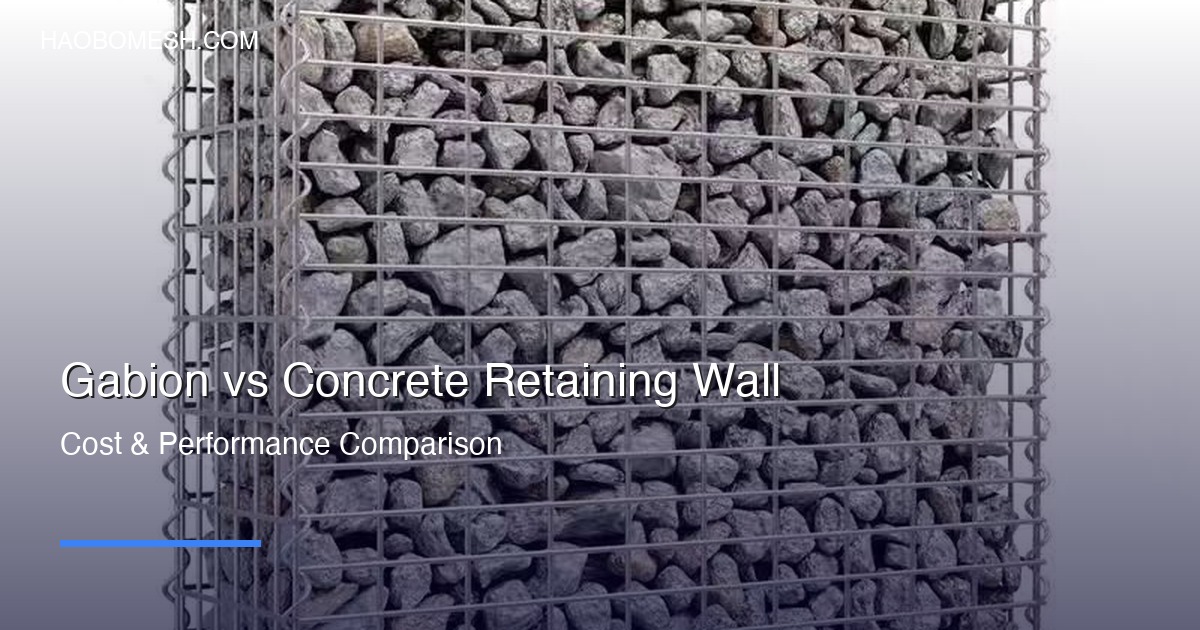
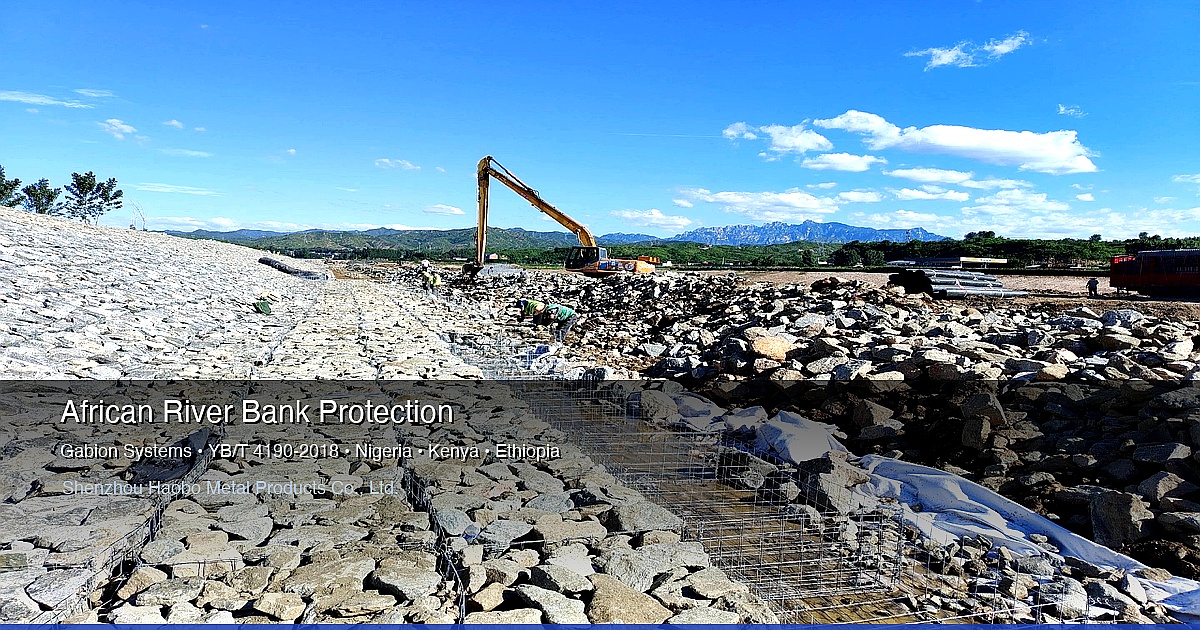
Gabion Erosion Control for Brazilian River Systems: NBR 15854 Engineering & FOB Supply

Brazil's hydrological system is one of the most powerful and dynamic on Earth. The country possesses 12% of the world's freshwater resources, with river systems that include the Amazon (world's largest by discharge volume), Paraná (South America's second-longest), São Francisco, and Tocantins-Araguaia basins. Combined with intense seasonal rainfall patterns — annual precipitation reaching 2,000-3,000 mm in the Amazon and 1,200-1,800 mm in the Southeast — Brazilian rivers generate erosion forces that demand engineered protection solutions combining structural durability with environmental compatibility.
Gabion and Reno mattress systems have become the preferred erosion control technology for Brazilian river engineering, adopted by DNIT (Departamento Nacional de Infraestrutura de Transportes), ANA (Agência Nacional de Águas), and state-level water resource agencies. Their flexibility accommodates Brazil's challenging conditions: seasonal water level fluctuations exceeding 6-8 m in regulated rivers, high sediment transport during flood seasons, and tropical lateritic soils that lose cohesion when saturated. This article provides a comprehensive engineering guide to gabion erosion control for Brazilian river systems, with NBR 15854-compliant designs and direct FOB supply from Tianjin to Brazilian ports.
1. Brazilian River Erosion: Hydrology & Failure Mechanisms
Riverbank erosion in Brazil is driven by a combination of hydrological, geotechnical, and anthropogenic factors that differ significantly from temperate-zone river systems:
| Erosion Mechanism | Brazilian-Specific Condition | Gabion Solution | Design Priority |
|---|---|---|---|
| Hydraulic Scour (Toe) | Flow velocities 2.5-5.0 m/s during floods; 6-8 m seasonal level fluctuation | Reno mattress apron + gabion toe wall | Critical — foundation failure controls 80% of bank collapses |
| Bank Slumping | Lateritic soils lose cohesion at saturation; rapid drawdown after flood recession | Free-draining gabion wall — no hydrostatic pressure | High — rapid drawdown the primary failure trigger |
| Sediment Abrasion | High suspended sediment (Amazon: 600-800 million tonnes/year) | 3.4-4.0 mm wire for high-wear zones | Medium — specifies thicker wire in lower baskets |
| Vegetation Pressure | Tropical riparian vegetation with aggressive root systems | Gabions accommodate natural colonisation; flexible face tolerates root growth | Low — vegetation stabilises system long-term |
| Meander Migration | Active meander belts in alluvial plains; migration rates 5-50 m/year | Continuous gabion revetment + bendway weirs | High — outer-bend erosion concentration |
Critical Brazilian parameter — rapid drawdown: The transition from wet season high water to dry season low flow occurs over just 4-8 weeks in most Brazilian river basins. As river levels drop, saturated banks lose the stabilising effect of water pressure against the face. This rapid drawdown condition — where the bank is saturated but unsupported — is the single most common trigger of riverbank collapse in Brazil. Gabion walls eliminate this failure mode because their free-draining structure prevents pore pressure build-up within the retained soil mass.
2. NBR 15854 vs YB/T 4190-2018: Standards Alignment
Brazil applies NBR 15854:2010 — Gabions — Requirements and Test Methods (under revision to NBR 15854:2024), which specifies material requirements for gabion wire mesh used in hydraulic and retaining applications. YB/T 4190-2018 (China) alignment with NBR 15854 is as follows:
| Property | NBR 15854:2010 (Brazil) | YB/T 4190-2018 (China) | Equivalence |
|---|---|---|---|
| Wire Tensile Strength | 380-550 MPa | 350-550 MPa | ✅ Specify ≥ 380 MPa for NBR compliance |
| Wire Elongation | ≥ 10% | ≥ 12% | ✅ YB/T 4190 exceeds NBR requirement |
| Galfan Coating (Zn-5%Al) | ≥ 245 g/m² (minimum) | ≥ 275 g/m² (per GB/T 1839) | ✅ YB/T 4190 exceeds NBR by 12% |
| PVC Coating (Optional) | ≥ 0.4 mm thickness; UV-stabilised | ≥ 0.5 mm (optional, available) | ✅ YB/T 4190-2018 exceeds minimum |
| Mesh Opening (Standard) | 80×100 mm (Type 8×10) | 80×100 mm | ✅ Identical standard configuration |
| Selvedge Wire | ≥ 1.4× mesh wire diameter | 1.5× mesh wire diameter | ✅ YB/T 4190 exceeds NBR |
| Lacing/Binding Wire | ≥ 2.2 mm; same coating as mesh | ≥ 2.2 mm; Galfan-coated | ✅ Identical minimum |
Brazilian conformity pathway: NBR 15854 does not mandate INMETRO certification for gabion products. Acceptance is typically based on manufacturer-declared performance supported by independent laboratory test reports. For Brazilian projects, supply the following documentation package:
- Mill Test Certificate (Certificado de Ensaio de Fábrica): Wire chemistry, tensile strength, and elongation
- Coating Compliance Report (Relatório de Conformidade do Revestimento): Galfan coating weight per GB/T 1839 with NBR 15854 equivalence statement
- ISO 9001:2015 Certification: Factory production control system compliance
- ART (Anotação de Responsabilidade Técnica): Brazilian projects require a locally registered engineer to issue ART for the gabion design — this is typically the contractor's or consultant's responsibility, not the material supplier's
3. Reno Mattress Design for Bank Revetment
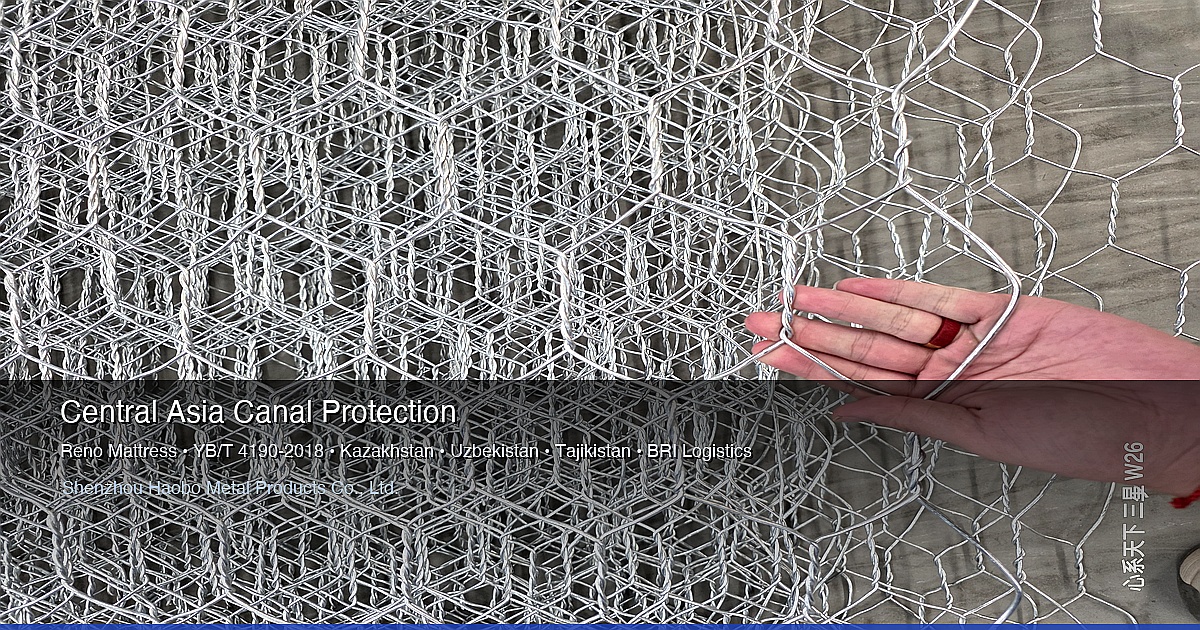
Reno mattresses — flat, wide gabion units typically 0.17-0.30 m thick and 4-6 m wide — form the primary protection layer on Brazilian riverbank slopes. Their low profile and flexibility make them ideal for the gradual slope transitions (1V:2H to 1V:3H) commonly adopted in Brazilian river engineering.
3.1 Hydraulic Design Criteria
| Design Parameter | Brazilian Design Range | Reno Mattress Specification | Verification Method |
|---|---|---|---|
| Flow Velocity (design flood) | 2.5-5.0 m/s | Mattress thickness 0.23-0.30 m; wire 2.7-3.0 mm | Isbash stability equation: D50 ≥ V²/(2g·Δ·C²) |
| Shear Stress (τb) | 50-250 N/m² | Filter layer (geotextile) beneath mattress | τb ≤ τc (critical shear of protected bed) |
| Scour Depth (toe) | 1.5-4.0 m (general scour + local scour) | Mattress apron extended 2× scour depth beyond toe | Lacey, Blench, or HEC-18 scour equations |
| Slope Protection Extent | From 1.0 m below design bed to 0.5 m above design flood level | Continuous mattress coverage + gabion anchor beam at crest | Hydraulic model or empirical correlation |
3.2 Geotextile Filter Design
Brazilian lateritic soils present a specific challenge for filter design. The fine fraction (silt and clay content 30-60% in typical lateritic profiles) creates a risk of internal erosion through the Reno mattress voids unless a properly designed geotextile filter is installed. Key filter criteria per NBR 15854 Annex B:
- Retention criterion: AOS (Apparent Opening Size) ≤ 1.0 mm for lateritic soils (prevents soil particle migration)
- Permeability criterion: kgeotextile ≥ 10 × ksoil (typically requires 0.05-0.10 cm/s for Brazilian laterites)
- Puncture resistance: ≥ 500 N (CBR test, NBR ISO 12236) — critical for stone placement during construction
- UV resistance: ≥ 80% retained strength after 500 hrs UV exposure (NBR 14972) — Brazil's tropical sun accelerates geotextile degradation if left exposed during construction phasing
4. Gabion Retaining Walls for Steep River Banks
Where bank slopes exceed 1V:1.5H — or where right-of-way constraints prevent graded slope profiles — gabion retaining walls replace or supplement Reno mattress revetment. Brazilian practice typically deploys gabion walls at the following locations:
- Outer meander bends: Where thalweg migration concentrates erosive energy against the bank
- Bridge approach embankments: Protecting road infrastructure from scour-induced undermining
- Urban riverfronts: Where property boundaries constrain bank geometry (São Paulo's Tietê and Pinheiros rivers are prominent examples)
- Hydroelectric reservoir margins: Stabilising banks subject to operational water level fluctuations at Brazil's 200+ hydroelectric dams
4.1 Typical Brazilian Gabion Wall Configurations
| Wall Height | Basket Dimensions | Wire (Mesh/Selvedge) | Reno Mattress Toe Protection | Typical Brazilian Application |
|---|---|---|---|---|
| 2-3 m | 2×1×1 m; single tier | 2.7 / 3.4 mm | 4×2×0.23 m; 2.2 mm mesh | Minor stream banks; low-energy reaches |
| 4-6 m | 2×1×1 m; 2-3 tiers with 0.15 m setback | 3.0 / 3.9 mm | 6×3×0.30 m; 2.7 mm mesh | Medium rivers; São Francisco tributaries |
| 7-10 m | 2×1.5×1 m; tiered + geogrid reinforcement | 3.4 / 4.4 mm | 8×4×0.30 m; 3.0 mm mesh + gabion toe wall | Major rivers; Paraná, Tocantins |
Diaphragm spacing for Brazilian conditions: Brazilian practice typically specifies diaphragm spacing of 0.5-1.0 m within gabion baskets (every 1-2 mesh cells) for hydraulic applications — tighter than the 1.0 m typically used for retaining walls in non-hydraulic contexts. This enhanced internal bracing prevents stone migration during flood events and maintains basket geometry under impact loading from floating debris (common in Brazilian rivers during flood season).
5. Brazilian Case Studies: São Francisco, Paraná & Amazon Tributaries
5.1 São Francisco River — Bank Stabilisation at Petrolina (PE)
The São Francisco River at Petrolina, Pernambuco, has experienced progressive bank erosion over a 2.8 km reach, driven by regulated flow releases from Sobradinho Dam upstream. Daily flow fluctuations of 1.5-2.0 m — imposed by hydropeaking operations — subject banks to repeated wetting-drying cycles that accelerate lateritic soil degradation.
The stabilisation design combined Reno mattress revetment on the lower bank (slope 1V:2H, 0.23 m thick, 2.7 mm Galfan mesh) with a gabion retaining wall at the upper bank transition (3.0 m height, 2×1×1 m baskets). The key design feature was a deep toe trench (1.8 m below design bed level) filled with gabion baskets to arrest progressive scour — a critical detail given the regulated flow regime that concentrates erosion at a consistent bank elevation corresponding to the power generation flow band.
Post-installation monitoring over five wet seasons recorded zero bank retreat versus a pre-intervention average of 0.8-1.2 m/year. Vegetation establishment within the Reno mattress voids achieved 60-70% coverage within 18 months, enhancing both aesthetic integration and long-term stability through root reinforcement.
5.2 Paraná River — Bridge Approach Protection at Foz do Iguaçu (PR)
The Friendship Bridge (Ponte da Amizade) approach embankments on the Brazilian side at Foz do Iguaçu are subject to some of the highest flow velocities in the Paraná basin — reaching 4.5-5.0 m/s during the Itaipu Dam spillway operation periods. Gabion protection was specified for both the upstream and downstream bridge approach embankments over a combined 640 m length.
The design deployed 0.30 m thick Reno mattresses (3.0 mm wire, Galfan-coated with additional 0.5 mm PVC coating for the splash zone) over a double-layer nonwoven geotextile filter (600 g/m²). At the bridge pier locations, articulated concrete block mats were integrated with the gabion revetment to provide enhanced local scour protection at the highly turbulent pier wake zones.
The dual-coating solution (Galfan + PVC) was specifically developed for the aggressive splash zone environment, where repeated wetting-drying combined with intense UV radiation (Foz do Iguaçu receives 2,200+ sunshine hours annually) accelerates conventional coating degradation. Accelerated weathering tests confirmed an estimated 45-55 year coating service life for the dual-coated product under these conditions.
5.3 Madeira River (Amazon Tributary) — Port Terminal Bank Protection
The Madeira River at Porto Velho, Rondônia, is one of the Amazon's principal sediment-transporting tributaries, carrying an estimated 500 million tonnes of suspended sediment annually. A gabion-reinforced riverbank was designed for a new grain terminal, requiring protection against both hydraulic erosion and mechanical abrasion from sediment-laden flows.
The solution specified thicker wire diameters throughout (3.4 mm mesh wire, 4.4 mm selvedge, 3.0 mm lacing wire) with a 0.30 m thick Reno mattress over the entire 450 m terminal frontage. The mattress extended 6.0 m into the river bed as a scour apron, with a sacrificial toe detail — an additional row of gabion baskets at the mattress leading edge, designed to settle into any developing scour hole and maintain protection continuity without structural failure.
The sacrificial toe concept is particularly suited to Brazilian sediment-rich rivers: it avoids the cost and construction difficulty of excavating a deep toe trench below the active bed level (which may be 3-5 m below low water in sand-bed rivers), while providing adaptive scour protection that self-adjusts to evolving river morphology.
6. Tropical Climate Durability: Galfan Performance in Brazilian Conditions
Brazil's tropical and subtropical climate zones impose specific durability demands on gabion coatings:
| Climate Zone | Representative Region | Corrosion Aggressivity | Galfan 275 g/m² Estimated Life | Recommended Enhancement |
|---|---|---|---|---|
| Equatorial (Af) | Amazon Basin (Manaus, Belém) | C4 (high) — high humidity + organic acids | 40-55 years | +0.5 mm PVC coating for permanently submerged zones |
| Tropical Savannah (Aw) | Central Brazil (Brasília, Goiânia) | C3 (medium) — wet/dry cycling | 55-70 years | Standard Galfan sufficient |
| Humid Subtropical (Cfa) | Southeast (São Paulo, Rio) | C3-C4 (medium-high) — industrial + marine | 35-50 years | Galfan + PVC for coastal proximity or industrial zones |
| Semi-Arid (BSh) | Northeast Sertão (Petrolina, Juazeiro) | C2 (low) — low humidity | 70+ years | Standard Galfan sufficient |
UV degradation consideration: Brazil's tropical latitude (5°N to 33°S) means UV radiation levels are 30-50% higher than European or North American reference conditions. While the Galfan metallic coating itself is UV-immune, optional PVC coating must be specifically formulated with UV stabilisers for Brazilian conditions. Specify PVC compound with minimum 2.5% carbon black content and UV absorber additives to achieve 30+ year polymer life under tropical exposure.
7. Supply Chain: Tianjin FOB to Santos/Itajaí
| Logistics Parameter | Details |
|---|---|
| Port of Loading | Tianjin Xingang (CNTXG) |
| Brazilian Port of Discharge | Santos (BRSSZ) — São Paulo/Southeast; Itajaí (BRITJ) — South; Suape (BRSUA) — Northeast; Manaus (BRMAO) — Amazon (via coastal feeder) |
| Ocean Transit Time | 35-45 days (Tianjin → Santos via Cape of Good Hope or Panama Canal) |
| Container Type | 40ft HC — approx. 800-1,200 flat-packed gabion baskets or 1,000-1,500 m² Reno mattress panels |
| Brazilian Import Duty | HS 7314.3190 — 14% II (Import Duty) + ICMS (state VAT, variable 7-18%) + PIS/COFINS (9.25%) |
| Clearance Documentation | Commercial Invoice, Packing List, BL, Certificate of Origin (China-Brazil non-preferential), Mill Test Certificate, Coating Compliance Report, RADAR licence (importer) |
| Inland Transport (Brazil) | Santos → São Paulo: 1-2 days; Santos → Brasília: 3-4 days; Manaus → Amazon project sites: barge transport 5-10 days |
Brazilian import tax planning: Brazil's import tax regime is complex, with the effective tax burden reaching 40-60% above CIF value when II, IPI, PIS/COFINS, and ICMS are combined (the "custo Brasil"). Two strategies to mitigate this:
- Drawback regime: If the gabion materials are used in an infrastructure project that generates export revenue (e.g., a port terminal serving export grain), import duties may be suspended or reimbursed under the Drawback programme
- Ex-tarifário (ex-tariff): If equivalent gabion products are not manufactured in Brazil with the required specifications (particularly high-performance Galfan coating), importers can apply for temporary duty reduction to 2% under the ex-tarifário regime — this requires demonstrating absence of domestic production equivalent
8. Cost Analysis: Gabion vs Concrete Revetment
| Cost Element | Gabion Revetment (BRL/m²) | Concrete Lining (BRL/m²) | Articulated Concrete Blocks (BRL/m²) | Gabion Advantage |
|---|---|---|---|---|
| Material Supply (FOB China) | R$ 80-120 | R$ 150-220 (local concrete) | R$ 180-250 | 35-45% |
| Stone Fill (local source) | R$ 30-50 | N/A (rebar + formwork) | N/A | — |
| Installation Labour | R$ 40-65 | R$ 90-140 | R$ 70-110 | 50-55% |
| Geotextile Filter | R$ 15-25 | R$ 15-25 | R$ 15-25 | Equal |
| Total (excl. import taxes) | R$ 165-260 | R$ 255-385 | R$ 265-385 | 32-35% |
Whole-life cost analysis for Brazilian conditions: Gabion revetment offers three structural advantages that translate to significant whole-life cost benefits in Brazilian river environments:
- Settlement tolerance: Concrete lining cracks under differential settlement — a near-certainty on Brazilian alluvial riverbanks — requiring full-panel replacement. Gabions flex and self-adjust, maintaining protection integrity
- Hydrostatic pressure elimination: Concrete revetment requires weep-holes and drainage blankets behind the lining. Blocked weep-holes (common in sediment-rich Brazilian rivers) generate uplift pressures that delaminate concrete panels. Gabions are inherently free-draining
- Local repair simplicity: Damaged gabion sections can be repaired by replacing individual baskets and restitching lacing wire — achievable with local labour and no specialised equipment. Concrete revetment repair requires demolition, formwork, pouring, and curing
For a typical Brazilian riverbank project spanning 5,000 m² of protected area, the gabion revetment solution delivers approximately R$ 450,000-600,000 capital cost saving versus concrete alternatives, with an additional R$ 120,000-200,000 estimated maintenance cost avoidance over a 30-year service life.
Key Takeaways
- Rapid drawdown is the critical Brazilian failure mechanism: Seasonal water level fluctuations of 6-8 m, concentrated over 4-8 weeks of flood recession, create bank instability that free-draining gabion structures inherently resist — a decisive advantage over impermeable concrete alternatives.
- YB/T 4190-2018 meets or exceeds NBR 15854 requirements: Chinese gabion wire mesh delivers equivalent tensile strength (specify ≥ 380 MPa), 12% higher Galfan coating weight (275 vs 245 g/m²), and identical mesh configurations to Brazilian standard specifications.
- Sacrificial toe design suits Brazilian sediment rivers: In rivers with active sediment transport (Amazon basin, Paraná, São Francisco), a sacrificial gabion toe that self-adjusts to developing scour holes avoids the cost and difficulty of deep toe trench excavation in saturated sand-bed conditions.
- Dual coating for aggressive environments: Equatorial (Amazon) and coastal (Southeast) climate zones benefit from Galfan + UV-stabilised PVC coating for splash-zone and permanently submerged applications, extending service life to 45-55 years.
- Geotextile filter design must account for lateritic soils: Brazilian lateritic soils with 30-60% fines content demand properly specified geotextile filters (AOS ≤ 1.0 mm, k ≥ 10× ksoil, puncture resistance ≥ 500 N) to prevent internal erosion through Reno mattress voids.
- 32-35% installed cost advantage versus concrete alternatives, with additional whole-life savings from zero hydrostatic pressure maintenance, settlement tolerance, and local-repair simplicity — all critical in remote Brazilian project locations with limited equipment access.
Protect Your Riverbank — NBR 15854 Gabion Solutions from Factory
Send us your river cross-section, design flood level, and bank length. We will provide a complete Reno mattress and gabion wall specification with FOB Santos pricing and full Brazilian import documentation.
📱 Request Riverbank Quote 📧 Send Email