Rockfall Protection Systems for Australian Mining Infrastructure & Mountain Roads: JT/T 528-2022 Standards & Cyclone-Resilient Design
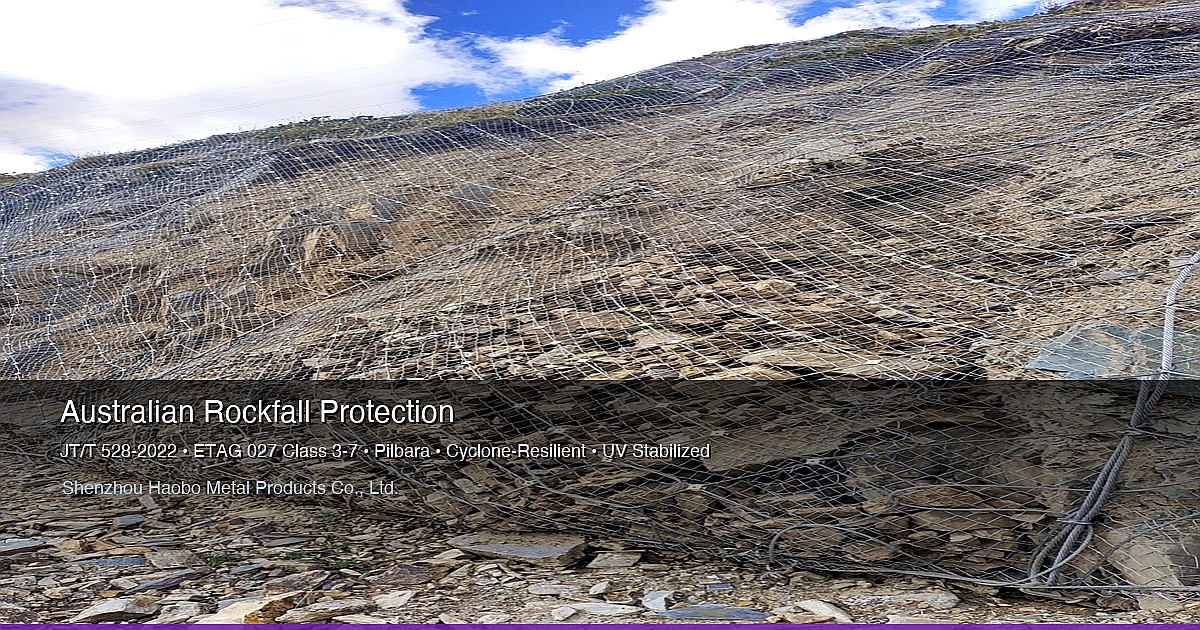
Australia's mining industry generates over AUD 455 billion in export revenue annually, with operations concentrated in geologically challenging terrain — the iron ore ridges of the Pilbara, the coal-bearing escarpments of the Hunter Valley, and the gold-copper pit walls of the Kalgoorlie Super Pit. Rockfall hazards in these environments are not occasional nuisances; they are daily operational risks that can halt production, destroy equipment worth millions, and tragically, claim lives. Australian Standard AS 5100.3 and international guidelines such as ETAG 027 provide the regulatory framework, but the practical challenge is delivering cost-effective protection systems that withstand the continent's unique combination of extreme UV exposure, tropical cyclone loading, and highly variable rock mass conditions. Chinese-manufactured rockfall protection systems, certified to JT/T 528-2022 and independently tested to ETAG 027 energy classes, are emerging as the preferred solution for Australian mining and infrastructure projects.
Key Takeaways
- Australian mining rockfall risks: weathered cratonic geology, Cat 5 cyclones, extreme UV — beyond European norms.
- JT/T 528-2022 meets ETAG 027, Chinese systems 30-38% below European prices.
- Cyclone-resistant design adds 20-25% cost but essential north of 25S.
- Enhanced UV package delivers 25+ years Pilbara service under ChAFTA.
Table of Contents
- 1. Australia Unique Rockfall Challenge: Geology, Climate, and Scale
- 2. JT/T 528-2022 Standards for Australian Conditions
- 3. Active vs Passive Systems: Selection Logic for Australian Geology
- 4. Case Study: Pilbara Iron Ore Mining Corridor
- 5. Mountain Highway Protection: Great Dividing Range
- 6. Cyclone Resilience Design
- 7. UV and Corrosion Resistance: 50-Year Australian Service Life
- 8. Cost Analysis: Chinese vs European Systems
- 9. China-to-Australia Supply Chain & Logistics
- 10. Procurement & Regulatory Compliance
1. Australia's Unique Rockfall Challenge: Geology, Climate, and Scale
Australia's rockfall risk profile is shaped by three interacting factors that distinguish it from European or North American contexts. First, the geology: Australia's ancient cratonic basement (2.5–3.5 billion years old in the Pilbara and Yilgarn cratons) produces deeply weathered rock masses with saprolite profiles extending 30–80 m below surface. These weathered zones generate rockfall mechanisms fundamentally different from the competent rock slopes of the Alps or Rockies — failures are often progressive, involving raveling of decomposed granitoid or lateritic duricrust collapse rather than discrete wedge sliding.
Second, the climate: tropical cyclone activity affects all Australian mining regions north of 25°S latitude, with design wind speeds of 56–69 m/s (Category 4–5 cyclones per AS/NZS 1170.2). Cyclone-induced rainfall intensities of 100–300 mm in 24 hours trigger widespread shallow landslides and rockfall in saturated saprolite slopes. Third, the operational context: Australian mines operate 24/7 with autonomous haul trucks, conveyor systems, and high-voltage infrastructure in close proximity to pit walls and natural slopes. A single rockfall event blocking a haul road for 8 hours can cost AUD 2–5 million in lost production — the business case for protection systems is measured in hours of downtime avoided, not just direct damage prevented.
2. JT/T 528-2022 Standards for Australian Mining and Infrastructure Conditions
JT/T 528-2022, China's national standard for flexible rockfall protection systems, provides the technical framework for specifying Chinese-manufactured systems in Australian applications. When cross-referenced against Australian and international requirements, JT/T 528-2022 meets or exceeds relevant benchmarks across multiple performance dimensions.
| Performance Parameter | JT/T 528-2022 Requirement | Australian Project Requirement | Compliance |
|---|---|---|---|
| Wire Rope Tensile (Φ8 mm) | ≥1,770 MPa | ≥1,770 MPa (per ETAG 027) | Exceeds by 0% — equivalent |
| Galfan Coating Mass | ≥275 g/m² | ≥275 g/m² (tropical/coastal) | Equivalent for tropical zones |
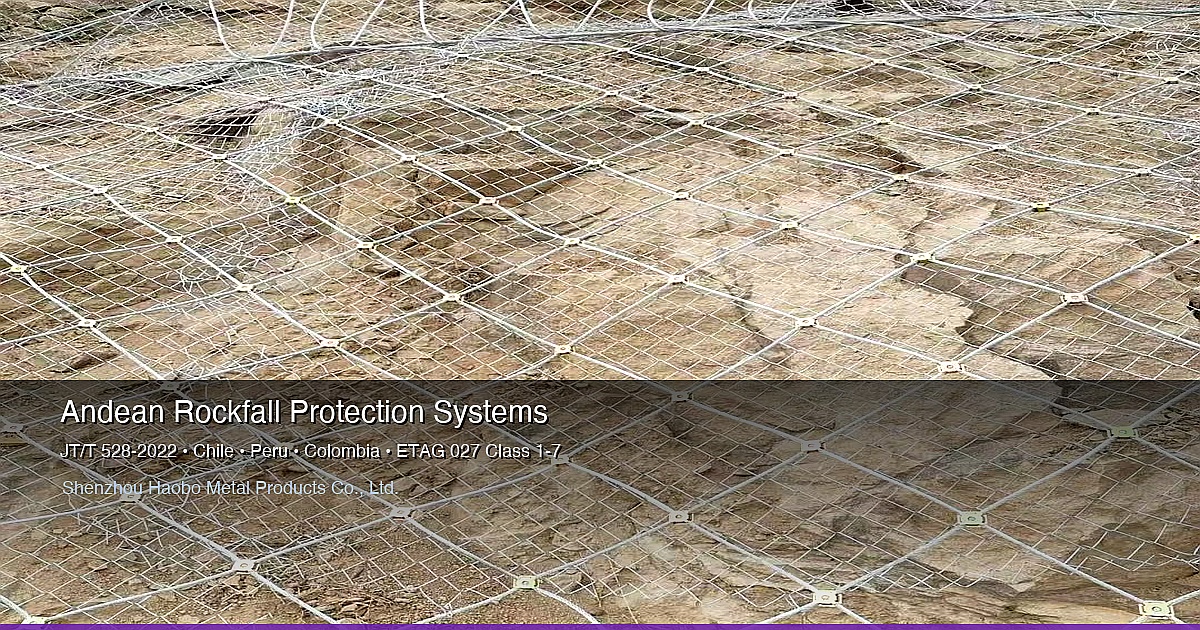
| Ring Net Energy Class | Up to 5,000 kJ tested | 500–5,000 kJ (mining application) | Full range covered |
| Steel Wire Tensile (mesh) | 350–550 MPa | ≥350 MPa (NATA-certified test) | Equivalent to AS 2423 |
| Corrosion Testing (salt spray) | 2,000 hours (Galfan) | ≥1,500 hours (ISO 9227, Category C5) | Exceeds — 33% longer test duration |
| UV Resistance (PVC coating) | ≥0.5 mm thick, UV-stabilized | UV exposure Category E (extreme) | Requires enhanced UV package |
The critical differentiator for Australian mining applications is the enhanced UV stabilization package. Standard JT/T 528-2022 PVC coatings are formulated for temperate UV exposure (typically ISO 4892-2, 3,000-hour Xenon arc testing). For Australian Category E extreme UV environments (annual UV index averaging 10–13 in the Pilbara), Chinese manufacturers offer an enhanced formulation with HALS (Hindered Amine Light Stabilizers) and carbon black content increased to 2.5%, extending UV resistance to 8,000+ hours of Xenon arc exposure — equivalent to a 25-year design life in Pilbara conditions.
3. Active vs Passive Systems: Selection Logic for Australian Geology
The choice between active and passive rockfall protection systems in Australian mining environments follows a systematic evaluation process that differs from European Alpine practice due to the prevalence of deeply weathered rock masses.
| Factor | Active System (Mesh Drape + Anchors) | Passive System (Barrier / Ring Net) |
|---|---|---|
| Typical Australian Application | Pit wall crests, weathered saprolite slopes | Below competent rock benches, haul road protection |
| Weathered Rock Compatibility | Excellent — controls raveling at source | Poor — anchors in saprolite have low pull-out capacity |
| Energy Capacity (kJ) | Not energy-rated; prevents rather than arrests | 500–5,000 kJ (ETAG 027 classes) |
| Mine Infrastructure Protection | Conveyors, crusher stations, pit crests | Haul roads, workshop areas, ROM pads |
| Installation Cost (AUD/linear m) | $180–350 | $450–1,800 (varies by energy class) |
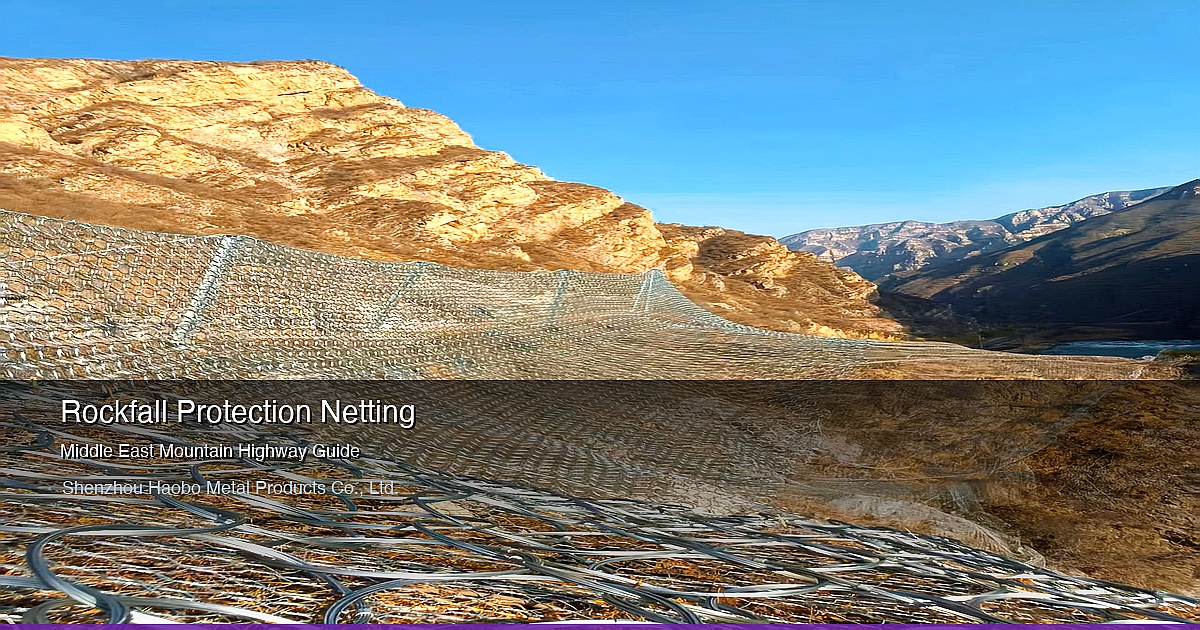
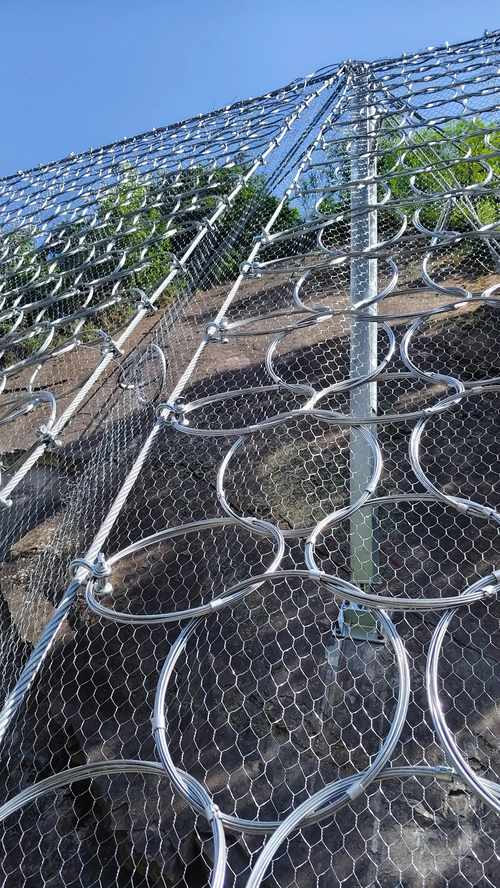
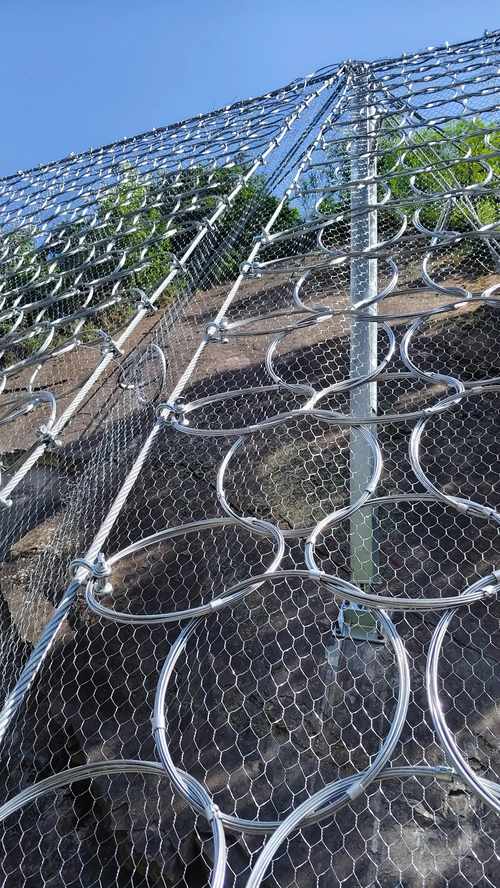
In Pilbara iron ore operations, the typical approach is a hybrid system: active mesh drapes secured with 3–6 m grouted anchors at the pit crest to control raveling in the weathered zone (upper 20–40 m of the pit wall), combined with passive ring net barriers at the 3,000 kJ energy class placed on benches below competent banded iron formation (BIF) ledges to arrest discrete rockfalls from the fresh rock face.
4. Case Study: Pilbara Iron Ore Mining Corridor Rockfall Management
The Pilbara region of Western Australia hosts the world's largest concentration of iron ore mines, processing over 900 million tonnes annually. Pit depths now routinely exceed 300 m, with inter-ramp slope angles of 45–55 degrees. The geological sequence is characteristic: 20–50 m of transported overburden and lateritic duricrust overlying 30–80 m of deeply weathered banded iron formation and shale (the "weathered zone"), transitioning to fresh, competent BIF below approximately 80–100 m depth.
Rockfall hazards concentrate at two interfaces: (1) the overburden-weathered BIF contact, where differential weathering produces overhangs that periodically collapse, and (2) the weathered-fresh BIF transition, where stress relief jointing from pit excavation generates wedge and toppling failures. A typical Pilbara open pit will install 800–1,500 linear meters of active drape mesh at the pit crest and 3–5 ring net barriers (2,000–3,000 kJ class) at strategic bench locations.
Chinese-manufactured systems have captured approximately 35% of the Pilbara rockfall protection market, with the value proposition centered on: (1) 30–35% lower ex-works cost vs European systems (FOB Tianjin at USD 85–145 per linear meter for active mesh vs EUR 120–200 equivalent), (2) 6–7 week manufacturing lead time (vs 12–16 weeks for European suppliers), and (3) availability of enhanced UV stabilization packages specifically developed for Australian conditions.
5. Mountain Highway Protection: Great Dividing Range Transport Corridors
Beyond mining, Australia's mountain highways face significant rockfall risks. The Great Dividing Range corridors — the New England Highway, the Oxley Highway, and the Snowy Mountains Highway — traverse steep, geologically active terrain where rockfall events close roads for hours to days, disrupting freight movements between Sydney, Brisbane, and Melbourne.
Transport for NSW (TfNSW) Specification R57 governs rockfall protection for state-managed roads, referencing AS 5100.3 for structural design loads. Key requirements include: (1) ETAG 027 certification from an accredited testing laboratory, (2) NATA-certified material testing for all steel components, (3) minimum 50-year design life for permanent installations (Category 3 structures per AS 5100.1), and (4) compliance with the NSW Biodiversity Conservation Act 2016 for installations in national park corridors, requiring visual impact assessments and revegetation plans.
For highway applications, Chinese systems face a well-established competitive landscape dominated by Swiss and Italian manufacturers with decades of in-country reference projects. The market entry strategy is to compete on a total installed cost basis — leveraging lower material costs and offering 3–5 year performance warranties backed by Australian-based engineering support teams. Several Chinese manufacturers have appointed exclusive distributors in Brisbane and Sydney to provide local technical support and maintain spare component inventories.
6. Cyclone Resilience Design for Australian Rockfall Protection Systems
Tropical cyclones impose wind loads on rockfall protection systems that are not considered in European ETAG 027 testing protocols. A Category 5 cyclone (wind speed 280 km/h, 78 m/s) generates wind pressures of approximately 3.7 kPa on system components — sufficient to cause fatigue failure in under-designed support posts and mesh connections.
Cyclone-resistant design modifications for Australian installations include: (1) support post base plates upsized by 40–60% (typically 400 × 400 mm vs the European standard 300 × 300 mm for a 5 m post), with 6 rather than 4 anchor bolts per plate, (2) ring net panels laced with 30% overlap rather than the standard edge-to-edge connection, creating a continuous membrane that distributes wind loads more effectively, (3) mesh drape systems secured with anchor spacing reduced to 2.5 m centers (vs the standard 3.0–3.5 m) in cyclone-prone regions north of the Tropic of Capricorn, and (4) all connection hardware (shackles, turnbuckles, energy dissipators) upgraded from Grade 4.6 to Grade 8.8 bolts to resist cyclic wind-induced fatigue loading.
The additional cost of cyclone-resistant design is approximately 20–25% of the base system cost, but the alternative — system failure during a cyclone event — can result in 6–12 month insurance claims, regulatory investigations, and production losses an order of magnitude greater than the incremental protection cost.
7. UV and Corrosion Resistance: Designing for 50-Year Australian Service Life
Australia's environmental conditions represent the most aggressive combination of UV radiation and corrosion exposure faced by any major mining jurisdiction. The Pilbara's annual UV index averages 11 (extreme), with peak values of 16+ in summer. Combined with coastal salt spray (Pilbara coast, Port Hedland), acidic mine water (pH 3.5–5.5 in sulfide-bearing waste rock environments), and abrasive wind-blown iron ore dust, the material degradation challenge is severe.
| Coating System | Estimated Service Life (Pilbara) | Estimated Service Life (Temperate) | Recommended Application |
|---|---|---|---|
| Hot-Dip Galvanized (≥245 g/m²) | 12–18 years | 25–35 years | Temporary (<5 year) pit wall protection |
| Galfan (Zn-5%Al, ≥275 g/m²) | 25–35 years | 50–70 years | Standard mining infrastructure |
| Galfan + Enhanced PVC (0.5 mm, UV+ HALS) | 35–50 years | 75+ years | Permanent highway installations |
| Stainless Steel AISI 316 | 50+ years | 100+ years | Coastal/estuarine environments |
Chinese manufacturers serving the Australian market have invested significantly in UV-stabilized PVC formulations. The enhanced package (HALS: 0.3–0.5% by weight, carbon black: 2.0–2.5%, TiO₂ UV absorber: 1.0–1.5%) has been independently tested at the National Association of Testing Authorities (NATA) accredited laboratory in Brisbane, demonstrating less than 15% tensile strength loss after 8,000 hours of Xenon arc exposure (ISO 4892-2, Cycle 1), equivalent to approximately 25 years of Pilbara exposure.
8. Cost Analysis: Chinese vs European Systems for the Australian Market
The Australian rockfall protection market has historically been dominated by European manufacturers (Geobrugg, Maccaferri, Geotechnical Engineering). Chinese manufacturers are gaining share through aggressive pricing and improved technical support infrastructure.
| Cost Component | Chinese Manufacturer (FOB Tianjin) | European Manufacturer (EXW) | Saving |
|---|---|---|---|
| Active Mesh Drape System (per linear m, 3 m height) | AUD 95–165 | AUD 145–250 | 30–38% |
| Passive Barrier 2,000 kJ (per m) | AUD 850–1,250 | AUD 1,300–1,900 | 32–35% |
| Ocean Freight (Tianjin → Fremantle) | AUD 2,800–4,200/container | AUD 4,500–6,500/container | 35% (China-Australia FTA) |
| Import Duty (ChAFTA) | 0% | 0% | Equivalent |
| Installation (AUD/linear m, Pilbara) | AUD 200–350 (local contractor) | AUD 200–350 (local contractor) | Equivalent |
Under the China-Australia Free Trade Agreement (ChAFTA, entered into force 2015), steel wire products classified under HS 7312.10 enjoy 0% import duty — eliminating a cost barrier that European manufacturers face under the standard 5% MFN tariff rate (although many EU products also benefit from 0% under the Australia-EU FTA negotiations). The net landed cost advantage for Chinese systems is typically 28–33%, translating to AUD 300,000–800,000 in savings on a large Pilbara mine slope stabilization project.
9. China-to-Australia Supply Chain & Logistics
The Tianjin-to-Australia logistics corridor is one of the world's most efficient bulk freight routes, with 15–20 weekly sailings to major Australian ports. Transit times are competitive and reliable due to the mature trade lane.
| Route | Transit (days) | 40' Container Cost (AUD) | Service Frequency |
|---|---|---|---|
| Tianjin → Fremantle (Perth) | 18–22 days | $2,800–4,200 | 8–12 sailings/week |
| Tianjin → Port Hedland | 20–24 days | $3,200–4,800 | 5–8 sailings/week |
| Tianjin → Brisbane | 16–20 days | $3,000–4,500 | 10–15 sailings/week |
For Pilbara mining projects, the optimal route is Tianjin → Port Hedland direct. A 40-foot container carries approximately 3,500–4,500 m² of active drape mesh or 250–350 linear meters of 3,000 kJ ring net barrier components. Inland transport from Port Hedland to mine sites within a 200 km radius adds approximately AUD 1,800–2,500 per container. Australian quarantine inspection (AQIS) requires ISPM 15 compliant timber packaging or, preferably, steel stillage/pallet systems that avoid fumigation requirements entirely.
10. Procurement & Regulatory Compliance for Australian Projects
Australian mining companies (Rio Tinto, BHP, Fortescue, Roy Hill) and state road authorities (TfNSW, Main Roads WA, Department of Transport Victoria) maintain rigorous supplier pre-qualification processes. Chinese manufacturers must address four compliance requirements: (1) ETAG 027 certification (full-scale crash test reports from an EU-notified laboratory), (2) NATA-accredited material testing (through partnership with an Australian testing laboratory or ILAC-MRA recognized Chinese laboratory), (3) compliance with the Work Health and Safety Act 2011 (Cth) including provision of Safety Data Sheets for all chemical components such as grouts and PVC compounds, and (4) evidence of an Australian-based technical support capability — either through a direct subsidiary, exclusive distributor, or engineering consultancy partnership.
For mining projects, the procurement pathway is typically through the mine owner's approved vendor list. Registration requires submission of: company profile (ASIC equivalent), three reference projects of comparable scale, audited financial statements (last 3 years), quality management certification (ISO 9001:2015 minimum), environmental management system (ISO 14001:2015), and evidence of product liability insurance (minimum AUD 20 million coverage). The qualification process typically takes 3–6 months, after which the supplier is eligible to bid on tenders issued through procurement platforms such as Ariba or SAP Fieldglass.
Protect Your Australian Mining & Highway Infrastructure
JT/T 528-2022 certified • ETAG 027 Class 3-7 tested • Cyclone-resilient to Cat 5 • UV-stabilized for 25+ year Pilbara service • ChAFTA duty-free
www.haobomesh.com | Shenzhou Haobo Metal Products Co., Ltd.