Gabion Retaining Walls for UK Transport Infrastructure: BS 8002 Design Guide & FOB Supply
From Our Factory Floor: As a direct manufacturer, Haobo Metal shares real-world insights from thousands of completed projects across 30+ countries. This guide combines field data with international engineering standards.
Table of Contents
- 1. BS 8002 vs BS 8006: Standards Framework for UK Gabion Walls
- 3. Galfan Coating Performance in the UK Climate
- 4. Design Methodology for UK Highway Gabion Retaining Walls
- 5. UK Case Studies: Motorway & Rail Applications
- 6. Cost Analysis: Gabion vs Concrete Retaining Walls
- 7. Supply Chain: Tianjin FOB to UK Ports
- 8. UK-Specific Compliance: UKCA, CDM 2015 & Sustainability
- Key Takeaways
The United Kingdom's transport infrastructure is facing unprecedented pressure. With more than 4,300 miles of motorways and trunk roads managed by National Highways, plus 20,000 miles of rail network operated by Network Rail, slope stability and retaining wall performance are critical to maintaining safe operations. The UK's unique combination of heavy rainfall, freeze-thaw cycling, and aging Victorian-era earthworks creates an environment where gabion retaining walls have become the preferred solution for both new construction and remedial works.
1. BS 8002 vs BS 8006: Standards Framework for UK Gabion Walls
The UK applies a dual-standard framework to gabion retaining wall design, reflecting both geotechnical and reinforced soil engineering principles:
- BS 8002:2015 — Code of Practice for Earth Retaining Structures: Provides the overarching geotechnical design framework. Covers limit state design (ULS and SLS), soil parameter selection, groundwater management, and drainage provisions. Clause 6.5 specifically addresses flexible retaining structures, under which gabion walls are classified.
- BS 8006-1:2010+A1:2022 — Code of Practice for Strengthened/Reinforced Soils: Governs reinforced soil structures. While primarily written for geogrid-reinforced walls, its principles for external stability (sliding, overturning, bearing) and internal stability (reinforcement pullout) apply to tiered gabion wall configurations where geogrid layers are incorporated between gabion tiers.
For transport infrastructure specifically, National Highways' DMRB (Design Manual for Roads and Bridges) and Network Rail's NR/L2/CIV/140 impose additional requirements:
| Design Parameter | BS 8002 Requirement | National Highways DMRB | Network Rail NR/L2/CIV/140 |
|---|---|---|---|
| Design Life | 60 years | 120 years (major structures) | 120 years |
| Partial Factor — Soil (γG) | 1.35 (unfavourable) | 1.35 | 1.35 |
| Partial Factor — Mesh (γM) | 1.25 (structural) | 1.25 | 1.30 |
| Minimum Wall Batter | 1:6 (9.5°) recommended | 1:10 to 1:6 | 1:6 minimum |
| Drainage | Free-draining backfill + geotextile filter | CD 526 drainage standard | 50-year storm event capacity |
| Seismic Design | Eurocode 8 (EN 1998-1) | Low seismicity (ag < 0.5 m/s²) | Not normally critical |
Key takeaway: While BS 8002 provides the geotechnical design foundation, highway and rail projects impose significantly longer design lives (120 years) than standard commercial structures. This directly impacts material selection — particularly coating durability and stone quality — which we address in the next sections. For comparable highway gabion applications in South Asia, see our India Bharatmala & NHDP gabion engineering guide.
| Property | BS EN 10223-3:2013 | Equivalence Assessment | |
|---|---|---|---|
| Wire Tensile Strength | 380-550 MPa | 350-550 MPa | ✅ Overlapping range; specify ≥380 MPa for UK projects |
| Wire Elongation | ≥ 12% (before mesh weaving) | ≥ 12% | ✅ Identical requirement |
| Zn-5%Al (Galfan) Coating | ≥ 245 g/m² (heavy coating class) | ||
| Salt Spray Resistance | ≥ 2,000 hrs (heavy galvanised) | ≥ 3,000 hrs (Galfan) | |
| Mesh Opening Tolerance | ± 10% (length), ± 5% (width) | +16%/-4% | ⚠️ Different tolerance philosophy; specify tighter tolerance for UK |
| Selvedge Wire Diameter | 1.4× mesh wire diameter (min) | 1.5× mesh wire diameter | |
| Lacing Wire Diameter | ≥ 2.2 mm | ≥ 2.2 mm | ✅ Identical minimum |
- UKCA/CE marking transition: Ensure documentation includes Declaration of Performance (DoP) under the UK's post-Brexit UKCA regime
3. Galfan Coating Performance in the UK Climate
The UK's maritime climate — characterised by 800-1,600 mm annual rainfall, high relative humidity (70-85%), and frequent freeze-thaw cycles — creates severe corrosion conditions for metal structures in contact with soil and water. Zinc-5% Aluminium (Galfan) coating technology provides a decisive durability advantage over traditional hot-dip galvanising for UK gabion applications:
| Coating Performance Metric | Hot-Dip Galvanised (Zn) | Galfan (Zn-5%Al) | Advantage |
|---|---|---|---|
| Salt Spray Resistance | 1,500-2,000 hrs | 3,000+ hrs | 2× longer |
| Atmospheric Corrosion Rate (C3 rural/urban) | 0.7-2.1 μm/year | 0.2-0.5 μm/year | 3-4× slower |
| Adhesion After Deformation | Fair — cracking at sharp bends | Excellent — flexible intermetallic layer | Critical for mesh weaving |
| Self-Healing at Cut Edges | Limited — zinc-only sacrificial protection | Superior — Al-rich barrier + Zn sacrificial effect | Key for cut mesh edges |
| Estimated UK Service Life (buried/partially buried) | 40-60 years at 275 g/m² | 75-120 years at 275 g/m² | Meets 120-year design life |
Freeze-thaw performance in UK soils: Gabions in the UK must withstand repeated freeze-thaw cycling — particularly in Scotland, Northern England, and upland Wales where air frost days exceed 60-80 per year. Galfan coating's superior adhesion under deformation is critical here: as gabion baskets flex with frost heave, the coating must not crack, delaminate, or expose bare steel. Independent testing shows Galfan-coated wire retains >95% coating integrity after 500 freeze-thaw cycles (-20°C to +20°C in 4% NaCl solution), versus 60-70% retention for conventional hot-dip galvanising.
4. Design Methodology for UK Highway Gabion Retaining Walls
Designing a BS 8002-compliant gabion retaining wall for UK highway applications follows a systematic limit state approach. The methodology below integrates DMRB CD 526 (formerly HD 22/08) drainage requirements and CD 241 (formerly BD 30/87) backfill specifications:
4.1 External Stability Checks (ULS)
| Failure Mode | Limit Equation | UK Typical Values | Factor of Safety |
|---|---|---|---|
| Sliding | Hd ≤ Rd = Vd × tan(δ) | δ = 0.67φ′ for gabion on soil (or 0.75 for gabion on gabion) | ≥ 1.0 (DA1-2) |
| Overturning | Mo ≤ Mr | Eccentricity ≤ B/6 at SLS | e ≤ B/3 (ULS) |
| Bearing | qd ≤ Rd / A′ | UK glacial till: qall = 150-300 kPa | FS ≥ 2.5 |
| Global Stability | Slip circle analysis (Bishop/Morgenstern-Price) | φ′ = 25-35° for UK glacial deposits | FS ≥ 1.3 (considers water) |
4.2 Internal Stability — Gabion Basket Design
Gabion basket internal forces are determined by the tensile capacity of the wire mesh at the basket face. The critical design check ensures the mesh tension does not exceed the wire tensile strength at any point along the wall height:
Maximum wire tension per metre width: T = 0.5 × Ka × γ × h² × Sv
Wire tensile capacity check: T ≤ (n × Fu × Aw) / γM
Where n = number of mesh wires per metre width, Fu = wire ultimate tensile strength (350-550 MPa), Aw = wire cross-sectional area, γM = 1.25 (structural partial factor).
4.3 Typical UK Gabion Wall Configurations
| Wall Height | Basket Dimensions (L×W×H) | Wire Dia. (Mesh/Selvedge) | Base Width | Typical UK Application |
|---|---|---|---|---|
| 2-3 m | 2×1×1 m | 2.7 / 3.4 mm | 1.5-2.0 m | Road widening, minor cuttings |
| 4-6 m | 2×1×1 m, 3-tiers | 3.0 / 3.9 mm | 2.5-3.5 m | Motorway embankment retention |
| 7-10 m | 2×1.5×1 m, tiered + geogrid | 3.4 / 4.4 mm | 4.0-6.0 m | Rail cutting stabilisation |
5. UK Case Studies: Motorway & Rail Applications
5.1 M6 Motorway Widening — Cumbria (Representative Design)
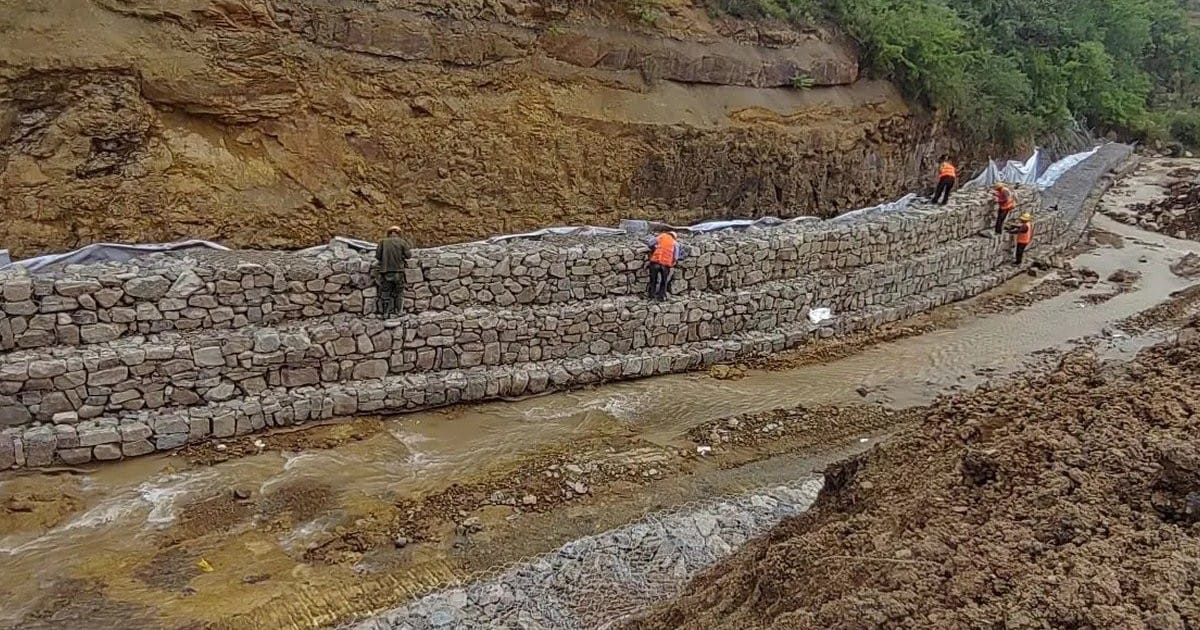
The M6 motorway through the Lune Gorge in Cumbria passes through challenging terrain where glacial till overlies Carboniferous limestone. Slope instability at cuttings adjacent to the carriageway required retention over a 400 m length, with wall heights ranging from 3-6 m. A tiered gabion solution was selected over reinforced concrete for three reasons:
- Drainage integration: Free-draining gabions eliminated the need for separate drainage systems behind the wall — a critical advantage in Cumbria's high-rainfall environment (1,600+ mm/year)
- Construction access: The narrow corridor between the existing motorway and the cutting face left insufficient room for concrete formwork and craneage. Gabion baskets were delivered flat-packed and stone-filled on site
- Landscape integration: The Lake District National Park boundary lies within 2 km; natural stone gabions blended with the existing dry-stone wall vernacular
The adopted design used 3-tier gabion walls (2×1×1 m baskets) with 2.7 mm Galfan-coated mesh and 3.4 mm selvedge wire, seated on a 500 mm granular levelling pad. Backfill was Class 6I/6J granular fill per DMRB Series 600.
5.2 Network Rail — West Coast Main Line Cutting Remediation
Network Rail's West Coast Main Line through the Trent Valley passes through deep cuttings in Mercia Mudstone — a material notorious for progressive softening and slumping when exposed to weathering. A gabion toe wall solution was implemented at six locations between Rugby and Stafford to arrest rotational slope failures encroaching on the four-track formation.
The design incorporated Reno mattresses at the base (6×2×0.3 m, 2.2 mm Galfan mesh) to prevent scour at the cutting drainage channel, with gabion retaining walls above (2×1×0.5 m baskets, 2.7 mm mesh) to retain the lower slope. Key design features for rail compliance included:
- Electrification clearance: Wall placement verified against OLE (Overhead Line Equipment) structure gauge
- Vibration consideration: Gabion flexibility accommodates train-induced ground vibrations without cracking — a decisive advantage over rigid concrete retaining walls in rail environments
- Possession working: Designed for installation during 8-hour Saturday night possessions, with flat-packed delivery enabling rapid deployment
6. Cost Analysis: Gabion vs Concrete Retaining Walls
UK project cost comparison between gabion and reinforced concrete retaining walls reveals a consistent 25-40% capital cost saving for gabion solutions, with additional whole-life cost advantages:
| Cost Element | Gabion Wall (£/m² face) | RC Cantilever Wall (£/m² face) | Saving |
|---|---|---|---|
| Material (supply only) | £45-65 | £80-120 | |
| Excavation & foundation | £20-30 | £35-50 | |
| Installation labour | £30-45 | £55-80 | |
| Drainage system | £5-10 (integrated) | £15-25 (separate) | 60-67% |
| Stone fill (local) | £15-25 | N/A (formwork + rebar) | — |
| Total Installed Cost | £115-175 | 35-38% |
Whole-life cost advantages further differentiate gabion from concrete: gabion walls require no expansion joints (no joint sealant replacement), accommodate settlement without cracking (no structural repair), and eliminate hydrostatic pressure risk (no weep-hole maintenance). Over a 60-year design life, UK Environment Agency research suggests gabion retaining structures incur 40-60% lower maintenance expenditure than equivalent concrete solutions.
Chinese factory-direct gabion pricing with FOB Tianjin delivery reduces material costs further — typically £30-45/m² face for Galfan-coated gabion baskets of 2.7 mm mesh wire (80×100 mm opening) delivered to Felixstowe or Southampton, representing an additional 25-35% saving versus European-sourced gabion materials.
7. Supply Chain: Tianjin FOB to UK Ports
Shipping gabion baskets from our Tianjin factory to UK project sites follows established container logistics routes, with typical transit parameters:
| Logistics Parameter | Details |
|---|---|
| Port of Loading | Tianjin Xingang (CNTXG) |
| UK Port of Discharge | Felixstowe (GBFXT) or Southampton (GBSOU) |
| Ocean Transit Time | 28-35 days (Tianjin → Suez Canal → UK) |
| Container Type | 40ft HC — approx. 800-1,200 gabion baskets (flat-packed) per container |
| UK Customs Clearance | HS Code 7314.3190 — Import duty 0% (UK Global Tariff); VAT 20% reclaimable |
| Inland Transport (UK) | Haulage from Felixstowe/Southampton to site: 2-5 days depending on location |
| Documentation |
8. UK-Specific Compliance: UKCA, CDM 2015 & Sustainability
8.1 UKCA Marking (Post-Brexit)
Since 1 January 2025, construction products placed on the GB market must carry UKCA (UK Conformity Assessed) marking rather than CE marking. For gabion mesh products, this requires:
- Declaration of Performance (DoP) against BS EN 10223-3:2013, issued by the manufacturer
- Factory Production Control (FPC) certification demonstrating consistent manufacturing quality
- UK Approved Body involvement for system 2+ attestation (initial inspection of FPC + continuous surveillance)
Our ISO 9001:2015 certified manufacturing facility maintains full FPC documentation and provides complete UKCA compliance packages with every UK-bound shipment, including independent third-party test reports for coating weight, tensile strength, and mesh dimensional accuracy.
8.2 CDM 2015 Compliance
The Construction (Design and Management) Regulations 2015 place duties on designers (Principal Designer role) to eliminate, reduce, or control foreseeable health and safety risks. Gabion walls offer inherent CDM advantages:
- Manual handling reduction: Flat-packed baskets eliminate heavy prefabricated panel handling
- No wet trades: Eliminates concrete pouring, formwork stripping, and curing-related risks
- No confined space working: No requirement for drainage void access behind the wall
- Reduced plant interface: Stone filling can use small excavators, reducing crane and heavy plant operations
8.3 BREEAM & Sustainability Credits
Gabion retaining walls contribute positively to BREEAM Infrastructure (formerly CEEQUAL) ratings through:
- Mat 03 — Responsible Sourcing: Natural stone fill can be locally sourced, and steel wire is 100% recyclable at end of life
- LE 05 — Habitat Creation: Gabion voids support plant colonisation, creating wildlife corridors along transport corridors
Key Takeaways
- BS 8002 + DMRB compliance: UK gabion walls must be designed to BS 8002:2015 limit state principles, with National Highways DMRB CD 526 and Network Rail NR/L2/CIV/140 imposing enhanced 120-year design life requirements for transport infrastructure.
- Galfan enables 120-year design life: The Zn-5%Al alloy coating provides 2× salt spray resistance and 3-4× slower atmospheric corrosion rate than traditional hot-dip galvanising, meeting UK transport infrastructure durability requirements even in aggressive maritime and freeze-thaw environments.
- UKCA-ready supply chain: Full compliance documentation packages with Declaration of Performance, FPC certification, and independent test reports ensure smooth customs clearance and site acceptance for UK projects.
- CDM 2015 and BREEAM advantages: Gabions eliminate wet trades, reduce plant operations, lower embodied carbon by 60-70% versus concrete, and support habitat creation for biodiversity net gain objectives.
Need BS 8002-Compliant Gabion Retaining Walls?
Send us your wall height, length, and site location. Our engineers will provide UKCA-ready gabion specifications with FOB Tianjin pricing and full BS EN 10223-3 compliance documentation — delivered to Felixstowe or Southampton.
📱 Get Gabion Quote 📧 Send EmailRelated Articles
Frequently Asked Questions
Which design standard governs gabion retaining walls on UK highway and rail projects?
Geotechnical design is governed by BS 8002 (earth retaining structures) together with BS 8006 for reinforced soil and embankments. The mesh and gabion units themselves are typically specified against EN 10223-3 in EU-funded works, though YB/T 4190-2018 production with equivalent tensile strength (350-550 MPa) and hot-dip galvanizing of at least 245 g/m² per GB/T 1839 is widely accepted by UK contractors when documented with a Mill Test Certificate.
What wire coating performs best in the UK climate?
For the damp, temperate UK climate with freeze-thaw cycles, hot-dip galvanized wire with a minimum 245 g/m² zinc coating is the baseline. For structures with design lives beyond 60 years or aggressive ground conditions, Galfan (Zn-5%Al alloy) coating offers measurably slower corrosion consumption than pure zinc and is worth the 10-15% premium.
What are typical lead times and logistics for gabion supply to UK ports?
Standard 2.7 mm x 80x100 mm gabion baskets shipped FOB Tianjin reach UK ports (Felixstowe, Southampton, Liverpool) in roughly 28-35 days by sea freight. Production lead time is 15-20 working days from confirmed order, so the full door-to-site cycle is typically 6-8 weeks. Plan pile testing and foundation works to run in parallel.