Gabion River Training Works for South Asia: India, Bangladesh, Nepal Flood Control & Bank Protection Design Guide 2026
Editor's Note: This article draws on Shenzhou Haobo Metal's 15+ years of manufacturing experience, providing practical engineering guidance for procurement professionals and civil engineers worldwide.
Introduction: Why Gabion River Training Works Are Critical for South Asia
South Asia is home to three of the world's largest river systems — the Ganges-Brahmaputra-Meghna (GBM), the Indus, and the peninsular rivers of India — which together drain a catchment area exceeding 2.8 million km² and support over 750 million people (for highway-sector applications, see our gabion retaining wall guide for India's Bharatmala & NHDP highway programme). These rivers carry some of the highest sediment loads on the planet (the Ganges alone transports an estimated 1.6 billion tonnes annually) and experience extreme flow variations between dry-season base flows of a few hundred m³/s and monsoon peak discharges exceeding 100,000 m³/s.
Key Takeaways
- Gabions are the dominant river training technology in South Asia because their flexibility accommodates the extreme flow variability, channel migration, and deep scour that cause rigid concrete structures to fail. Gabion structures account for over 65% of bank protection works in the Ganges-Brahmaputra-Meghna basin.
- YB/T 4190-2018 material specifications provide the quality benchmark: 2.7mm mesh wire (3.0mm for spur heads), 245 g/m² minimum zinc coating (275-300 g/m² for aggressive water), 350-550 MPa tensile strength with ≥10% elongation, and 80×100mm mesh opening as the South Asian standard.
- The launching apron is the single most critical design element: A Reno mattress toe apron extending minimum 1.5× predicted scour depth (typically 6-12m for major rivers) prevents undermining — the leading cause of gabion revetment failure. Modified Lacey-Inglis scour prediction remains the standard methodology for South Asian conditions.
- Geotextile filters are mandatory: Non-woven needle-punched geotextile (300-400 g/m²) between gabion and natural bank soil prevents piping failure — the second most common cause of gabion structure degradation after toe scour.
- Chinese manufacturers offer the optimal quality-cost-capacity balance: FOB Tianjin gabions are 35-45% cheaper than European alternatives with equivalent quality to international standards, 10-18 day container shipping to South Asian ports, and the production capacity to support mega-projects exceeding 100,000 m³.
In this hydrological context, river training — the art and science of controlling river alignment, protecting banks from erosion, and preventing channel migration — is not an optional infrastructure investment. It is an existential necessity for communities, agricultural lands, transportation corridors, and urban centers across India, Bangladesh, Nepal, and Pakistan. Among the many engineering solutions available, gabion structures have emerged as the most widely adopted and cost-effective technology for river training in South Asia, accounting for an estimated 65-70% of all bank protection works in the region.
This article provides a comprehensive engineering guide to gabion river training works for South Asian conditions, referencing Chinese national standards (YB/T 4190-2018, GB/T 1839) alongside Indian IRC codes and Bangladesh BWDB specifications. Whether you are a consulting engineer designing erosion control for the Brahmaputra's shifting channels, a contractor bidding on a World Bank-funded flood protection project in Bangladesh, or a procurement officer sourcing gabion materials for Nepal's mountain river training, this guide covers the technical specifications, design methodologies, material selection criteria, and practical construction considerations you need.
The South Asian River Training Challenge: Hydrology That Demands Flexibility
Conventional rigid river training structures — reinforced concrete retaining walls, masonry revetments, sheet pile walls — have a well-documented history of catastrophic failure in South Asian rivers. The fundamental problem is that rigid structures cannot accommodate the three defining characteristics of South Asian fluvial systems:
1. Extreme flow variability. The Ganges at Farakka Barrage, for example, oscillates between dry-season flows of approximately 500 m³/s and monsoon peaks that have exceeded 76,000 m³/s — a flow ratio of over 150:1. Rigid structures designed for a single design flood are inevitably under-designed for the actual extreme event, and over-designed (and excessively expensive) for normal conditions.
2. Channel migration. The Brahmaputra River has migrated laterally by over 15 km in some reaches over the past 50 years, with annual bank erosion rates of 200-800 meters in actively eroding bends. A rigid revetment installed at one location may find itself stranded on dry land — or, worse, attacked from an unexpected angle — within a single flood season.
3. Deep scour at structure toes. Alluvial riverbeds in the Indo-Gangetic plain can scour to depths of 15-30 meters below bed level during floods. The Lacey regime theory (developed specifically for Indian alluvial rivers) predicts scour depths that would require concrete retaining wall foundations extending impractically deep and costing prohibitively — if they can be constructed at all in flowing water.
Gabion structures solve all three problems through their inherent flexibility: they can settle and deform without structural failure, they can be extended or modified as channel alignment shifts, and gabion mattress toe aprons can be laid to accommodate any scour depth through self-launching behavior.
Gabion River Training Structure Types and Applications
1. Gabion Bank Revetment (Slope Protection)
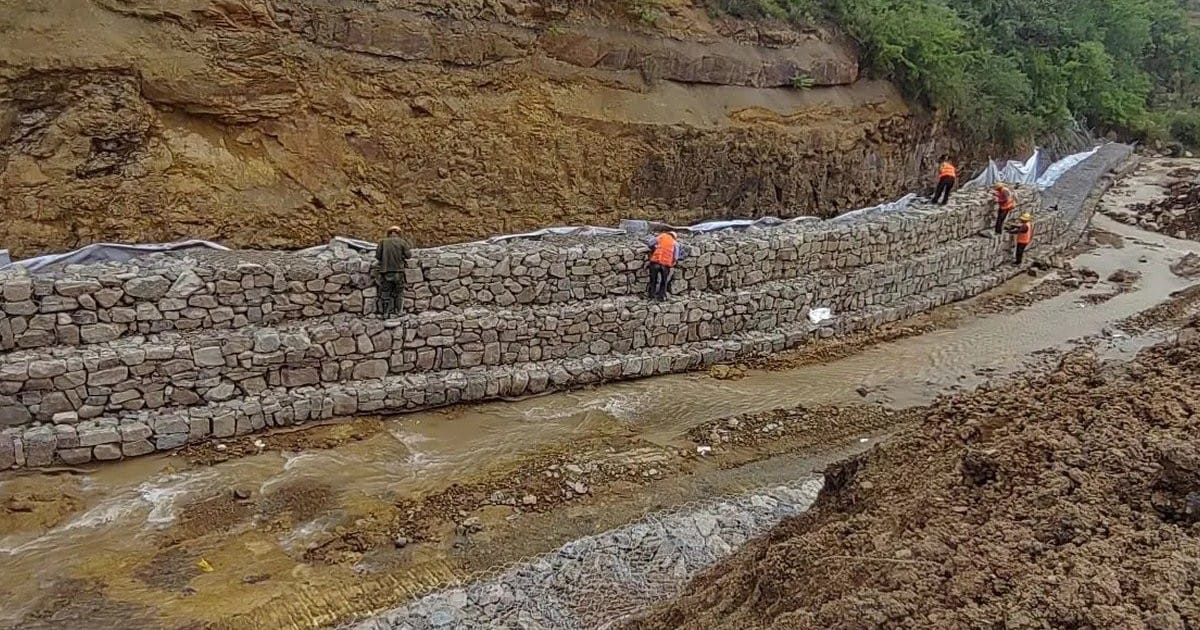
The most common river training application, consisting of gabion mattresses or box gabions laid on graded riverbank slopes. For South Asian conditions, the recommended slope is 1V:2H (approximately 26.6°) for gabion box constructions and 1V:2.5H to 1V:3H for Reno mattress revetments on fine alluvial soils.
Design specification per YB/T 4190-2018:
- Wire diameter: 2.7mm for box gabions, 2.2mm for Reno mattresses (mesh opening 80×100mm standard, 60×80mm for high-velocity zones above 4.0 m/s)
- Zinc coating: Minimum 245 g/m² per GB/T 1839 for standard galvanized; Galfan (Zn-5%Al) coating minimum 275 g/m² recommended for perennial immersion in aggressive water (pH < 6.5 or > 8.5, common in Indian peninsular rivers in mining areas)
- Wire tensile strength: 350-550 MPa per GB/T 228.1, with elongation minimum 10% — the ductility is critical for gabion structures to accommodate differential settlement without wire fracture
- Selvedge wire: 3.4mm (the outer edge wire must be one gauge thicker than mesh wire)
- Lacing wire: 2.2mm, minimum 60g/m² additional zinc coating recommended for river applications
2. Gabion Toe Wall / Launching Apron
The critical foundation element that prevents undermining — the leading cause of South Asian river training failure. A Reno mattress apron is laid horizontally at the toe of the revetment, extending into the riverbed. As scour develops during floods, the flexible mattress "launches" (folds down) into the scour hole, maintaining continuous protection of the riverbed.
Design methodology for South Asian rivers (modified Lacey-Inglis approach):
- Predicted maximum scour depth (Dₛ): Dₛ = 1.35 × (q²/f)^(1/3), where q = discharge intensity (m³/s/m) and f = Lacey silt factor (typically 0.8-1.5 for Indo-Gangetic alluvium)
- Apron width: Minimum 1.5 × Dₛ measured horizontally from the revetment toe, with a practical minimum of 4.0m for small rivers (bankfull width < 100m) and 8.0-12.0m for large braided rivers (Brahmaputra-scale)
- Mattress thickness: 0.30m minimum (0.50m for launch zones), per GB/T standard dimensions
3. Gabion Spur Dikes (Groynes)
Transverse structures projecting from the bank into the river to deflect flow away from eroding banks and encourage sediment deposition in the inter-spur fields. Extensively used on the Ganges, Brahmaputra, and Kosi rivers.
Spur design parameters for South Asian conditions:
- Length: 15-25% of the design bankfull channel width (shorter spurs, 10-15%, for braided reaches where flow patterns are unpredictable)
- Spacing: 1.5-2.5 times the spur length for attracting spurs (deflecting flow), 3-5 times for repelling spurs (maintaining alignment)
- Orientation: 70-80° upstream angle (repelling) for channel alignment; 90° (normal) or 100-110° downstream (attracting) for bank protection at specific erosion points
- Crest elevation: Design HFL (High Flood Level) minus 0.3 to 0.5m, allowing overtopping during extreme floods without structural damage — this is a key advantage of gabions over concrete spurs, which fail catastrophically when overtopped
- Head protection: Gabion boxes 3.0×2.0×2.0m with 3.0mm mesh wire at the spur head (the point of maximum flow attack), transitioning to standard 2.0×1.0×1.0m boxes with 2.7mm wire along the shank
4. Gabion Drop Structure / Grade Control Weir
Used in South Asian foothill rivers (Nepal Terai, Indian Himalayan foothills) where steep bed slopes (1:50 to 1:200) cause excessive bed degradation and bank instability. Gabion weirs stabilize the riverbed profile by creating a series of controlled drops, dissipating energy and reducing flow velocity.
Design specification:
- Drop height per structure: 0.5-1.5m maximum (for stability and to avoid excessive downstream scour)
- Weir crest width: 2.0-3.0m minimum to dissipate energy within the gabion body
- Downstream stilling basin: Reno mattress apron extending minimum 5 × drop height downstream, in a 0.30-0.50m thick mattress
- Cutoff walls: Gabion box cutoff at upstream and downstream ends, embedded minimum 1.0m below predicted scour depth
Material Quality Control: Chinese National Standards for South Asian Projects
Chinese-manufactured gabion materials dominate the South Asian market, accounting for an estimated 80%+ of supply for major river training projects. The Chinese national standard YB/T 4190-2018 ("Gabion Mesh for Civil Engineering") provides the material specification framework that most South Asian government agencies (India's CPWD, Bangladesh's BWDB, Nepal's DoR) have adopted or referenced in their own specifications.
Key Material Specifications (YB/T 4190-2018) for South Asian River Conditions
| Parameter | Standard Requirement | South Asian River Enhancement |
|---|---|---|
| Mesh wire diameter | 2.7mm (standard), 2.0-3.4mm range | 3.0mm for main channel spurs; 2.7mm for bank revetment; 2.2mm for mattress |
| Selvedge wire | One gauge thicker than mesh wire | 3.4mm (when mesh = 2.7mm); 3.9mm (when mesh = 3.0mm) |
| Lacing wire | Minimum 2.2mm | 2.2mm with additional 60g/m² zinc; 2.7mm for underwater lacing |
| Zinc coating (standard) | ≥245 g/m² (GB/T 1839) | ≥275 g/m² for perennial immersion; ≥300 g/m² for acid mine drainage areas |
| Galfan coating (Zn-5%Al) | ≥275 g/m² | Mandatory for pH <6.5 or >8.5 water (common in mining-affected tributaries) |
| Wire tensile strength | 350-550 MPa | 400-500 MPa preferred — sufficient for structural integrity, sufficient ductility for settlement accommodation |
| Elongation at break | ≥10% | ≥12% for seismic zones (India Zone IV/V, Nepal, Bangladesh) |
| Mesh opening | 60×80mm, 80×100mm, 100×120mm | 80×100mm standard; 60×80mm for high-velocity (>4.0m/s) or small stone fill (50-100mm) |
| PVC coating (optional) | 0.5mm minimum thickness | 0.6mm for tropical UV exposure (India, Bangladesh); dark grey color for UV resistance |
| Stone fill size | 1.5-2.0× mesh opening | d50 = 150-200mm; angular quarried basalt/granite; no rounded river gravel |
Quality Inspection Protocols for South Asian Project Sites
The following inspection procedures — derived from YB/T 4190-2018 Annex A and adapted for South Asian field conditions — should be performed on every container received at the project site:
Visual inspection (every bundle): Check for uniform mesh opening (no more than ±5% variation from nominal), consistent wire diameter (use digital caliper, sample 20 wires per 100m²), absence of weld breaks or twist failure at joints, and uniform zinc coating with no bare spots or excessive zinc runs.
Zinc coating weight test (per GB/T 1839, one sample per 5,000m²): The gravimetric method (weigh-strip-weigh) using antimony trichloride solution to dissolve zinc coating. Minimum acceptable: 245 g/m² for standard galvanized, 275 g/m² for Galfan. For South Asian projects, require the manufacturer to provide test certificates from a China National Accreditation Service (CNAS) accredited laboratory — third-party testing at CIMM (Central Institute of Mining and Fuel Research, Dhanbad) or BUET (Bangladesh University of Engineering and Technology) is recommended for projects exceeding 50,000m².
Tensile test (per GB/T 228.1, one sample per 10,000m²): Wire specimens 300mm gauge length tested at 50mm/min crosshead speed. Must meet 350-550 MPa tensile strength AND ≥10% elongation. Import criteria: a batch is rejected if ANY single specimen falls below 350 MPa or below 8% elongation.
Mesh panel dimensional check (every 50 panels): Length and width within ±3% of ordered dimensions; diagonal measurement difference <1% of panel width (confirms square mesh geometry). For the Brahmaputra River Training Project (Assam, India), the acceptable diagonal tolerance was reduced to 0.5% due to the extreme hydraulic loading.
Salt spray test (ASTM B117, one sample per project): For aggressive water conditions (high TDS rivers in Rajasthan/Gujarat, tidal reaches in Bangladesh Sundarbans), 500-hour salt spray exposure with maximum 5% red rust formation. The standard 500-hour requirement comes from the combination of tropical humidity (monsoon season) and elevated water salinity.
Design Methodology: Gabion River Training for South Asian Conditions
Step 1: Hydrological Data Collection
For South Asian rivers, reliance on published 50-year or 100-year flood estimates from government agencies (India CWC, Bangladesh BWDB, Nepal DHM) is the starting point, but these estimates should be independently verified for project-critical reaches. The key data requirements are:
- Design flood discharge (Q₅₀ or Q₁₀₀): CWC flood frequency analysis or regional flood formulae
- Design High Flood Level (HFL): Gauge data from nearest CWC/BWDB station, with +0.5m freeboard for gabion structures
- Velocity distribution at design flood: ADCP measurements or HEC-RAS 2D modeling for complex braided reaches
- Sediment grain size distribution (d₅₀, d₉₀): Sieve analysis of riverbed samples at 3-5 cross-sections spanning the project reach
- Bank material properties: Cohesion, friction angle (triaxial test), and erodibility classification (from jet erosion test or empirical correlation)
Step 2: Scour Depth Prediction
The Lacey-Inglis method remains the most widely used scour prediction approach in South Asia, despite its empirical origins in early 20th-century Indian canal engineering. For modern gabion design, the following modified approach is recommended:
Lacey's regime scour depth (Dₛ):
Dₛ = 0.473 × (Q/f)^(1/3)
Where Q = design flood discharge (m³/s) and f = Lacey's silt factor = 1.76 × √(d₅₀ in mm).
Practical application for gabion design:
- For a typical medium-sized river (Q₅₀ = 5,000 m³/s, d₅₀ = 0.25mm, f = 0.88): Dₛ = 0.473 × (5000/0.88)^(1/3) = 8.5m below HFL. This is the total scour depth from water surface to scoured bed.
- The gabion toe must be placed below this predicted scour level, or a launching apron provided to accommodate the full scour depth.
- For the Brahmaputra (Q₅₀ ≈ 60,000 m³/s at Pandu, d₅₀ ≈ 0.20mm, f ≈ 0.79): Dₛ = 0.473 × (60000/0.79)^(1/3) ≈ 20.1m — confirming why gabion launching aprons are essential: no rigid structure can practically reach this depth.
Step 3: Revetment Thickness and Stone Size
The Pilarczyk method (modified for gabion containment) determines the required revetment thickness based on the design shear stress:
Required stone size (d₅₀) within gabion baskets:
d₅₀ = (0.035 × V²) / (Δ × g × Kt)
Where V = depth-averaged velocity (m/s), Δ = relative density of stone (1.65 for basalt/granite), g = 9.81 m/s², Kt = turbulence factor (1.5-2.0 for river bends, 2.0-3.0 for braided reaches).
For V = 4.5 m/s (typical monsoon velocity in Ganges tributaries), Kt = 2.0: d₅₀ = (0.035 × 20.25) / (1.65 × 9.81 × 2.0) = 0.71 / 32.37 = 0.022m → 22mm. This confirms that the standard gabion stone fill of 100-200mm is conservative by a factor of approximately 5× for typical velocities — gabion structures are inherently erosion-resistant.
However, the stone must also be large enough not to be expelled through the mesh openings under turbulent flow. The rule-of-thumb in South Asian practice is: minimum stone size = 1.5 × mesh opening dimension. For 80×100mm mesh, this means minimum stone dimension of 120mm in the smaller dimension and 150mm in the larger dimension.
Step 4: Filter Design
The most common cause of gabion revetment failure in South Asia is NOT structural — it is the loss of fine bank material through the gabion/mattress voids (piping failure). A geotextile filter is mandatory between the gabion and the natural bank soil.
Filter specification (per IRC:79-2019 and BWDB guidelines):
- Geotextile type: Non-woven needle-punched polypropylene or polyester, minimum mass 300 g/m² (400 g/m² for braided river reaches with high suspended sediment)
- Apparent Opening Size (AOS, O₉₅): 0.075-0.15mm for silty banks (Ganges alluvium); 0.15-0.30mm for sandy banks (Brahmaputra/Jamuna)
- Permittivity (Ψ): Minimum 0.5 sec⁻¹ to allow free drainage without pore pressure buildup — a unique advantage of gabion structures that rigid concrete walls cannot provide
- Grab tensile strength: Minimum 700 N (machine direction) and 500 N (cross-machine direction), per ASTM D4632
- UV resistance: Minimum 70% strength retention after 500 hours UV exposure (ASTM D4355) — critical for the 3-6 month gap between filter placement and gabion covering in large South Asian projects with phased construction
Case Studies: Gabion River Training Successes in South Asia
Case 1: Kosi River Eastern Afflux Bund, Bihar, India
The Kosi River — infamously known as the "Sorrow of Bihar" — has shifted its course by over 120 km westward in the past 250 years. The Eastern Afflux Bund, a 32 km gabion-reinforced embankment protecting millions of hectares in Bihar's flood-prone districts, represents one of the world's largest applications of gabion river training.
Project specifications (Phase III, 2018-2023):
- Length: 12.5 km of gabion bank revetment at critical bend locations
- Structure type: Gabion box revetment (2.0×1.0×1.0m boxes, 2.7mm Galfan-coated wire) on 1V:2H slope, with 8.0m wide Reno mattress toe apron (0.30m thick)
- Total gabion volume: Approximately 180,000 m³
- Material source: Chinese manufacturers, supplied in 40' HQ containers via Haldia Port (Kolkata), then trucked 350 km to project sites
- Unit cost: INR 4,200/m² (approximately USD 50/m²), including materials, transport, stone fill, and installation
- Performance: Survived the 2019 Bihar floods (50-year return period, Kosi discharge 14,500 m³/s at Birpur) with zero structural failure at gabion-protected sections, while adjacent unreinforced earthen embankment sections suffered 12 major breaches
Key lesson: The Galfan coating (Zn-5%Al, 275 g/m²) was specified after standard galvanized (245 g/m²) gabions installed in the 2012 Phase II showed 15-20% zinc loss after just 6 years in the aggressive Kosi water (pH 6.2-7.8, high suspended sediment abrasion). The Galfan upgrade added approximately 8% to material cost but is projected to extend service life from 25 to 40+ years.
Case 2: Jamuna River Right Bank Protection, Bangladesh
The Jamuna River (Brahmaputra in Bangladesh) is one of the world's most unstable braided rivers, with channel widths varying from 5 km to 15 km within a single flood season. The Right Bank Protection Project, funded by the World Bank and implemented by BWDB, protects critical infrastructure including the Bangabandhu Bridge approach roads and the Sirajganj urban area.
Project details (2015-2024, ongoing):
- Protection length: 18 km of continuous gabion bank revetment with 25 spur dikes
- Spur design: T-head spurs, 120-180m length (15-20% of bankfull width), spaced at 700-900m intervals
- Gabion material: 3.0mm wire for spur head boxes (highest stress zone), 2.7mm for revetment, 2.2mm for mattress apron
- Zinc coating: 300 g/m² specified (above YB/T 4190-2018 minimum) due to perennial immersion and high abrasion from suspended sediment (average suspended sediment concentration during monsoon: 2,500-3,500 mg/L)
- Stone fill: Imported crushed basalt from Indian quarries (d₅₀ = 180mm), trucked 400 km from Dumka, Jharkhand to Sirajganj ferry point, then barged to site
- Total project cost: BDT 28.5 billion (approximately USD 260 million)
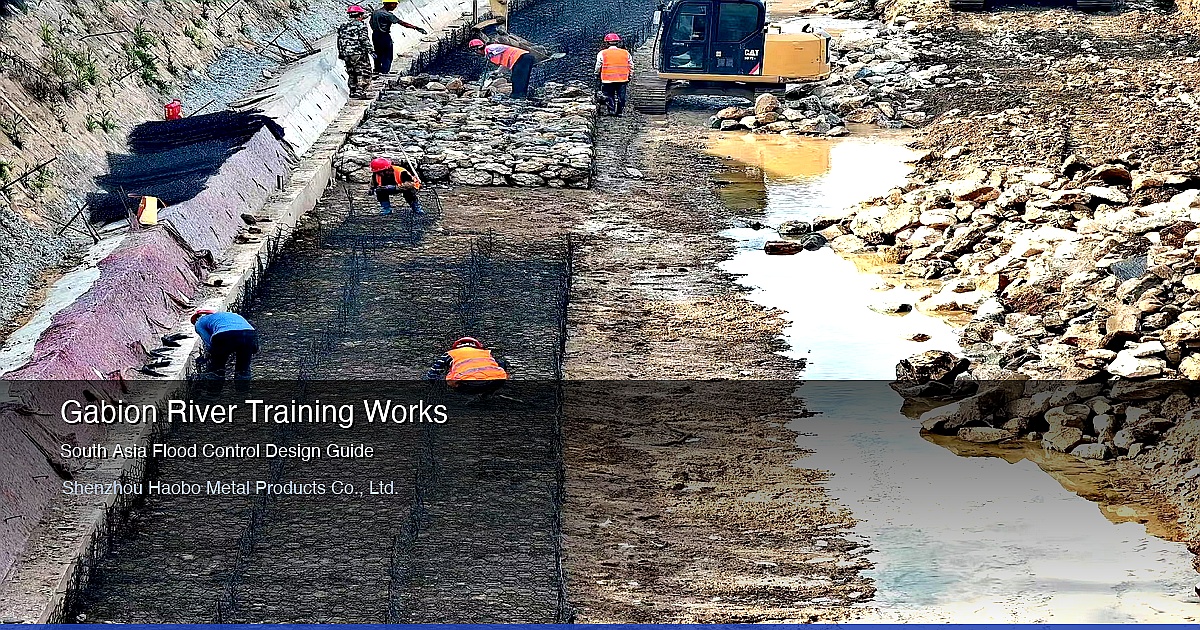
Construction innovation: The Jamuna project pioneered "underwater gabion placement" using GPS-guided split barges for the toe apron in reaches where flow depth exceeded 8m and conventional dry construction was impossible. Gabion mattresses (6.0×3.0×0.50m) were prefabricated on shore, loaded onto split barges with the halves held closed by quick-release pins, positioned using RTK-GPS, and released to fall precisely onto the prepared riverbed. This method achieved placement accuracy of ±0.5m in water depths up to 15m.
Performance: After 8 flood seasons (2016-2023), monitoring shows 94% of gabion structures intact, with localized damage (abrasion of wire coating, stone settlement) at 6% of the protection length — all within repairable limits and none requiring complete reconstruction.
Case 3: Nepal Middle Mountains River Training (Karnali and Babai Rivers)
Nepal's middle-mountain rivers, characterized by steep gradients (1:50 to 1:200), boulder-bed channels, and flash flood hydrology, present fundamentally different challenges from the alluvial plains rivers of India and Bangladesh. Gabion drop structures and check dams have proven highly effective for grade control and bank stabilization.
Typical Nepal gabion river training design:
- Gabion check dam / drop structure: 1.5-2.5m drop height, trapezoidal cross-section (crest width 2.0m, base width 4.0-5.0m), founded minimum 1.5m below bed level
- Side key: Gabion boxes extending minimum 3.0m into each bank, anchored into undisturbed soil to prevent flanking
- Wire specification: 2.7mm standard galvanized (245 g/m²) — the mountain river water is generally less aggressive than the alluvial plains due to lower TDS and pH closer to neutral
- Stone fill: Locally sourced river boulders (200-400mm), abundant in the mountain environment, eliminating the need for crushed aggregate import
- Unit cost: NPR 8,500-12,000 per cubic meter (approximately USD 65-90/m³), higher unit cost than India/Bangladesh due to remote site access and manual labor transport in roadless mountain terrain
Procurement and Logistics: Importing Chinese Gabions for South Asian Projects
For project developers, contractors, and government agencies in South Asia, the procurement route from Chinese manufacturers offers significant advantages in cost, quality consistency, and production capacity — but requires careful logistics planning.
Shipping Routes and Transit Times
| Destination | Port | From Tianjin | From Shanghai | Container Capacity |
|---|---|---|---|---|
| India (East) | Kolkata/Haldia | 18-22 days | 14-18 days | ~650 boxes (2×1×1m flat) per 40'HQ |
| India (West) | Mundra/Nhava Sheva | 22-26 days | 18-22 days | ~650 boxes per 40'HQ |
| Bangladesh | Chittagong | 15-18 days | 10-14 days | ~650 boxes per 40'HQ |
| Nepal (via India) | Kolkata → Birgunj/Kakarbhitta | +5-7 days inland | +5-7 days inland | N/A (break-bulk at Kolkata CFS) |
| Sri Lanka | Colombo | 14-16 days | 10-12 days | ~650 boxes per 40'HQ |
| Pakistan | Karachi | 20-24 days | 16-20 days | ~650 boxes per 40'HQ |
Import Duty and Taxation
| Country | HS Code | Basic Customs Duty | GST/VAT | Total Duty Burden |
|---|---|---|---|---|
| India | 7314.19.10 | 7.5% | 18% GST | ~26.9% |
| Bangladesh | 7314.19.00 | 10% (pref. rate) | 15% VAT | ~26.5% |
| Nepal | 7314.19.00 | 5% | 13% VAT | ~18.7% |
| Sri Lanka | 7314.19.00 | 15% (general) | 15% VAT | ~32.3% |
| Pakistan | 7314.19.00 | 11% | 17% GST | ~29.9% |
Note: India and Bangladesh offer preferential duty rates for government infrastructure projects (roads, flood control, railways) — projects with a valid government tender award can typically reduce the BCD to 0-5% through exemption certificates. In Bangladesh, World Bank and ADB-funded projects enjoy full duty exemption under the Development Project Proforma (DPP) approval process.
Commercial Considerations for FOB Tianjin Pricing
Based on YB/T 4190-2018 standard gabion boxes (2.0×1.0×1.0m, 2.7mm wire, 80×100mm mesh, standard galvanized 245 g/m²):
- FOB Tianjin price (per box): Approximately USD 18-25, depending on order quantity and wire gauge. The price is driven by the zinc-coated steel wire raw material cost (approximately 55-60% of total) and manufacturing labor (15-20%).
- Ocean freight (per 40'HQ container, Tianjin to Chittagong/Kolkata): USD 1,800-2,500 (rate varies seasonally, higher during Q3-Q4 pre-monsoon procurement rush)
- Container efficiency: Flat-packed gabions achieve approximately 85-90% volume utilization; a 40'HQ container (67.6 m³) carries approximately 58-62 m³ of flat-packed gabion panels, equivalent to 600-680 standard boxes
- Landed cost (per box) at Kolkata for 10-container order: FOB USD 22 + freight USD 3.70 + insurance USD 0.22 + customs clearance USD 0.80 = approximately USD 26.72 before duty. Total landed including duty and inland transport: approximately USD 35-38 per box.
Construction Best Practices for South Asian Field Conditions
Foundation Preparation
The single most important construction activity — and the one most often compromised in South Asian projects due to schedule pressure — is foundation preparation. The following sequence is mandatory:
- Excavation to design grade: Remove all loose, organic, or disturbed material to expose competent natural soil. For alluvial bank soils, the excavation should extend minimum 300mm into undisturbed natural ground.
- Compaction: Compact the prepared subgrade to minimum 95% Standard Proctor density (per IS:2720 Part 7 for India, or equivalent national standard). In fine-grained alluvial soils, compaction at optimum moisture content (±2%) is essential to prevent differential settlement.
- Geotextile filter placement: Lay non-woven geotextile with minimum 300mm overlaps at all joints, secured with steel pins (6mm diameter, 300mm length) at 1.0m spacing. The geotextile must extend minimum 500mm beyond the gabion structure footprint on all sides.
- Key trench at toe: Excavate a trench 1.0m deep × 1.0m wide along the entire revetment toe line. The lowest course of gabion boxes is placed in this trench, providing passive resistance against sliding and preventing toe undermining.
Gabion Assembly and Stone Filling
- Assembly on firm, level ground: Never assemble gabions on uneven or soft ground — the base must be firm and level before box placement. Use temporary timber formwork if necessary to maintain alignment during filling.
- Internal tie wires: Install internal bracing (tie wires connecting opposite faces) at every third cell and at mid-height in boxes 1.0m deep. This is the most commonly omitted spec in South Asian construction — and the leading cause of bulging failures. Tie wire spacing: 500mm centers, both horizontal and vertical planes.
- Stone filling sequence: Fill in 300mm lifts (approximately three layers per 1.0m box), placing larger stones (150-200mm) at the faces and smaller stones (100-150mm) in the core. Hand-place face stones for a tight, aesthetically uniform appearance — this is not cosmetic; gaps in face stone placement create weak points where flow can enter and erode the fill.
- Lid closure: After filling to within 25-50mm of the top, pull the lid tight using a lid-closing tool (lever bar) and lace to all four sides using continuous 2.2mm lacing wire with double loops at 100mm spacing. The lid tension must be sufficient to compress the stone fill by 25-50mm — this pre-compression prevents settlement and stone movement during flood loading.
- Inter-basket connection: All adjacent baskets must be laced together along all contacting edges (not just at corners). Use 2.2mm lacing wire, alternating double and single loops at 100mm spacing. This creates a monolithic structure — without proper inter-basket lacing, individual baskets behave independently and are susceptible to displacement.
Quality Control During Construction
| QC Checkpoint | Method | Frequency | Acceptance Criteria |
|---|---|---|---|
| Foundation level | Dumpy level / total station | Every 10m along revetment | ±25mm from design grade |
| Geotextile overlap | Tape measure | Every joint | ≥300mm overlap; no gaps or folds |
| Box alignment | String line + level | Continuous | ±50mm horizontally; ±30mm vertically |
| Internal tie wires | Visual count | Every basket | 500mm centers, all planes |
| Stone size (d₅₀) | Sieve / caliper measurement | 1 test per 50m³ fill | d₅₀ ≥ 150mm; d₁₀ ≥ 100mm |
| Face stone placement | Visual | Continuous | No gaps > 50mm between stones |
| Lid tension | Visual + manual check | Every basket | Lid depressed 25-50mm below rim |
| Inter-basket lacing | Visual count | All edges | 100mm spacing, alternating double/single loops |
Maintenance and Long-Term Performance
Gabion river training structures are not "zero-maintenance" — they require inspection and occasional repair, but the maintenance burden is dramatically lower than for rigid concrete alternatives. For South Asian conditions, the recommended inspection and maintenance protocol is:
- Post-monsoon inspection (October-November): Full visual survey of all gabion structures. Check for stone settlement (>100mm requires topping up), wire breakage (individual broken wires acceptable; clusters of 5+ broken wires in 1m² requires panel replacement), scour at toe (additional mattress launching if scour exceeds design assumption), and vegetation establishment (deep-rooted woody vegetation must be removed; shallow-rooted grasses are beneficial).
- Pre-monsoon preparation (May-June): Repair any damage identified in post-monsoon survey. Top up settled stone fill. Tighten loose lacing. Clear debris accumulation at spur dike heads (debris increases local scour and flow concentration).
- Emergency inspection after major floods (>1-in-10-year event): Within 48 hours of flood peak passage, inspect critical locations (bridge approaches, spur heads, tight bend apex). Deploy emergency repairs immediately if scour threatens structural integrity.
Design service life: Gabions manufactured to YB/T 4190-2018 with 245 g/m² zinc coating have a design service life of 25-35 years in freshwater river environments. With Galfan coating (275 g/m²), this extends to 40-50 years. With PVC coating in addition to Galfan (the "Galfan + PVC" specification), service life extends to 60+ years — making gabions competitive with concrete structures on a whole-life cost basis while providing the flexibility benefits that concrete cannot match.
Advantages of Chinese-Sourced Gabions for South Asian Projects
Chinese gabion manufacturers have become the preferred supply source for South Asian river training projects for several compelling reasons:
- Production capacity: Major Chinese manufacturers (concentrated in Hebei and Anhui provinces) operate highly automated production lines capable of producing 50,000-100,000 boxes per month. For large-scale projects like the Kosi Eastern Afflux Bund (180,000 m³), only Chinese manufacturers have the capacity to deliver within project timelines without mobilizing multiple smaller suppliers — which introduces quality inconsistency risk.
- Quality consistency: Chinese manufacturers certified to YB/T 4190-2018 and ISO 9001 maintain rigorous quality control systems with in-house tensile testing, zinc coating measurement, and mesh dimensional inspection equipment. This consistency is critical for South Asian projects where field QC resources are limited.
- Cost competitiveness: FOB Tianjin prices for standard gabions are typically 30-40% lower than equivalent products from European or Australian manufacturers. When combined with the short sea freight distances to South Asian ports (10-18 days), the total landed cost advantage extends to 35-45%.
- Specification flexibility: Chinese manufacturers can produce to multiple national standards simultaneously (YB/T 4190-2018, ASTM A975, EN 10223-3, BS 8002) and can customize wire diameters, coating specifications, and box dimensions to match individual project specifications — a critical capability when South Asian projects often reference a hybrid of international standards.
Key Takeaways
- Gabions are the dominant river training technology in South Asia because their flexibility accommodates the extreme flow variability, channel migration, and deep scour that cause rigid concrete structures to fail. Gabion structures account for over 65% of bank protection works in the Ganges-Brahmaputra-Meghna basin.
- YB/T 4190-2018 material specifications provide the quality benchmark: 2.7mm mesh wire (3.0mm for spur heads), 245 g/m² minimum zinc coating (275-300 g/m² for aggressive water), 350-550 MPa tensile strength with ≥10% elongation, and 80×100mm mesh opening as the South Asian standard.
- The launching apron is the single most critical design element: A Reno mattress toe apron extending minimum 1.5× predicted scour depth (typically 6-12m for major rivers) prevents undermining — the leading cause of gabion revetment failure. Modified Lacey-Inglis scour prediction remains the standard methodology for South Asian conditions.
- Geotextile filters are mandatory: Non-woven needle-punched geotextile (300-400 g/m²) between gabion and natural bank soil prevents piping failure — the second most common cause of gabion structure degradation after toe scour.
- Chinese manufacturers offer the optimal quality-cost-capacity balance: FOB Tianjin gabions are 35-45% cheaper than European alternatives with equivalent quality to international standards, 10-18 day container shipping to South Asian ports, and the production capacity to support mega-projects exceeding 100,000 m³.
Need Gabion River Training Systems for Your South Asian Project?
Send us your design flood discharge (Q50/Q100), riverbed d50, bankfull width, and total protection length. We provide YB/T 4190-2018 standard gabion boxes and Reno mattresses with Galfan coating (275 g/m²), lacing wire, and FOB Tianjin pricing within 48 hours. 40' HQ containers to Kolkata, Chittagong, or Karachi, 10-18 days transit.
www.haobomesh.com | Shenzhou Haobo Metal Products Co., Ltd.