Rockfall Protection Systems for Korean Mountain Highway Tunnels: JT/T 528 Design & Supply
South Korea's mountainous terrain — where 70% of the country is covered by mountains and hills — creates one of the world's most demanding environments for rockfall protection engineering. The country's 4,737 km expressway network, much of it carved through granite and gneiss mountainsides, requires continuous rockfall hazard management. With annual rainfall concentrated in intense summer monsoons (June-September, accounting for 60-70% of annual precipitation) and winter freeze-thaw cycling in sub-zero temperatures, Korean highway tunnel portals and mountain road cuttings face compound rockfall risks that demand engineered protection systems meeting the highest performance standards.
Korea's rockfall protection market has matured significantly over the past decade, driven by Korea Expressway Corporation (KEC) standards and Ministry of Land, Infrastructure and Transport (MOLIT) regulations. This article examines how JT/T 528-2022 certified rockfall protection systems from Chinese manufacturers deliver cost-effective, technically compliant solutions for Korean mountain highway projects — from active drape mesh for tunnel portal slope stabilisation to high-energy passive rockfall barriers rated up to 5,000 kJ for expressway cuttings.
1. Korean Mountain Geohazards: Rockfall Risk Profile
Korea's geological and climatic conditions create a distinctive rockfall risk environment that differs significantly from European Alpine or North American mountain contexts:
| Risk Factor | Korean-Specific Condition | Rockfall Implication | Required Protection Level |
|---|---|---|---|
| Rock Type | Predominantly Mesozoic granite & Precambrian gneiss | Joint-controlled block failure; boulder sizes 0.5-5.0 m³ common | 2,000-5,000 kJ barriers |
| Weathering | Deep chemical weathering (up to 30 m in granite) | Progressive spalling and loss of block interlock | Active mesh + periodic maintenance |
| Monsoon Rainfall | 1,200-1,500 mm/year; 60-70% in Jun-Sep | Pore pressure build-up in joint networks triggers block release | Drainage-integrated systems |
| Freeze-Thaw | 20-60 frost days/year; winter temps -10°C to -20°C | Ice wedging in fractures; spring thaw rockfall peaks | Cold-rated wire rope & mesh |
| Seismic Activity | Moderate seismicity; magnitude 5-6 events recorded | Earthquake-induced rockfall on steep slopes | Seismic design category per KDS 17 10 00 |
| Tunnel Portal Density | 1,700+ highway tunnels; portal spacing often < 3 km in mountains | Concentrated failure risk at approach cuttings | Integrated portal + slope protection |
Critical seasonal pattern: Korean rockfall incidents follow a bimodal distribution — a summer monsoon peak (July-August) driven by rainfall-induced joint water pressure, and a spring thaw peak (March-April) caused by ice-wedge release after winter freezing. Rockfall protection designs must account for both mechanisms, which means systems must perform under saturated slope conditions (summer) and low-temperature service (winter, down to -20°C).
2. JT/T 528-2022 vs Korean Rockfall Protection Standards
Korean rockfall protection design is governed by KDS 44 90 20 (Rockfall Protection Facility Design Standards) under MOLIT's Korean Design Standard (KDS) framework. Chinese systems certified to JT/T 528-2022 must demonstrate equivalence to these Korean requirements:
| Design Parameter | JT/T 528-2022 (China) | KDS 44 90 20 (Korea) | Equivalence |
|---|---|---|---|
| Wire Rope Tensile | ≥ 1,770 MPa (Φ8 mm+) | ≥ 1,770 MPa (KS D 3514) | ✅ Identical tensile grade |
| Barrier Energy Rating | 500-5,000 kJ (standardised MEL classification) | 250-5,000 kJ | ✅ Overlapping range |
| Mesh Wire Tensile | ≥ 350 MPa | ≥ 350 MPa (KS D 7011) | ✅ Identical minimum |
| Coating Requirement | ≥ 245 g/m² Zn or Zn-5%Al (Galfan) | ≥ 350 g/m² Zn for coastal/marine exposure | ⚠️ Specify 275+ g/m² Galfan for marine areas |
| Ring Net Diameter | 300-500 mm (19-25 rings per barrier) | 300-500 mm | ✅ Compatible specifications |
| Service Temperature | -40°C to +50°C | -20°C to +40°C (typical Korean range) | ✅ JT/T 528 exceeds Korean range |
| Full-Scale Crash Test | ETAG 027 / EAD 340059 compliant | KDS requires full-scale verification | ✅ ETAG 027 accepted as equivalent |
Practical compliance pathway: For Korean highway projects, specify JT/T 528-2022 rockfall protection systems with the following project-specific enhancements to ensure full KDS 44 90 20 compliance:
- Coastal/marine exposure areas (Busan, Incheon, Ulsan, Pohang): Specify ≥ 275 g/m² Galfan coating to approach Korean 350 g/m² hot-dip requirement — Galfan's 2× corrosion resistance provides equivalent protection at lower coating weight
- Wire rope certification: Include KS D 3514 equivalence statements and independent tensile test reports
- Seismic design: Provide barrier system performance data under dynamic loading to meet KDS 17 10 00 seismic requirements
- KEC acceptance: Korea Expressway Corporation maintains an approved product list; supply full ETAG 027 crash test reports and ISO 9001 certification for listing
3. Active Protection Systems for Tunnel Portal Slopes
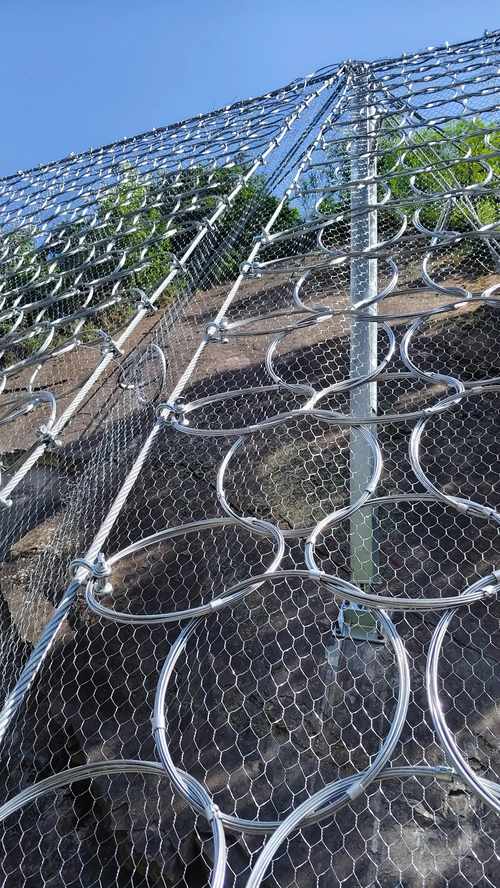
Tunnel portal approaches represent the highest-consequence rockfall locations on Korean highways — a rockfall event at 100 km/h highway speed leaves less than 3 seconds reaction time. Active protection systems (TECCO, HEA, or equivalent high-tensile steel wire mesh) stabilise the slope face itself, preventing rock detachment at source:
3.1 System Components for Korean Applications
| Component | JT/T 528-2022 Specification | Korean Application |
|---|---|---|
| High-Tensile Mesh | TECCO G65/3 or equivalent; 1,770 MPa wire; 3.0 mm dia. | Granite face weathering containment above tunnel portals |
| Spike Plates | P33 (330×330 mm) or P66 (660×660 mm); galvanised steel | Anchor plate for nail heads; spacing 2.5-3.5 m c/c |
| Soil/Rock Nails | Φ25-32 mm deformed bar; 3-6 m length; grouted | Self-drilling anchors for weathered granite (avoid caving) |
| Boundary Rope | Φ16 mm wire rope; 1,770 MPa; perimeter anchoring | Critical at portal crown boundary — prevents progressive failure |
| Drainage Integration | Perforated drain pipes behind mesh at spring lines | Essential for monsoon — prevents hydrostatic mesh loading |
3.2 Design Methodology for Portal Slopes
The active protection design process for Korean tunnel portals follows a five-step methodology aligned with KDS 44 90 20:
Step 1 — Slope Characterisation: Map joint sets, fracture spacing, weathering grade (Korea uses the 6-grade ISRM weathering classification; Grade III-IV granite is most susceptible to progressive spalling).
Step 2 — Block Size Determination: Compute potentially unstable block volumes using stereographic projection. Korean granite typically produces blocks in the 0.1-2.0 m³ range at portal cuts, requiring mesh apertures ≤ 65 mm.
Step 3 — Mesh Specification: Select mesh type and nail pattern based on block size and slope angle. For a typical 70° portal cut in Grade III granite:
- Mesh: TECCO G65/3 high-tensile (3.0 mm wire, 65 mm aperture, 1,770 MPa)
- Nail spacing: 3.0 m × 3.0 m grid (diamond pattern)
- Nail length: 4.0 m (minimum 2.0 m embedment in competent rock beyond weathering front)
- Design load per nail: 45-60 kN (ULS)
Step 4 — Drainage Design: Korean monsoon conditions demand dedicated drainage behind the mesh. Install perforated HDPE collector pipes (Φ100 mm) at 10 m horizontal spacing along spring lines, connected to portal drainage system.
Step 5 — Monitoring & Maintenance Plan: KDS requires a 2-year monitoring programme post-installation, with biannual visual inspections (pre-monsoon in May, post-monsoon in October) and mesh tension checks.
4. Passive Rockfall Barrier Design: Energy Absorption Tiers
Where slope stabilisation is impractical — typically on slopes exceeding 100 m height or where access for drilling is restricted — passive rockfall barriers intercept detached blocks before they reach the highway. Korean expressway practice typically deploys barriers at one of three energy tiers:
| Barrier Class | MEL (kJ) | Post Height | Typical Korean Application | Ring Net Configuration |
|---|---|---|---|---|
| Low Energy | 500-1,000 | 2.0-3.0 m | Mountain road cuttings (< 30 m height); secondary roads | 7-ring (Φ300 mm) |
| Medium Energy | 1,500-3,000 | 3.0-4.0 m | Expressway cuttings (30-80 m); EX Highway Route 1 (Gyeongbu) | 9-ring (Φ350 mm) |
| High Energy | 5,000 | 4.0-5.0 m | Major expressway cuttings (> 80 m); tunnel approach zones | 19-ring (Φ500 mm) |
4.1 Kinetic Energy Calculation for Korean Slopes
Rockfall trajectory analysis for Korean highway projects typically employs 3D simulation software (Rockfall 7.1 or equivalent) calibrated to site-specific slope geometry. The design kinetic energy is determined by:
EK = ½ × m × v²
Where m = block mass (kg) and v = impact velocity (m/s) at barrier location. For a typical Korean granite slope (60° incline, 50 m height, 2.0 m³ block, ρ = 2,650 kg/m³):
- Block mass = 2.0 × 2,650 = 5,300 kg
- Impact velocity at base (50 m drop, rolling/free-fall mix) ≈ 18-22 m/s
- Kinetic energy = ½ × 5,300 × 20² ≈ 1,060 kJ (minimum 1,500 kJ barrier required with safety factor)
MEL vs SEL selection: Korean KDS 44 90 20 requires barriers designed to Maximum Energy Level (MEL) for highway applications — meaning the barrier must withstand a single maximum-energy impact without catastrophic failure. Service Energy Level (SEL) — the ability to withstand two consecutive impacts without repair — is specified for lower-risk secondary roads.
5. Case Studies: Korean Expressway & Mountain Road Projects
5.1 Gyeongbu Expressway (Route 1) — Daejeon-Busan Section
The Gyeongbu Expressway, Korea's oldest and busiest highway (opened 1970, daily traffic > 400,000 vehicles on urban sections), crosses the Sobaek Mountain range south of Daejeon through a series of deep cuttings in Jurassic granite. Rockfall incidents at Km 260-280 historically occurred 12-15 times per year during monsoon seasons, prompting a major rockfall mitigation programme.
The adopted solution combined active mesh on cut faces above 45° slope angle with 3,000 kJ ring-net passive barriers at the cutting toe. Active mesh installation used helicopter-slung material delivery (limited road closure windows on this high-traffic corridor). Passive barriers were spaced at 80-120 m intervals along a 3.2 km section, with 4.0 m post height to accommodate block trajectory heights. Post-installation monitoring over three monsoon seasons recorded zero vehicle-impact incidents versus the pre-mitigation average of 14/year.
5.2 Seoul-Chuncheon Expressway — Tunnel Portal Cluster
The Seoul-Chuncheon Expressway features 12 tunnels within a 40 km mountain section. Tunnel portal approaches — particularly at the Gapyeong and Hwado tunnels — expose weathered gneiss faces with open jointing (joint spacing 0.3-1.0 m, persistence > 10 m).
The portal protection design deployed TECCO system active mesh (G65/3, 3.0 mm, 1,770 MPa) with self-drilling anchors (Φ32 mm, 6 m length) on slopes up to 80 m above portal crowns. A key innovation was the transition zone detailing between the sprayed concrete portal lining and the mesh-covered natural slope — a critical detail where rockfall risk concentrates due to the stiffness contrast between rigid tunnel lining and flexible mesh.
The transition was managed with a reinforced boundary rope system (Φ16 mm wire rope double-laced) creating a continuous load path from the mesh perimeter to rock anchors at 1.5 m spacing along the portal arch. This prevented mesh tearing at the rigid-flexible interface — a documented failure mode in earlier Korean portal projects.
6. Monsoon Climate Performance: Corrosion & Drainage
Korea's summer monsoon (June-September) delivers 800-1,000 mm of rainfall concentrated in 3-4 months, with individual storm events exceeding 100 mm/day common. Combined with winter temperatures dropping to -20°C, rockfall protection systems face compound deterioration mechanisms:
6.1 Corrosion Protection Strategy
| Component | Standard Coating | Enhanced (Marine/Monsoon) | Expected Korean Service Life |
|---|---|---|---|
| Wire Rope (Φ8-20 mm) | 245 g/m² Zn | 275 g/m² Galfan (Zn-5%Al) | 50-75 years (inland); 30-40 years (coastal) |
| Mesh Wire (Φ3.0 mm) | 245 g/m² Zn | 275 g/m² Galfan | 40-60 years (inland); 25-35 years (coastal) |
| Anchor Plates/Heads | Hot-dip galvanised (85 μm) | Galfan + epoxy paint at cut edges | 50+ years |
| Energy Dissipators | Galvanised steel (standard) | Stainless steel 304 (coastal) | 75+ years |
6.2 Drainage Integration
Korean monsoon conditions demand rigorous drainage design to prevent hydrostatic overloading of rockfall protection systems:
- Active mesh systems: Install Φ100 mm perforated HDPE collector pipes at 10 m horizontal spacing along spring lines, connected to main slope drainage channels. Backfill pipe trenches with free-draining gravel to prevent mesh deformation from water pressure
- Passive barrier foundations: Design reinforced concrete plinths with surface water diversion channels; standing water around post bases accelerates corrosion and reduces bearing capacity
- Winter freeze protection: All drainage elements must be designed with ≥ 2% minimum gradient and frost-depth burial (minimum 800 mm cover in Gangwon and northern Gyeonggi provinces where frost penetration exceeds 600 mm)
7. Supply Chain: Tianjin FOB to Busan/Incheon
The Tianjin-Busan/Incheon shipping corridor is one of the shortest and most efficient China-Korea logistics routes, with typical parameters:
| Logistics Parameter | Details |
|---|---|
| Port of Loading | Tianjin Xingang (CNTXG) |
| Korean Port of Discharge | Busan (KRPUS) — primary; Incheon (KRINC) — Seoul area projects |
| Ocean Transit Time | 2-4 days (Tianjin → Busan); 3-5 days (Tianjin → Incheon) |
| Container Type | 40ft HC — mixed load: mesh rolls, wire rope coils, anchors, accessories |
| Korean Customs | HS Code 7314.39 — 0% duty under China-Korea FTA (with Certificate of Origin) |
| Documentation | China-Korea FTA Certificate of Origin, Mill Test Certificate, Coating Compliance, ETAG 027 Crash Test Report, ISO 9001 |
Key advantage — China-Korea FTA: Rockfall protection systems fall under HS Chapter 73 (articles of iron or steel), which enjoys 0% import duty under the China-Korea Free Trade Agreement when accompanied by a valid Certificate of Origin (Form AK). This eliminates the standard 5-8% MFN duty, making Chinese-sourced systems price-competitive with Korean-manufactured alternatives.
Transit time of just 2-4 days to Busan enables just-in-time delivery strategies, reducing the need for on-site storage — a significant advantage on Korean mountain highway projects where laydown space is severely constrained.
8. Cost Comparison: Chinese vs Korean/European Systems
| System Type | Chinese JT/T 528 (USD/m²) | Korean-Manufactured (USD/m²) | European (Geobrugg/Maccaferri) (USD/m²) | Saving vs Korean |
|---|---|---|---|---|
| Active Mesh (TECCO G65/3) | $18-25 | $28-38 | $40-55 | 30-35% |
| Passive Barrier (1,500 kJ) | $280-380/lin.m | $420-550/lin.m | $550-700/lin.m | 30-33% |
| Passive Barrier (3,000 kJ) | $520-650/lin.m | $750-950/lin.m | $950-1,250/lin.m | 30-32% |
| Passive Barrier (5,000 kJ) | $850-1,100/lin.m | $1,250-1,600/lin.m | $1,600-2,100/lin.m | 30-32% |
On a typical Korean expressway rockfall mitigation project spanning 2 km of cutting with 5,000 m² active mesh and 800 m of passive barriers (3,000 kJ), the total system cost saving from Chinese JT/T 528-2022 certified product versus Korean-manufactured equivalents approaches $250,000-350,000 — a 30-33% reduction that frees budget for extended coverage or additional monitoring systems.
These prices are FOB Tianjin (excluding ocean freight to Busan/Incheon, typically $800-1,200 per 40ft container for this short-sea route), and exclude installation labour which is typically contracted locally under Korean construction regulations.
Key Takeaways
- JT/T 528-2022 meets Korean KDS 44 90 20 requirements across all critical parameters — wire rope tensile (1,770 MPa), mesh specifications, barrier energy ratings (500-5,000 kJ), and ETAG 027 crash test compliance. Enhancements needed only for coastal corrosion protection (specify 275 g/m² Galfan).
- Korean rockfall risk is bimodal: Summer monsoon peak (July-August) from rainfall-induced joint pressure, and spring thaw peak (March-April) from ice wedge release. Protection systems must perform under both saturated and sub-zero conditions.
- Tunnel portal transitions are the critical design interface: The stiffness contrast between rigid tunnel lining and flexible mesh demands reinforced boundary rope detailing to prevent progressive mesh tearing — a documented failure mode in earlier Korean projects.
- Monsoon drainage integration is non-negotiable: Active mesh systems must incorporate dedicated drainage (perforated HDPE collectors at 10 m spacing) to prevent hydrostatic mesh loading during 100+ mm/day storm events.
- 30-33% cost saving from Chinese supply: FOB Tianjin pricing for JT/T 528-2022 certified systems delivers equivalent technical performance at significant cost advantage, enhanced by China-Korea FTA zero-duty provisions.
- 2-4 day shipping to Busan enables just-in-time delivery: The shortest China-Korea logistics route eliminates the need for large on-site storage — critical on Korean mountain highway projects with constrained laydown space.
Secure Your Korean Expressway Slopes — Get a Protection Plan
Tell us your slope height, rock type, and target energy rating. Our team will design a KDS 44 90 20-compliant rockfall protection system with JT/T 528-2022 certified components and FOB Busan pricing.
📱 Get Slope Solution 📧 Send Email