Rockfall Protection Systems for Latin American Mining & Mountain Highway Safety (JT/T 528-2022 Standards)
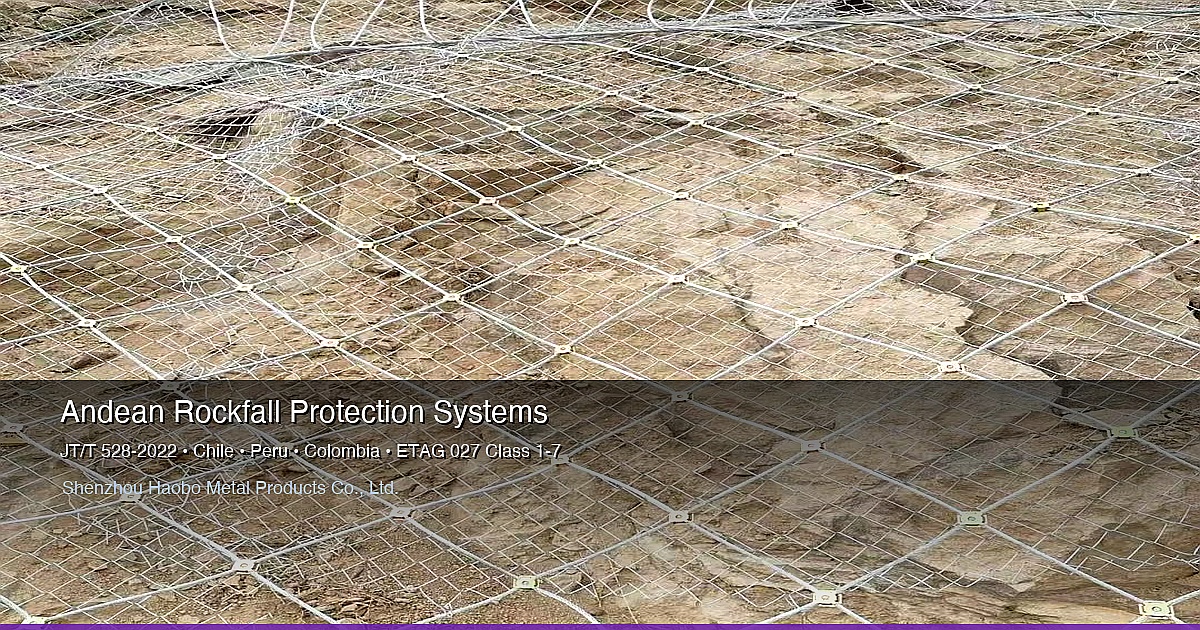
The Andes Mountains — the world's longest continental mountain range stretching 7,000 km along South America's western spine — are simultaneously the continent's greatest mineral treasure and its most lethal infrastructure challenge. Chile produces 27% of the world's copper. Peru ranks second globally in silver and zinc production. Colombia's mountain highways connect 50 million people across three Andean cordilleras. And every kilometer of these roads, every mine access ramp, every power transmission corridor is threatened by rockfall.
Key Takeaways
- The Andes combine tectonic activity (Nazca Plate subduction), extreme topography (200m+ vertical cuts), El Niño-driven rainfall, and mining-induced vibration — creating rockfall hazards that demand engineered protection systems tested to ETAG 027 Classes 3-7.
- JT/T 528-2022 specifies wire rope tensile strength ≥ 1,770 MPa and Galfan coating ≥ 275 g/m² — exceeding many international benchmarks for high-altitude, high-corrosion environments.
- Seismic design is non-negotiable at Andean sites with PGA 0.3-0.5g. Grouted anchors must demonstrate ≥ 5% elongation before failure, and barrier posts require base plates 30-50% larger than European standard designs.
- Both Chile and Peru have FTAs with China eliminating import duties on steel wire products — providing Chinese suppliers a 6-15% landed cost advantage over European/US alternatives.
- High-altitude installation (> 4,000m) demands specialized logistics: component modularization for worker handling, helicopter-assisted placement, accelerated grout formulations, and mandatory worker acclimatization protocols.
Table of Contents
- The Andean Rockfall Challenge: Geography Meets Industry
- JT/T 528-2022 Material Standards & System Specifications
- Active vs Passive Protection: Selection Logic for Andean Conditions
- Case Studies: Chile, Peru, and Colombia
- Seismic Design Considerations for the Andean Tectonic Setting
- High-Altitude Installation: Logistics & Methods above 4,000 m
- ETAG 027 Energy Classification & System Selection Matrix
- China-to-South America Cost Model & Supply Chain
- Procurement & Compliance for Latin American Projects
- Frequently Asked Questions
In 2023 alone, Chile's Ministry of Public Works recorded 847 road closures due to slope failures and rockfall events. Peru's Central Highway (Carretera Central), the primary freight route connecting Lima to the mining heartland of Cerro de Pasco, averages 45 days of disruption per year from landslides and rockfall. Colombia's National Institute of Roads (INVÍAS) estimates that slope instability adds $1.2 billion annually to the country's road maintenance and rehabilitation budget — money that could otherwise fund new infrastructure in underserved regions.
Chinese-manufactured slope protection systems, produced to the JT/T 528-2022 standard, are increasingly specified by Latin American mining companies and highway authorities. The combination of technical performance equivalent to European EN systems, competitive pricing enabled by China's integrated steel wire rope production chain, and reliable logistics from Tianjin to Pacific Coast ports has positioned Chinese rockfall protection as the default choice for a growing share of Andean infrastructure projects.
This article provides a comprehensive technical reference for mining engineers, highway designers, and procurement specialists evaluating rockfall protection solutions for Latin American applications. We cover material specifications under JT/T 528-2022, compare active and passive protection system configurations, analyze case studies from Chile, Peru, and Colombia, address seismic design requirements unique to the Andean tectonic setting, and provide a detailed China-to-South America supply chain model.
📋 Table of Contents
- The Andean Rockfall Challenge: Geography Meets Industry
- JT/T 528-2022 Material Standards & System Specifications
- Active vs Passive Protection: Selection Logic for Andean Conditions
- Case Studies: Chile, Peru, and Colombia
- Seismic Design Considerations for the Andean Tectonic Setting
- High-Altitude Installation: Logistics & Methods above 4,000 m
- ETAG 027 Energy Classification & System Selection Matrix
- China-to-South America Cost Model & Supply Chain
- Procurement & Compliance for Latin American Projects
- Frequently Asked Questions
1. The Andean Rockfall Challenge: Geography Meets Industry
The Andean region presents a convergence of four factors that make rockfall protection simultaneously essential and exceptionally demanding:
| Risk Factor | Andean Context | Impact on Rockfall Frequency |
|---|---|---|
| Tectonic Activity | Nazca Plate subduction under South American Plate at 60-80 mm/yr | M7.0+ earthquakes every 10-20 years trigger mass rockfall |
| Extreme Topography | Road cuts through 60°-80° slopes, vertical faces exceeding 200 m | Gravitational instability + freeze-thaw at altitude |
| Intense Precipitation | El Niño events produce 3-5× normal rainfall in 48-hour periods | Water pressure in rock joints — primary trigger |
| Mining-Induced Vibration | Open-pit blasting at mines; heavy haul truck traffic (400-tonne class) | Repeated dynamic loading destabilizes jointed rock masses |
Chile — The world's largest copper producer operates over 50 open-pit and underground mines in the Andes. The Chuquicamata mine alone excavates 600,000 tonnes of material daily from a pit 4.5 km long, 3.5 km wide, and over 1 km deep. Haul roads spiraling down pit walls are continuously exposed to bench-scale rockfall, while access roads traversing the Precordillera face regional slope instability. Chile's National Geology and Mining Service (SERNAGEOMIN) recorded 142 significant rockfall incidents affecting mining operations in 2023.
Peru — The Central Highway (Carretera Central, PE-22) climbs from sea level at Lima to 4,818 m at Ticlio Pass in just 120 km of horizontal distance — one of the steepest road gradients in global infrastructure. The highway serves 8,000 vehicles daily, including heavy mining trucks transporting concentrates from Cerro de Pasco, La Oroya, and Junín. Every rainy season (December-March), sections are closed by rockfall for days at a time, severing the economic artery between Peru's central mining region and the Lima-Callao port complex.
Colombia — With three Andean cordilleras converging on its territory, Colombia's primary highway network is a continuous sequence of cut slopes, tunnels, and bridges. The recently completed La Línea Tunnel, at 8.65 km South America's longest road tunnel, required extensive rockfall protection along both approach roads where 400 m vertical cuts expose heavily jointed metamorphic rock. Colombia's seismic hazard (two major earthquakes in the last 25 years: the 1999 Armenia M6.2 and the 2008 El Calvario M5.9) adds a dynamic dimension to rockfall protection design not present in more stable continental interiors.
2. JT/T 528-2022 Material Standards & System Specifications
JT/T 528-2022 is the current Chinese transport industry standard governing flexible slope protection systems for highway applications. It supersedes the 2009 version and incorporates lessons from two decades of deployment on Chinese mountain highways — including the challenging Sichuan-Tibet Highway, where rockfall protection systems have been tested against some of the world's most aggressive geological hazards.
| Component | JT/T 528-2022 Specification | Test Standard |
|---|---|---|
| Steel Wire Rope (Φ8 mm) | Tensile strength ≥ 1,770 MPa | GB/T 20118 / ISO 2408 |
| Wire Rope Construction | 6×19+FC or 6×19+IWS, galvanized | GB/T 8918 |
| Zinc Coating (Wire Rope) | ≥ 245 g/m² (hot-dip, Class B) | GB/T 1839 |
| Galfan Coating (High Corrosion) | ≥ 275 g/m² (Zn-5%Al) | GB/T 1839 |
| Support Rope (Φ16 mm) | Tensile strength ≥ 1,770 MPa | GB/T 20118 |
| Ring Net (Φ3.0 mm wire) | Tensile strength ≥ 1,770 MPa, 7×7 or 7×19 strand | GB/T 20118 |
| Anchor System | Self-drilling or grouted, pull-out ≥ 50 kN (active) / ≥ 100 kN (passive) | Site pull-out test |
| Energy Absorbing Device | Brake rings / friction brakes, calibrated to design energy level | ETAG 027 / JT/T 528 Annex C |
2.1 The Ring Net Innovation
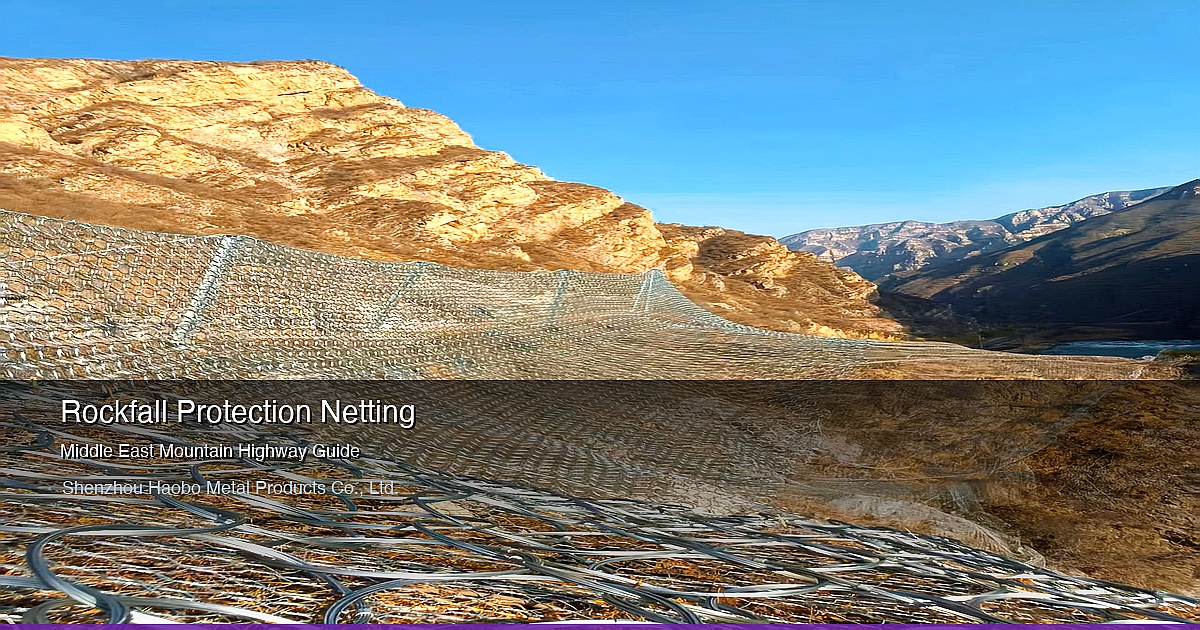
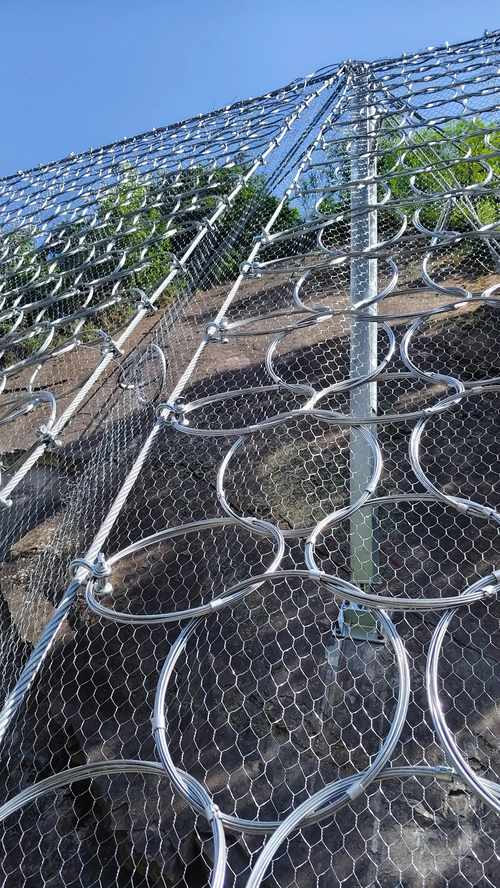
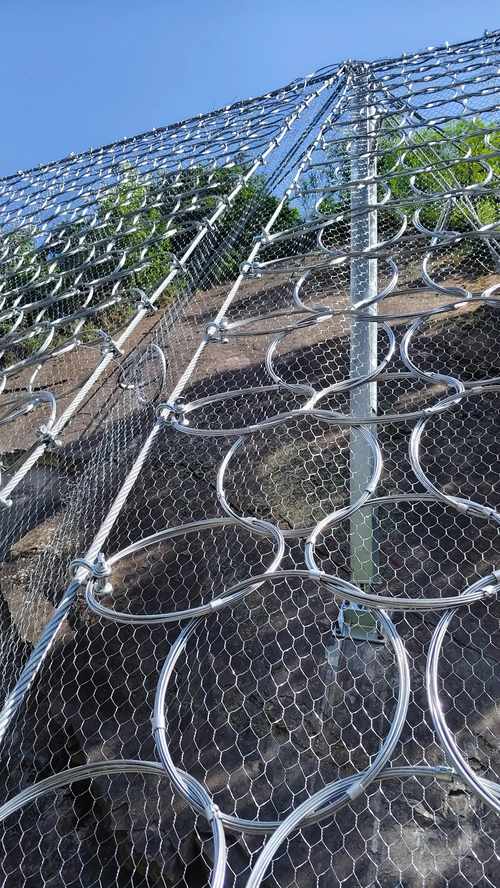
One of the most significant advances in Chinese slope protection technology is the high-tensile ring net. Unlike traditional diamond mesh (which absorbs energy primarily through wire elongation before rupture), ring nets absorb impact energy through a combination of ring deformation, inter-ring friction, and wire rope elongation. This multi-stage energy absorption mechanism enables ring net systems to achieve ETAG 027 energy classifications up to Class 7 (≥ 5,000 kJ) while maintaining significantly lighter system weight than equivalent wire rope net configurations.
For Andean mining applications — where haul roads beneath 200 m high pit walls face rockfall energies that can exceed 3,000 kJ — ring net systems offer a compelling combination of high energy capacity, reduced anchor loading (and therefore smaller, faster-to-install anchors), and maintenance-friendly design (individual damaged rings can be replaced without dismantling the entire panel).
3. Active vs Passive Protection: Selection Logic for Andean Conditions
| Criterion | Active Systems (Anchor + Mesh Drapery) | Passive Systems (Rockfall Barrier) |
|---|---|---|
| How it Works | Mesh pinned to slope face prevents rock detachment | Flexible barrier at slope toe intercepts falling rocks |
| Energy Capacity | Low-medium (typically < 500 kJ) | Medium-very high (500-8,000+ kJ) |
| Best For | Shallow blocky rockfall from weathered near-surface zone | High-energy rockfall from high, steep faces |
| Andean Application | Lower slopes of road cuts, weathered granodiorite in Chilean Precordillera | Pit wall benches, high road cuts in Colombian metamorphic rock |
| Installation Access | Requires rope-access technicians on entire slope | Barrier installed at toe — minimal slope access needed |
| Maintenance | Mesh inspection + annual anchor re-tensioning | Post-impact inspection + rock clearance from catchment area |
In Andean practice, the most effective rockfall protection strategies combine both systems. A typical mining haul road configuration might use active mesh drapery on the upper weathered zone (where freeze-thaw produces continuous small-block spalling), transitioning to high-energy passive barriers at the mid-slope bench (where larger rock masses detach from deeper, less weathered rock), with a secondary barrier at the road shoulder for redundancy.
4. Case Studies: Chile, Peru, and Colombia
4.1 Chile: Chuquicamata Mine Haul Road Protection
CODELCO's Chuquicamata mine, located in the Atacama Desert at 2,870 m elevation, operates one of the world's deepest open pits. The transition from open-pit to underground mining (completed in 2019) did not eliminate rockfall risk — the remaining pit walls, up to 1,000 m high, continue to generate rockfall that threatens access roads and conveyor systems on lower benches.
The rockfall protection system specified for the primary haul road (at the 2,600 m bench level) included:
- Upper slope (2,800 – 3,000 m elevation): Active system using high-tensile steel wire rope mesh (Φ8 mm, 1,770 MPa) with 6 m long self-drilling anchors on a 4 m × 4 m grid pattern. Mesh panels were hot-dip galvanized to 245 g/m² (GB/T 1839). The active system covers approximately 18,000 m² of slope face.
- Mid-slope bench (2,700 m): A 500 kJ (Class 3 per ETAG 027) passive rockfall barrier, 250 m in length and 4.0 m in height, installed with post spacing at 10 m. The barrier uses 5 brake rings per 50 m segment to provide staged energy absorption.
- Haul road shoulder (2,600 m): A 1,000 kJ (Class 4) redundant barrier, 180 m in length, designed as a secondary containment line for oversized blocks that may overwhelm the mid-slope barrier.
The system was sourced from Chinese manufacturers with JT/T 528-2022 compliance certification. Total system cost (delivered to Antofagasta port and trucked 220 km to the mine site) was approximately $2.8 million — 28% below the competing European tender. Post-installation monitoring over 24 months has recorded 17 barrier impact events, all successfully contained without damage to the haul road. Maximum recorded impact energy was estimated at 780 kJ (a 2.3 m³ block of granodiorite that detached during a M4.8 aftershock).
4.2 Peru: Central Highway Rockfall Mitigation (Ticlio Section)
The Ticlio Pass section of Peru's Central Highway (km 120-135) represents one of the most rockfall-prone road segments in South America. The road climbs through 300 m high cuts in the Casapalca Formation — intensely folded and faulted Cretaceous limestone and shale with three major joint sets creating wedge failure geometries that produce rockfall blocks ranging from 0.1 m³ cobbles to 50+ m³ catastrophic failures.
The Ministry of Transport and Communications (MTC) implemented a phased rockfall mitigation program beginning in 2021:
- Phase 1 (km 120-125): High-energy passive barriers (2,000 kJ, Class 5) at 12 critical locations where trajectory analysis indicated direct impact on the carriageway. Barriers were 3.5 m high with post spacing of 8 m, using Galfan-coated wire rope (275 g/m²) for the high-corrosion environment at 4,500+ m elevation (freeze-thaw cycles + acid rock drainage from pyrite-bearing shale).
- Phase 2 (km 125-135): Active drapery system on slopes exceeding 70° where shallow block failure was the dominant mechanism. Ring net panels (Φ3.0 mm × 7×19 strand, 300 mm ring diameter) were pinned with 4 m rock bolts on a 3 m grid pattern.
- Monitoring: 12 automated wire rope tension sensors connected to a solar-powered telemetry system, providing real-time barrier status to the MTC Regional Operations Center in La Oroya.
The procurement was handled through a public tender that attracted bids from Chinese, European, and Chilean manufacturers. The Chinese bid won on combined technical score (JT/T 528-2022 compliance with supplementary testing to ETAG 027 Class 5) and price (approximately 32% below the lowest European bid). Delivery via Callao port with onward trucking (280 km) added 18 days to the factory-to-site timeline.
4.3 Colombia: La Línea Tunnel Approach Roads
The recently completed La Línea Tunnel project on the Bogotá-Buenaventura corridor (Ruta 40) includes 24 km of approach roads cut through the Central Cordillera's Cajamarca Complex — a geologically chaotic mélange of schist, phyllite, and serpentinite with notoriously poor rock mass quality (RMR typically 25-40). The approach roads feature cuts up to 400 m high, and seismic loading from the nearby Romeral Fault System (capable of M7.0+ events) adds a critical design dimension.
INVÍAS specified a hybrid rockfall protection strategy:
- Cut slopes above 300 m: Double-layer system — ring net drapery (JT/T 528-2022, Φ3.0 mm wire, Galfan 275 g/m²) with 6 m fully grouted anchors at 3 m × 3 m spacing, overlaid with a secondary high-strength wire rope mesh at 150 mm × 150 mm aperture for small-block retention.
- At-grade passive barriers: 3,000 kJ (Class 6) barriers at 8 locations identified by RocFall 3D trajectory analysis as high-probability impact zones. Barrier height 5.0 m, post spacing 8 m, with twin brake ring assemblies providing redundant energy dissipation capacity for the seismic design case.
- Seismic hold-down system: A Colombian innovation — auxiliary anchor cables at 45° from barrier posts, tensioned to 30 kN, designed to prevent barrier toppling during the 0.4g PGA design earthquake. Field testing on a full-scale mockup confirmed barrier integrity through simulated M7.0 ground motion.
5. Seismic Design Considerations for the Andean Tectonic Setting
The Andean region's position above the Nazca-South America subduction zone introduces seismic loading as a primary design consideration for rockfall protection systems. Unlike European alpine environments where seismic hazard is generally low to moderate, Andean sites routinely experience PGA values of 0.3g–0.5g (10% probability of exceedance in 50 years).
Key seismic design provisions for rockfall protection in these environments:
- Anchor ductility: Grouted anchors must demonstrate a minimum elongation of 5% before pull-out failure. This ductility allows the anchor to absorb seismic energy through plastic deformation rather than brittle fracture. Self-drilling hollow bar anchors (e.g., R32 or R38) with continuous thread provide inherently more ductile behavior than smooth bar anchors.
- Post-base moment capacity: Passive barrier posts must be designed for the overturning moment induced by horizontal PGA × barrier height × retained rock mass. In practice, this typically requires base plate dimensions 30-50% larger than European standard designs for equivalent energy class.
- Mesh flexibility reserve: The wire rope mesh must be installed with 10-15% slack (versus 5% for non-seismic design) to provide additional deformation capacity during earthquake-induced ground movement. Post-seismic inspection and re-tensioning are specified as standard maintenance procedures.
- Rock slope stability under seismic loading: Pseudo-static slope stability analysis (using horizontal seismic coefficient kh = 0.5 × PGA/g per Colombian NSR-10 seismic code) should be performed to identify slopes where earthquake-induced failure could overwhelm the design capacity of installed barriers. In such cases, slope reinforcement (rock bolts, shotcrete) must precede barrier installation.
6. High-Altitude Installation: Logistics & Methods above 4,000 m
Installing rockfall protection at Andean altitudes presents physical and logistical challenges unknown in lower-elevation projects. Work above 4,000 m (common in Peruvian and Bolivian mining projects) reduces worker productivity by 40-60% relative to sea level due to hypoxia. Material handling becomes significantly more demanding — a 25 kg coil of wire rope mesh at sea level feels substantially heavier when every movement requires deep breathing.
Practical adaptations developed through Andean project experience:
- Component modularization: Mesh panels are pre-cut at sea level to the maximum weight one worker can handle at altitude (approximately 18 kg per panel at 4,500 m vs 30 kg at sea level). This reduces on-slope handling and minimizes the risk of panels being dropped during installation.
- Helicopter-assisted placement: For slopes above 4,500 m with no road access, lightweight helicopters (e.g., Airbus H125) can place pre-bundled mesh panels and anchor assemblies. The cost premium (typically $3,000-5,000 per flight hour) is often offset by eliminating the need for access road construction in environmentally sensitive alpine zones.
- Weather windows: At elevations above 4,000 m in the tropical Andes, the diurnal temperature range can exceed 30°C. Anchor grouting must be completed during morning hours (before 11:00 AM) to ensure proper curing before nighttime freezing temperatures. Accelerated grout formulations with calcium chloride admixtures can reduce initial set time to 2-3 hours at 5°C ambient temperature.
- Worker acclimatization: Chilean mining contractors follow a mandatory 5-day acclimatization protocol for workers assigned above 3,000 m. Portable supplemental oxygen is maintained at all workstations above 4,500 m, and work cycles are limited to 4-hour shifts with mandatory rest periods.
7. ETAG 027 Energy Classification & System Selection Matrix
European Technical Approval Guideline ETAG 027 provides the internationally recognized framework for classifying rockfall protection kits by their maximum energy absorption capacity. Chinese manufacturers serving the Latin American market routinely offer systems tested and certified to ETAG 027 energy classes, in addition to JT/T 528-2022 compliance.
| Energy Class | MEL (kJ) | Barrier Height | Typical Andean Application |
|---|---|---|---|
| Class 1 | 100 | 2.0 m | Low cut slopes (< 10 m), landscaping applications |
| Class 2 | 500 | 3.0 m | Secondary roads, rural highways, small block rockfall |
| Class 3 | 1,000 | 3.5 m | Main highways (moderate rockfall), mine access roads |
| Class 4 | 2,000 | 4.0 m | Major highways, pit bench protection, railway corridors |
| Class 5 | 3,000 | 4.5 m | Critical infrastructure, high-energy Andean sites |
| Class 6 | 5,000 | 5.0 m | Open-pit mine benches, high-seismicity zones |
| Class 7 | ≥ 5,000 | 6.0+ m | Extreme sites — dams, power stations, deep pit walls |
8. China-to-South America Cost Model & Supply Chain
| Cost Component | Unit | Cost Range (USD) |
|---|---|---|
| FOB Tianjin (ring net system, Class 3) | per linear meter | $220 – $310 |
| FOB Tianjin (ring net, Class 5) | per linear meter | $480 – $620 |
| Active mesh system (Φ8 mm, Galfan) | per m² installed | $18 – $26 |
| Ocean Freight (Tianjin → Callao/Valparaíso) | per 40-ft container | $2,800 – $4,200 |
| Import Duty (Peru / Chile) | % of CIF value | 0% (China-Peru FTA) / 0% (China-Chile FTA) |
Key advantage: Both Chile and Peru have free trade agreements with China that eliminate import duties on steel wire products (HS 7312.10). This provides Chinese suppliers a 6-15% landed cost advantage over European or US alternatives subject to MFN tariff rates. Colombia does not currently have an FTA with China, and standard MFN duties of 5-10% apply — though many mining projects qualify for duty exemption under special import regimes for capital equipment.
Lead time: Standard production 30-40 days, ocean transit Tianjin → Valparaíso 35-40 days (via Pacific crossing, typically with Panama Canal transit or Colombia's Pacific ports for shorter transit), port clearance 5-7 days, inland trucking 2-5 days. Total procurement cycle: 75-95 days.
9. Procurement & Compliance for Latin American Projects
9.1 Certification Requirements
- Chile: Systems must be certified by an IDIEM-registered laboratory (Instituto de Investigaciones y Ensayos de Materiales, Universidad de Chile) or an international equivalent accepted by the Ministry of Public Works (MOP). SERNAGEOMIN requires mining rockfall protection to meet the same seismic design standards as primary mine infrastructure per Decreto Supremo 132.
- Peru: MTC accepts international certifications (ETAG 027, JT/T 528-2022) for road projects. Mining projects under MINEM jurisdiction require certification by an accredited laboratory recognized under ISO/IEC 17025. Site-specific pull-out testing of anchor systems is mandatory for all Peruvian mining installations.
- Colombia: INVÍAS requires compliance with the Colombian Seismic-Resistant Construction Code (NSR-10, Title H for geotechnical structures). International product certifications must be accompanied by a sworn translation to Spanish by a Colombian-licensed translator.
9.2 Recommended Documentation Package
Chinese manufacturers exporting to Latin America should prepare:
- JT/T 528-2022 Compliance Certificate (notarized + apostilled for Hague Convention countries: Chile, Peru, Colombia are all signatories)
- ETAG 027 Classification Report from an accredited EU Notified Body (for barrier systems)
- Third-party material test reports (wire rope tensile, coating mass, anchor pull-out) from SGS / Bureau Veritas / Intertek, dated within 6 months of shipment
- Certificate of Origin (Form F for China-Chile FTA, Form R for China-Peru FTA) for duty-free import
- Installation manual in Spanish with detailed anchor installation and tensioning procedures
10. Frequently Asked Questions
Q: Can JT/T 528-2022 certified systems meet the ETAG 027 testing requirements accepted by Latin American authorities?
Yes. Leading Chinese manufacturers routinely have their systems independently tested to both JT/T 528-2022 and ETAG 027 by EU-accredited laboratories. The ETAG 027 certification is the key document for Latin American regulatory acceptance. When evaluating Chinese suppliers, always request the full ETAG 027 test report (not just the certificate) and verify that the testing laboratory is notified by an EU member state for ETAG 027 assessments.
Q: What is the design life of slope protection systems in Andean mining environments?
With Galfan (Zn-5%Al) coating at 275 g/m², the design life is 50+ years in non-aggressive atmospheric conditions and 25-35 years in aggressive mining environments (sulfide-rich rock, acid mist from heap leaching). Annual inspection with replacement of corroded or impact-damaged components is essential to achieving design life. In Chilean copper mines with acid mist exposure, some operators specify 0.5 mm PVC overcoating on wire rope components for additional chemical resistance.
Q: How are high-energy rockfall barriers maintained after impact events?
After any impact event exceeding 50% of the barrier's MEL (Maximum Energy Level), the following maintenance procedure is required: (1) clear accumulated rock from the barrier base — blocked debris reduces remaining energy capacity; (2) inspect brake rings for full deployment — any fully-deployed rings must be replaced; (3) check all wire rope terminations and clips for loosening — re-tension to specification; (4) verify post alignment — posts tilted more than 5° from vertical require re-anchoring. A maintenance inspection report should be filed with the mine safety or highway authority within 7 days of the impact event.
Q: What is the minimum rock bolt embedment depth for active mesh systems in weathered Andean rock?
For weathered granodiorite (typical of the Chilean Precordillera), minimum embedment in competent rock (RQD > 50%) is 2.0 m beyond the weathered zone. In the Cajamarca Complex mélange (Colombia), rock bolt length is typically 6-9 m to reach adequately competent material. All designs must be validated by site-specific pull-out testing — minimum 5% of installed anchors tested to 1.5× design load with less than 5 mm of creep over 10 minutes.
Protect Your Andean Mining & Highway Operations
JT/T 528-2022 certified • ETAG 027 Class 3-7 tested • Seismic design for PGA 0.3-0.5g • Tianjin to Callao/Valparaíso/Buenaventura logistics
www.haobomesh.com | Shenzhou Haobo Metal Products Co., Ltd.