Gabion Corrosion Protection Guide: Galvanized vs Galfan vs PVC Coating Comparison & Lifespan
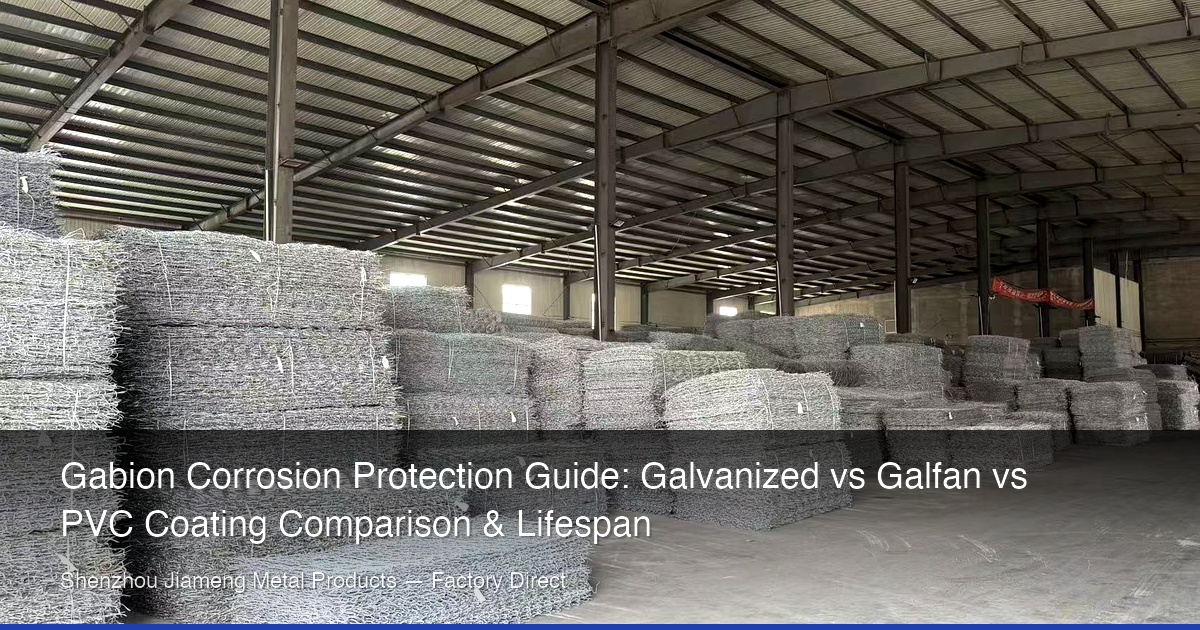
Corrosion is the single most critical factor determining the service life of gabion structures. A poorly specified coating can turn a 50-year design life into a 10-year failure — and the cost difference between coating types is negligible compared to the cost of premature reconstruction. This guide provides a comprehensive comparison of galvanized, Galfan (Zn-5%Al), and PVC-coated gabion wire, with engineering data on coating mass, salt spray test performance, and real-world service life projections across different environmental exposure classes.
🔑 Key Takeaways
- 🔹 Coating mass (g/m²) is the #1 quality metric — always specify: Never accept just 'galvanized'; require minimum 245-275 g/m² for permanent structures
- 🔹 Galfan (Zn-5%Al) offers 2-3× the corrosion protection of standard HDG for only 8-15% more cost — the best ROI for coastal and high-durability projects
- 🔹 PVC coating adds 10-25+ years to service life but should always be applied over a HDG or Galfan base — PVC alone cannot prevent rust at scratches or cut edges
- 🔹 Environmental exposure class (ISO 9223 C1-C5) is the starting point for coating selection — match the coating to the most aggressive condition the gabion will face
- 🔹 For critical infrastructure, always require EN 10204 Type 3.1 mill test certificates specifying coating mass, adhesion test results, and wire diameter tolerance
📋 Table of Contents
- 1. Why Corrosion Protection Matters: The Cost of Getting It Wrong
- 2. Hot-Dip Galvanizing Explained: Process, Standards, and Performance
- 3. Galfan (Zn-5%Al) Coating: The Next-Generation Alternative
- 4. PVC Coating: When and Why to Add a Polymer Layer
- 5. Environmental Exposure Classes and Coating Selection Matrix
- 6. Salt Spray Testing and Accelerated Corrosion Evaluation
- 7. Cost-Benefit Analysis: Coating Selection Economics
- 8. Inspection and Quality Control for Coated Gabion Wire
- 9. Real-World Field Performance: What Decades of Data Show
- 10. Coating Specification Checklist for Engineers and Buyers
1. Why Corrosion Protection Matters: The Cost of Getting It Wrong
The wire mesh in gabion structures is typically only 2.0mm to 4.0mm in diameter. Without adequate corrosion protection, this thin steel core can deteriorate rapidly in aggressive environments. A gabion retaining wall or riverbank revetment represents a significant investment — excavation, stone fill, geotextile, and installation labor often exceed the cost of the gabion baskets themselves. When the baskets fail prematurely due to corrosion, the total reconstruction cost can be 3-5 times the original installation cost.
The American Association of State Highway and Transportation Officials (AASHTO) and the European Standard EN 10223-3 both specify minimum coating requirements based on the intended service environment. Understanding these standards — and how different coating technologies perform in real-world conditions — is essential for engineers, contractors, and procurement managers specifying gabion structures for infrastructure projects.
Key failure modes caused by inadequate corrosion protection:
- Wire rupture: Corrosion reduces the effective cross-section of the wire, leading to tensile failure under load
- Mesh unraveling: Localized corrosion at selvedge edges and lacing points causes structural disintegration
- Basket bulging: Loss of wire strength leads to deformation and eventual collapse of the gabion unit
- Environmental contamination: Zinc and iron corrosion products can leach into water bodies, though this is generally not a regulatory concern for gabions
2. Hot-Dip Galvanizing Explained: Process, Standards, and Performance
Hot-dip galvanizing (HDG) is the most widely used corrosion protection method for gabion wire. The process involves immersing cleaned steel wire in a bath of molten zinc at approximately 450°C (842°F), forming a metallurgical bond between the zinc coating and the steel substrate. The resulting coating consists of multiple intermetallic layers (gamma, delta, zeta) with an outer layer of pure zinc (eta), providing both barrier protection and cathodic (sacrificial) protection.
| Standard | Min. Coating Mass (g/m²) | Typical Life (Rural) | Wire Diameter Range |
|---|---|---|---|
| EN 10223-3 (Class A) | 245–275 | 30–50 years | 2.0–4.0 mm |
| EN 10223-3 (Class B) | 215–245 | 20–35 years | 2.7–4.0 mm |
| ASTM A975 (Class 1) | 230+ | 25–40 years | 2.7–4.0 mm |
| ASTM A975 (Class 3) | 245+ | 30–50 years | 3.0–4.0 mm |
The coating mass (g/m²) is the primary quality indicator for hot-dip galvanized wire. Higher coating mass directly correlates with longer service life, as zinc corrodes at a relatively predictable rate depending on the environment. In rural atmospheres, zinc corrosion rates are typically 0.5–1.0 μm/year; in coastal/marine environments, this can accelerate to 3–5 μm/year due to chloride exposure.
The cathodic protection mechanism is crucial: even if the coating is scratched or damaged, the surrounding zinc will sacrificially corrode to protect the exposed steel — a property that paint coatings and PVC coatings alone cannot provide. This is why HDG remains the baseline coating choice for most gabion applications.
3. Galfan (Zn-5%Al) Coating: The Next-Generation Alternative
Galfan is a zinc-aluminum alloy coating containing approximately 5% aluminum, with trace amounts of mischmetal (rare earth elements) to improve adhesion and uniformity. Developed in the 1980s and standardized under EN 10244-2, Galfan offers significantly improved corrosion resistance compared to conventional hot-dip galvanizing — typically 2-3 times longer service life in the same environment.
Key advantages of Galfan over conventional HDG:
- Superior corrosion resistance: The aluminum-rich oxide layer is more stable and less soluble than pure zinc oxide, providing better long-term barrier protection
- Better formability: Galfan coatings are more ductile, reducing the risk of micro-cracking during wire drawing and mesh weaving
- No intermetallic brittleness: Unlike pure zinc coatings, Galfan forms a thinner, more uniform intermetallic layer, reducing the risk of coating delamination during fabrication
- Self-healing cut edges: The aluminum content promotes the formation of protective corrosion products at cut edges, though cathodic protection is somewhat reduced compared to pure zinc
| Property | Hot-Dip Galvanized | Galfan (Zn-5%Al) |
|---|---|---|
| Coating composition | 99% Zn | 95% Zn + 5% Al |
| Salt spray resistance (ISO 9227) | 200–400 hrs to red rust | 600–1,000 hrs to red rust |
| Relative corrosion rate | 1.0× (baseline) | 0.3–0.5× |
| Cost premium (vs HDG) | — | +8–15% |
| Typical life in marine environment | 8–15 years | 20–30 years |
Galfan is increasingly specified for coastal and marine gabion applications, where the 8-15% cost premium is easily justified by the 2-3× service life extension. It is also gaining traction in European infrastructure projects, particularly in Germany and the Netherlands, where life-cycle cost analysis (LCCA) favors higher durability materials.
4. PVC Coating: When and Why to Add a Polymer Layer
PVC (polyvinyl chloride) coating is applied as an additional layer over galvanized or Galfan-coated wire, typically by extrusion. The PVC layer provides an impermeable barrier against moisture, chemicals, and abrasive materials, making it ideal for specific applications where the base metallic coating alone would be insufficient.
PVC coating thickness typically ranges from 0.4mm to 0.8mm, applied over a minimum 240 g/m² zinc or Galfan base coating. The base coating is essential — PVC alone cannot provide cathodic protection if the polymer layer is punctured or degraded.
| Application | Recommended Coating | Reason |
|---|---|---|
| Riverbank revetment (freshwater) | HDG Class A or Galfan | Moderate corrosion risk; PVC adds cost without significant benefit |
| Coastal seawalls & breakwaters | Galfan + PVC | High chloride exposure; PVC provides additional barrier |
| Acidic soil / mining environments | Galfan + PVC (0.7mm+) | Chemical attack on metallic coatings; thick PVC essential |
| Highways (de-icing salt zones) | HDG Class 3 or Galfan + PVC | Salt spray from traffic; PVC improves durability |
| Landscaping & architectural | Galfan + PVC (color options) | Aesthetic requirements; PVC available in grey/green/brown |
| General retaining walls (rural) | HDG Class B (sufficient) | Low corrosion environment; over-specification wastes money |
PVC coating limitations to consider:
- UV degradation: PVC can become brittle and crack after prolonged UV exposure unless UV-stabilized additives are included
- Abrasion vulnerability: In high-energy river environments with coarse sediment transport, PVC can wear through faster than metallic coatings
- Weight addition: PVC adds approximately 15-25% to wire weight, affecting shipping costs and handling
- Fire risk: PVC releases hydrogen chloride gas when burned, a consideration for wildfire-prone areas
5. Environmental Exposure Classes and Coating Selection Matrix
ISO 9223 defines atmospheric corrosivity categories that provide a framework for selecting appropriate corrosion protection for gabion wire. The selection should be based on the most aggressive condition the structure will face during its design life.
| ISO Category | Environment | Zinc Loss (μm/yr) | Recommended Coating |
|---|---|---|---|
| C1 | Very low (dry indoor) | ≤ 0.1 | HDG Class B (minimal protection needed) |
| C2 | Low (rural inland) | 0.1–0.7 | HDG Class A or Galfan (50+ year design) |
| C3 | Medium (urban/industrial) | 0.7–2.1 | Galfan or HDG Class A + PVC |
| C4 | High (industrial/coastal) | 2.1–4.2 | Galfan + PVC (0.5mm min.) |
| C5 | Very high (marine/aggressive) | 4.2–8.4 | Galfan + PVC (0.7mm+) or stainless steel wire |
For gabion applications, the most common environments fall into categories C2 through C4. Category C5 environments are rare but do occur in splash zones, industrial chemical exposure, and highly polluted waterways. In these extreme cases, 316L stainless steel wire or heavily coated Galfan with thick PVC should be considered.
6. Salt Spray Testing and Accelerated Corrosion Evaluation
The neutral salt spray test (ASTM B117 / ISO 9227) is the standard accelerated corrosion test used to evaluate gabion wire coatings. In this test, coated wire specimens are continuously exposed to a 5% NaCl salt fog at 35°C, and the time to first appearance of red rust is recorded. While salt spray results do not directly correlate to field service life, they provide a valuable comparative benchmark between different coating systems.
| Coating System | Coating Mass (g/m²) | Time to Red Rust (Hrs) | Typical Use Case |
|---|---|---|---|
| HDG (light) | 200–220 | 150–250 | Economy-grade gabions, temporary works |
| HDG (heavy) | 260–300 | 300–500 | Standard infrastructure gabions |
| Galfan (Zn-5%Al) | 200–260 | 600–1,200 | Coastal / high-durability projects |
| Galfan + PVC (0.5mm) | 200+ base | 1,500–2,500+ | Marine / chemical / extreme environments |
Important caveat on salt spray testing: Salt spray results should be used for comparative purposes only. Actual service life depends on many factors including wet/dry cycling, UV exposure, mechanical abrasion, soil chemistry, and water chemistry. A gabion with 500-hour salt spray resistance might last 15 years in a marine environment or 50+ years in an inland environment. Always combine salt spray data with field experience and environmental exposure classification.
7. Cost-Benefit Analysis: Coating Selection Economics
The upfront cost difference between coating systems is modest relative to the total installed cost of a gabion structure — and even smaller compared to the cost of premature failure and reconstruction. A life-cycle cost perspective almost always favors higher-specification coatings for permanent infrastructure.
| Coating System | Wire Cost Index | Estimated Life (Rural/Inland) | Life-Cycle Cost Factor (50-yr) |
|---|---|---|---|
| HDG (Class B / 215–245 g/m²) | 1.00 | 20–30 years | 2.0–2.5× (requires replacement) |
| HDG (Class A / 245–275 g/m²) | 1.05 | 30–50 years | 1.0–1.1× (may last full design life) |
| Galfan (Zn-5%Al) | 1.10 | 50–75+ years | 0.8–0.9× (lower LCC despite higher upfront) |
| Galfan + PVC (0.5mm) | 1.30 | 75–100+ years | 0.7–0.8× (best LCC for permanent structures) |
Key economic insight: For a typical gabion retaining wall where baskets represent 35-50% of total installed cost, upgrading from HDG Class B to Galfan adds approximately 3-5% to the total project cost. When this upgrade extends service life from 25 years to 60+ years — eliminating one full reconstruction cycle — the life-cycle savings are enormous.
8. Inspection and Quality Control for Coated Gabion Wire
Verifying coating quality upon delivery is essential to ensure that the specified protection level has been achieved. Key inspection points and test methods include:
- Coating mass measurement (gravimetric method): Per ASTM A90 / EN 10244-2. A weighed wire specimen is stripped of its coating in inhibited acid, and the weight loss is used to calculate coating mass in g/m². This is the definitive test for metallic coatings.
- Coating thickness measurement (magnetic method): Per ISO 2178. A portable magnetic induction gauge provides rapid, non-destructive thickness readings. Useful for spot-checking but less accurate than gravimetric for rough or small-diameter wires.
- Adhesion test: Per EN 10244-2. The wire is wrapped around a mandrel of specified diameter (typically 3-5× wire diameter). No flaking or peeling of the coating should occur.
- PVC coating integrity: Visual inspection for pinholes, blisters, and uniform color. A spark tester (high-voltage holiday detector per ASTM D4787) can identify hidden pinholes in PVC coatings.
- Uniformity of coating: Per ASTM A239. The Preece test (copper sulfate dip) can identify thin spots in zinc coatings.
- Wire diameter tolerance: Per EN 10218-2. Verify that the finished coated wire diameter meets the specified tolerance.
Recommended sampling rate: At least 2 samples per coil or per production batch. For large orders (50+ tons), increase to 5 samples per batch. Third-party inspection (SGS, Bureau Veritas, TÜV) provides independent verification and is recommended for critical infrastructure projects.
9. Real-World Field Performance: What Decades of Data Show
Long-term field studies provide the most reliable basis for coating selection. Several notable studies have tracked gabion corrosion over multiple decades:
- UK Environment Agency (2015): Surveyed 120 gabion structures aged 15-45 years. HDG (heavy) structures in freshwater environments showed "slight to moderate" surface corrosion at 30-40 years, with no structural failures attributed to corrosion alone. Galfan-coated structures at 20-25 years showed "negligible" corrosion.
- US Army Corps of Engineers (2018): Evaluated gabion revetments on the Mississippi River. HDG baskets at 25 years showed 15-25% zinc loss in splash zone, 5-10% loss in continuously submerged zone. PVC-coated baskets showed no visible corrosion at 20 years.
- Italian Alpine Region (2019): Gabion retaining walls on mountain roads at 15-30 years. HDG structures showed accelerated corrosion at road level due to de-icing salt exposure — zinc loss rates 3-5× higher than adjacent areas without salt exposure. Galfan + PVC structures showed no degradation.
- Australian Coastal Study (2020): Gabion seawalls in Queensland. HDG baskets began showing significant corrosion (red rust) at 8-12 years in splash zones. Galfan + PVC baskets at 15 years showed no through-coating corrosion, though PVC showed minor surface chalking from UV exposure.
The consistent finding across all studies: In aggressive environments (marine, de-icing salt, industrial), upgrading from standard HDG to Galfan or Galfan + PVC extends service life by a factor of 2-4×, and the cost premium is recovered many times over through avoided reconstruction costs.
10. Coating Specification Checklist for Engineers and Buyers
When specifying corrosion protection for gabion projects, use this checklist to ensure all critical parameters are covered:
| Checklist Item | What to Specify |
|---|---|
| Coating type | HDG per EN 10244-2 / Galfan per EN 10244-2 Class A / PVC over Zn or Zn-Al |
| Minimum coating mass | For HDG: specify g/m² (not just "hot-dip galvanized") — e.g., 260 g/m² min. |
| PVC coating thickness | 0.5mm nominal (min. 0.4mm) — specify if UV-stabilized grade is required |
| PVC color | Grey (RAL 7030) / Green (RAL 6005) / Brown — specify RAL code |
| Adhesion requirement | Per EN 10244-2: no flaking when wrapped around 3× wire diameter mandrel |
| Test certificates | Mill test certificate per EN 10204 Type 3.1 or 3.2 (third-party) required |
| Environmental class | ISO 9223 category (C1-C5) — reference in specification to justify coating choice |
Pro tip for buyers: When sourcing gabions from Chinese manufacturers, always request a detailed coating specification in the proforma invoice — not just "galvanized gabion." Specify: coating standard (EN 10244-2), coating mass (g/m²), wire diameter tolerance, and test certificate requirements. This eliminates ambiguity and protects you from receiving under-coated wire that will fail prematurely.
Need Gabion Baskets? Get a Quote Today
Factory-direct gabion baskets, wire mesh, and reno mattresses. ISO 9001 certified, EN 10223-3 compliant. Free samples, fast global shipping, and 24-hour quote response.