Wire Mesh International Shipping Guide: Packaging, Containers, and Customs Documentation
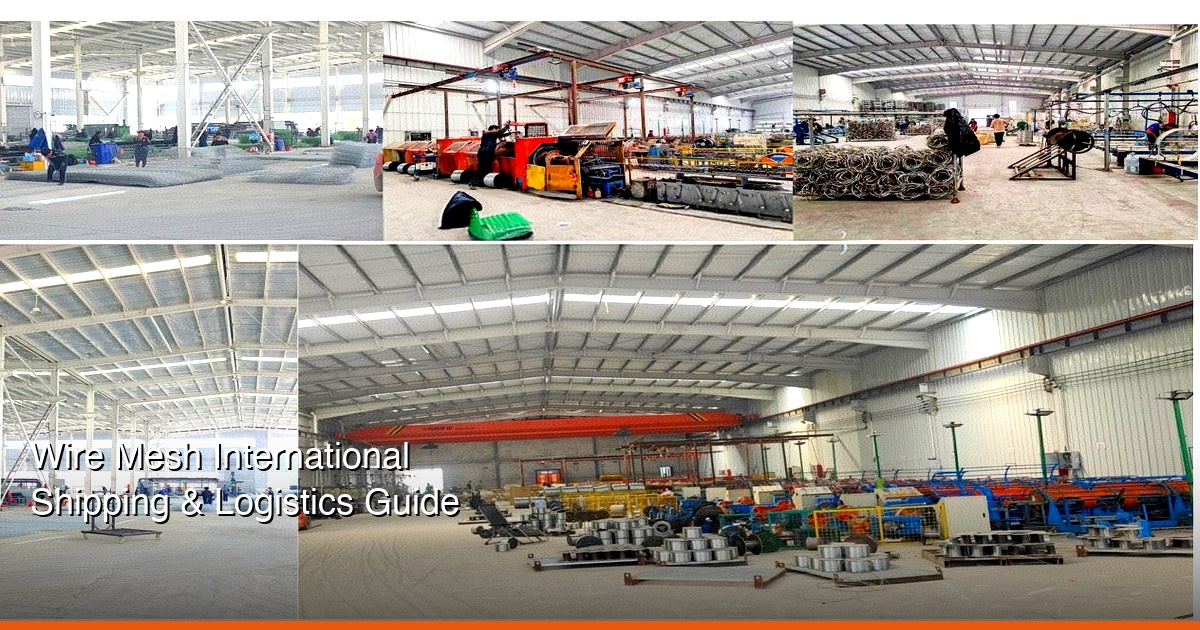
For wire mesh manufacturers and international buyers alike, efficient logistics represents the critical bridge between factory production and project site delivery. A well-designed shipping strategy reduces landed costs by 10–18%, prevents cargo damage (which typically affects 3–7% of poorly packed wire mesh shipments), and ensures customs clearance without costly delays. This comprehensive guide covers every stage of the wire mesh shipping process—from factory packaging and container loading optimization to customs documentation and freight mode selection.
📋 Key Takeaways
- Folding saves 60% on freight: Gabion mesh folded flat fits 3-5× more units per container vs assembled boxes — the single biggest logistics cost lever
- Ocean freight dominates: 25-35 days China to major ports — plan 45-50 days total with customs clearance and inland transport
- Incoterms define responsibility: FOB = buyer pays freight; CIF = seller pays freight+insurance; DDP = seller handles everything including import duties
- Document package is critical: Commercial invoice, packing list, bill of lading, certificate of origin, and MTC — missing any one delays customs clearance
- Wire mesh HS codes: 7314.39 for welded mesh, 7314.49 for woven mesh — wrong classification triggers customs inspections and potential fines
Whether you are importing gabion baskets for a riverbank protection project, welded mesh panels for an industrial fence installation, or rockfall netting for highway slope stabilization, understanding the logistics variables specific to wire mesh products will help you optimize cost, timeline, and cargo integrity.
1. Packaging Methods for Different Wire Mesh Products
Wire mesh products vary dramatically in form factor—from flexible gabion mesh rolls to rigid welded fence panels—and each requires a different packaging approach to prevent transit damage and maximize container utilization.
| Product Type | Form Factor | Recommended Packaging | Unit Weight |
|---|---|---|---|
| Gabion mesh rolls (double-twist) | Coiled rolls, 25–50m long | Steel strap-bundled + woven PP fabric wrap + wooden pallet base | 800–1,500 kg/pallet |
| Welded gabion baskets (flat-packed) | Flat panels, 1.0×2.0–2.0×3.0m | Palletized stacks + steel banding + stretch film + edge protectors | 1,000–2,000 kg/pallet |
| Welded wire fence panels | Rigid panels, 1.5×2.5–2.0×3.0m | Steel frame crating + foam spacers between panels + VCI paper | 500–1,200 kg/crate |
| Chain link fence rolls | Tightly coiled rolls, 10–25m long | PP woven bags + pallet stacking (3–4 rolls per layer) | 200–600 kg/roll |
| Rockfall netting (ring/diamond) | Folded bundles, irregular shape | Custom wooden crates + internal bracing + desiccant packs | 300–800 kg/crate |
Critical packaging details: All steel strapping must be tensioned to 400–600 kg to prevent bundle loosening during ocean transit. For galvanized or PVC-coated products, VCI (Volatile Corrosion Inhibitor) paper or film is strongly recommended for shipments exceeding 30 days, particularly on routes crossing equatorial zones where container interior temperatures can reach 55–65°C and humidity exceeds 90%. For PVC-coated mesh, avoid direct contact with petroleum-based preservatives in wooden pallets—specify heat-treated (HT) pallets without chemical treatment.
2. Container Loading Optimization: Maximizing Space and Stability
Wire mesh products are challenging to containerize efficiently due to their varied dimensions and the need for structural stability during transit. The goal is to maximize container utilization (typically targeting 85–95% volume fill for 20-foot containers and 80–90% for 40-foot containers) while ensuring load security.
| Container Type | Internal Dimensions (L×W×H) | Max Payload | Typical Gabion Rolls | Typical Fence Panels |
|---|---|---|---|---|
| 20-foot GP | 5.90 × 2.35 × 2.39 m | 28,000 kg | 18–22 pallets (22–26 tons) | 10–14 crates (12–18 tons) |
| 40-foot GP | 12.03 × 2.35 × 2.39 m | 26,500 kg | 38–44 pallets (24–26 tons) | 22–28 crates (20–26 tons) |
| 40-foot HQ (High Cube) | 12.03 × 2.35 × 2.69 m | 26,300 kg | 44–50 pallets (24–26 tons) | 26–32 crates (20–26 tons) |
Loading sequence best practices:
- Heavy items first: Place the heaviest pallets/crates (≥1,500 kg) against the container front wall (closest to the tractor unit) to maintain axle weight distribution.
- Lateral symmetry: Distribute weight evenly left-to-right. Off-center loading by more than 5% of total cargo weight increases rollover risk during road transport segments.
- Void filling: Use airbags (dunnage bags) in gaps exceeding 10 cm. Inflate to 0.2–0.3 bar (3–5 psi) for lateral voids—over-inflation can deform wire mesh products.
- Tiered stacking: For gabion rolls on pallets: maximum 3 tiers high in 20-foot containers, 4 tiers in 40-foot HQ. Use anti-slip matting between tiers.
- Door bracing: Always install timber or steel cross-bracing at the container rear to prevent cargo shift toward the doors during braking events. Wire mesh loads can exert 2–3× their weight in forward force under emergency braking.
3. Freight Mode Selection: Ocean, Air, Rail, and Multimodal
The choice of freight mode for wire mesh products involves a trade-off between transit time, cost per ton, cargo security, and destination accessibility.
| Freight Mode | Transit Time (China → ) | Cost Index (USD/ton) | Best For |
|---|---|---|---|
| Ocean FCL (Full Container) | 15–35 days (Asia→EU/US) | $40–120/ton | Orders ≥ 20 tons; project cargo; regular supply |
| Ocean LCL (Less than Container) | 20–40 days | $80–200/m³ (volumetric) | Sample orders, small batches < 5 tons |
| Rail (China-Europe Express) | 15–20 days (to EU) | $150–250/ton | Time-sensitive EU projects; Central Asia routing |
| Air freight | 3–7 days (global) | $2,500–5,000/ton | Emergency replenishment; high-value specialty mesh |
Practical decision framework: For standard wire mesh orders (15–26 tons), ocean FCL is the default choice—providing the lowest cost per unit and dedicated container security. The China-Europe Railway Express has emerged as a competitive option for EU-bound projects with tight construction schedules: at 15–20 days versus 30–35 days for ocean, it saves 2–3 weeks of project float at roughly double the ocean freight cost. For African and Middle Eastern destinations without direct rail links, ocean routing via hub ports (Dubai, Mombasa, Durban) with onward road haulage remains the only viable option.
4. Customs Documentation: Essential Paperwork for Smooth Clearance
Wire mesh shipments require precise documentation to avoid customs delays, storage charges, and potential fines. Incomplete or incorrect paperwork is the leading cause of customs holds for industrial products—accounting for approximately 40% of clearance delays according to WCO trade facilitation data.
Core shipping documents for every wire mesh export:
- Commercial Invoice: Must include detailed product description (e.g., "PVC-coated double-twist hexagonal woven gabion mesh, wire diameter 2.7mm/3.7mm PVC, mesh opening 80×100mm"), HS code, unit price, total value, Incoterm (e.g., FOB Tianjin, CIF Rotterdam), country of origin, and seller/buyer legal names matching the bill of lading.
- Packing List: Itemizes every package in the container: number of pallets/crates, dimensions, gross/net weight per package, and total weight. Any discrepancy between declared and actual weight triggers customs inspection.
- Bill of Lading (B/L) or Air Waybill (AWB): Contract of carriage. For ocean shipments, specify "Clean on Board" and ensure the consignee field matches the Letter of Credit requirements exactly. Telex release (surrender B/L) is preferred for shorter transit routes to avoid original document mailing delays.
- Certificate of Origin: Issued by CCPIT (China Council for the Promotion of International Trade) or equivalent chamber of commerce. Essential for claiming preferential tariff rates under FTAs (e.g., RCEP for ASEAN destinations, China-Pakistan FTA). Wire mesh products typically qualify for Form E (ASEAN), Form F (Chile), Form P (Pakistan), and Form RCEP.
Additional documents that may be required:
- Mill Test Certificate (EN 10204 Type 3.1): Required by most infrastructure project specifications. Certifies mechanical properties and zinc coating weight of the specific production batch.
- Fumigation Certificate: Required when using solid wood packaging (pallets/crates). Specify ISPM-15 compliant heat treatment (HT stamp on wood). Avoid methyl bromide fumigation where possible—it is banned in the EU and increasingly restricted worldwide.
- Product Certification Documents: CE marking documentation (EU), test reports per ASTM/EN standards. Keep these on file—customs may request them during random compliance checks.
- Insurance Certificate: Marine cargo insurance covering 110% of CIF value against All Risks (Institute Cargo Clauses A) is recommended for all shipments. Wire mesh cargo is susceptible to saltwater corrosion damage and handling impact.
5. HS Code Classification for Wire Mesh Products
Correct HS (Harmonized System) code classification is critical—it determines import duty rates, anti-dumping duty applicability, and trade statistics reporting. Wire mesh products fall under Chapter 73 (Articles of Iron or Steel).
| Product | HS Code (6-digit) | Common Duty Rate (MFN) | AD Risk |
|---|---|---|---|
| Gabion mesh (woven, galvanized) | 7314.31 | 0–5% (EU: 0%) | Low |
| Welded mesh (fence panels) | 7314.39 | 0–7% (varies by country) | Moderate (check destination) |
| Chain link fence | 7314.41 | 3–8% | Moderate |
| Rockfall netting (wire rope mesh) | 7312.10 (stranded wire) or 5608.19 (netting of textile) | 0–5% | Low (specialty product) |
Important: HS codes are harmonized only at the 6-digit level internationally. The 8-digit, 10-digit, or 12-digit national tariff codes vary by importing country. Always verify the full destination-country tariff code before preparing documentation. Some countries (notably the United States for certain welded wire mesh products and the European Union for specific steel wire products) maintain anti-dumping duties on Chinese-origin wire mesh—check the current AD/CVD status before quoting CIF or DDP prices.
6. Cargo Insurance and Risk Management for Wire Mesh Shipments
Wire mesh cargo is exposed to specific risks during international transit: saltwater spray corrosion (from container leaks or deck stowage), mechanical damage from rough handling (forklift punctures, container drops), theft (for high-value galvanized material), and water damage from condensation (container sweat).
Recommended insurance coverage:
- Institute Cargo Clauses (ICC) A — All Risks: Covers physical loss or damage from any external cause, subject to standard exclusions (war, strikes, inherent vice, insufficient packaging). This is the recommended minimum for all wire mesh shipments.
- Additional coverage considerations: For shipments to regions with high theft risk (certain Latin American and African ports), consider adding theft, pilferage, and non-delivery (TPND) coverage. For project-critical cargo where delivery delay penalties apply, consider delay in start-up (DSU) insurance.
- Insurance value: Insure for CIF value + 10% (standard practice) to cover incidental costs (survey fees, claim preparation). The additional 10% costs approximately $30–60 per $100,000 of cargo value.
Pre-shipment risk mitigation:
- Photograph every pallet/crate before container loading. Include a shipping mark, date, and scale reference in at least 3 photos per package.
- Apply container seals and record seal numbers on the packing list. Use high-security bolt seals (ISO 17712 compliant) for all FCL shipments.
- For PVC-coated or galvanized products on routes exceeding 30 days, include humidity indicator cards inside sealed packages and specify "stow away from heat" and "under deck stowage" on the bill of lading.
- Consider GPS trackers for high-value full-container shipments to high-risk destinations—cost is approximately $50–100 per container with real-time location and tamper alerts.
7. Last-Mile Delivery: Getting Wire Mesh from Port to Project Site
The final stage of the logistics chain—last-mile delivery from the destination port to the project site—often accounts for 15–25% of total logistics costs and presents unique challenges for wire mesh products due to load dimensions, site access limitations, and unloading equipment requirements.
Key considerations for last-mile planning:
- Vehicle selection: Gabion pallets (1,000–1,500 kg each) require flatbed trucks or curtain-side trailers with forklift offloading capability. For project sites without hardstanding, specify trucks with all-terrain tires or arrange for a mobile crane at the destination. Welded fence panels (up to 3.0 m long) require extended flatbed trailers—verify road transport regulations for over-length loads (typically > 12 m for standard trailers).
- Offloading equipment: The project site must have a forklift with minimum 3-ton capacity (counterbalance type, not reach truck) or a mobile crane for containers. If the site lacks equipment access, arrange for a truck-mounted crane (HIAB) for self-unloading delivery—this adds approximately $150–300 per delivery but eliminates offloading delays.
- Storage at site: Wire mesh must be stored on level ground, off the soil (on pallets or timber bearers), and covered with waterproof tarpaulins. Galvanized mesh stored in contact with soil for extended periods develops white rust (zinc hydroxide) that compromises coating integrity. For PVC-coated mesh, avoid storage in direct sunlight for more than 3 months without UV-protective covering.
- Documentation handover: The delivery driver should carry a delivery note listing package count, weight, and condition. The site receiver must check package count against the packing list and note any visible damage on the delivery receipt before signing. Photograph any damaged packages immediately—cargo insurance claims require evidence collected at the point of delivery.
Shipping Wire Mesh to Your Project Site?
Haobo Metal handles complete export logistics—from factory packaging and container loading to customs documentation and delivery coordination. Request a shipping quote with your project destination and volume.
Related Articles
Quality Control in Wire Mesh Manufacturing
Read More →
Welded Wire Fence for Australia: 120,000 Linear Meters
Read More →
Wire Mesh Manufacturing: From Steel to Finished Product
Read More →