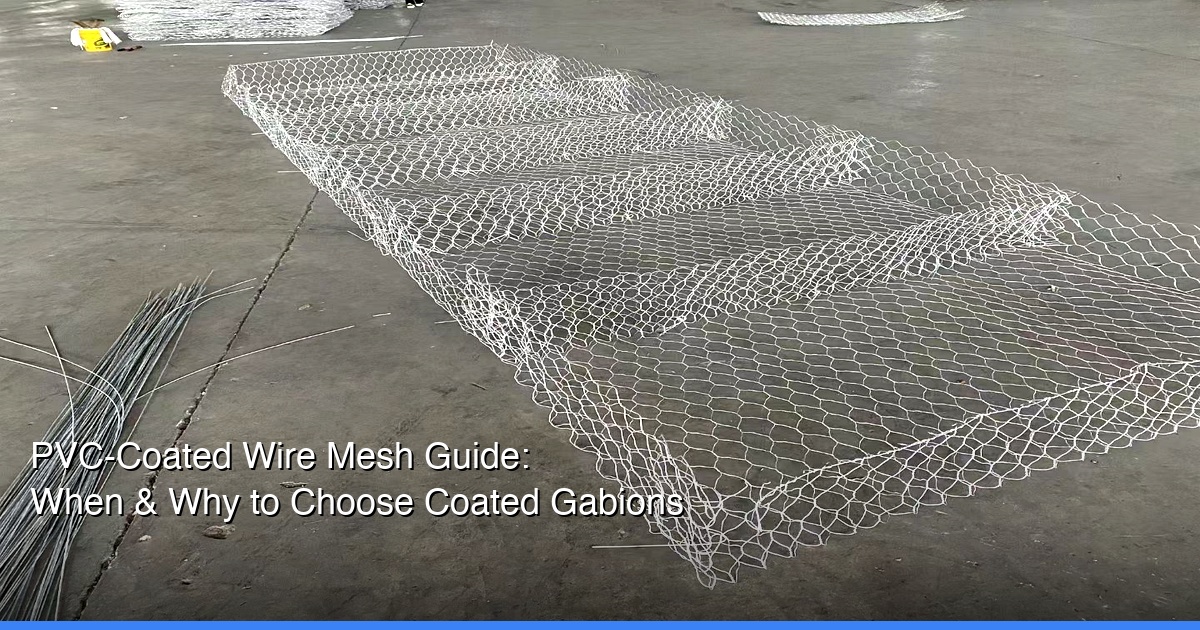
PVC-Coated Wire Mesh Guide: When and Why to Choose Coated Gabions and Fence
When specifying wire mesh products for infrastructure projects—whether gabion retaining walls, highway slope protection systems, or industrial security fencing—the choice of protective coating directly determines service life, maintenance costs, and long-term performance. Among the available options, PVC (polyvinyl chloride) coating has become increasingly popular for projects in aggressive environments: coastal zones with salt spray, industrial areas with chemical exposure, and waterways with fluctuating pH levels.
This guide provides a comprehensive technical reference for engineers, procurement managers, and project specifiers evaluating PVC-coated wire mesh. We cover the manufacturing process, coating thickness standards, mechanical property comparisons against galvanized alternatives, application-specific selection criteria, cost-benefit analysis, and quality verification methods. By the end, you will have a clear decision framework for determining whether PVC-coated wire mesh is the right specification for your project.
1. What Is PVC-Coated Wire Mesh and How Is It Manufactured?
PVC-coated wire mesh is produced by applying a thermoplastic PVC layer over a metallic core wire—typically low-carbon steel that has already received a primary corrosion protection treatment such as hot-dip galvanizing (Zn) or Galfan (Zn-5%Al) coating. The PVC layer serves as a secondary barrier, providing additional protection against chemical attack, UV degradation, and mechanical abrasion.
The manufacturing process follows three stages:
- Stage 1 — Core Wire Preparation: Steel wire rod is drawn to the target diameter (commonly 2.0mm–4.0mm for gabion applications, 1.6mm–3.0mm for fencing), then hot-dip galvanized to a minimum coating weight of 240–275 g/m² (EN 10244-2 Class A) or Galfan-coated to 255 g/m² (EN 10244-2 Class A). The zinc layer acts as sacrificial anode protection—if the PVC coating is scratched, the zinc underneath continues to protect the steel through cathodic protection.
- Stage 2 — PVC Extrusion Coating: The galvanized wire passes through a cross-head extrusion die where molten PVC compound (containing plasticizers, stabilizers, UV inhibitors, and color pigments) is applied concentrically around the core at temperatures of 160–200°C. Wall thickness is controlled by die gap adjustment and haul-off speed, achieving uniform coating thickness of 0.4mm–1.0mm depending on specification requirements.
- Stage 3 — Cooling and Winding: The coated wire passes through a water cooling trough to solidify the PVC layer, then through a diameter gauge for quality verification, and is wound onto spools. The finished wire is then fed into automatic mesh weaving or welding machines to produce the final mesh product.
Key quality indicators during manufacturing include: concentricity of the PVC layer (eccentricity < 15%), absence of pinholes (tested via spark testing at 5–10 kV), adhesion strength between PVC and zinc layer (peel test per ASTM D903), and color uniformity (visual inspection under D65 lighting).
2. PVC-Coated vs. Galvanized-Only Wire Mesh: Complete Comparison
The fundamental difference between PVC-coated and galvanized-only mesh is not merely "one extra layer." It is a fundamentally different corrosion protection mechanism with distinct performance profiles across environmental conditions, mechanical loading scenarios, and aesthetic requirements.
| Property | Hot-Dip Galvanized (Zn) | Galfan (Zn-5%Al) | PVC-Coated over Zn |
|---|---|---|---|
| Core wire diameter (typical) | 2.0–4.0 mm | 2.0–4.0 mm | 2.0–4.0 mm (core) |
| Coating thickness (min) | 50–85 μm (240–275 g/m²) | 50–85 μm (255 g/m²) | 0.4–1.0 mm PVC + Zn base |
| Salt spray resistance (ASTM B117) | 500–1,500 hours to red rust | 2,000–4,000 hours to red rust | 5,000+ hours to under-film corrosion |
| Chemical resistance | Poor in acidic/alkaline (pH <6 or >9) | Better than Zn, still limited | Excellent across pH 2–12 range |
| UV resistance (outdoors) | Excellent (metallic surface) | Excellent | Good–Very Good (with UV stabilizers) |
| Abrasion resistance | Moderate (zinc is soft) | Better than pure Zn | Good (PVC is tough and flexible) |
| Color options | Silver-gray only | Silver-gray only | Green, gray, black, brown, blue, custom RAL |
| Aesthetic durability | Dulls to gray patina over 1–2 years | Dulls more slowly | Maintains color 10–15+ years |
| Relative cost | 1.0× (baseline) | 1.1–1.2× | 1.3–1.6× |
| Best application | General outdoor, rural, inland | Coastal, high-humidity | Coastal, chemical, architectural, high-visibility |
The key insight: zinc/galvanized coatings provide cathodic (sacrificial) protection—when scratched, zinc continues protecting the exposed steel. PVC provides barrier protection—it physically isolates the steel from the environment. The combination of both (zinc under PVC) creates a synergistic system: even if PVC is damaged, the zinc layer underneath prevents immediate corrosion creep.
3. PVC Coating Thickness Standards and Specifications
PVC coating thickness is not arbitrary—it must comply with international standards that define minimum requirements based on the intended service environment. The most widely referenced standards for PVC-coated wire mesh in civil engineering applications are EN 10223-3 (European), ASTM A975 (American), and BS 1052 (British).
| Standard | Core Wire Diameter | Min. PVC Thickness | Application Scope |
|---|---|---|---|
| EN 10223-3 | 2.0–4.0 mm | 0.4 mm (Class A) / 0.6 mm (Class B) | Gabion baskets and mattresses |
| ASTM A975 | 2.2–4.0 mm | 0.5 mm (min.) | Double-twisted gabions and mattresses |
| BS 1052 | 1.6–4.0 mm | 0.4–1.0 mm (per spec) | Mild steel wire for general engineering |
| ISO 7989-2 | 1.0–5.0 mm | 0.2–1.5 mm (class dependent) | Zinc or zinc-alloy coated steel wire with organic coating |
Practical recommendation for specifiers: For most gabion retaining wall and erosion control applications in non-aggressive environments, EN 10223-3 Class A (0.4 mm PVC) over standard galvanized wire provides adequate protection and is cost-effective. For coastal projects, industrial wastewater channels, or architectural applications with high visibility requirements, specify Class B (0.6 mm PVC) or higher. For extreme chemical environments (pH < 4 or pH > 11), consult with the manufacturer about specialized PVC formulations with enhanced chemical resistance.
4. When Should You Specify PVC-Coated Wire Mesh? Key Application Scenarios
Not every project benefits from the added cost of PVC coating. The decision to specify PVC-coated mesh should be driven by clear technical justification rather than an impulse to "upgrade" the specification. Here are the scenarios where PVC coating provides genuine value:
Scenario 1: Coastal and Marine Environments
Salt spray and high humidity accelerate zinc corrosion rates exponentially. In coastal gabion retaining walls and sea defense structures, PVC-coated wire with a Galfan (Zn-5%Al) under-layer can extend design life from 25–30 years (galvanized only) to 50–75+ years. A 2018 study of gabion seawalls in Southeast Asia found that PVC/Galfan double-coated systems showed less than 5% coating degradation after 15 years of continuous saltwater exposure, compared to 40–60% zinc loss on galvanized-only systems.
Scenario 2: Industrial and Chemical Zones
Wastewater treatment plants, chemical storage areas, and mining runoff channels expose wire mesh to acidic or alkaline conditions (pH 3–5 or pH 9–11) where zinc dissolves rapidly. PVC's excellent chemical resistance across a wide pH range (2–12) makes it the preferred choice. For mining applications involving sulfuric acid leachate, specify PVC formulations with enhanced acid resistance.
Scenario 3: Architectural and Landscape Applications
When gabion walls are visible architectural features—building facades, landscape terracing, noise barriers in urban areas—the aesthetic longevity of PVC coating becomes important. Green PVC-coated mesh blends into vegetated landscapes, while dark gray or black PVC provides a modern architectural appearance. Unlike galvanized mesh, which weathers to an uneven gray patina within 1–2 years, PVC maintains consistent color for 10–15+ years.
Scenario 4: High-Visibility Safety Fencing
PVC-coated chain link and welded mesh fences in bright colors (orange, yellow, white) serve dual purposes: perimeter security plus visibility for safety. Airport perimeter fences, highway median barriers, and construction site hoarding benefit from PVC coating that maintains high visibility and does not develop sharp corrosion edges.
When NOT to specify PVC coating: For temporary structures (design life < 5 years), inland rural applications with low corrosion risk, or purely structural applications where the mesh will be permanently buried and aesthetics are irrelevant—standard hot-dip galvanized or Galfan-only mesh is more cost-effective and technically sufficient.
5. Mechanical Properties: Does PVC Coating Affect Wire Strength?
A common concern among structural engineers is whether the PVC extrusion process and the resulting polymer layer affect the mechanical properties of the underlying steel wire. The short answer: the PVC coating process has minimal impact on wire tensile strength, but it does influence the overall system behavior in ways that specifiers should understand.
| Mechanical Property | Uncoated Galvanized Wire | PVC-Coated Wire (same core) | Notes |
|---|---|---|---|
| Tensile strength (MPa) | 380–550 | 380–550 | PVC does not alter core wire strength (tested on stripped wire) |
| Elongation at break (%) | ≥12% (EN 10223-3) | ≥12% (core wire) | Core requirement unchanged |
| Apparent diameter (mm) | e.g., 2.7 | 3.5–4.7 (core 2.7 + 0.4×2–1.0×2 PVC) | PVC adds 0.8–2.0 mm to overall diameter. Important for mesh opening calculations |
| Mesh opening (practical) | e.g., 80 × 100 mm | Slightly reduced by coating thickness | Effective opening ≈ nominal opening − 2 × PVC thickness |
| UV degradation (10yr outdoor) | N/A (metal only) | Slight embrittlement with non-UV-stabilized PVC | Always specify UV-stabilized PVC for outdoor use |
Critical engineering note: When specifying PVC-coated mesh, the engineer should define two diameters in the specification: (1) the nominal core wire diameter (e.g., 2.7 mm steel wire per EN 10223-3), and (2) the minimum PVC coating thickness (e.g., 0.4 mm per Class A). The combined outer diameter determines the actual mesh opening size, which affects stone retention in gabions and ventilation characteristics in fencing. This is particularly important for gabion baskets where EN 10223-3 mandates specific mesh opening tolerances relative to stone fill size (typically mesh opening ≤ 1.5× the smallest stone dimension).
6. Cost-Benefit Analysis: Is PVC Coating Worth the Premium?
The 30–60% cost premium for PVC-coated wire mesh over standard galvanized mesh can seem difficult to justify at the procurement stage. However, when evaluated on a total lifecycle cost basis—including maintenance, replacement, and downtime costs—PVC coating often delivers superior long-term economics for projects with design lives exceeding 25 years.
Sample Lifecycle Cost Comparison — Gabion Retaining Wall (1,000 m² face area, coastal location):
| Cost Item | Galvanized-Only (Zn 275 g/m²) | PVC-Coated (Zn base + 0.5mm PVC) |
|---|---|---|
| Initial material cost (USD) | $8,500 | $12,750 |
| Installation cost (USD) | $15,000 | $15,000 |
| Estimated design life (coastal) | 25–30 years | 50–75 years |
| Maintenance cost (50yr) | $20,000 (partial replacement at year 25) | $2,000 (minor repairs) |
| Total 50-year cost (USD) | $43,500 | $29,750 |
| Annualized cost (50yr, USD/yr) | $870 | $595 |
| Cost savings (50yr) | Baseline | 32% lower total cost |
The analysis shows that PVC coating saves approximately 32% over a 50-year lifecycle in coastal environments, despite the higher initial procurement cost. The savings are even more pronounced when factoring in indirect costs: traffic disruption during maintenance, engineering inspection fees, environmental compliance documentation for replacement work, and the increasing cost of skilled labor over time.
7. How to Verify PVC-Coated Wire Mesh Quality Before Acceptance
Quality verification of PVC-coated wire mesh requires both visual inspection and laboratory testing. Here is a practical pre-acceptance checklist for project engineers and quality inspectors:
A. Visual and Dimensional Inspection (On-Site)
- Color uniformity: Check for color variation between rolls or panels. Minor shade differences are acceptable; streaking or blotching indicating uneven pigment dispersion is not.
- Surface finish: The PVC surface should be smooth and glossy, free of bubbles, cracks, pinholes, or uncoated spots. Run a finger along 1 meter of wire—any roughness indicates contamination in the extrusion process.
- Diameter measurement: Use a digital micrometer (±0.01 mm accuracy) to measure the outer diameter at 5 random points per coil. The coating thickness (calculated as [outer diameter − core diameter] ÷ 2) must meet the specified minimum.
- Concentricity check: Cut a cross-section, polish, and examine under 10× magnification. The PVC layer should be concentric around the core wire with eccentricity ≤ 15% (i.e., max thickness − min thickness ≤ 15% of average thickness).
B. Laboratory Testing (Per Batch, Representative Sampling)
- Adhesion test (EN 10223-3 Annex A): Make two circumferential cuts 10 mm apart through the PVC layer to the zinc surface. Attempt to peel the PVC strip. Coating should not separate from the zinc layer—adhesion failure indicates inadequate surface preparation before PVC extrusion.
- Salt spray test (ASTM B117, EN ISO 9227): Expose PVC-coated wire samples with intentional 6 mm scratches through to the steel core. After 2,000 hours of neutral salt spray (5% NaCl, 35°C), under-film corrosion creep from the scratch should be ≤ 2 mm on each side.
- Tensile strength (EN 10223-3): Strip PVC coating from wire ends, grip exposed steel in tensile tester. Core wire must meet minimum tensile strength and elongation requirements (typically 380–550 MPa, ≥ 12% elongation).
- UV resistance (EN ISO 4892-2, optional): For outdoor applications, accelerated UV aging (xenon arc, 1,000 hours) should not produce significant color change (ΔE ≤ 5 per CIE Lab) or surface cracking.
C. Documentation to Request from Supplier
- Mill test certificate (MTC) for the core steel wire (EN 10204 Type 3.1)
- Zinc coating weight test report (gravimetric method, EN 10244-2)
- PVC compound certificate showing UV stabilizer and plasticizer content
- Third-party test report for PVC coating thickness and adhesion
- Batch traceability records linking finished mesh to raw material heat numbers
For critical infrastructure projects, consider engaging an independent third-party inspection agency (such as SGS, Bureau Veritas, or TÜV) to witness the production, conduct sampling, and issue inspection reports before shipment.
Need PVC-Coated Gabion Mesh for Your Project?
Haobo Metal manufactures EN 10223-3 certified PVC-coated gabion mesh with 0.4–1.0 mm coating thickness options in green, gray, and custom RAL colors. Contact our engineering team for a specification review and quotation.