Hot-Dip Galvanized Chain Link Fence: Specifications and Installation Guide

A hot-dip galvanized chain link fence is one of the most widely used perimeter security solutions worldwide — from residential backyards to high-security industrial compounds. The hot-dip galvanizing process embeds a thick zinc coating into the steel wire, providing decades of corrosion resistance without the need for painting or maintenance.
At Haobo Metal, we manufacture chain link fence systems meeting international standards including ASTM A392, BS 1722, and EN 10244-2. Whether you need 500 meters for a warehouse perimeter or 5,000 meters for a highway boundary, understanding the specifications will help you select the right product and avoid costly installation mistakes.
1. What Is Hot-Dip Galvanizing?
Hot-dip galvanizing is a metallurgical process where steel wire is immersed in molten zinc at approximately 450°C (842°F). The zinc reacts with the steel surface to form a series of zinc-iron alloy layers, topped with a pure zinc outer layer. This creates a metallurgical bond — not just a coating — that provides both barrier protection and cathodic (sacrificial) protection.
Key characteristics of hot-dip galvanized fence wire:
- Zinc coating weight: 260-610 g/m² (depending on wire diameter and standard)
- Service life: 30-50 years in rural/urban environments, 20-30 years in coastal/marine environments
- Self-healing: If the coating is scratched, the surrounding zinc sacrificially protects the exposed steel
- Full coverage: The immersion process coats all surfaces, including inside the wire mesh joints
Hot-dip vs. electro-galvanized: Hot-dip galvanizing provides 3-5× thicker zinc coating than electro-galvanizing, making it the standard choice for outdoor fencing. Electro-galvanized chain link is suitable only for temporary or indoor applications.
2. Standard Chain Link Fence Specifications
Chain link fence is specified by four key parameters: wire diameter, mesh opening size, roll dimensions, and coating type.
| Specification | Standard Options | Application |
|---|---|---|
| Wire Diameter | 2.0mm, 2.5mm, 3.0mm, 3.5mm, 4.0mm | 2.5mm for residential; 3.0-3.5mm for commercial/industrial; 4.0mm for high-security |
| Mesh Opening | 50mm (2"), 60mm (2-3/8"), 75mm (3") | 50mm for high-security; 60mm standard; 75mm for tennis courts |
| Roll Height | 1.0m, 1.2m, 1.5m, 1.8m, 2.0m, 2.4m, 3.0m | 1.5-1.8m residential; 2.0-3.0m industrial/high-security |
| Roll Length | 10m, 15m, 20m, 25m | 25m standard; 10-15m for easier handling |
The most commonly specified configuration is 2.5mm wire × 60mm opening × 1.8m height × 25m roll, which balances cost, strength, and ease of installation.
3. Chain Link Fence System Components
A complete chain link fence system consists of more than just the mesh fabric. Here are the essential components:
- Line posts: Vertical posts at regular intervals (typically 2.5-3m spacing). Diameter: 48mm or 60mm for standard fences; 76mm or 89mm for heavy-duty
- Terminal posts: End posts, corner posts, and gate posts. Heavier gauge than line posts (typically 60mm or 76mm)
- Top rail: Horizontal pipe running through post caps. Diameter: 42mm standard. Provides rigidity and prevents sagging
- Tension wire: 3.0mm or 3.5mm galvanized wire threaded through the bottom of the mesh. Prevents the fence from being pushed inward
- Tension bars: 5mm × 19mm flat bars inserted through the mesh at terminal posts. Secures the fabric to end/corner/gate posts
- Tie wires: 2.5mm galvanized wire used to attach the mesh fabric to line posts and top rail (approximately 5 ties per meter)
- Post caps: Pressed steel caps that cover post tops and hold the top rail
- Barbed wire arms: Optional 3-strand barbed wire extension for additional security (adds 300mm height)
4. Step-by-Step Installation Guide
Proper installation is critical for fence longevity. Follow these steps:
- Site survey and marking: Mark all post positions at 2.5-3m intervals. Ensure terminal posts are accurately positioned at corners, ends, and gate locations
- Post hole excavation: Dig holes 200-300mm diameter, depth = 1/3 of post height + 100mm. For a 2.4m post, dig 900mm deep
- Set terminal posts first: Install and concrete all terminal posts (end, corner, gate). Allow concrete to cure 24 hours before tensioning
- Set line posts: Install line posts between terminals using a string line for alignment. Ensure posts are plumb (vertical) in both directions
- Install top rail and tension wire: Attach post caps, insert top rail through caps, and thread tension wire through bottom of line posts
- Unroll and attach mesh: Unroll chain link fabric along the fence line. Insert tension bar through the first row of mesh at the terminal post, attach to post with tension bands
- Stretch the fabric: Use a fence stretcher (come-along) to pull the mesh tight before attaching at the far terminal post. Proper tension eliminates sagging
- Tie the mesh: Secure mesh to line posts and top rail with tie wires at approximately 400mm intervals. Twist ties tightly with pliers
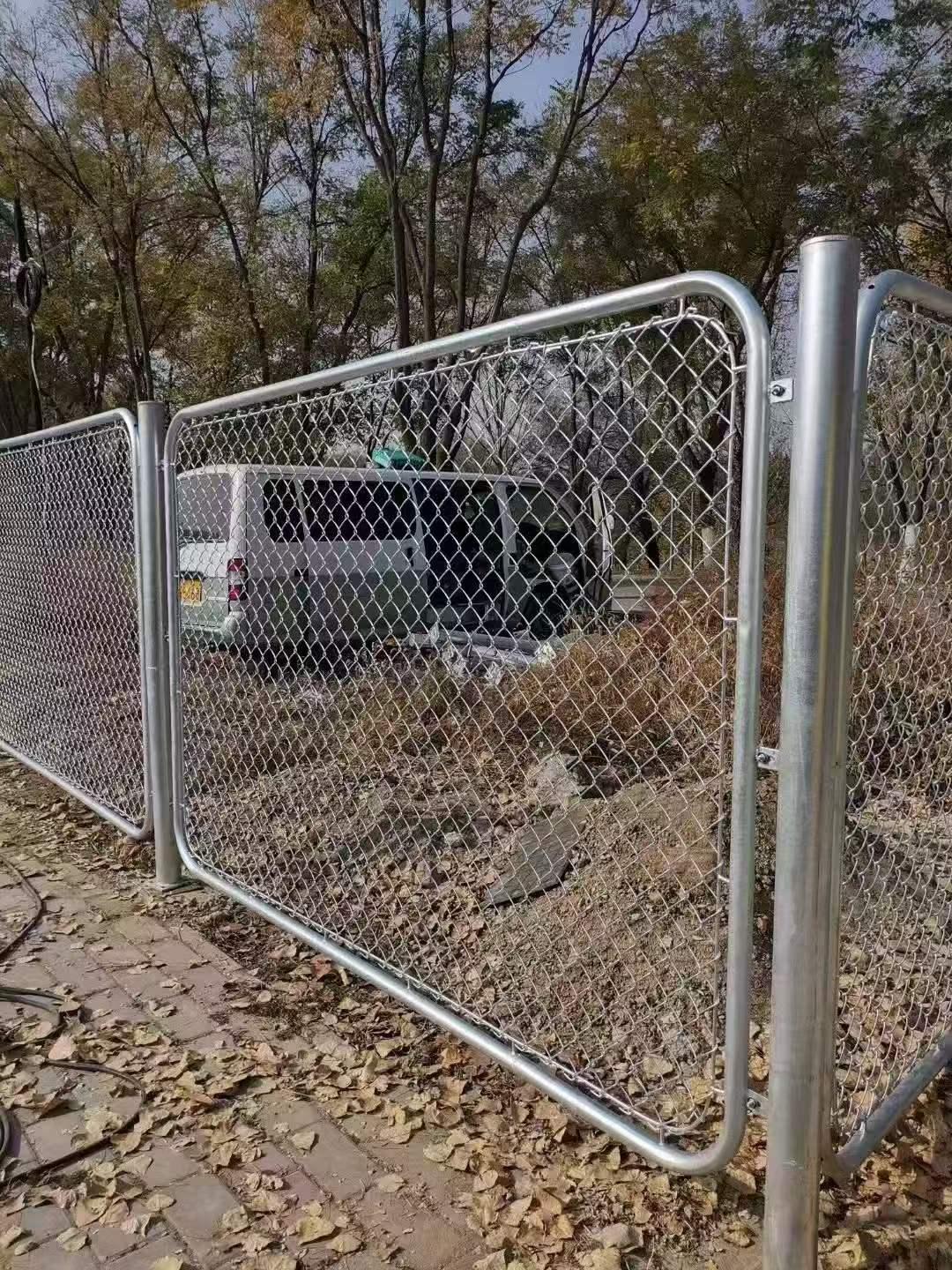
- Install gates: Hang swing gates or install sliding gates last, ensuring proper clearance and latch alignment
Pro tip: Always stretch chain link fabric in cool weather if possible. Hot weather causes the wire to expand — a fence stretched tight at 35°C will sag noticeably at 10°C.
5. Post Spacing and Foundation Requirements
Correct post spacing is essential for structural integrity:
| Post Type | Spacing | Hole Depth | Concrete Volume |
|---|---|---|---|
| Line Post (2.4m height) | 2.5-3.0m | 800mm | 0.025 m³ per hole |
| Terminal Post (2.4m) | As required | 900mm | 0.04 m³ per hole |
| Gate Post (2.4m) | Gate width + 100mm | 1000mm | 0.06 m³ per hole |
For loose or sandy soil, increase hole diameter to 300mm and consider adding a concrete collar at ground level to prevent post wobble.
6. Coating Standards and Quality Control
When purchasing hot-dip galvanized chain link fence, verify these quality indicators:
- ASTM A392: Standard specification for zinc-coated steel chain-link fence fabric. Requires minimum 1.2 oz/ft² (366 g/m²) zinc coating for wire 2.5mm and thicker
- EN 10244-2: European standard for zinc coatings on steel wire. Class A coating: minimum 260 g/m²
- Uniform coating test: The zinc coating should be smooth, continuous, and free from bare spots, lumps, or blisters
- Adhesion test: Wire wrapped around a mandrel 3× the wire diameter should not show zinc flaking or cracking
- Thickness verification: Coating thickness can be measured with a magnetic gauge — typically 40-85 microns for hot-dip galvanized wire
At Haobo Metal, every batch of galvanized chain link fence undergoes zinc coating weight testing and visual inspection before shipment. We provide material test certificates (MTC) with each order.
7. Cost Factors and Budgeting
Chain link fence project costs are driven by several factors:
- Wire diameter: Each 0.5mm increase in wire diameter adds approximately 30-40% to mesh cost, but significantly extends service life
- Fence height: Cost scales roughly linearly with height — a 2.4m fence costs approximately 60% more than a 1.5m fence of the same specification
- Post specification: Upgrading from 48mm to 60mm posts adds about 25% to the post/accessory cost
- Site conditions: Rocky terrain, slopes, and remote access can increase installation labor by 50-100%
- Gate complexity: A double-leaf swing gate costs 3-5× more than the equivalent length of fixed fence
Budget estimate (materials only): For a standard 1.8m × 25m roll with 2.5mm wire, budget approximately $8-12 per linear meter including posts, top rail, and accessories. Installation labor typically adds 50-100% depending on local rates and site conditions.
📋 Table of Contents
Need Hot-Dip Galvanized Chain Link Fence?
Tell us your perimeter length, height requirements, and mesh opening preference. We will quote the complete fence system — mesh, posts, top rail, and accessories — with delivery to your project site.
📱 Request Fence Quote 📧 Send Email