How to Verify a Chinese Wire Mesh Supplier: A Complete Buyer's Guide for 2026

Why This Matters: Choosing the right wire mesh specification can mean the difference between a 50-year structure and one that fails in 5. This guide is based on our direct factory experience supplying global infrastructure projects.
Sourcing wire mesh products from China — the world's largest producer of gabion baskets, slope protection netting, and welded wire fence — can deliver significant cost savings. But the supply landscape is complex. For every reputable, ISO-certified manufacturer like Haobo Metal, there are dozens of trading companies posing as factories, brokers offering substandard materials, and manufacturers cutting corners on zinc coating weight or wire diameter.
This guide provides a systematic framework for evaluating and verifying Chinese wire mesh suppliers. Whether you are a procurement manager preparing for your first import order or an experienced buyer looking to qualify a new source, these verification steps will help you separate reliable manufacturers from the rest.
📋 Table of Contents
- 1. Why Supplier Verification Matters in Wire Mesh Sourcing
- 2. Essential Certifications: What to Look For and How to Verify Them
- 3. The Factory Audit Checklist: What to Inspect On-Site
- 4. Sample Testing Protocol: Verifying Product Quality Before Bulk Orders
- 5. Red Flags: Warning Signs of Unreliable Suppliers
1. Why Supplier Verification Matters in Wire Mesh Sourcing
The consequences of choosing an unverified range from disappointing to catastrophic. Common problems reported by buyers include:
- Under-specification of zinc coating: The most common issue — suppliers delivering wire with zinc coating weight 20-40% below the specified value. A gabion basket specified with 275 g/m² galvanizing that actually has 180 g/m² will have its service life reduced by 40-60%.
- Wire diameter reduction: "2.7mm" wire that actually measures 2.4-2.5mm — a 10% reduction in diameter translates to approximately 20% less tensile strength, potentially compromising structural integrity.
- Trading company misrepresentation: A trading company presenting itself as a manufacturer, adding a markup of 15-30% without providing any quality oversight or production control.
- Falsified certifications: ISO certificates or test reports that appear genuine but are either expired, issued by unaccredited bodies, or simply fabricated.
- Inconsistent quality between sample and bulk: A perfect sample followed by a bulk shipment of inferior material — a classic bait-and-switch that wastes time and money.
Proper supplier verification — combining document review, factory audit, and sample testing — reduces these risks dramatically. The cost of verification (typically $500-2,000 for a third-party audit) is insignificant compared to the potential losses from a failed shipment.
2. Essential Certifications: What to Look For and How to Verify Them
Certifications are the starting point for supplier evaluation, but they must be verified — not just accepted at face value. Here are the key certifications for wire mesh manufacturers and how to confirm their validity:
ISO 9001:2015 (Quality Management System): This is the minimum baseline certification for any serious manufacturer. It demonstrates that the company has documented quality processes, management review procedures, and continuous improvement systems. To verify an ISO 9001 certificate:
- Check the certificate number against the issuing body's online database (e.g., SGS Certification Marks, Bureau Veritas Certipedia, or the IAF CertSearch database)
- Verify that the scope of certification specifically covers wire mesh or metal product manufacturing — a generic "trading" scope is a red flag
- Confirm the certificate is current (not expired) and issued by an IAF-accredited certification body
- Request a copy of the most recent surveillance audit report
Product-Specific Certifications: Depending on your target market and application, verify that the manufacturer holds relevant product certifications:
- CE Marking (EU): Required for construction products sold in the European Economic Area. For gabion mesh, the relevant harmonized standard is EN 10223-3. Verify the Declaration of Performance (DoP) and CE certificate against the notified body's database.
- ASTM Compliance (US): While ASTM does not issue "certification," reputable manufacturers provide test reports demonstrating compliance with ASTM A975 (gabions), ASTM A974 (welded wire), and related standards. These reports should come from ISO 17025 accredited laboratories.
- SASO/SABER (Saudi Arabia): Required for products exported to Saudi Arabia. Verify the Certificate of Conformity through the SABER online platform.
- SONCAP (Nigeria): Required for regulated products imported into Nigeria.
Factory Business License: Every legitimate Chinese manufacturer has a business license issued by the local Administration for Market Regulation. Key information to verify on the license:
- Business scope: Should explicitly include manufacturing of wire mesh or metal products — not just trading or import/export
- Registered capital: Provides an indication of company scale. For wire mesh manufacturers, registered capital of RMB 5 million+ is typical for established factories
- Establishment date: Companies established for 10+ years have a track record you can research
- Legal representative: Should match the person you are communicating with or their documented representative
Export License: For companies exporting directly (not through a trading company), verify that they hold a valid Import-Export License registered with China Customs. You can verify a company's customs registration status through the China Customs online portal or by requesting a copy of their customs registration certificate.
3. The Factory Audit Checklist: What to Inspect On-Site
A physical factory audit is the most reliable way to verify a 's capabilities. Whether conducted by your own team or a third-party inspection agency (SGS, Bureau Veritas, Intertek), here is what to look for:
Production Equipment Assessment:
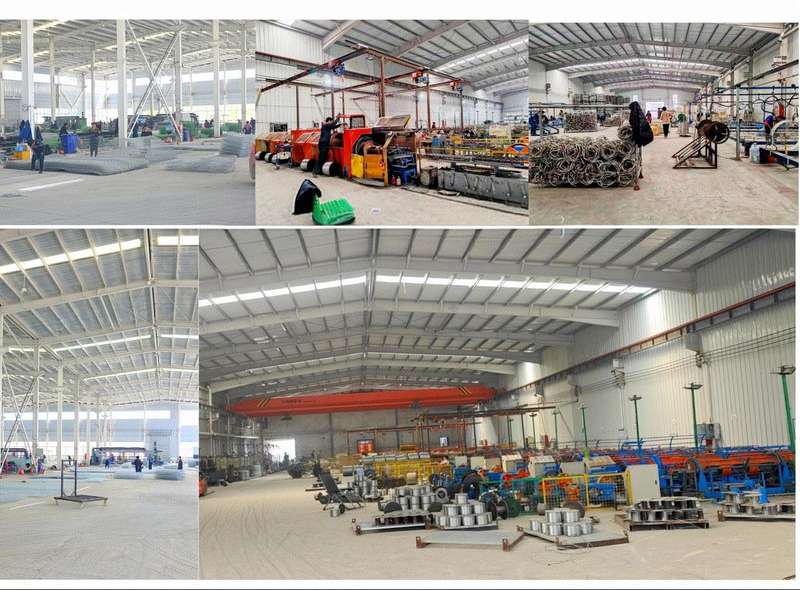
- Wire Drawing Machines: Check the number and condition of wire drawing lines. A legitimate gabion mesh factory should have at least 2-3 drawing lines. Look for evidence of regular maintenance (cleanliness, lubrication, spare parts inventory).
- Mesh Weaving Machines: Count the number of double-twist weaving looms in operation. A medium-scale gabion factory typically operates 10-30 looms. Observe the weaving speed and twist quality on running machines.
- Welding Lines: For welded wire fence production, automated welding lines with PLC controls indicate a professional operation. Manual spot welding stations are acceptable for small orders but suggest limited capacity.
- Galvanizing Line: The galvanizing line is the most capital-intensive part of a wire mesh factory. Look for a dedicated galvanizing building with proper ventilation, fume extraction, and zinc bath temperature control. The size of the zinc bath determines the maximum product dimensions.
- PVC Coating Line: If PVC-coated products are required, verify the existence of an in-house PVC extrusion line. Many factories outsource PVC coating, which adds cost and reduces quality control.
Quality Control Infrastructure:
- Testing Laboratory: An on-site testing lab with calibrated equipment is a strong indicator of quality commitment. Minimum expected equipment: universal testing machine (tensile tester), digital micrometers, zinc coating thickness gauge, analytical balance (for gravimetric coating tests), and a Preece test setup.
- Calibration Records: All measuring and testing equipment should have current calibration certificates. Check the calibration stickers and logbook.
- Sample Retention: Ask to see retained samples from recent production batches. A well-organized sample retention system with labeled storage indicates systematic quality management.
Raw Material and Finished Goods Storage:
- Raw Material Area: Check the condition of stored wire rod — it should be under cover, protected from rain and ground moisture. Look for mill certificates and batch identification tags on stored coils.
- Finished Goods Warehouse: Finished products should be stored on pallets or racks, not directly on the floor. Packaging should be intact with clear labels. The warehouse should be dry and well-ventilated.
- Production Capacity vs. Claims: Compare the observed equipment, staffing, and work-in-progress inventory against the supplier's claimed monthly capacity. A factory claiming 500,000 m²/month capacity but operating only 10 weaving looms is inflating its numbers.
Workforce and Management:
- Worker Count: Count workers on the production floor during your visit. Cross-reference with the claimed total workforce.
- Technical Staff: Ask to meet the quality manager or chief engineer. Their ability to discuss technical specifications in detail reveals the company's technical depth.
- English Communication: For export-oriented factories, verify that sales and technical staff can communicate effectively in English. Miscommunication about specifications is a leading cause of quality disputes.
4. Sample Testing Protocol: Verifying Product Quality Before Bulk Orders
Never place a bulk order without first testing samples — and ideally, without testing samples that you have personally selected from production inventory (not "special samples" prepared specifically for you). Here is a systematic sample testing protocol:
Step 1: Define Your Testing Requirements Before Requesting Samples
Create a testing specification that lists every parameter you need to verify, the applicable standard for each test, and the acceptance criteria. Common parameters for gabion mesh include: wire diameter (ASTM A975, tolerance ±0.06mm), mesh opening dimensions (tolerance ±5mm), zinc coating weight (ASTM A90, minimum 245 g/m² for heavy galvanized), tensile strength (ASTM A370, minimum 380 MPa), elongation (minimum 12%), and coating adhesion (wrap test, no flaking).
Step 2: Request Production Samples — Not Custom Samples
Specify that you want samples randomly selected from current production inventory, not specially prepared. Custom samples may be made with extra care and higher-quality materials that do not reflect standard production. If visiting the factory, select samples yourself from the production line or finished goods warehouse.
Step 3: Split Testing — In-House and Third-Party
Divide your samples into two sets: one for the supplier's in-house testing (request their test reports) and one for independent third-party testing at an ISO 17025 accredited laboratory. Comparing the two sets of results reveals whether the supplier's in-house testing is reliable. Significant discrepancies are a red flag.
Step 4: Document Everything
Create a sample testing report that includes: sample identification (batch number, production date, specification), test methods and standards applied, measured values vs. specification requirements, pass/fail determination for each parameter, and photographs of test specimens before and after testing.
Step 5: Pre-Shipment Inspection (PSI)
Once you have qualified a supplier and placed a bulk order, arrange a pre-shipment inspection before the goods leave the factory. The PSI should follow the same testing protocol as your sample testing but on a statistical sampling basis (typically AQL 2.5 or 4.0 per ISO 2859-1). A PSI costs $300-500 for a standard inspection by a third-party agency and is the most cost-effective insurance against receiving non-conforming goods.
5. Red Flags: Warning Signs of Unreliable Suppliers
Over two decades of experience in the Chinese wire mesh industry, we have observed consistent patterns among unreliable suppliers. Here are the red flags that should trigger additional due diligence — or cause you to walk away entirely:
Documentation Red Flags:
- Business license shows trading but the supplier claims to be a manufacturer
- ISO certificate issued by an unaccredited or unknown certification body
- Refusal to provide certificate numbers for verification
- Test reports that look photocopied or have altered dates/values
- Company name on certifications does not match the name on the business license
Communication Red Flags:
- Unwilling to provide factory address or GPS coordinates for a visit
- Pricing that is 20-30% below market average — quality costs money
- Vague answers to technical questions about wire specifications or coating processes
- Excessive focus on price with no discussion of quality or standards compliance
- Pressure to place an order quickly without allowing time for verification
Factory Visit Red Flags:
- Factory appears under-staffed or equipment is idle during normal working hours
- No evidence of quality control — no testing equipment, no inspection records
- Raw material storage conditions are poor (exposed to weather, no batch identification)
- The factory you are taken to does not match the address on the business license
- Staff cannot answer basic technical questions about their own production process
Payment Red Flags:
- Request for 100% payment before production or shipment
- Bank account in a different city or in an individual's name rather than the company name
- Refusal to accept Letter of Credit (L/C) payment terms
- Invoices that do not match the company name on the business license
Working with Haobo Metal — A Transparent Partnership: At Haobo Metal, we welcome — and encourage — supplier verification. Our factory in Shenzhou City, Hebei Province is open for customer visits year-round. We provide our ISO 9001:2015 certificate number for independent verification, share Material Test Certificates with every shipment, and welcome third-party inspection by SGS, Bureau Veritas, or any agency of your choice. Our 20+ year track record of serving customers in 50+ countries is your best guarantee of quality and reliability.
Start Your Supplier Verification with Haobo Metal
Ready to source wire mesh from a verified, ISO-certified Chinese manufacturer? Request our factory audit report, sample testing documentation, and a customized quotation. Factory visits welcomed.
📱 Contact Haobo Metal 📧 Send Email